
## Part 2: A Concrete Truck Arrived While I Was Sixty Miles Away
After the fence incident, I stopped treating Debbie’s letters as harmless paperwork. Sandra helped me organize the violations, survey records, inspection results, and correspondence into separate folders. A petition asking the county to condemn the tank gathered sixty-one signatures, but officials dismissed it after reviewing the permits and easement. Several neighbors later admitted they’d signed because Debbie told them the water was unsafe.
In late August, I found a heavy chain padlocked across the gravel road leading to my pump house. A laminated sign warned that unauthorized vehicles would be towed, even though the road was protected by our recorded access easement. Sandra demanded removal, and the chain disappeared two days later. The posts remained, along with fresh scrape marks where someone had tried to anchor them permanently.
That same week, Bill Muñoz, the HOA treasurer, called my house after dinner. He sounded tired. “Debbie removed your utility payment from the budget,” he said. “I showed her the old agreement, Cole. She told me the board doesn’t recognize it anymore.” I asked whether the other directors had voted on that decision, and Bill hesitated long enough to answer without speaking.
I spent the following Saturday documenting the entire water system. I photographed the pump serial numbers, filtration equipment, tank interior, permits, and pressure readings. I also collected fresh water samples and filed copies of the maintenance records in Sandra’s office. My father had always said a man’s work should speak for itself, but I was beginning to understand why lawyers preferred photographs.
On September 14, I left home at five-thirty in the morning to repair a rancher’s failing submersible pump outside Llano. The job ran longer than expected, and by early afternoon I was standing beside an open well casing with grease on my hands. At 2:13, Roy called. He didn’t bother greeting me.
“Cole, there’s a concrete truck on your property.” I asked where, although his voice had already given me the answer. “At the tank. They’ve got a chute running into the top hatch, and Debbie’s standing there telling them where to put it.” I told him to call the sheriff, then packed my tools and headed home.
Forty-seven minutes later, I turned onto the gravel access road and saw the mixing truck beside the pump house. Two workers stood near the tank’s open inspection hatch. Gray concrete crusted the rim, and the flexible chute was still positioned over the opening. The smell of wet cement hung in the hot afternoon air.
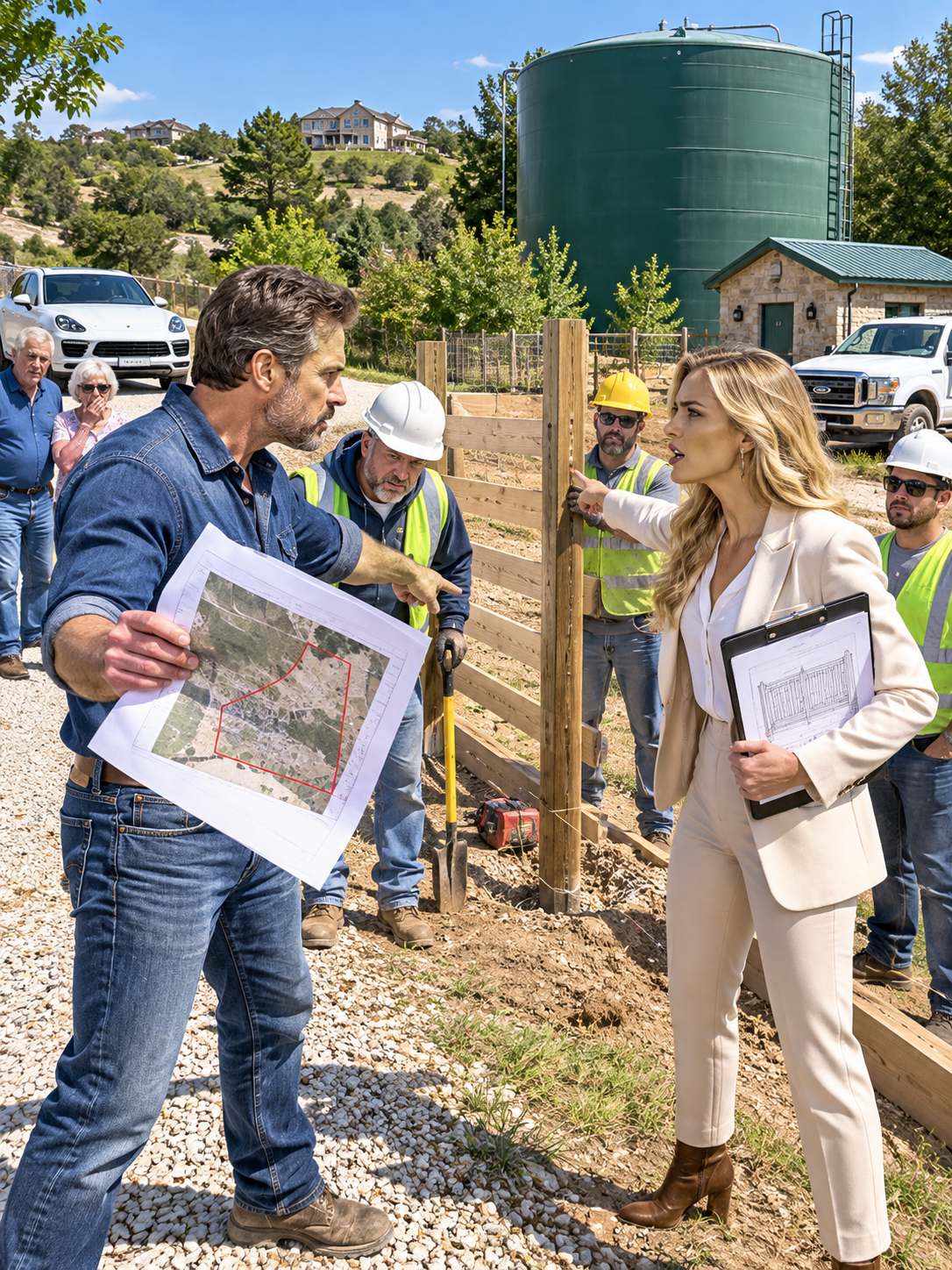
“Stop the pour!” I shouted as I approached. The driver shut down the discharge and climbed from the cab, looking from me to Debbie. She stood a few feet away in white linen trousers and a matching blouse, holding her familiar clipboard. “Mr. Dawson,” she said, “the board has authorized the decommissioning. This has been discussed extensively.”
I climbed the short metal ladder and looked inside. Concrete had settled into the lower section of the tank, burying the intake assembly and blocking the connected supply lines. The pump equipment below was also affected, and gray slurry had entered openings that should never have seen anything but water. I could already tell that clearing the tank would not be a simple matter of pumping it out.
“Who told you this was abandoned?” I asked the driver. He glanced at Debbie before answering. “She did, sir. We were hired to fill an old cistern. She showed us authorization.” He reached into the cab and returned with a work order bearing Debbie’s signature beside the words Property Owner.
I held the paper where she could see it. “You signed this as the owner?” Debbie’s gaze moved briefly toward the workers. “I signed on behalf of the community,” she replied. “You were given plenty of chances to cooperate.” I pointed to the property line beyond the fence and asked which county record made that land hers.
She didn’t answer.
Four cubic yards of quick-setting concrete had been delivered. I photographed the hatch, the remaining material, the truck registration, and the work order before calling the sheriff and Sandra. Roy stood with me while the crew packed up, and the driver gave the deputy his supervisor’s number. Debbie insisted she had acted for the neighborhood’s benefit, but when the deputy asked for a board resolution authorizing the work, she said it was in the association’s files.
That evening, I spread my grandfather’s notebooks across the kitchen table. Beside them went the county inspection report, the letters, the easement, photographs, and the contractor’s paperwork. Sandra called shortly after nine and listened while I described what I’d found inside the tank. “Cole,” she said, “we’re not dealing with a fence violation anymore. We need the county water authorities involved immediately.”
I looked through the kitchen window toward the pump house, where a single security light illuminated the old green steel. My grandfather had built that system when my father was still young. I had inspected it that very morning, never imagining I’d be collecting evidence of its destruction before bedtime.
At six the following evening, Roy called again.
“My sprinklers aren’t working,” he said. “And Frank says the fountain at the entrance has stopped.”
I opened the pressure-monitoring log on my kitchen counter. The supplemental distribution gauge read zero.
## Part 3: The Neighborhood Learned What Their Beautiful Lawns Depended On
By the second morning, the community pool’s refill connection had lost pressure, the clubhouse supply line was dead, and residents were calling the management company about dry outdoor taps. Household municipal faucets still worked, but drought restrictions made that supply unsuitable as a simple replacement for everything our well had provided. The difference between having water for daily living and having enough water to maintain an entire development became painfully visible.
I filed reports with the sheriff, county water officials, and prosecutor’s office. Mike Salazar, the same inspector who had examined my tank months earlier, visited the site and arranged for additional testing. After confirming that the fire-suppression supply was offline, he contacted Fire Marshal Ellen Reyes. She issued a compliance notice warning that the clubhouse could close if its protected water service wasn’t restored within thirty days.
Within the week, the common-area landscaping had begun to brown. The pool’s automatic refill equipment failed, and its circulation pump suffered damage before the maintenance company shut everything down. The gate was padlocked, with an initial repair estimate of $14,000 for the pool equipment alone. Parents who once complained about my tank’s appearance were now asking why nobody had told them what it supplied.
The calls I remember most weren’t about grass or swimming pools. June Kepler, whose husband Harold was eighty-one and used supplemental oxygen, explained that their whole-house humidification equipment had lost its secondary water connection. Harold had been coughing badly in the dry air, and June couldn’t manage the temporary arrangements alone. I helped connect the household system to an appropriate municipal source and arrange a portable unit; another family needed help replacing a filtered water connection they’d relied on for their child’s prescribed skin-care routine.
Five days after the concrete pour, the remaining HOA directors attempted an emergency meeting. Debbie arrived with documents claiming my poor maintenance was responsible for the outage. Bill Muñoz stood before she had finished speaking. “Debbie, I saw the invoice for the concrete truck,” he said. “You can’t call this a maintenance failure when somebody deliberately filled the equipment with cement.”
She told him he was out of order. Bill looked toward the empty chairs where resigned directors should have been sitting. “Then I’ll be out of order somewhere else,” he replied, gathering his folder. Without a quorum, the meeting ended without a restoration plan.
The county issued a citation, and investigators began examining the destruction of the registered system. Debbie’s insurance carrier notified her that it would not cover the deliberate act alleged in the claim. Meanwhile, an Austin television station sent reporter Amanda Torres to interview me. She photographed the hardened concrete, the dead landscaping, the closed pool, and the fire marshal’s notice before sitting down at my kitchen table.
I showed Amanda the original agreement, the county’s clean inspection report, and the maintenance notebook. She turned its yellowed pages carefully, stopping at a reading my father had written nearly twenty years earlier. “He recorded the pressure every week?” she asked. “Every week he could,” I said. “And when he couldn’t, Grandpa or I did.”
The report aired that evening. By morning, thousands of people had shared photographs of the concrete-filled tank. Debbie posted a statement saying she’d removed a dangerous, abandoned structure, but neighbors began contradicting her with evidence of their own. Six posted recent pictures of working irrigation lines, and Roy uploaded a video filmed three days before the pour showing clean water flowing from the tank’s test valve.
Detective Carolyn Webb later obtained the concrete company’s work order and payment records. Debbie had paid the $3,200 invoice with her personal credit card, not association funds. The driver confirmed she had identified herself as the property owner, and several board members stated they had never voted to destroy or decommission the system. Debbie’s attorney subsequently advised her to stop making public statements.
In early October, 137 homeowners crowded into an emergency meeting at the clubhouse. Chairs filled the hall and spilled onto the patio, where people listened through open doors. Debbie sat beside her attorney in a pearl-gray blazer, her expression carefully composed. He explained that his client believed she had acted in the community’s best interests and had misunderstood the scope of her authority.
Frank Odom rose from the back row, leaning one hand against a chair. “I believed you when you said that tank was dangerous,” he told Debbie. “I should’ve asked Cole. I should’ve read the inspection report myself.” He glanced toward me, then continued, “You’ve lived here less than two years. His family has looked after this land for more than fifty. We didn’t even know enough to say thank you.”
Several neighbors lowered their eyes. Debbie uncrossed her ankles and whispered something to her attorney, who shook his head slightly. When the vote to remove her as president was counted, the result was 131 to 6.
She stood, smoothed the front of her blazer, and walked toward the exit. At the doorway, she stopped and looked back at the residents who had once applauded her plans for a more beautiful neighborhood. Nobody followed her.
## Part 4: The Cost of One Decision and the Legacy We Rebuilt
David Chen, a retired civil engineer who had lived in Lone Star Bluffs for twelve years, became interim HOA president. His first visit to my property was on a Thursday morning, carrying a copy of the original development agreement. He apologized for the association’s conduct, acknowledged the protected easement, and restored the annual utility payment. Then he asked whether I’d be willing to help design the replacement system.
“David, I want this fixed,” I told him. “But I can’t pretend it was just a misunderstanding.” He nodded and looked toward the concrete-stained tank. “I’m not asking you to. I want us to do it properly this time.”
The engineering assessment came back at $214,000. Concrete contamination had affected the original well bore, and the project required a replacement tank, pump, filtration equipment, connections, fire-suppression repairs, and pool restoration. The landscaping losses added another layer of work. David brought the estimate to the next association meeting and laid it on the table without attempting to soften the number.
Meanwhile, the criminal investigation moved forward. Prosecutors reviewed the property records, contractor statements, photographs, and evidence that Debbie had been repeatedly informed of the tank’s legal status. She ultimately entered a no-contest plea to felony criminal mischief, while the separate water-system tampering charge was held in abeyance under the negotiated disposition. Her sentence included three years of supervised probation, a $15,000 fine, court costs, and $214,000 in restitution toward restoration.
Sandra also pursued a civil case addressing the damage to my property, interference with our easement, improper fines, withheld payments, and legal expenses. Debbie’s attorney eventually negotiated a $340,000 settlement covering those separate civil claims and related losses. Under its terms, she agreed not to contact me or enter the water-system property, and she would never again seek an HOA leadership position.
I didn’t attend every legal proceeding. Some days I had wells to repair, invoices to send, and customers who couldn’t wait for the latest development in a dispute they had nothing to do with. Once, while sorting repair receipts, I found a photograph of Grandpa standing beside the tank in 1972. He was younger than I was now, wearing a sweat-stained shirt with his hand resting proudly against the steel.
For the first time, I understood how much of my anger had nothing to do with Debbie. I’d grown accustomed to the tank being permanent, as if the men who built it could somehow remain with me through their work. Losing it felt like losing something of them a second time. Sandra listened while I tried to explain that one afternoon and said, “Cole, nobody can take away the years they kept that system running.”
By December, contractors had drilled a new 400-foot well thirty feet from the original bore. A larger 15,000-gallon tank rose beside a rebuilt pump house, fitted with variable-speed controls, modern filtration equipment, and digital pressure monitoring. Mike Salazar inspected the completed work, reviewed the final test results, and signed the system back into service. I opened the restored supply valves while David watched the gauges climb.
That evening, the community pool began refilling. The clubhouse fire-suppression loop returned to service, and the neighborhood irrigation connections regained pressure. Roy called just to tell me his sprinkler heads had come up again. I could hear water striking his driveway through the phone.
At the next meeting, homeowners voted unanimously, 136 to 0, to strengthen the neighborhood covenants protecting the Dawson water system from interference and aesthetic removal orders. David asked whether I wanted the new tank painted a more decorative color. I looked at the sample cards he had brought and chose the same dark green my grandfather had used.
One cold Saturday in January, Roy helped me attach a bronze plaque near the base of the new tank. It read: Dawson Water Supply — Serving This Community Since 1971. In Memory of Hank Dawson. Below that were Grandpa’s familiar words: Take care of the water, and the water takes care of everyone.
Roy tightened the final bolt and stepped back. “Your grandfather would’ve been proud,” he said. I studied the new equipment, the fresh gravel, and the neat conduit running toward the pump house. “He would’ve complained about the electronics,” I answered, and Roy laughed hard enough that he had to wipe his eyes.
Debbie listed her house in February. It sold the following month for $42,000 below the original asking price, and I heard she returned to Dallas. I didn’t contact her, and I never drove past the house to see whether she’d left. By then, I had more important things to do.
The new owners arrived on a warm Saturday morning with a moving truck, a toddler, and another baby on the way. I brought over bottled water and a peach cobbler Patty Odom had baked that morning. The wife thanked me, then looked toward the green tank beyond the trees. “We’ve been wondering what that big thing is,” she said. “Nobody mentioned it when we bought the house.”
I told her about my grandfather, the well, and the old agreement. I explained the supplemental system and how the neighborhood had nearly lost it. She listened while her husband carried a box through the front door, then glanced toward the tank again. “So that ugly old-looking thing is actually important?”
I smiled at the word ugly. “More important than it looks.”
Later that afternoon, I returned to the pump house and opened the old maintenance notebook. My father’s last entry was still there, written in the careful block letters he used when his hands had grown stiff. I hung it on the same nail we’d salvaged from the original building, placed a fresh notebook beneath it, and recorded the day’s pressure reading.
Outside, the new tank stood quietly against the cedars. Water moved through pipes buried beneath roads and lawns, reaching people who would probably never think about where it came from. I was glad of that.
My grandfather hadn’t built the well to be admired. My father hadn’t maintained it to receive applause. And I hadn’t rebuilt it to prove Debbie Prescott wrong.
We did it because people depended on it.
The next morning, I checked the gauge at seven, closed the pump-house door, and drove to work.
The End .
All characters and events in this story are fictional, created for storytelling and entertainment purposes. Thank you sincerely for reading. Your feedback and support are invaluable and motivate me to continue sharing more stories with you.


