### Part 2: A Forged Signature Turned a Birthday Party Into Evidence
Marisol Reyes had handled Walter’s estate, and I trusted her more than anyone to recognize a dangerous document. Her office sat above a bakery in Traverse City, where the smell of cinnamon rolls drifted through the stairwell. She examined page six and pointed to a provision labeled gifting authority. “Gwen, this could allow your daughter to transfer your property to herself, including your house and savings, without asking you again.”
I looked at the yellow note Vanessa had attached. “She wouldn’t know how to write something like that,” I murmured. Marisol agreed the clause appeared deliberately inserted into a standard template, then asked whether someone close to Vanessa understood real estate transactions. Prue had worked in real estate for forty years, and suddenly her expensive lunches seemed almost innocent.
Marisol helped me prepare new protective documents naming my oldest friend, Delores Whitfield, as my financial agent, with her firm as backup. We excluded gifting authority, completed my healthcare directive, and addressed any previous authorizations that might exist. Then she recommended a cognitive assessment, explaining that an independent medical record could protect me if anyone questioned my ability to manage my affairs.
My longtime physician, Dr. Patel, examined me that Friday. She tested my memory, concentration, and judgment, asking me to draw a clock, recall words, and perform calculations. I scored thirty out of thirty, and she gave me a signed letter confirming no cognitive impairment. I slipped it into a folder, hoping it would never become necessary.
Two Saturdays later, while I was raking leaves in Walter’s old flannel shirt, three vehicles pulled into my driveway. A catering van, a truck loaded with chairs, and a florist arrived together, followed by a young event coordinator named Kayla. “We’re here for Mrs. Alderton’s seventieth birthday luncheon,” she announced cheerfully. “Thirty guests, two o’clock. Where should we set up?”
I stared at her clipboard. The contract identified me as the host, listed a $1,500 deposit, and authorized another $5,200 against my Visa ending in 4417. Beneath those charges appeared a signature resembling mine, except the capital G curved in the wrong direction. After three decades of recording testimony, I knew the importance of a single misplaced stroke.
“I didn’t sign this,” I told Kayla. Her expression changed instantly, and she admitted Prue had described me as forgetful and said Vanessa was handling my paperwork. I asked her to notify the company that I disputed the authorization, stop any further card charges, and preserve the contract. Then I photographed every page before calling my attorney.
At twelve-thirty, Prue arrived in a silver Lexus wearing a lavender suit and a corsage. Vanessa climbed out carrying an enormous birthday cake, while balloons bobbed above the car. “Surprise!” Prue cried, spreading her arms toward the chairs being arranged across my lawn. “We thought entertaining would cheer you up, Gwen.”
“You booked my home without permission,” I replied. “You used my credit card and signed my name.” Prue’s smile tightened as she reminded me that thirty guests were already traveling to the party. I suggested she find another venue and begin making telephone calls.
Vanessa whispered my name, but I didn’t change my mind. After they left, I purchased a dozen crab cakes from the caterer at full price and ate three standing at my kitchen counter. They tasted wonderful because nobody had ordered them for me. That night, I added a second rule to my ledger: Nobody uses my name, my money, or my home without asking.
The following Thursday, I went to Maple Ridge Country Club carrying an envelope of statements. Prue was presiding over a luncheon with eight elegantly dressed women when I approached her table. Inside my envelope were records showing $17,220 in membership dues and $6,310 in guest charges bearing her signature.
“I’ve itemized everything,” I said, placing the papers beside her salad. “A check for your charges would be fine.”
The conversation stopped. One woman, Charlotte, picked up the statement and examined the signatures while Prue insisted we had a family arrangement. I asked the club manager, Mr. Delacroix, to close my membership and document the disputed guest charges. Prue rose abruptly, but her friends were already looking at her differently.
I left without raising my voice.
Behind me, Charlotte asked a question Prue couldn’t answer: “You’ve been putting our lunches on Gwen’s account?”
For the first time in years, the embarrassment belonged to the person who had earned it.
### Part 3: The Plan Behind Their Concern Was My Greatest Betrayal
A week passed without Vanessa calling. I spent the evenings in Walter’s recliner, trying not to stare at my silent phone. I missed the daughter who once raced her bicycle down our driveway, laughing when her father pretended he couldn’t catch her. I didn’t miss being treated like an open wallet, but knowing the difference didn’t make the loneliness easier.
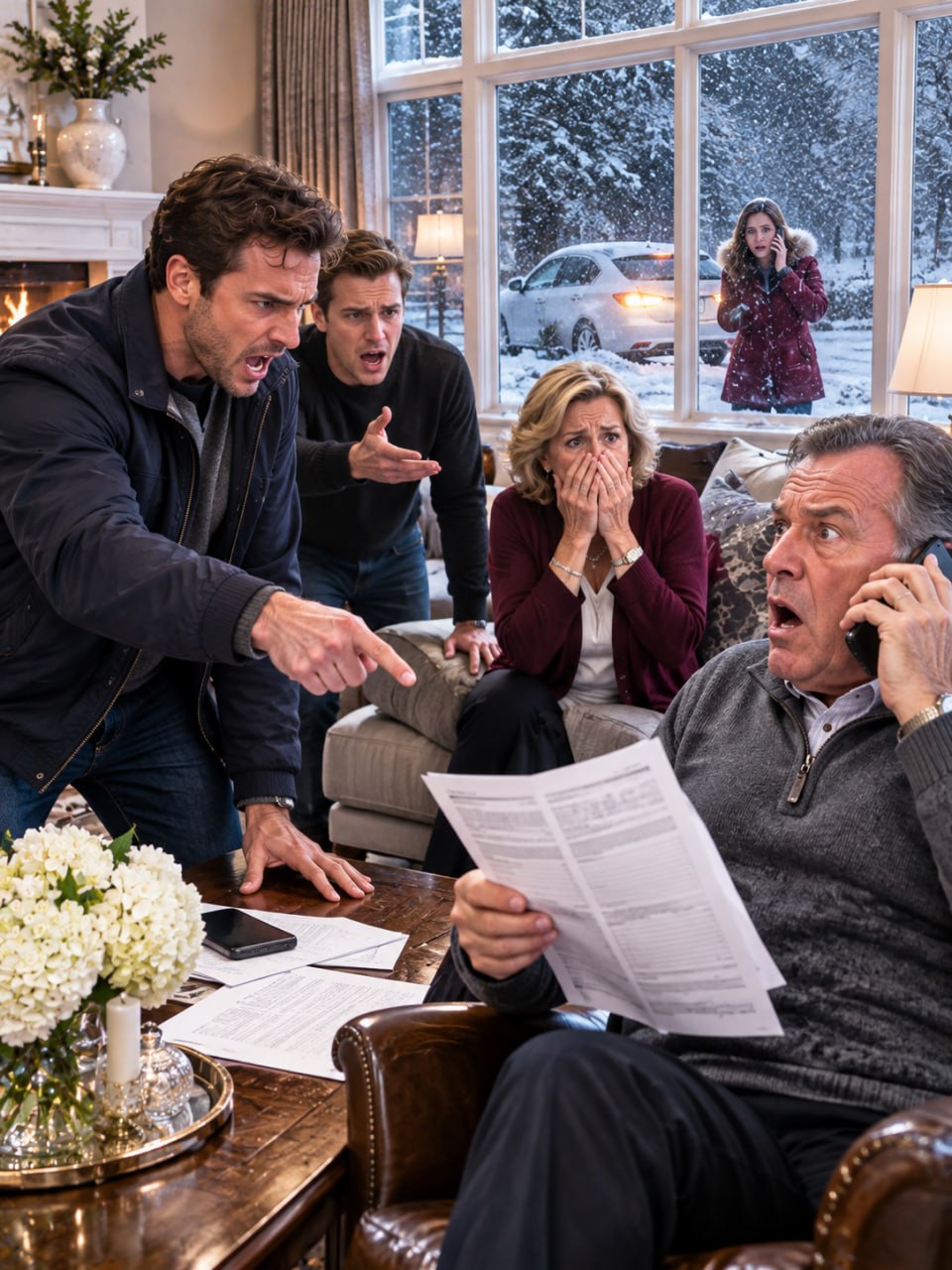
Then a message arrived asking whether we could talk. I agreed to Sunday at four, and at 3:58 my doorbell camera showed three people approaching. Vanessa wore a gray sweater, Theo looked exhausted, and Prue carried a white binder against her chest. I invited them inside, offered coffee, and settled into Walter’s chair with my own folder beside me.
Vanessa began by saying they loved me and were frightened about my well-being. Prue opened her binder and described what she called troubling incidents, including a kettle I’d briefly left on the stove and two calls I’d made about the same bill. I reminded her those calls concerned money she owed me, but she continued talking about suspicion, isolation, and age-related confusion.
“Gwen, a woman living alone in a large property needs supervision,” she said.
Vanessa slid a brochure across the coffee table. Lakeview Gardens, an assisted-living residence, offered attractive common rooms and cheerful photographs of older people gardening. Someone had circled room fourteen, an eleven-by-thirteen-foot space without a lake view. The deposit was $18,000, followed by $6,800 each month.
“And how do you propose paying for this?” I asked.
Prue opened her binder to a color-coded spreadsheet. Under projected proceeds from the Hollis property, someone had entered $1,400,000. Another section identified a proposed family trust with Theo Alderton as trustee, and beneath the figures lay a comparative market analysis signed by Prudence Alderton.
I examined the date.
It was two weeks before our disastrous weekend at the Birchwood Inn.
Before I’d refused the hotel bill, before I’d canceled payments, before I’d confronted anyone, Prue had already calculated the sale value of my house.
Walter had built our dock with his own hands. We’d planted the maples along the driveway, and every summer evening we’d watched the lake change colors from our porch. Those memories had become an estimated sale price on Prue’s spreadsheet, while my future had been reduced to a small room and a monthly charge.
I turned to Vanessa. “Did you know they were planning to sell my house?”
She looked toward Theo instead of answering.
I opened my folder. First came Dr. Patel’s signed assessment documenting my intact memory and judgment. Next were the documents establishing Delores as my chosen agent, followed by my healthcare directive and the twelve-page power of attorney packet Vanessa had mailed.
Then I exposed page six.
“Vanessa, did you understand that this clause could let you give my property away, including to yourself?”
She swallowed. “Prue said it was standard.”
“Someone deliberately included it,” I answered, turning toward her mother-in-law. “And you have spent weeks telling people I cannot remember things.”
Prue straightened her shoulders. “You’re making outrageous accusations.”
“No,” I replied. “I’m showing you the documents.”
I laid the disputed catering contract beside the property valuation. “You used my name for a party, you described me as forgetful to strangers, and you valued my home before I ever asked you to stop spending my money. Now you’re offering me a small room while discussing a trust controlled by my son-in-law.”
Theo covered his face.
Vanessa began crying, then suddenly snapped that I would regret refusing help when I fell inside my empty house. I told her Delores called every morning at seven and that I’d already purchased a medical alert pendant. I was preparing responsibly for old age, not surrendering my independence because someone found it convenient.
Prue gathered her binder and walked toward the door. Before leaving, she glanced back and muttered, “You were much easier before.”
“I know,” I said. “That was the problem.”
After they left, I wrote my third rule: Respect is the price of admission.
The next morning, my sister Loretta called from Scottsdale. Prue had posted a message to forty-one relatives in our family group chat, claiming I was showing signs of serious decline and rejecting necessary care. Hearts, prayers, and worried messages filled the conversation, and Vanessa had made no effort to correct them.
I refused to argue publicly. Instead, I sent Loretta my medical letter and asked her to share it with relatives who wanted accurate information. Within days, several family members called to apologize, while Marisol issued formal notices restricting unauthorized use of my name, cards, and signature.
I preserved the catering contract and the other records in case further action became necessary.
I had spent my career watching families fight over inheritances after someone died.
Mine had begun discussing my inheritance while I was still alive.
### Part 4: My Daughter’s Confession Revealed the Cost of Buying Love
Theo came alone on a cold Monday in November, holding a paper bag from Hogan’s bakery. Inside were cider donuts, Walter’s favorite, still warm enough to fog the paper. We sat at the kitchen table without touching them until he finally cleared his throat. “Gwen, Vanessa and I owe forty-one thousand dollars.”
He told me about the credit cards, expensive dinners, vacations, and the lifestyle they couldn’t afford. Prue had repeatedly assured them that family wealth should be shared, especially when I had property and savings. Eventually, they stopped distinguishing between generosity and entitlement.
“And the power of attorney?” I asked.
Theo rubbed his face. “My mother added the gifting clause. She convinced Vanessa it was standard, but Vanessa knew enough to question it.” He looked up with reddened eyes and admitted he’d recognized their behavior was wrong long before the hotel confrontation.
I didn’t comfort him or offer another loan. He explained that he’d sold his motorcycle, Vanessa had taken weekend shifts at the dental office, and they’d arranged an appointment with a nonprofit credit counselor. When he finished, I thanked him for telling the truth, although his honesty couldn’t erase what had happened.
That weekend, Delores, her husband Ray, and several neighbors joined me for dinner. We carried chicken pot pie onto the dock and wrapped ourselves in blankets while the lake turned silver beneath the evening sky. Delores told a ridiculous story about Walter losing a giant walleye, and Ray laughed so hard he spilled his cider. Nobody asked what anything cost, and nobody waited for me to reach for my purse.
Three weeks later, Vanessa sent a handwritten letter asking to meet somewhere neutral. I let it sit overnight before answering, and on a snowy Tuesday we met at a diner in Traverse City. She was already seated in a corner booth, wearing an ordinary wool coat and holding several index cards. There was no designer handbag, no expensive coffee, and no practiced smile.
“I wrote things down,” she explained. “Otherwise I’ll start making excuses instead of apologizing.”
I waited while she gathered herself.
She admitted she’d allowed Prue to convince her that my property would eventually become hers, making it easier to justify taking money now. She acknowledged signing the power of attorney packet without examining the dangerous provision carefully enough. Most painfully, she admitted knowing Prue was spreading false concerns about my memory and doing nothing to stop her.
“I wanted you to keep paying because it made my life easier,” she whispered. “And I knew how to make you feel guilty when you didn’t.”
I felt tears gathering, but I didn’t look away.
Then she turned over her final index card.
“There’s something else about Dad,” she said.
Her voice faltered. After Walter died, every conversation between us had drifted toward him, and we always ended up crying. She couldn’t bear hearing how lonely I was because it reminded her how badly she missed him, too. Eventually, she began calling only when she needed financial help because asking for money felt easier than talking about her father.
“I turned you into a bank,” she whispered, “because I didn’t know how to be your daughter without falling apart.”
For a long moment, I couldn’t speak.
I remembered Vanessa standing at Walter’s hospital bedside, gripping his hand while the machines hummed around us. I remembered how she’d stopped visiting without a reason afterward, how every ordinary conversation had become a request. Her confession didn’t excuse what she’d done, and it certainly didn’t explain away Prue’s calculated scheme, but it revealed the grief hiding behind some of my daughter’s choices.
“That hurts,” I finally told her. “And somehow, understanding it helps, too.”
She asked whether I could forgive her. I said I could forgive her for being human, but rebuilding trust would require more than tears. She nodded and pushed a small envelope across the table, containing a $500 check and a repayment schedule signed by her and Theo.
For one dangerous second, I nearly pushed it back.
Then I understood that accepting the payment mattered. Vanessa needed to learn she could repair damage instead of relying on my willingness to absorb it. I placed the check in my purse, and she asked whether she could visit sometime.
“Of course,” I told her. “Just call first.”
Her smile was small, but it was real.
Over the winter, news of Prue reached me indirectly. She paid the $6,310 in documented guest charges to Maple Ridge, lost her favored position among the luncheon ladies, and quietly resigned from her garden committee. In February, a stiff note arrived on cream stationery acknowledging she’d been wrong to presume.
I wrote back that I appreciated the acknowledgment and wished her well from a distance. I didn’t invite her into my home or resume the friendship. Some relationships can be repaired through accountability, while others are safest left behind.
By April, Vanessa had begun visiting regularly, always calling beforehand. One Saturday she arrived while I was taping an index card inside the kitchen cabinet where Walter’s coffee mugs stood. She leaned over my shoulder and read the three rules aloud, then turned toward me with an expression I hadn’t seen since she was young.
“I think I could’ve used these years ago, too,” she said.
She reached for one of Walter’s mugs and asked whether she could make coffee. I told her she could, although I intended to buy my own beans. She burst into laughter, the unguarded kind I remembered from summers when her father was alive.
We drank our coffee at the kitchen table and talked about Walter without asking either of us to stop crying.
Later, Vanessa helped me rake leaves beneath the maples, and we found an old photograph tucked inside Walter’s fishing tackle box. It showed the three of us standing outside our first house in 1984, the little property that had cost $63,000. On the back, Walter had written in his unmistakable handwriting: Everything we need is right here.
I held that photograph longer than I expected.
For months, I’d believed my ledger proved how foolish I’d been, how much I’d lost, and how easily the people closest to me could mistake kindness for weakness. Now I saw something else in those pages. I had been trying to purchase a feeling Walter and I once created freely, just by sitting together at the end of an ordinary day.
The missing money mattered, and Vanessa would continue repaying what she could. I wouldn’t surrender my independence, excuse the forged signature, or pretend trust had returned overnight. But I no longer needed my daughter to visit because I paid her bills, and she no longer needed an excuse to sit across from me.
I kept the green ledger, but I started a different kind of record on its final pages. Instead of dollar amounts, I wrote down Sunday dinners, walks along the lake, conversations with friends, and afternoons when Vanessa called simply because she wanted to hear my voice.
The original entries remained untouched.
Every payment was still there, every signature, every date, every uncomfortable truth. I had spent thirty-one years ensuring other people’s words couldn’t be changed after the fact, and I wasn’t about to rewrite my own history simply because its ending had become kinder.
One Sunday evening, Vanessa helped me carry two coffee mugs to the sink. Before leaving, she hugged me in the doorway, held on for a moment, and whispered, “I love you, Mom.”
There was no bill waiting on the counter, no favor hidden inside her goodbye, and no expensive weekend that required my approval.
I hugged her back.
For the first time since Walter died, I didn’t wonder what that embrace was going to cost me.
THE END.
All characters and events in this story are fictional, created for storytelling and entertainment purposes. Thank you sincerely for reading. Your feedback and support are invaluable and motivate me to continue sharing more stories with you.