
## Part 2: Grandma’s hidden records expose a betrayal worth hundreds of thousands.
Sal pulled out a chair, but I couldn’t sit. I spread the contents of the bank bag across my kitchen table beneath the yellow light, and the room suddenly felt too small. There were five items altogether, and each one seemed more devastating than the last. Grandma had not simply hidden money in her sewing machine; she had hidden the story of what someone had done to her.
The green ledger began on December 4, 2023. Beside the first entry, Grandma had written, Pat says the checkbook is easier with her. $6,000 to Draper Building LLC. Not my signature. Thirty more transfers followed, each identified by its date, amount, and bank confirmation number. The final entry was dated January 29, and Grandma had added every dollar herself.
Beneath the ledger lay photocopied bank statements, with each suspicious transaction circled in pencil. I matched the first number to its bank record, then the second, then the third. Every amount agreed. By the time I reached the thirty-first transfer, my coffee had gone cold and my hands were trembling.
The third item was a certified copy of a property deed. In November 2023, the building at 41 Calder Street—Grandma’s shop and the apartment upstairs—had been transferred from Edith Hollis to Patricia Draper. The stated purchase price was one dollar.
A yellow sticky note clung to the corner.
Signed by Pat under the power of attorney I gave her for my hip surgery. Pat did not ask me.
I pressed my hand against my mouth. Aunt Pat had spent months telling everyone that Grandma was becoming forgetful, that someone needed to handle her bills, her mail, and her property. Now I understood what that authority had allowed her to do.
The fourth document was a two-page addition to Grandma’s will, legally titled a codicil. She had dated it February 9, signed it, and obtained a notary’s stamp at her credit union, with two tellers listed as witnesses. It explicitly left 41 Calder Street to me and stated that Patricia had transferred the property without Grandma’s knowledge or consent.
The fifth item was an envelope bearing my name.
I recognized Grandma’s handwriting before I unfolded the letter.
Kate, if you are reading this, the four of them got their $90,000, and I wanted them to have it. Your aunt Pat has been taking money from me since December 2023. I could not prove it until I counted, so I counted.
I did not take this to Gerald Whitlock because he has handled Dennis’s business closings for fifteen years, and I would not put him in that spot. I left you the machine because you would keep it, and Pat would sell it.
Take everything to a lawyer who has never met our family. Then finish it.
Love, Grandma.
I lowered the letter and looked toward the Singer. The woman everyone had treated as confused had spent more than two years building a case against her own daughter. She had continued serving customers, pinning hems, and making Sunday coffee while quietly recording each suspicious withdrawal.
Sal stood beside the refrigerator, his cap turning between his hands. “Your grandmother was sharper than people gave her credit for,” he said.
The next morning, he accompanied me to my credit union. We placed the original documents in a safe deposit box, and I kept photographs of every page. When I tried to pay him, Sal shook his head.
“Edith paid me forty dollars a visit for thirty-nine years. Keep your money, Kate. You’re going to need it.”
On March 26, I met attorney Priya Raman, a probate lawyer recommended by Sal’s niece. Priya read the codicil twice, studied the bank statements, and requested the county’s complete property records. Four days later, she called me back into her office.
“Kate, there’s another transaction your grandmother may never have discovered.”
Eleven days after transferring the building to herself, Pat had taken out a $140,000 mortgage against it. That money had gone to Draper Building LLC, Uncle Dennis’s contracting company, which had owed a lumber supplier $188,000 since the fall of 2023.
Priya laid a calculator on her desk.
“Between the transfers and that mortgage, three hundred fifty-four thousand, three hundred eighty dollars reached Dennis’s company.”
I stared at the numbers. My aunt hadn’t merely helped her husband borrow from his mother-in-law. She had used Grandma’s savings and her life’s work to keep his failing business alive.
On April 2, my phone rang while I was cutting fabric for a theater costume.
Aunt Pat’s voice sounded almost affectionate. “Kate, honey, we need to talk about your grandmother’s things.”
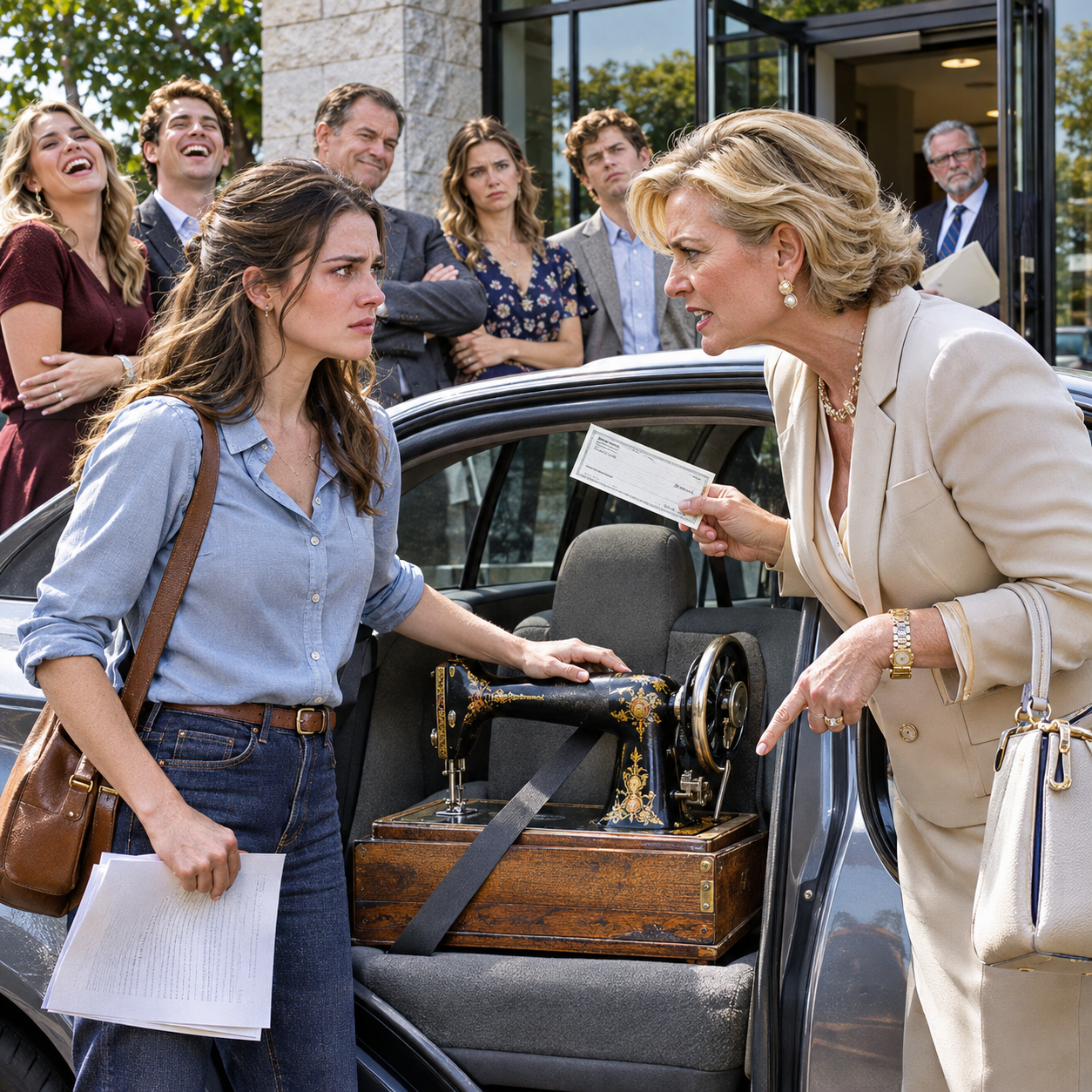
She said every dollar had been a loan. Dennis would repay everything when business improved. Then she offered me four thousand dollars for the Singer, increased it to ninety-five hundred when I remained silent, and finally offered fifteen thousand.
I asked, “Why do you want it so badly?”
Her breathing changed.
“Mom kept a green notebook. I watched her put it in that sewing case in January. If it’s there, Kate, that’s family business. It belongs with the family.”
I thought of Grandma’s handwriting, her careful dates, and the letter she had left for me.
“I have an attorney,” I said. “You can speak to Priya Raman.”
I ended the call before Aunt Pat could answer.
She had known about the notebook all along.
And she had been trying to buy back the evidence.
## Part 3: A cousin’s secret message destroys Aunt Pat’s carefully constructed lies.
Five days after Aunt Pat’s phone call, a letter arrived from Gerald Whitlock’s office. Acting on Pat’s instructions as executor, he demanded that I surrender the Singer for an estate inventory. The language was polite, but the meaning was obvious. My aunt had stopped offering money and started trying to use the law to take the machine.
Priya answered with one paragraph. The Singer was specifically bequeathed to me under Grandma’s will, so it was my property. She instructed me to preserve every message, document, and voicemail. On April 14, she filed three requests with the probate court: invalidate the deed to Pat, remove her as executor, and recognize Grandma’s February codicil.
The hearing was scheduled for June 10.
During the following weeks, I continued sewing costumes, although I barely remembered finishing them. I would catch myself staring at the Singer, wondering how often Grandma had opened that compartment while deciding whether to expose her own daughter. I wondered whether she had cried when she wrote those entries or whether the numbers had helped her remain steady.
On June 2, my cousin Lena called.
“Kate, could I come over? There’s something you need to see.”
She arrived wearing her veterinary clinic scrubs, gripping her phone with both hands. At twenty-six, she had always been the quietest of us, the person who apologized when someone else bumped into her. She sat on my couch without removing her jacket.
“I didn’t laugh at the will reading,” she said.
“I remember.”
“But I didn’t defend you either.”
I sat opposite her. “Lena, what’s going on?”
She turned her phone around.
On the screen was a group message Aunt Pat had sent to all four cousins on March 21, at 4:12 that afternoon, shortly after the will reading.
Whoever sees Kate first, find out if she’s opened the Singer. Mom kept her notebook in it. Do not mention this to Gordon.
I read it twice. Brooke and Tanner had known their mother was looking for something inside my inheritance. Wes had received the message too, yet nobody had warned me.
“Why are you showing me now?” I asked.
Lena rubbed her thumb against the edge of her phone. “Because Uncle Gordon asked me yesterday whether I thought Grandma knew what she was doing when she changed the will. I told him I thought she did. Then I realized Aunt Pat had been trying to make us believe the opposite.”
She swallowed.
“I already sent the screenshot to your lawyer this morning.”
For the first time in months, someone in my family had chosen the truth over the money. I reached across the coffee table and squeezed her hand.
On Wednesday, June 10, we entered the courtroom of Judge Annika Soderberg. Whitlock had withdrawn after Priya raised concerns about his longtime work for Dennis. Aunt Pat arrived with a new attorney named Calloway, while Dennis sat rigidly behind her. Brooke and Tanner avoided looking at me.
Calloway argued that Grandma had become confused during her final year. He suggested that the ledger contained imagined wrongdoing and that she lacked the judgment necessary to change her will. He spoke about her age as though eighty-seven years erased everything she had ever understood.
Priya stood and presented the bank statements.
Judge Soderberg placed them beside Grandma’s ledger and began comparing the entries. One by one, she checked the dates, amounts, and confirmation numbers. Every one of the thirty-one transfers matched the bank records to the cent.
Then Priya introduced a medical note from Dr. Amara Lindquist, dated February 2. Grandma had scored twenty-nine out of thirty on a standard memory screening, just seven days before signing the codicil.
The judge looked toward Calloway. “Do you have medical evidence supporting your position that Mrs. Hollis lacked capacity?”
He shuffled his papers. “Not a comparable assessment, Your Honor.”
Aunt Pat stared at the polished table.
Then Priya called her to testify.
“Mrs. Draper, did your mother personally sign the deed transferring 41 Calder Street to you?”
“No. I signed it under her power of attorney.”
“Did she instruct you to transfer the property?”
“She knew about the loan.”
“That wasn’t my question.”
Pat shifted in her chair. Dennis leaned forward, but she refused to look at him.
“Where did your mother record her consent?” Priya asked.
Pat said nothing.
Priya held up the screenshot from Lena’s phone.
“On March 21, you instructed four people to find out whether Kate had opened the Singer sewing machine. Why?”
Pat’s face tightened.
“I was concerned about my mother’s personal belongings.”
“Specifically, what did you expect to find?”
The courtroom fell silent. I could hear the faint hum of the ventilation system above the judge’s bench.
Pat looked toward Dennis, then lowered her eyes to her hands. Nine seconds passed before she answered.
“My mother’s notes.”
“What notes, Mrs. Draper?”
Pat swallowed.
“About the money.”
Priya allowed the words to settle before sitting down. There was no dramatic shouting, no sudden interruption. My aunt had just acknowledged that she knew about the very evidence her attorney had dismissed as Grandma’s imagination.
Judge Soderberg closed the ledger gently.
I looked down at my hands and recognized something Grandma had taught me long ago. When a seam began to unravel, pulling harder only made the damage worse. You had to find the first loose thread.
Grandma had found thirty-one.
## Part 4: Grandma’s final gift restores the truth, her shop, and my family.
On June 29, Judge Soderberg issued a nine-page order. I sat beside Priya as she explained each ruling, watching her index finger move down the document. The judge had invalidated the deed transferring 41 Calder Street to Aunt Pat, accepted Grandma’s codicil, and removed Pat as executor. She also ordered Pat to repay $214,380 to the estate, discharge the $140,000 mortgage within ninety days, and pay $31,500 toward my legal fees.
Then Priya reached the paragraph that mattered most.
“Kate, the building belongs to you.”
I looked at the courthouse window. For a moment, I could see Grandma standing behind her old counter, a measuring tape around her neck, waiting for me to stop staring and get back to work.
I hadn’t inherited a discarded sewing machine instead of ninety thousand dollars. Grandma had left me the keys to everything she had built, together with the evidence needed to protect it.
That was the truth Aunt Pat had tried to keep buried.
The financial consequences arrived quickly. In August, Aunt Pat sold her lake cabin on Island Lake for $265,000 and borrowed against her house to cover the remaining obligations. The mortgage on Calder Street was finally cleared on September 12. Dennis closed Draper Building LLC that same month, ending the company that had swallowed Grandma’s money.
Uncle Gordon replaced Pat as executor and completed the estate’s final accounting in October. The four cousins retained their ninety-thousand-dollar inheritances, just as Grandma had intended. Brooke and Tanner kept their money but stopped speaking to me after the hearing.
I no longer tried to change their minds.
Lena and Wes began meeting me for lunch on the first Sunday of every month. Wes admitted he had received Pat’s message and said nothing because he didn’t want to get involved. I told him his silence had hurt, and he listened without arguing.
It wasn’t a perfect reconciliation. But it was the beginning of one, and I had learned from Grandma that repairing something required admitting where it had torn.
On October 1, I reopened Hollis Alterations.
The storefront had stood quiet for months, its windows dusty and its front counter covered with old receipts. I spent three weekends cleaning, sorting fabric, and replacing burned-out bulbs. I kept Grandma’s wooden counter exactly where Walter had installed it in 1974.
Sal arrived that morning carrying a small ladder. Without asking, he climbed up and rehung the brass bell above the entrance.
“Edith always complained when people came in without making enough noise,” he said.
I laughed through tears. “She said a customer deserved to be greeted properly.”
Sal climbed down, examined the bell, and gave it a gentle tap. Its bright ring filled the room.
“Sounds right to me.”
The Singer rested on the back sewing table, precisely where Grandma had kept it. Sal had repaired the handwheel and polished the metal plate until the lettering shone. Beneath its wooden base, the secret compartment was empty except for a few spare bobbins.
The original documents remained protected, and the ledger had served its purpose.
Sometimes I thought about Grandma sitting alone upstairs, examining bank statements after everyone had gone home. For twenty-five months, she had written numbers while her family decided she was too old to understand them. She had known she might never see the money returned, yet she had kept collecting proof.
I used to think her last gift was the building.
Now I understood it was something more difficult to give: the truth about the people we loved, and the courage to act on it without becoming cruel ourselves.
On the first of every month, I began checking my own bank statements, line by line. I kept Grandma’s blue pen beside my checkbook. Not because I expected betrayal everywhere, but because trusting people should never require closing your eyes.
That first morning, just after Sal rehung the bell, a woman named Mrs. Anders stepped through the door holding a pair of trousers.
“Are you taking alterations again?” she asked.
I smiled. “Yes, ma’am. We are.”
“Your grandmother used to do all my husband’s work. Nobody could get a hem quite like hers.”
I took the trousers and measured them along the counter. Eighteen dollars for the alteration, I told her, and they would be ready Friday.
She glanced toward the Singer. “Is that Edith’s old machine?”
“Yes.”
“I’m glad you kept it.”
After she left, I pulled Grandma’s old carbon-copy ticket pad from beneath the register. The pages had yellowed around the edges, and the cardboard backing was worn soft. I wrote Mrs. Anders’s name, the service, and the price, pressing firmly as Grandma had taught me.
Then I lifted the first sheet.
The blue writing had transferred perfectly onto the page beneath it.
Outside, cars moved along Calder Street. The bell swayed gently above the door, and sunlight spread across the counter my grandfather had built. I carried the trousers to the back table, threaded Grandma’s Singer, and lowered the presser foot.
For years, people had measured my inheritance by what they thought an old sewing machine was worth.
But Grandma had never measured value that way.
She left my cousins money they could spend. She left me a place where I could build something lasting, the evidence to defend it, and the knowledge that I had been trusted when it mattered most.
I pressed the pedal.
The needle descended, the fabric moved, and for the first time since Grandma died, the familiar rhythm of that machine sounded exactly like home.
THE END.
All characters and events in this story are fictional, created for storytelling and entertainment purposes. Thank you sincerely for reading. Your feedback and support are invaluable and motivate me to continue sharing more stories with you.

