
## Part 2: The HOA President’s Campaign Uncovers a Developer’s Buried Secret
Pamela didn’t accept the inspector’s findings. She collected ninety-one signatures demanding that Burnet County take over my road, but the county attorney, Ellis Garza, rejected her petition because it was private property. She filed repeated complaints with Texas environmental regulators, and each investigation ended without a violation. Then, in April 2023, an Austin attorney named Brent Cavanaugh sent me four pages claiming Ridge Creek residents had acquired a permanent right to use Harden Ranch Road. I handed the letter to my daughter Megan, who was studying law at the University of Texas.
She called me that evening, papers rustling beside her telephone. “Dad, their argument doesn’t survive the timeline,” she said. “They started using the road under your written permission, and they haven’t been there nearly long enough to establish the prescriptive rights he’s claiming.” Gus sent Cavanaugh the recorded easement and supporting legal research. Within two weeks, Cavanaugh withdrew from representing the HOA. Pamela announced on social media that the fight was far from over, but she never mentioned why her attorney had disappeared.
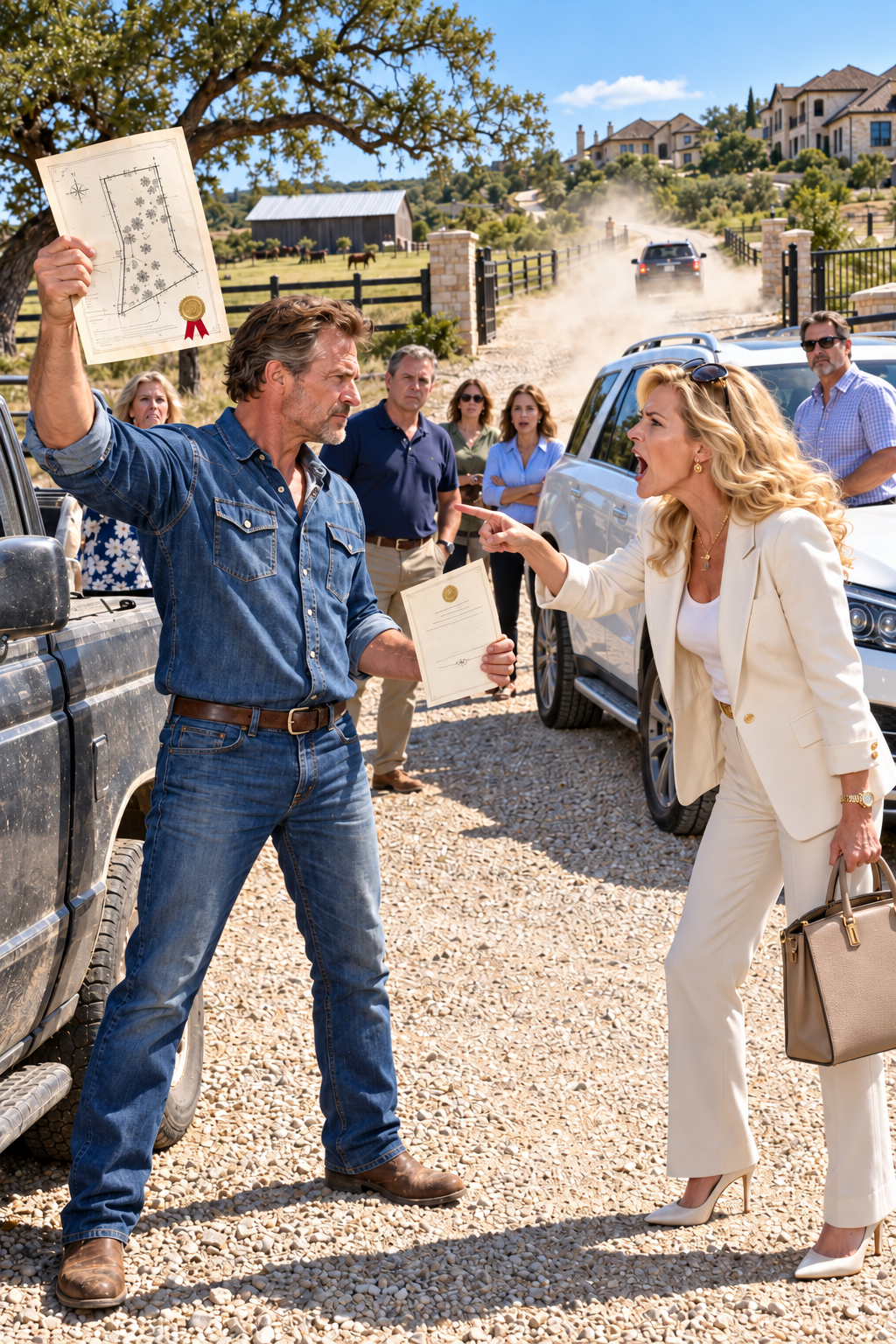
June 30 came, and the construction easement expired. I stood beside the cattle guard that morning, watching a school bus roll carefully over my grandfather’s culvert, and couldn’t bring myself to close the entrance. Then, one Saturday in July, Tanner called from his shop. “Dad, you’d better get down here.” Pamela had parked her Mercedes sideways across my road, with twelve residents sitting in lawn chairs behind handmade protest signs. She was broadcasting the demonstration on her phone, demanding that I surrender the road to the community.
I photographed the cars, the signs, and the beverage cans left in my drainage ditch. “You’re trespassing, Pamela,” I told her. She raised a bullhorn and called me a bully, so I stepped back and telephoned Gus and the sheriff’s non-emergency line. Deputy Tyler Peck arrived, explained that the road was privately owned, and asked the protesters to leave. Pamela walked away last, her sandals grinding into the limestone, but the look she gave me promised she wasn’t finished.
In October, she persuaded the HOA board to request eminent domain proceedings. I received a copy of the county’s rejection while Darla and I were having breakfast, and one sentence stopped me halfway through my coffee. County records indicated that Ridge Creek’s developer had been required to construct its own public entrance road. Ellis Garza was now reviewing why that condition had never been fulfilled.
I drove to the courthouse and obtained the subdivision’s 2019 approval documents. There it was, on page four, under condition seven: Lone Star Horizons had to build a dedicated public road connecting the neighborhood directly to FM 1431 before final occupancy approval. Yet the homes had been occupied, the developer had entered bankruptcy in 2023, and the promised road was missing. More astonishingly, the county file identified a $680,000 performance bond intended to secure the developer’s unfinished obligations.
I carried the documents into our kitchen and spread them across the table. Darla read the approval while Tanner leaned against the doorway, still wearing his leather welding apron. “So they’ve been blaming you for a road their developer never built?” she asked. I nodded. “And there’s a bond that may pay for it.” She looked through the window at the dusty procession of cars beyond our orchard. “Then build your road the way it deserves to be built, Cole,” she said quietly. “But stop letting people treat your family’s generosity like something they own.”
The following Tuesday, land-use attorney Russell Meeks drove from Austin to review everything. He studied my deed, the expired easement, Pamela’s letters, the county’s decisions, and the developer’s bond before setting down his pen. “You could restrict this road now,” he said. “But we can establish a lawful, paid-access arrangement while the county pursues the public road.” He wrote two words across his yellow legal pad: TOLL GATES.
Tanner looked over his shoulder and smiled for the first time in months. “I can build those,” he said. Russell turned to me. “First, we confirm the permits, emergency access, and every detail with the county. Then you pave the road and charge for its use.” I thought about my grandfather hauling stone behind a mule, my father standing in the rain clearing those culverts, and the two years Pamela had spent demanding I solve a problem she didn’t understand. I looked at my son and said, “Start measuring.”
## Part 3: Fresh Asphalt and Two Steel Gates Turn Her Victory Sour
I spent December checking drainage plans and road specifications while Russell handled the legal notices. The Ramirez brothers, contractors I’d worked with during my highway career, quoted $82,000 to rebuild the surface with a compacted base, hot-mix asphalt, and upgraded culverts. Tanner fabricated two bronze-colored toll gates with solar-powered motors, payment terminals, cameras, and emergency-vehicle overrides. The signs announced that Harden Ranch Road was private property, with access costing $4 per trip or $150 per month.
Construction began January 8, 2024. I stood beside the grader with my rolled-up drawings while the crew stripped loose gravel and prepared the foundation. Pamela drove past in her Mercedes, watched the equipment, and smiled as though she had personally ordered every truck. That afternoon, her Nextdoor post declared victory for the HOA and congratulated residents for pressuring me into paving. More than a hundred people liked it, including several who had never bothered to ask who owned the road.
Four days later, Tanner arrived with his flatbed carrying two enormous steel frames. Pamela stopped beside him, climbed out of her Mercedes, and pointed at a twelve-foot boom arm. “What exactly is that?” Tanner wiped his hands on a rag. “A toll gate, ma’am.” Her smile vanished. “You can’t charge us to drive home!” I stepped beside my son and showed her the recorded deed. “I’m not charging anyone to drive home, Pamela. I’m charging people who choose to use my private road.”
She filed another complaint and sought a temporary restraining order. Judge Patricia Montoya reviewed our documents and denied her request, finding no grounds to stop the road improvements. Pamela then summoned residents to another protest, but Russell arrived with the court order and Deputy Peck stood nearby to keep the peace. Most of the twenty-three protesters dispersed after learning that the easement had expired. Tanner kept working, his welding torch throwing blue sparks against the fresh steel.
At six o’clock on Monday morning, February 5, both gates began operating. The first driver, a hospital worker in blue scrubs, tapped her credit card at 6:14 and passed through without speaking. A retired firefighter named Bobby Stall paid next, grinning at me through his pickup window. By seven-thirty, fourteen cars were waiting, and some drivers were furious. I watched a tired mother with two children in her minivan study the payment screen before finally paying. That sight hurt more than Pamela’s insults ever had, because I knew she was another person caught in somebody else’s deception.
Walt Hessler, a retired electrician who had once helped me repair a fence, approached on foot. “I understand why you’re doing this, Cole,” he said. “But folks are scared about what comes next.” I handed him a complimentary first-month pass. “Tell them the emergency vehicles are exempt, and these gates come down when Ridge Creek gets its own public road.” He shook my hand and promised to explain. By noon, the sheriff’s office had received dozens of calls, but the gates remained in place.
Pamela arrived that afternoon with a television crew from Austin. Wearing a cream silk blouse and carefully applied makeup, she told reporter Keisha Wardell that I was holding hardworking families hostage. Keisha eventually turned her microphone toward me. Instead of arguing, I held up the original deed, the temporary easement, and the subdivision approval showing condition seven. “The developer promised these families a public road,” I explained. “It never built one. My family has been providing the access, and the HOA president tried to fine me for the dust its traffic caused.”
Keisha studied the documents. “So there’s money available to build the missing road?” she asked. “There’s a $680,000 performance bond,” I said. “That’s where this community should have been looking from the beginning.” The story aired that evening, and suddenly the questions on neighborhood social media changed. People stopped asking why I was charging tolls and started asking why their developer had never delivered the entrance they had been promised.
Pamela posted another furious statement, but Linda answered beneath it: “Cole told us the truth about his road. You refused to listen.” For the first time, Linda’s comment drew more support than Pamela’s accusations. I turned off my phone and joined Darla on the porch, where headlights flashed between the oak trees toward the new gates. “They’re finally asking the right questions,” she said. I nodded, though I knew the hardest part was still ahead: making sure the families received the road they had already paid for.
## Part 4: The Missing Public Road Finally Ends Our Bitter War
On February 12, Russell submitted a formal request for Burnet County to enforce the developer’s unfulfilled road obligation. He attached the subdivision approval, bankruptcy records, and performance bond documentation. On February 27, the county commissioners voted unanimously to pursue the $680,000 bond. Ridge Creek’s new attorney, Sarah Kendrick, then delivered another devastating finding: Pamela’s fines against me were unenforceable, and her campaign had cost the HOA approximately $41,000 in legal expenses.
At an emergency neighborhood meeting, Walt Hessler demanded a vote of no confidence. Linda seconded it, and the final count was 114 to 31. Pamela was removed as HOA president on March 14. She sat motionless as the results were announced, then collected her designer handbag and walked out without speaking. The room remained silent until the doors closed behind her.
The new president, retired Army officer Ray Dominguez, visited my ranch carrying a pecan pie from his wife. He apologized for the HOA’s treatment of my family and asked what it would take to settle the dispute. We agreed on $240,000 for past unauthorized access, reimbursement of the $82,000 paving expense, and a public written apology. The board approved the agreement, funded through a special assessment and recovery connected to the developer, and we signed it on April 2.
I knew the financial burden would sting innocent homeowners, and I told Ray so. “They deserved better than this,” I said. He nodded. “They deserved the road they were promised. We’re finally getting it.”
On September 3, 2024, Ridge Creek Parkway opened. Three-quarters of a mile of public asphalt connected the subdivision directly to FM 1431, paid for through the performance bond. That morning, Tanner and I unbolted both toll gates and loaded them onto his flatbed. As the last steel frame rose from its foundation, I looked down the quiet pavement toward our ranch. For the first time in years, no procession of strangers was headed toward our cattle guard.
Pamela and Derek had sold their home in May for eleven percent less than they paid. They moved to a gated community outside San Antonio. Darla laughed when Linda told us, but I felt more relief than triumph. I hadn’t wanted to ruin anybody’s life. I’d wanted people to respect the difference between something generously shared and something they had a right to demand.
We used part of the settlement to establish the Jasper Harden Memorial Scholarship, awarding $10,000 annually to a student pursuing agriculture or land management. Tanner built a rodeo arena on our north pasture, free for local 4-H and FFA groups. Megan passed the bar and began helping other rural landowners protect their property rights.
One afternoon, I found our old blue heeler, Buster, sleeping peacefully in the middle of the paved ranch road. Darla stood beside me, watching sunlight flicker through the live oaks. “Your grandfather would have loved this,” she whispered.
I looked toward the road Jasper had built in 1958, now smooth and silent beneath the Texas sky. His work had survived sixty-six years, a developer’s broken promise, and one woman’s determination to claim what wasn’t hers.
All it had needed was someone willing to defend it.
THE END.
All characters and events in this story are fictional, created for storytelling and entertainment purposes. Thank you sincerely for reading. Your feedback and support are invaluable and motivate me to continue sharing more stories with you.


