
Part 2: A Hidden Checklist Showed Where They Planned To Put Me
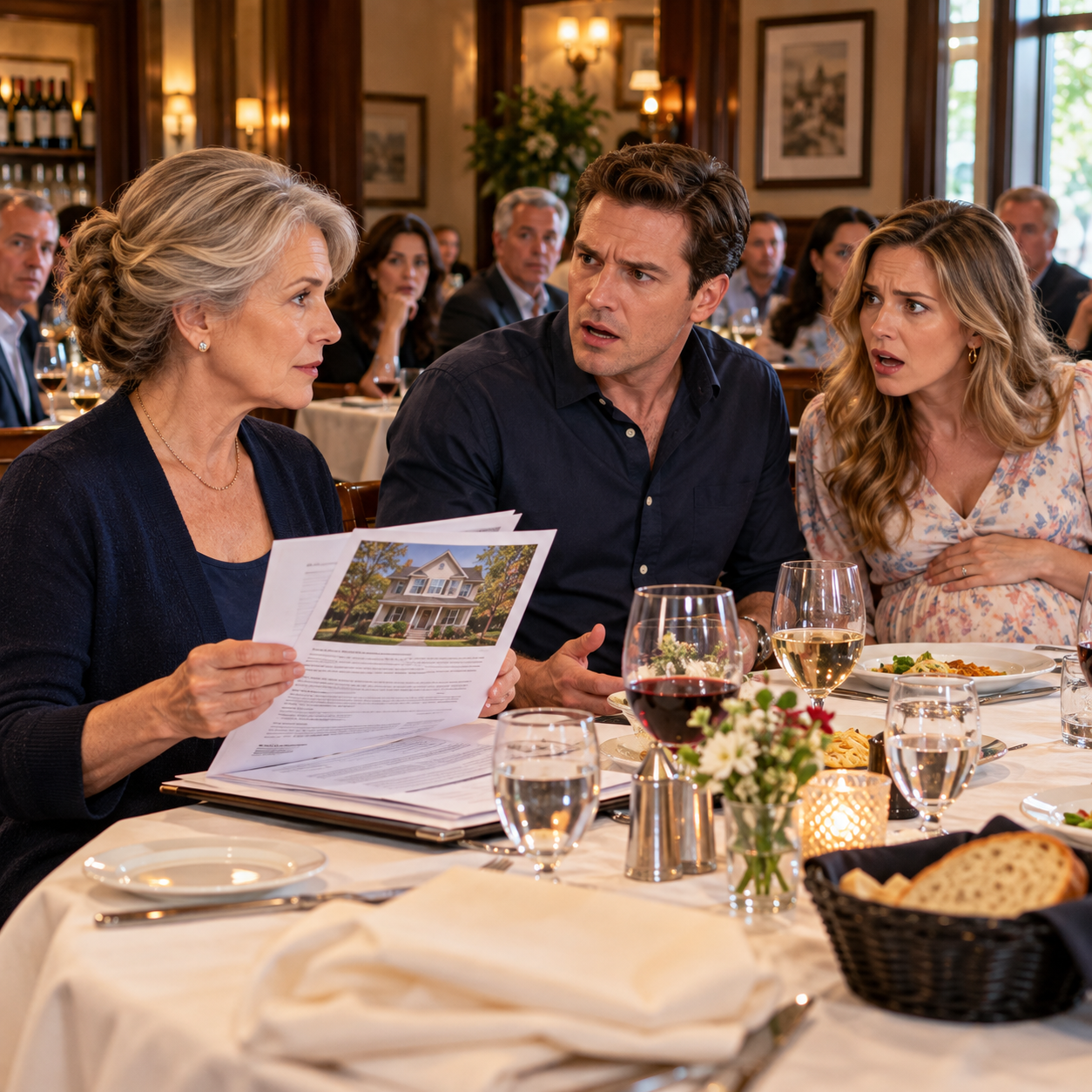
Daniel lowered his fork very carefully. “Without talking to us?”
“I talked to the people legally involved.”
His face changed. Not rage exactly. Hurt wrapped in disbelief. “Mom, we’re your family.”
“I know.”
Alyssa’s voice went quiet. “We have a baby coming. We needed something stable.”
“I understand that. But you didn’t ask me to provide it. You planned around it.”
Daniel pushed back from the table. “We thought this was something families did.”
“Families also knock before moving furniture.”
Alyssa looked down at her hands. For the first time that evening, she looked less like a woman executing a plan and more like an expectant mother whose plan had failed. I knew they wanted stability, but they had converted my generosity into an assumption.
“Where are you going?” Daniel asked.
“I rented a two-bedroom apartment on Maple Street.”
His eyebrows rose. “An apartment?”
“Second floor of a converted Victorian. West-facing windows. A porch big enough for herbs.”
He rubbed his thumb against the edge of his napkin, a childhood habit. “You’re giving up a paid-off house for an apartment?”
“No. I’m exchanging a house I’m finished with for a life I chose.”
Alyssa reached for her empty wineglass, then stopped. “You could have told us.”
“So could you.”
Daniel said something sharp about inheritance. I don’t remember the exact wording, only the meaning: someday the house would have been his anyway. That was when I saw how far the assumption had traveled. Not merely into a nursery and a contractor’s estimate, but into the future tense of my own life.
I paid for my coffee and let them leave first.
Over the next three days, Daniel called seven times. I answered the fourth call while standing beside the west window in my new apartment, watching leaves gather along the curb.
“You really did it,” he said.
“I did.”
“When did you decide?”
“The afternoon I found Alyssa’s renovation list in my hall closet.”
Nothing came back for several seconds.
“What list?”
“The one that said my things were going to a storage unit.”
His breath moved close to the phone. “She didn’t mean for you to see that.”
“I know.”
“That’s not what I meant.”
“I know that too.”
He tried to explain. Alyssa liked planning. The list was preliminary. He thought I would want the baby close and assumed I was lonely in that big house. Each sentence contained enough truth to make the next more painful.
“Daniel,” I said, “if you were worried I was lonely, you could have asked me.”
“I thought you’d say yes.”
“That isn’t the same thing.”
He was quiet again. When he spoke, the anger had thinned out. “So what happens now?”
“The sale closes Wednesday. I finish moving this weekend.”
“You want help?”
The offer surprised me. I almost accepted it. Then I pictured him carrying boxes into Maple Street while silently inventorying everything I had reduced, lost, or changed.
“No,” I said. “But thank you.”
His voice roughened. “You’re really shutting us out.”
“I’m four blocks from the library, not in witness protection. You’re my son. The baby will be my grandchild. You can visit whenever we arrange it.”
“That’s not the same.”
“No,” I said. “This time you’ll have to knock.”
Part 3: The Sale Became Real When My Son Appeared
Closing morning was cold. Karina and Dex sat across from me with a folder of documents, careful not to celebrate before the keys were theirs. Roberta had just uncapped her pen when the office door opened.
Daniel stood there in the same navy shirt he had worn to dinner.
Roberta looked at me. I gave the smallest shake of my head.
“This is a private legal proceeding,” she told him. “You may sit quietly, or you may leave.”
He looked at Karina and Dex as if he had expected strangers to be easier to resent. Karina met his eyes. Dex moved his coffee away from an empty chair so Daniel could sit.
No one argued.
I signed the deed. I initialed the disclosures. At 10:14, Roberta confirmed the transfer, and the house I had carried for nineteen years belonged to someone else.
Daniel watched me hand over the keys.
For one second, his face became the face of the twenty-year-old who had stood beside Leonard’s hospital bed, furious that love had not been enough to keep his father alive. I understood then that some of his entitlement had grown around grief. The house had become permanent in his mind because his father had not been. Losing it felt to him like losing another piece of Leonard.
Understanding did not make the house his.
Karina held the key ring in her palm. “We’ll take care of it,” she said.
Daniel looked at me. “Was that what you needed to hear?”
“No,” I said. “It was simply kind of her to say.”
He nodded once and left.
My move to Maple Street took two afternoons. I hung four photographs of Leonard instead of nine: our wedding day, the garden, a beach trip with Daniel, and one terrible Christmas sweater he wore proudly. I left an empty stretch of wall beside them.
Two weeks after closing, Alyssa called while I was repotting basil.
“I never meant to make you feel unwelcome in your own house,” she said.
I pressed soil around the roots. “I believe you.”
She let out a small breath. “That almost makes it worse.”
“Why?”
“Because I wasn’t trying to hurt you. I just… stopped thinking of the house as a decision you still got to make.”
There it was. No excuse dressed up as an apology.
“I found the checklist,” she said.
“I know.”
“You put it back exactly where it was.”
“Yes.”
“You could have confronted me.”
“I could have.”
“Why didn’t you?”
I looked around the little kitchen, at my chipped yellow bowl, the afternoon light, the basil leaves trembling because my hand had brushed them. “Because I had spent years explaining myself to people I loved. I wanted to see what happened if I made one clean decision without asking anyone to approve it.”
Alyssa was silent, then said, “The baby’s due in February.”
“I know.”
“If you still want to come to the hospital…”
“I do.”
She exhaled. “Okay.”
“Okay.”
It was not forgiveness. It was a door left unlocked.
Part 4: We Learned Family Still Has To Knock First
In November, Daniel texted me a photo of the house they had finally rented in Brierwood. The nursery was painted soft green, with white curtains and a secondhand rocking chair beside the window. He wrote, We found this one ourselves. I stared at that sentence longer than I stared at the photograph.
It looks beautiful, I replied.
Thanksgiving came two weeks later. I drove to their rental with pumpkin pie and the Willamette Valley pinot Leonard used to save for holidays. Daniel opened the door wearing an apron, and we both laughed before either of us could stop ourselves.
Dinner was ordinary in the most reassuring way. Alyssa corrected Daniel on one work story, I ate too much stuffing, and nobody mentioned Cartwright Street until the plates were stacked in the sink.
Then Daniel said, “Mom, can I show you something?”
He led me to the nursery. The crib was assembled, though the mattress was still wrapped in plastic. On a shelf sat the woodland-animal mobile I had found in my closet months earlier.
Alyssa stood in the doorway. “I almost threw that out.”
“I’m glad you didn’t,” I said.
Daniel rested one hand on the crib rail. “I kept thinking about Dad.”
I waited.
“When I was a kid, he used to say, ‘One day this will all be yours.’ He meant tools. His records. Maybe the lawn mower.” Daniel gave a short, embarrassed smile. “Somehow, after he died, I turned it into the house. Then I turned the house into proof that something was still waiting for me.”
Alyssa looked at him, surprised enough that I knew this was not a rehearsed confession.
“I should’ve asked,” he said. “Not because asking would’ve guaranteed yes. Because you were still here to answer.”
That was the sentence I had needed, though I had stopped expecting it.
“I’m still here,” I said.
He nodded. “I know.”
After dessert, Alyssa handed me a small brass key on a plain ring. “We made you one,” she said, then quickly added, “But only if you want it.”
I looked from her to Daniel.
Months earlier, they had planned my rooms without asking. Now they were asking permission to give me access to theirs.
I closed my fingers around the key. “I’d like it.”
Daniel smiled, but there were tears in his eyes. “You can come anytime.”
“I’ll still call first.”
“Probably wise.”
On the drive home, I passed Cartwright Street. Warm lights lined the porch; two little girls moved behind the front window, and the greyhound slept near the fireplace. Two raised garden beds now stood along the backyard fence.
I did not feel replaced.
That surprised me more than anything.
At Maple Street, I made tea and stood by the west window. Leonard’s photographs lined the hall behind me, with one empty space at the end. I had once believed that protecting my place in the family meant holding on to everything I had built. It turned out I had protected it by refusing to disappear inside other people’s plans.
The house had been mine. Selling it had been mine too.
So was the decision to forgive slowly, without pretending the injury had never happened. So was the decision to keep loving my son without financing his assumptions. So was the little brass key resting beside my teacup, offered instead of taken.
Family, I had learned, was not unlimited access.
It was a door, a hand raised to knock, and someone on the other side choosing to let you in.
The End .
All characters and events in this story are fictional, created for storytelling and entertainment purposes. Thank you sincerely for reading. Your feedback and support are invaluable and motivate me to continue sharing more stories with you.

