
### Part 2: One Question Exposed A Marriage My Family Had Hidden
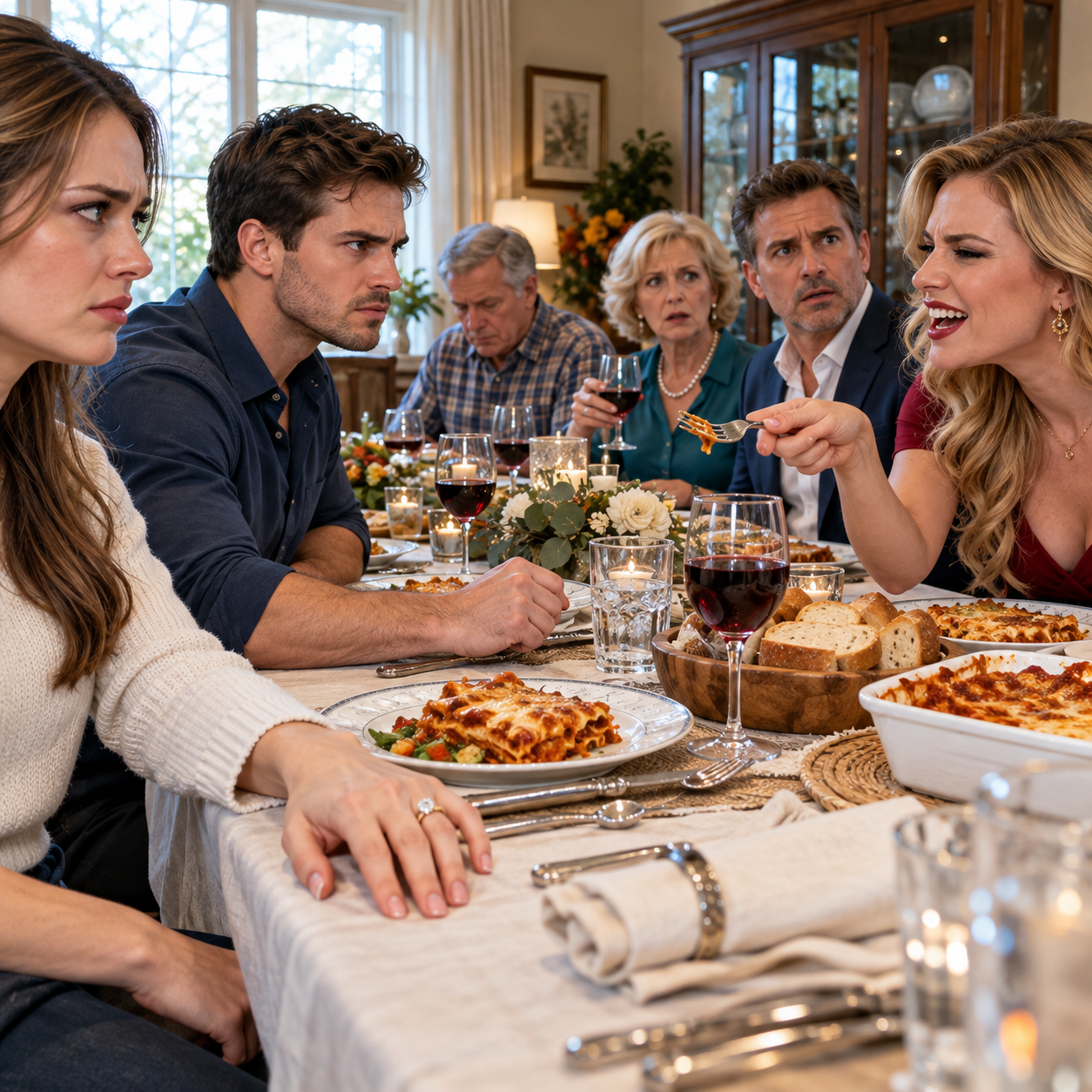
The silence around that dinner table was extraordinary. Elliot explained that when he booked their Christmas cruise, the company had questioned why Chelsea’s identification showed Pilaski rather than our family’s surname. She had told him it was a clerical mistake, and because he’d trusted her, he hadn’t challenged the explanation. Now he watched her carefully, waiting for something he could believe.
“Elliot, honey, it’s complicated,” Chelsea murmured.
My mother slapped her palm against the table hard enough to rattle the gravy boat. “The marriage was annulled!” she declared, apparently believing she was helping. Elliot slowly turned toward her, and I saw the moment he understood that both women had known about the marriage while he had been kept in the dark.
“An annulment requires a court order,” I said. “Rory has a hearing this Friday to finalize their divorce. You can’t divorce somebody you’ve never been legally married to, and you can’t divorce someone whose marriage was already annulled.”
Chelsea shot to her feet. “You’ve been talking to Rory behind my back!”
“I warned you at Labor Day, beside your car. I told you to tell Elliot yourself.”
“He’s jealous!” she cried, reaching toward her boyfriend. “He’s always been jealous of me, and now he’s ruining my happiness because of some stupid old ring!”
Elliot didn’t look at the ring. He looked at Chelsea with the exhausted expression of a man recognizing a familiar betrayal. “I asked you one question on our second date,” he said. “You knew what happened in my first marriage, and you looked me in the eyes and lied anyway.”
Chelsea began crying, reaching for his arm, but Elliot stood before she could touch him. He folded his napkin, placed it beside his plate, and thanked my mother for dinner. Then he turned to Chelsea. “The garage code will work until Saturday. Collect your things.”
He walked out without raising his voice.
My father, who had watched everything while quietly eating lasagna, reached past Mom’s elbow. “Could somebody pass the rolls?” he asked, and Laurel passed them without saying a word.
The sound of Elliot’s car disappearing down the driveway had barely faded when Mom turned on me. “Get out of my house! You’ve destroyed your sister’s future!” I stood, and Laurel calmly walked into the kitchen, returned with her half-full lasagna pan, and covered it with aluminum foil. “I brought this,” she said, tucking it beneath her arm before smiling at Dad. “Good night, Roy.” He thanked her for the food while Mom stared in disbelief.
In the car, Laurel held the warm pan on her lap as Chelsea’s crying echoed from the porch behind us. After several blocks, my wife glanced over. “Was telling him worth all that?” I pictured Grandma straightening the ring beneath the maple tree, then remembered my mother’s laughter when Chelsea called it a cheap toy. “Yes,” I answered. Laurel peeled back the foil, stole a bite of lasagna, and smiled. “Good. I wanted to make sure we agreed.”
By Monday morning, Mom had begun sending angry messages. She accused me of ruining Chelsea’s chance with a wealthy man, insisted Elliot wasn’t answering her calls, and demanded an apology. Rory was quieter when I called him, but after hearing everything, he said, “That poor guy. I know what finding out feels like.”
That afternoon, I repaired a stubborn elevator door in an older building on Riverside Avenue. The manager, Arvin, mentioned that the owner had arrived unusually upset and locked himself in his office without bringing his customary Monday donuts. I thought little of it, concentrating instead on the worn mechanisms that needed replacing.
On Tuesday, Rory’s process server finally caught Chelsea outside Elliot’s mansion while she was moving out. She was balancing a floor lamp and a box of shoes when he approached with the legal envelope, leaving her no convenient door to slam in his face. Rory texted me the news, explaining that she had been furious but could no longer claim ignorance of the proceeding.
By Wednesday evening, my mother had stopped sending insults. At almost ten, a message appeared on my phone.
“We’re coming tomorrow after work. Be home. We need to fix this. Mom.”
Laurel read it over my shoulder, then looked down at Grandma’s ring on her finger.
“What exactly does she think we’re going to fix?”
I didn’t know yet.
But the following evening, when Mom’s Buick rolled into our driveway with Chelsea sitting beside her, I saw my sister staring at Laurel’s left hand through the windshield.
And I finally understood why they had come.
### Part 3: Four Days Later They Demanded The Ring To Save Chelsea
I stepped onto the porch before my mother could ring the bell. Laurel remained just inside the doorway, a dish towel draped over her shoulder, while Chelsea climbed out wearing sunglasses despite the November darkness. Mom marched toward me without offering a greeting. “Here’s what’s going to happen,” she announced, sounding exactly like the woman who used to decide which child deserved something before either of us asked.
“You’re calling Elliot tonight,” she continued. “You’ll tell him you made everything up because you were angry about the ring. You’ll explain that Rory is just some bitter former boyfriend spreading lies.”
I stared at her. “You want me to tell a lie to cover up Chelsea’s lie?”
“Your sister deserves another chance,” Mom snapped. “And you’re going to give her that ring.”
Chelsea finally removed her sunglasses. Her eyes were swollen, and without the confident smile she’d worn at dinner, she looked almost unrecognizable. “I need a lawyer, Lane,” she said. “A good one, somebody who can fight Friday’s hearing and get this marriage properly annulled. Then I can show Elliot the paperwork and convince him this was all a misunderstanding.”
She pointed toward Laurel’s hand.
“That ring is a real diamond. Grandma’s diamond. Selling it would cover the retainer.”
Four days earlier, the ring was supposedly something purchased from a vending machine. Now my sister wanted to sell it to fund a legal fight over the marriage she’d spent years denying. Mom stepped closer, reminding me that Grandma should have left the ring to Chelsea in the first place and suggesting the old woman hadn’t been thinking clearly.
I looked at Laurel, who stood completely still in our doorway.
Then I took out my phone.
“Fine,” I said. “I’ll make a call.”
Chelsea exhaled in relief, and Mom nodded as though she’d finally convinced her difficult son to behave. I scrolled through my contacts, selected a number, and turned on the speaker. After two rings, Rory’s familiar voice came through.
“Hey, Lane. Everything okay?”
Chelsea froze.
“Rory,” I said, “I’m standing here with Chelsea and my mother. They need to know whether you’re still married.”
“Until tomorrow morning at nine,” Rory answered. “My lawyer expects the judge to finalize everything. She’s also asking for my truck title and repayment of those nineteen thousand dollars.”
My sister stepped toward the phone. “You can’t do that! I haven’t agreed!”
“You had eight years to respond, Chelsea,” Rory said evenly. “My lawyer tried to reach you. The newspaper notice ran for weeks. Somebody came to that house five times. I’m not keeping my life on hold anymore.”
For the first time that evening, my sister had no answer.
After Rory said goodbye, Mom stared at me with undisguised fury. “You did that deliberately!”
“You asked me to make a call. I called the one person who could tell you the truth.”
Chelsea’s eyes moved toward Laurel again. “And the ring?”
I shook my head. “You said it came from a gumball machine, remember? Those machines don’t take trade-ins.”
Behind me, Laurel turned toward the kitchen, suppressing a laugh. Mom threatened that neither of us would ever be welcome in her house again, but I reminded her she’d already thrown us out Sunday. Then I wished them a safe drive because the forecast called for freezing temperatures, stepped inside, and gently closed our front door.
Friday morning, a judge in Coeur d’Alene ended Rory’s ten-year marriage. Chelsea didn’t appear, but Rory attended with Mariah and his attorney. The decree restored his truck title and ordered Chelsea to repay the $19,000 through monthly installments beginning in January. Rory sent me a photograph of himself and Mariah holding the signed paperwork outside the courthouse, smiling like two people who could finally plan a wedding without looking backward.
Chelsea’s Christmas cruise was canceled. Elliot returned the leased Lexus she’d been driving, and because she’d already sold her own car, she moved back into her childhood bedroom and began borrowing Mom’s Buick to reach the radio station. The dance trophies were still on her shelves, although the life she’d expected was nowhere in sight.
Mom attempted to manage the embarrassment by calling her bunco friends and explaining that Chelsea’s engagement plans were over. After several calls, a woman named Phyllis interrupted her. “Gayla, sweetheart, Rory’s aunt goes to water aerobics with me. We’ve known about that marriage since 2016.”
Dad later told me Mom put down the telephone and didn’t make another call.
I might have laughed if the next thing that happened hadn’t nearly brought me to tears.
Two weeks after the hearing, Dad arrived at my house alone, carrying an old coffee can filled with bolts he’d been saving in his garage for thirty years.
He stood on my porch, studying the can.
“Thought you might need these for work,” he said.
### Part 4: My Father’s Confession Revealed The Ring’s True Family Legacy
I invited Dad inside despite having absolutely no use for his collection of mismatched bolts. Laurel made coffee and disappeared into the backyard, leaving us alone at the kitchen table. Dad turned his mug between his hands several times before looking toward Grandma’s ring, which Laurel had left briefly on the windowsill while washing dishes.
“In 1987,” he began, “the band cracked while your grandfather was in the hospital. Your grandmother couldn’t bear to leave him, so she sent me to a jeweler on Howard Street to get it repaired.”
Dad smiled faintly at the memory. He’d carried the ring in his shirt pocket, keeping one hand against it throughout the drive because he was terrified of losing something that precious. When the jeweler asked its insured value, Dad telephoned the hospital, and Grandpa Alvin answered, “Tell him two years of overtime.”
Then Dad’s smile disappeared.
“When Chelsea made that joke, I knew exactly what the ring meant,” he said. “I should have defended Laurel. Instead, I asked somebody to pass the rolls.” He lowered his eyes, his voice suddenly unsteady. “Son, I think I’ve been asking for the rolls for thirty years.”
I stared at the man who had spent my childhood avoiding every disagreement my mother started. Finally, I reached across the table and moved the coffee can closer. “They were good rolls, Dad,” I said, and he laughed before wiping his eyes.
He asked whether he could visit again the following Saturday. Laurel called through the open window that he was welcome anytime, and from then on, Dad started coming almost every weekend, bringing bolts and fixing things in our garage that weren’t broken.
Meanwhile, something unexpected happened at work.
My boss summoned me into his office and told me that Elliot owned four older buildings downtown, including the Riverside property where Arvin had complained about missing donuts. Elliot had transferred all four elevator service contracts to our company and specifically requested that I supervise the account.
I couldn’t understand why until Elliot called me.
“I wasn’t trying to repay you,” he explained. “I need someone responsible for those elevators, and I figured a man willing to tell the truth when it costs him his family’s approval is someone I can trust.”
That promotion came with lead pay, my own small crew, and enough security for Laurel and me to begin planning our future.
Before ending the call, Elliot asked about Grandma’s ring. I told him about Grandpa Alvin’s overtime and the forty-nine years Grandma had worn it. Elliot went quiet, then admitted that the engagement ring he’d purchased for Chelsea was still sitting in its box inside his sock drawer.
“I think I’ll leave it there for a while,” he said softly.
That winter, Laurel took Grandma’s diamond to a jeweler to arrange proper insurance coverage. The young man examined it under a magnifier, called his supervisor over, and disappeared into a back room with it. When they returned, they explained that the old European-cut diamond was exceptional for its age.
The appraisal came to $6,400.
Laurel stared at the paperwork before bursting into laughter. “Don’t tell your mother,” she whispered as we returned to the car. “She’ll show up asking for it again.”
In March, we sold our little two-bedroom house with its narrow carport and bought a three-bedroom home on Spokane’s north side, five minutes from Laurel’s school. It had a proper dining room, a basement, and an enormous maple tree in the backyard. Laurel had chosen it because the branches reminded her of our wedding.
On our first Sunday there, Dad came for dinner, along with Rory and Mariah, who brought a cooler of fish from Idaho. Laurel served lasagna in the same battered pan she’d carried out of my mother’s house that terrible November evening. We ate beneath the soft kitchen lights, laughing about Rory’s fishing stories while Dad passed the rolls without waiting to be asked.
Mom called him that afternoon to inquire whether Chelsea and she might be invited sometime.
Dad told her our door was open, provided they knocked politely and treated Laurel with respect. Neither woman had knocked yet, and I had stopped organizing my happiness around whether they ever would.
In May, Rory finally married Mariah beside the lake in Coeur d’Alene, close to the dock where he’d once taught me to tie a fishing knot. I stood beside him as his best man, watching Mariah proudly wear her grandmother’s wedding ring. During the reception, Rory raised a photograph of the tiny bass I’d caught years earlier and announced that anybody calling it a minnow would be banned from future fishing trips.
On the drive home, Laurel asked to stop for coffee near the state line. While I paid, she wandered toward an old red vending machine standing beside the gas station entrance. When I came outside, she was holding two quarters and smiling in a way that immediately made me suspicious.
She dropped the coins into the machine, twisted the handle, and retrieved a plastic capsule.
Inside was an enormous pink toy ring.
Laurel slipped it onto her right hand, lifted both hands beneath the fluorescent lights, and admired her matching jewelry. Grandma’s diamond glimmered softly on her left, while the ridiculous plastic jewel caught the light on her right.
“There,” she announced. “Now I finally have a proper gumball ring.”
I laughed until I had to sit on the curb.
She still wears that pink ring sometimes when Dad visits, and he laughs every time he sees it. Yet whenever Laurel straightens Grandma’s diamond on her finger, I remember an elderly woman beneath a maple tree, holding my bride’s hand and whispering that the ring had finally found its home.
My sister had thought its value was measured by what she could sell it for. My mother had thought it belonged to whoever carried the right family title. But Grandma had understood something neither of them ever learned.
A precious thing doesn’t belong to the person who wants it most. It belongs to the person who understands why it should be treasured.
And when I look across our dinner table at my wife, wearing a sixty-year-old diamond beside a fifty-cent plastic ring, I know Grandma chose exactly the right person.
THE END.
All characters and events in this story are fictional, created for storytelling and entertainment purposes. Thank you sincerely for reading. Your feedback and support are invaluable and motivate me to continue sharing more stories with you.

