
## Part 2: A Sinking Fishing Vessel Reveals Courage My Father Never Recognized
The storm struck our helicopter like a giant hand trying to tear it from the sky. Every instrument trembled as sheets of freezing rain hammered the windshield, and the aircraft dropped several feet before I steadied it. Miller watched the navigation display while Hayes reported that the rescue basket and medical equipment were secured. “Visibility’s almost gone,” Miller warned. “We’re approaching the target, but these downdrafts are getting worse.”
“Keep talking to me,” I replied. “Altitude, drift, anything that changes. I need every inch of this aircraft where it belongs.”
When we finally descended beneath the clouds, our searchlight caught the Arctic Star struggling against towering black waves. Its stern had nearly disappeared, and the vessel leaned sharply to port, its deck rising and falling beneath violent bursts of white spray. A damaged mast swung dangerously near the area where Hayes would have to work. I swallowed hard as I watched another wave break across the wheelhouse.
“There she is,” Miller said.
I eased the Dolphin into position, battling the crosswind with constant corrections. Through my headset, Hayes reported that two frightened fishermen had forced their way out of the flooded lower compartments and reached the deck. They were clinging to a railing, their orange life jackets barely visible through the spray. “Lieutenant, I’m ready to go down,” he said.
“Watch that mast, Hayes. I’ll hold you steady.”
The hoist cable lowered him toward the rolling vessel, and I kept my eyes moving between the aircraft instruments and the dangerous scene below. A sudden gust pushed us sideways, forcing me to correct immediately while Miller called out our drift. Hayes landed hard on the slippery deck, caught himself against a railing, and guided the first two men toward the rescue equipment. Their desperate movements were visible beneath the searchlight as the hoist began lifting them toward safety.
“Two coming up,” the hoist operator reported.
“Keep the line clear,” I answered. “Nobody gets left behind.”
At my father’s estate, the Christmas party had reached its most comfortable hour. Richard stood beside the stone fireplace, holding a glass of expensive Scotch while entertaining several guests with stories about my brother’s successful legal career. When a family friend asked why I wasn’t joining them, he offered the explanation he’d apparently rehearsed. “Vesper had another professional obligation,” he said casually. “You know these public service positions. They’re never particularly considerate of family traditions.”
A woman sitting near the television suddenly stopped eating. The local news had interrupted its Christmas programming with breaking coverage of a maritime emergency, showing grainy live footage of an orange-and-white helicopter above a sinking fishing vessel. “Richard, come look,” she called, setting down her dessert fork. “Those poor men are out there in this storm. Isn’t that the Coast Guard?”
My father glanced toward the screen. “Of course it is.”
The reporter explained that the Arctic Star was sinking, with twelve people aboard, and that a Coast Guard aircrew was conducting a dangerous rescue in winds gusting toward seventy knots. The footage from a distant news helicopter showed our aircraft fighting to remain almost motionless above the waves. Guests drifted closer to the television, leaving their food untouched as the broadcast followed the first survivors being lifted from the ship.
“The pilot is maintaining an extraordinary hover in nearly impossible conditions,” the reporter said. “One mistake could put the rescue crew and everyone aboard that fishing vessel in danger.”
My father watched without speaking.
Back over the Atlantic, Hayes returned to the flooded deck as the vessel rolled dangerously beneath him. More fishermen had managed to climb toward the hatch, but several remained trapped below, and the captain was refusing to abandon them. Water surged across the steel plates, making every movement a fight against the sea. “Lieutenant,” Hayes called, breathing hard, “the captain says three men are still below. He’s trying to get them out.”
“Tell him we’re staying as long as we safely can.”
A tremendous wave struck the Arctic Star, briefly burying its deck beneath a mountain of water. Hayes disappeared from my view, and my stomach tightened as I searched the dark water for any sign of movement. Then his voice returned over the headset. “Still here. But the hatch is flooding fast.”
In my father’s living room, the news camera zoomed toward our helicopter, and a quiet voice rose from among the guests.
“Richard, isn’t Vesper stationed somewhere near that coastline?”
He lowered his glass. For the first time that evening, he looked genuinely afraid.
## Part 3: Twelve Lives Are Saved As My Father’s Secret Collapses
“Hayes, report,” I ordered, fighting another violent downdraft. His answer came through beneath a roar of crashing water. “We’ve opened the hatch, Lieutenant. The remaining men are coming up, but the captain’s staying until everyone’s clear.” I glanced at the fuel gauges, then at the sinking vessel, knowing we had precious little time before the sea claimed it completely.
The next several minutes became a blur of hoist cables, shouted instructions, and desperate faces. Hayes worked with the fishermen as they emerged from the flooded compartments, helping them into rescue gear while our crew brought them up in repeated lifts. Miller monitored our instruments and called out every dangerous shift in the wind. Each time another man reached safety, I felt a fraction of the pressure lift from my chest, but I refused to count the mission successful while anyone remained below.
“Eleven accounted for,” the cabin crew finally reported.
I looked down through the windshield. One figure remained aboard the Arctic Star, crouched beside Hayes near the damaged wheelhouse, clutching the railing as the vessel sank beneath them. It was the captain, the same man who had sent that broken radio message begging someone to save his crew. His legs seemed too weak to hold him, and the ship’s bow was disappearing beneath the waves.
“Captain’s injured,” Hayes reported. “I’m securing him now.”
A violent gust shoved the helicopter sideways. Warning tones sounded briefly inside the cockpit as I corrected our position, fighting to keep the rotor clear of the swinging mast. Miller checked the engine readings and turned toward me. “We’re approaching our fuel margin, Vesper. We need to clear this area.”
“I know. Give Hayes another moment.”
Below us, Hayes fastened the final survivor into the rescue basket and signaled for the hoist. I saw the captain look up toward our aircraft, one gloved hand reaching desperately toward the cable. Then a towering wave smashed across the vessel, and the Arctic Star rolled farther into the dark water.
“Hoist now!” I shouted.
The basket rose just as the wave swallowed the section of deck where the captain had been standing. Hayes cleared the wreckage, and I held the aircraft steady until the crew confirmed they were both safely aboard. Behind us, the Arctic Star vanished beneath the storm-torn surface, leaving only scattered debris in the searchlight. Miller looked at me, his exhausted face illuminated by the instrument panel.
“Twelve survivors accounted for, Lieutenant.”
For one breath, I couldn’t speak. Then I nodded and turned the helicopter toward shore. “Let’s get everybody home.”
At my father’s estate, the television reporter received the same news moments later. The guests broke into relieved applause, and someone whispered a prayer of gratitude while the screen showed our aircraft pulling away from the sinking wreck. My father exhaled shakily, setting his untouched glass on the mantelpiece. He was turning away when the reporter announced that officials had confirmed the identity of the aircraft commander.
“The Coast Guard lieutenant who led tonight’s successful rescue is Vesper Vance, a local aviator whose crew has brought all twelve fishermen to safety.”
My official service photograph appeared on the television.
The room fell completely silent.
My father stared at the screen as though someone had struck him. There I was, in the exact uniform he’d forbidden me to wear, the same brass anchors shining against my collar. Beneath my photograph, my name and rank appeared clearly for everyone to read. The guests looked from the television to Richard, who had spent the evening dismissing my career and explaining away my absence.
“That’s your daughter,” the local judge standing beside the fireplace said quietly.
“Yes,” my father whispered.
The judge watched him for another moment. “You told us she couldn’t attend because of work. But I saw her car in your driveway when I arrived, Richard.” My father lowered his eyes, and the judge continued, “I saw her walking away from the house. She looked terribly upset.”
Richard gripped the edge of the mantelpiece.
“Did you ask her to leave?”
My father opened his mouth, but no answer came. His silence was enough, and several guests exchanged uncomfortable looks as the truth settled over the room. He had rejected his daughter over a uniform while that same daughter was preparing to answer a call that would save twelve strangers. For the first time in his life, the man who always knew what to say had no polished explanation left.
My father looked back at the television, where the reporter was describing the rescue crew’s extraordinary determination. He had spent Christmas Eve fearing that I would embarrass him in front of his friends. Instead, every person in that room had witnessed the courage he refused to acknowledge.
And the terrible truth was that he hadn’t recognized my worth until strangers told him what he should have known all along.
## Part 4: His Apology Comes Too Late To Change What Matters
When our helicopter finally touched down, the storm was still raging across the air station. Ground crews hurried toward us with flashlights as the rotor blades slowed, and medical personnel began caring for the exhausted fishermen. I removed my helmet, feeling the ache spread through my shoulders now that the adrenaline was fading. Miller climbed down beside me and squeezed my arm.
“Twelve people, Vesper. Twelve families getting another Christmas together.”
I watched Hayes help the captain toward the waiting medical team. Before the older fisherman was taken inside, he stopped and turned toward me, his face pale beneath his soaked wool cap. “Lieutenant,” he said, his voice trembling, “I thought I’d never see my family again. I’ve got a little granddaughter who keeps asking when Grandpa’s coming home for Christmas.”
I stepped closer and rested a hand briefly on his shoulder. “Then you’d better make sure she gets her Christmas hug.” His eyes filled with tears, and he nodded before following the medical team. I stood there in the bitter wind, realizing that no promotion, expensive dinner, or public recognition could have given me what that moment did.
Inside the station, my phone was vibrating across the briefing table. There were messages from reporters, unfamiliar numbers, old acquaintances, and people who apparently wanted to congratulate me for something they had just watched on television. A short video showed the rescue footage playing beneath a breaking-news headline. I watched only long enough to see our helicopter hovering over the Arctic Star before switching the phone to silent.
Hayes sank into a chair beside Miller, his wet hair flattened against his forehead. Someone handed us fresh coffee, and for several minutes, we simply sat together, letting the warmth return to our hands. We didn’t talk about heroes or headlines. We talked about the captain, the crew, and the frightening seconds when the vessel had disappeared beneath Hayes.
That night, for the first time I could remember, Christmas felt complete without my father’s approval.
A week passed before Richard contacted me.
I was sitting in my apartment overlooking the gray Atlantic when his message appeared. It was longer than anything he’d written to me in years, and its first sentence made me set down my coffee.
Vesper, I owe you an apology that should have come long before Christmas Eve.
He admitted that he had lied to his guests about why I wasn’t at dinner. He said he’d been more concerned about impressing people than respecting his own daughter, and that watching the rescue on television had forced him to confront what he’d spent years refusing to see. He asked whether we could meet for coffee, talk honestly, and perhaps begin repairing our relationship.
Then came the sentence that caught me off guard.
When I saw your photograph on that television, I was proud of you. But I realized you had deserved to hear those words from me long before the world started saying them.
I read the message twice.
Years earlier, those words would have sent me racing back to him. I would have accepted the apology without hesitation, grateful for the smallest indication that I’d finally become someone he could admire. But something had changed during those hours above the Arctic. I no longer wanted to spend my life trying to earn love by becoming whatever someone else considered respectable.
I didn’t hate my father. I hoped his apology was sincere, and perhaps one day I would be ready to talk to him. But rebuilding trust would require more than a frightening television broadcast and a beautifully written message. For once, I allowed myself the freedom to decide when, or whether, that conversation would happen.
I placed my phone facedown on the table.
The following morning, a small envelope waited for me at the station. Inside was a photograph of the Arctic Star’s captain smiling beside his granddaughter in front of a Christmas tree. On the back, someone had written a short message in careful handwriting.
Thank you for bringing Grandpa home.
I held the photograph for a long moment, remembering the captain’s trembling voice, Hayes fighting the freezing water, and Miller calling out our altitude while I struggled against the wind. None of us had been thinking about recognition that night. We’d simply been doing everything we could to make sure twelve people returned to the families waiting for them.
I slipped the photograph into my locker beside a picture of my rescue crew.
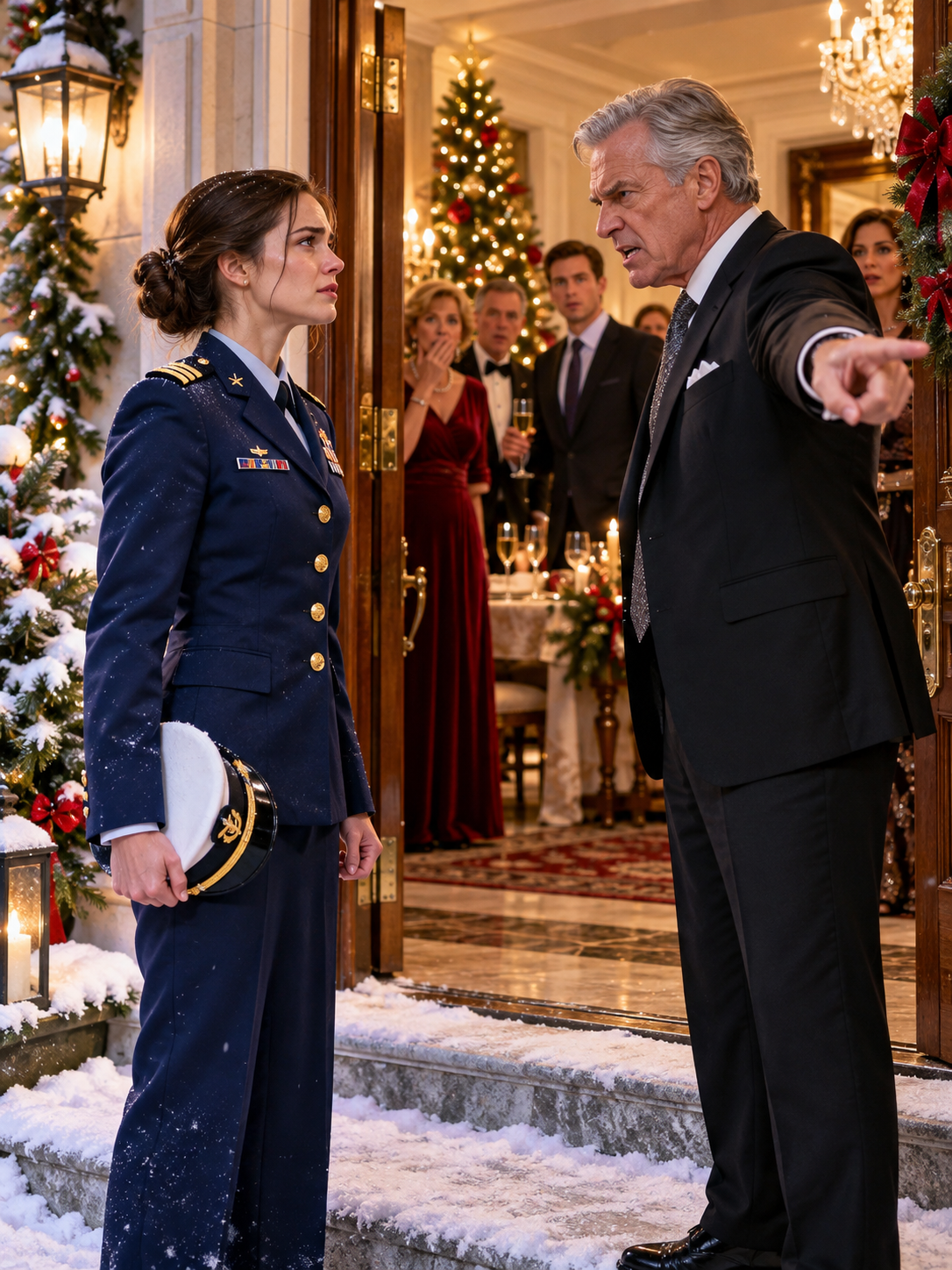
Before my next shift, I stood in front of the mirror and straightened my uniform. The dark fabric was clean, the ribbons carefully arranged, and the brass anchors rested precisely where they belonged. I looked at the woman reflected there and thought of my father’s doorway, the snow, and the terrible ache I’d felt when he turned me away.
Then I remembered twelve frightened men coming home alive.
My father had believed that my uniform would ruin Christmas because it didn’t belong in his perfect house. He’d been wrong about what made a Christmas worth remembering, and he’d been wrong about me. That uniform had helped give twelve families the chance to celebrate another holiday together.
I picked up my flight helmet and walked toward the hangar, where Miller and Hayes were already preparing the aircraft. Through the open doors, sunlight broke across the water, turning the gray waves silver. Hayes lifted his hand in greeting, and Miller called, “Morning, Lieutenant. Ready for another day?”
I smiled and walked toward them.
“Always.”
And as I climbed into the cockpit, I understood something my father had never been able to teach me: I didn’t need a seat at his Christmas table to know where I belonged.
I had already found my place among people who valued what I could give, not what I could display.
For the first time, I wasn’t trying to make my father proud.
I was simply proud of the woman I’d become.
THE END.
All characters and events in this story are fictional, created for storytelling and entertainment purposes. Thank you sincerely for reading. Your feedback and support are invaluable and motivate me to continue sharing more stories with you.


