
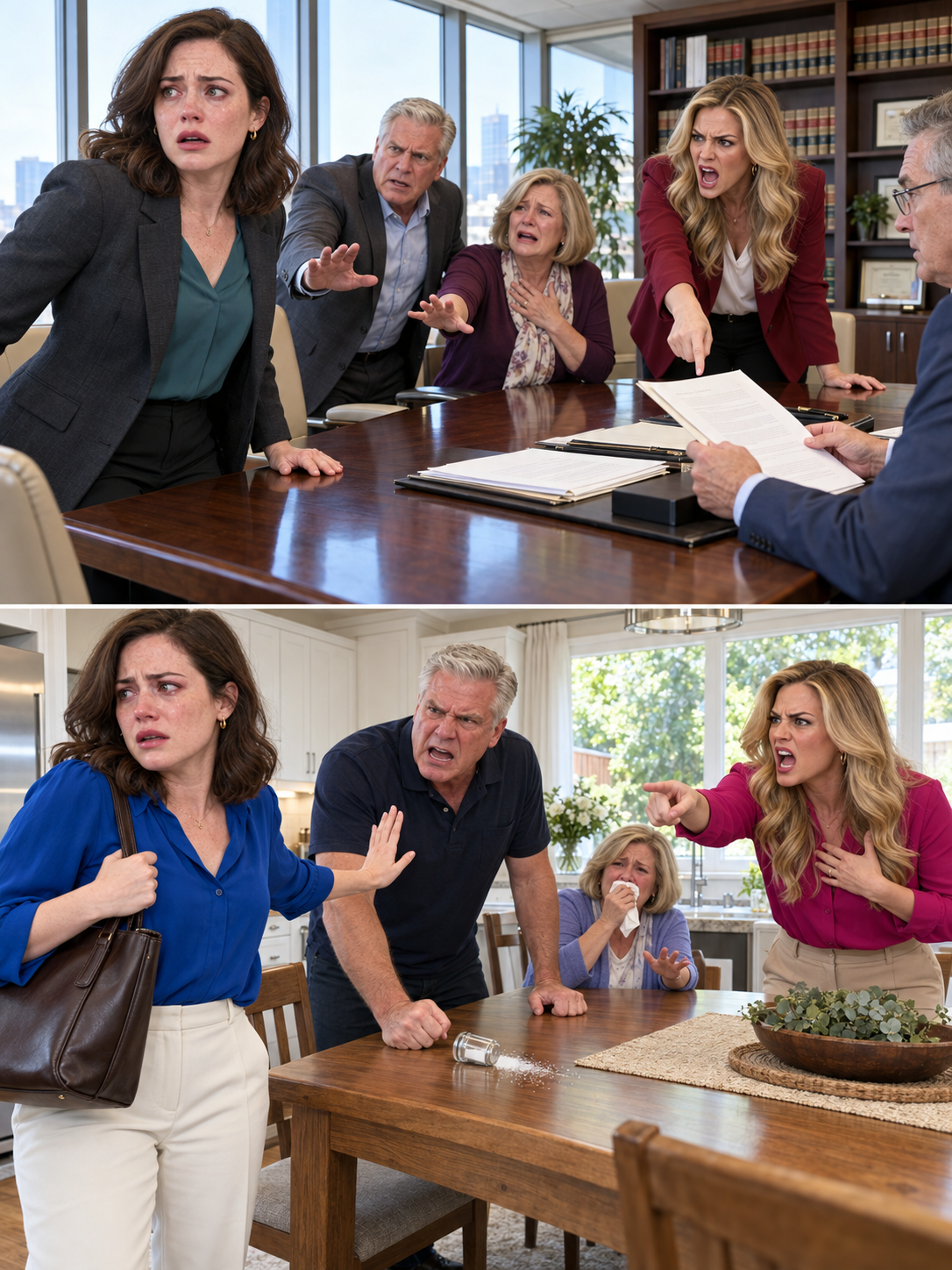
Part 2: A lawsuit appeared, backed by a witness and suspicious evidence.
I read the letter three times while standing in my hallway with my coat still on.
My parents claimed Grandma had made an oral agreement promising to divide her remaining estate equally between Melinda and me. They also claimed they had proof.
A witness.
And a handwritten note.
According to them, Grandma had promised Melinda another $150,000 before she died.
The next morning, I hired an inheritance attorney named Claire. She was calm in a way I desperately needed.
“The written will is strong,” she told me. “But they’re challenging intent. We need people who knew what Ruth actually intended.”
I immediately thought of Grandma’s bridge club.
Six women had met every Thursday for years. They played cards, drank tea, traded gossip, and apparently discussed far more family business than I realized.
The first woman I called was Dorothy.
“Come Thursday,” she said. “I’ll make tea.”
Her home smelled like cinnamon and old books. A gray cat sat on the arm of my chair while I explained everything.
Dorothy didn’t look surprised.
“Your grandmother talked about Melinda often.”
My stomach tightened.
“Did she ever say she wanted everything divided equally?”
Dorothy shook her head.
“Quite the opposite.”
She told me Grandma had repeatedly complained about being pressured for money. Eventually, she had calculated every payment she’d made on Melinda’s behalf.
“She told us the number was around three hundred fifty thousand dollars,” Dorothy said. “She said she’d already given one granddaughter far more than the other.”
Two other bridge-club friends confirmed the same story.
Both agreed to provide sworn statements.
Then I located Carol, Grandma’s longtime housekeeper.
We met at a diner.
“Your grandmother knew her own mind,” Carol said over black coffee. “She never told me she planned to split the money equally. She said she’d already done too much for one granddaughter.”
I asked about my parents’ witness.
The cook.
Carol’s expression changed.
“That woman?”
“You know her?”
“Barely. She was only around for maybe two months near the end.”
“Who hired her?”
Carol stirred her coffee.
“Your mother.”
I called Claire before leaving the parking lot.
She investigated.
Two days later, Claire phoned me.
“I found something.”
Their star witness had a criminal record involving theft and fraud.
Then Claire obtained Grandma’s banking history.
The transfers were there.
Year after year.
Tuition. Wedding expenses. Vehicle payments. Direct transfers.
Approximately $350,000.
At mediation, my parents sat across from me while their attorney acted as though the outcome were obvious.
“Settle now,” he said. “Trial will be expensive.”
Claire quietly placed the bank records on the table.
Then the bridge-club statements.
Then information about their witness.
The mediator looked at my parents.
“Do you want to reconsider?”
Dad folded his arms.
“No.”
Mom glared at me.
“She’s doing this to punish her sister.”
Claire touched my forearm beneath the table, silently telling me not to respond.
Mediation ended without an agreement.
That evening, I sat alone in my new kitchen.
A living-room rug I’d purchased was still rolled against the wall. For some reason, I couldn’t bring myself to lay it down.
Maybe because part of me still didn’t believe the house was safe.
Two months later, we entered court.
My parents’ cook testified first.
She looked directly at the judge.
“Ruth told me both granddaughters were supposed to receive equal amounts.”
Claire waited.
Then she presented three sworn statements from women who had known Grandma for decades.
Then the financial records.
Then she turned to the handwritten note supposedly promising Melinda $150,000.
Claire placed several genuine letters written by Grandma beside it.
The judge examined them silently.
My mother’s face slowly lost its color.
Finally, the judge looked up.
“The handwriting appears inconsistent.”
Dad shifted in his seat.
The judge ordered a forensic handwriting examination.
“We reconvene in three weeks.”
I glanced toward my parents.
Their attorney was whispering urgently.
Mom wouldn’t look at me.
And in that moment, I realized something that frightened me more than the lawsuit itself.
They already knew what the handwriting expert was going to find.
Part 3: The forged note collapsed their case—and exposed the deeper betrayal.
For three weeks, I went to work, came home, reheated dinners, and tried not to imagine every possible outcome.
The rug stayed rolled in the corner.
Then the second hearing arrived.
The judge entered, reviewed several documents, and wasted no time.
“The handwriting analysis is conclusive.”
My heart pounded.
“The disputed note was not written by Ruth.”
My mother immediately whispered something to my father.
Claire remained perfectly still beside me.
The judge continued.
The note was fake.
Someone had manufactured evidence in an attempt to prove Grandma promised Melinda money she had never promised.
Then came the next blow.
The cook’s background had been investigated further. Her prior convictions involved theft and fraud, and serious questions had arisen concerning the truthfulness of her testimony in our case.
The judge ruled her testimony unreliable and referred the matter for further investigation regarding possible perjury.
My parents began speaking at once.
“That’s irrelevant,” Dad said.
“The handwriting examiner is wrong,” Mom insisted.
Their attorney leaned toward them.
“Stop talking.”
The judge waited until the room became quiet.
Then she looked directly at my parents.
“I find it difficult to understand how parents could take their own daughter to court in an attempt to remove property legally left to her by her grandmother.”
Mom’s lips parted.
The judge continued.
“The will is clear. The financial records are clear. The deceased’s long-term friends are consistent. The evidence presented by the plaintiffs is not credible.”
She ruled entirely in my favor.
My house remained mine.
My inheritance remained mine.
And my parents were ordered to cover the court costs.
For a moment, I heard nothing.
Claire closed her folder.
“That’s it,” she whispered.
“It’s over.”
In the hallway, I thought my parents might scream at me.
Instead, Mom hurried toward me wearing an expression I had seen many times before.
The expression she used before asking Grandma for money.
“We need to talk about the court costs.”
I stared at her.
“We don’t have that kind of money right now,” she continued. “We’re already in debt because of the lawyers.”
Dad nodded.
“We need help.”
I almost admired the audacity.
“You spent months trying to take my house.”
“Brianna,” Mom pleaded, “we’re your parents.”
“You brought a fake document into court.”
Her eyes filled with tears.
I walked toward the elevator.
Dad called my name.
I pressed the button.
When the doors opened, I stepped inside without turning around.
That night, I blocked both their numbers.
But Melinda still wasn’t finished.
First came notes beneath my door.
SELFISH.
YOU STOLE MY FUTURE.
YOU’LL REGRET THIS.
I threw away the first two.
Then I started saving them.
I installed security cameras.
One morning, I opened my front door and froze.
Dark reddish-brown paint had been smeared across it.
I pulled up the overnight footage.
At 2:13 a.m., Melinda walked directly into camera view carrying a container.
Her face was unmistakable.
She stood on my porch and covered the door with paint.
I watched the recording twice.
Then I called the police.
For the first time in Melinda’s life, tears, accusations, and family pressure weren’t going to make the consequences disappear.
And when officers watched the footage, the story my family had spent decades telling themselves finally stopped mattering.
Part 4: Consequences ended the feud, leaving me with Grandma’s final lesson.
Melinda was fined for vandalism.
My attorney also obtained a court order requiring Melinda and my parents to stay away from my property.
It felt strange seeing that boundary written on official paper.
My family had spent months telling me that protecting my own home was cruel.
Now the law was protecting it for me.
The damaged door took two days to repair. Instead of restoring the original color, I painted it dark green.
It looked better.
A cousin later told me my parents had been forced to sell several things to cover their legal expenses and court costs. Furniture. Appliances. Eventually their car.
I didn’t celebrate.
But I didn’t rescue them either.
Every step had been a choice.
They chose the lawsuit.
They chose to ignore Grandma’s will.
They chose a questionable witness.
Someone chose to create the fake note.
And when all of it collapsed, their first instinct was still to ask me to pay for the consequences.
That realization hurt more than losing contact with them.
For years, I had thought our family problem was favoritism.
It wasn’t.
The deeper problem was that everyone had been trained to believe Melinda’s need automatically became somebody else’s responsibility.
Grandma had participated in that cycle for years. Every check solved the immediate crisis but created a bigger one later.
Finally, near the end of her life, the auditor in her did what she always knew how to do.
She looked at the numbers.
She stopped listening to the crying.
And she balanced the account.
About six months after the trial, I finally unrolled that living-room rug.
I remember standing there alone, pushing one corner beneath the coffee table with my foot, and laughing quietly at how much meaning I had given to a piece of fabric.
I had kept thinking, I’ll put it down when everything is settled.
Now everything was.
The house grew into a home.
I planted tomatoes, peppers, basil, and a few vegetables I had no idea how to grow properly. Some survived. Some didn’t.
Dorothy called occasionally.
Carol sent me a Christmas card.
Two cousins remained in my life because they had never asked me to choose sides or hand anyone a check.
One afternoon, Dorothy visited.
We sat in the backyard drinking iced tea while she looked at my uneven little garden.
“Ruth would have liked this place,” she said.
I smiled.
“I hope so.”
Dorothy studied me for a moment.
“There’s something she said once that I never told you.”
I turned toward her.
“She said she wasn’t leaving you money because you needed it more.”
My throat tightened.
“Then why?”
“Because she trusted what you’d do when someone told you no.”
I stared at the garden.
Dorothy continued.
“Your grandmother said Melinda always treated love like proof that someone would give in. She wanted at least one person in the family to learn that love can also mean refusing.”
For months, I had believed Grandma’s final gift was $300,000.
Standing there, I understood the real inheritance.
It was permission.
Permission to stop negotiating with people who believed my boundaries were betrayals.
Permission to let adults carry the consequences of their own decisions.
Permission to own something without apologizing for having it.
My parents never came back to the house.
Melinda never appeared on my porch again.
I don’t know whether they’ll ever understand why everything happened.
Maybe they never will.
But some truths don’t need unanimous agreement to remain true.
Grandma wrote her wishes down.
The court upheld them.
The evidence exposed the lies.
And I finally stopped confusing surrender with love.
That evening, after Dorothy left, I stood at my dark green front door with the sunset reflecting across the windows.
Inside was the rug I had finally put down.
Outside was a garden slowly learning how to grow.
And beneath my feet was a house nobody had given me permission to keep.
I didn’t need permission anymore.
The deed carried one name.
Mine.
THE END.
All characters and events in this story are fictional, created for storytelling and entertainment purposes. Thank you sincerely for reading. Your feedback and support are invaluable and motivate me to continue sharing more stories with you.


