
### Part 2: A Hidden Legal Document Reveals How Completely Dad Replaced Me
After dinner, I found Dad standing on the porch, his cane planted beside his boots and his breath clouding the cold air. “You humiliated me,” he said without turning around. “I wanted to give your brother something worth coming home for.” I reminded him that Dexter had already decided to stay in Arizona, but Dad shook his head and accused me of turning his son against him. “I carry the family name too,” I told him, and when he muttered, “You know what I mean,” I answered, “Yes, Dad. That’s exactly the problem.”
Asa drove us home across the river, reaching over to squeeze my knee at a red light. “Thirty-one keys,” he murmured. “I never realized how much you carried.” I watched the dark water beyond the bridge and thought about Mom’s promise. Fifteen years of work had apparently counted for less than being born the right child.
On Monday morning, I arrived at the store at 6:30, as usual. While clearing a paper jam from the office printer, I discovered an eleven-page legal document stamped DRAFT, prepared by the lawyer Dad had visited in October while I waited outside in the car. It transferred the hardware business and building to Dexter for one dollar, effective January first. On page seven, beneath the employees’ names, I found my own position described as store manager, permitted to remain employed only at the new owner’s discretion.
I sank into Mom’s chair beside her old rolltop desk, whose bottom drawer had remained locked since her death. The coffee maker hissed, and Irving sang terribly to the radio in the plumbing aisle while I stared at those words. Dad hadn’t merely overlooked my work during an emotional holiday announcement. He had secretly arranged for my younger brother to become the person who could fire me.
Dexter answered my call from Phoenix, listened as I read the document, and promised he had never seen it. “I’m not signing anything,” he said firmly. “I’m not taking your store, Georgie.” When Dad called him twice that week, Dexter repeated his refusal, but Dad insisted I must have manipulated him. Then Aunt Madeline called to scold me for embarrassing my father in front of the family.
The following Saturday, Madeline appeared at the store asking for rock salt before an approaching snowstorm. She watched me answer supplier calls, assist contractors, repair a register problem, and direct Irving toward a basement bin without leaving the counter. After nearly an hour, she quietly told me that our grandfather had once owned a grocery store in Lewiston. She had worked there for eleven years, including four keeping the books, but when he retired, he gave it to eighteen-year-old Roland, who sold it two years later to finance his move to Bangor.
“Nobody ever put my name on that store either,” she said, studying me across the counter. Then she picked up her salt and added, “I told Roland you embarrassed him at Thanksgiving. Tonight I’m going to tell him what I should have said sixty years ago.” She refused my offer to carry the bag to her car. I watched her leave, wondering how many women in our family had quietly kept businesses alive while men inherited the credit.
Two weeks later, Dad summoned me to Effie Nedeau’s law office on State Street. Dexter appeared on a laptop from Phoenix, and Effie placed the transfer documents between us before asking whether he intended to accept the business. “No, ma’am,” he answered, and she immediately explained that the proposed transfer could not proceed without his agreement. Then she turned to Dad and tapped the paragraph about my employment.
“Roland, I drafted this because you told me it was a standard management arrangement,” she said. “But I’ve reviewed fifteen years of business records, and every payroll, supplier agreement, and bank transaction has Georgia’s signature.” She folded her hands and looked directly at him. “Whatever that sign says outside, your daughter is the person running this company.”
Dad stared at his cane until Effie asked what he intended to do next. “I’ll think about it,” he muttered, then left the office and took a taxi home instead of riding with me. I hoped the meeting had finally forced him to reconsider. Instead, on January fifth, a stranger walked into my store wearing a homemade manager’s name tag and announced that Roland had hired him to take charge.
### Part 3: A Brutal Winter Morning Unlocks My Mother’s Final Secret
His name was Winslow Hatch, a sixty-one-year-old former district manager for a national home improvement chain. He shook my hand, smiled politely, and said, “Your father tells me you’ve been a tremendous help around here.” I gave him the guest computer login, showed him the office, and explained our ordering schedule. I did not surrender my keys.
Winslow wasn’t cruel or incompetent, which somehow made the situation harder. He wanted modern inventory software, fewer obscure parts, and higher profit margins, so he suggested clearing the basement of decades-old hardware and stopped stocking certain individual brass screws. He moved the duct tape from aisle four to aisle nine, confusing customers who had bought it from the same shelf for twenty years. Then he announced that Friday’s paper paychecks would be replaced by direct deposit.
Irving listened to that announcement while holding the envelope I’d handed him every Friday for fifteen years. “I’m eighty-one,” he told Winslow. “I cash my check on Saturday, buy a donut afterward, and go home. That’s my week.” Winslow tried to explain the efficiency of electronic banking, but Irving shook his head. “I’ve earned my donut, young man.”
The following Saturday, Bangor woke to temperatures nine degrees below zero. By seven-fifteen, plumbers, contractors, and frightened homeowners crowded our aisles looking for heat tape, copper fittings, insulation, and emergency shutoff valves. The loading dock padlock froze, the basement boiler began rattling, and register two jammed when someone slammed it shut. Winslow stood in aisle six clutching a clipboard while a plumber urgently waved a damaged pipe fitting in front of him.
“Georgia!” the plumber shouted over the crowd. “Three-quarter-inch brass, old thread!” Without looking up from the register, I answered, “Basement, bin forty. Irving knows.” Two minutes later, Irving returned carrying the exact fitting, then went downstairs to coax the boiler back to life with his familiar rubber mallet. By closing time, we’d recorded our highest single-day sales in two years.
Winslow waited until the last customer left before removing his name tag and placing it on the counter. “I’ve supervised eleven stores,” he told me, glancing toward Irving sweeping near the entrance. “But I’ve never seen a place operate on this much personal knowledge, and I can’t replace either of you.” He shook our hands and went home to telephone my father. Later, Dad admitted that Winslow had told him, “You already have the manager you need. You’ve simply refused to see her.”
On Monday, Dad arrived carrying his cane and walked silently through the aisles. He stopped at the misplaced duct tape, asked me to return it to aisle four, then wandered into the back office and lowered himself into Mom’s old chair. “She sat here thirty-two years,” he whispered, running his fingers across the worn desktop. “I never even knew where she kept the stamps.”
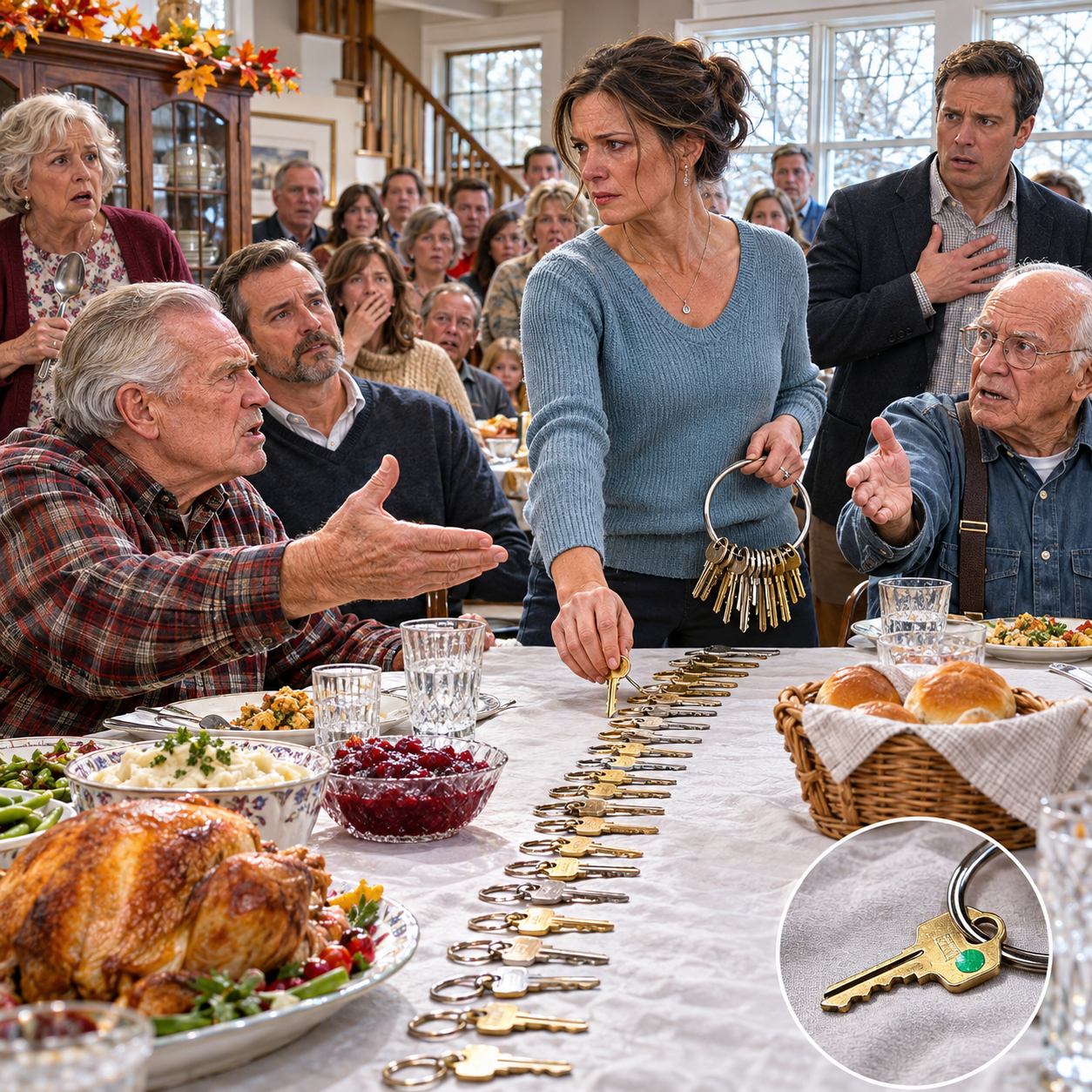
“Top left drawer,” I answered, and he almost smiled. Then he tugged at the locked bottom drawer, mentioning how he’d searched the house for its key after Mom died. Something tightened in my chest as I remembered the tiny brass key marked with green nail polish. I took my ring from my pocket, knelt beside the desk, and slipped the little key into the lock.
It turned.
Inside lay thirty-three green accounting ledgers, arranged by year, beginning in 1979 and ending in 2011. The final volume contained only a few months of entries, stopping when Mom became too sick to work. Dad opened it and discovered an envelope tucked behind the cover, bearing his name in her unmistakable handwriting. His hands trembled as he passed it to me and asked me to read.
The letter was short, just like Mom. She reminded Roland that she had maintained the books for thirty-two years without ever asking to have her name painted above the door. But she begged him not to leave Georgia invisible in the same way, because their daughter already understood every lock, every account, and every responsibility the business carried. Her last instructions were to give me the keys, put my name where customers could see it, and remember to feed Irving.
Dad covered his face, and for the first time in my life, I saw his shoulders shake with unguarded grief. When he finally spoke, he admitted Mom had asked him in the hospital to leave me the store, and he’d dismissed her request as something said through exhaustion. “My father handed me a business because I was his son,” he whispered. “I’ve spent fifteen years calling that tradition, when all I’ve really done is repeat the same mistake.”
He took my hand and apologized for the work shirts, the anniversary speech, the salesman, and every time he’d allowed customers to believe I merely assisted him. He admitted that pretending to remain the man in charge had been easier than acknowledging how much he depended on his daughter. I sat beside him while the afternoon sunlight crossed Mom’s ledgers, realizing that the woman we’d buried fifteen years earlier had left behind the one argument Dad could no longer dismiss.
### Part 4: My Father’s Last Gift Finally Restores Our Family Name
Two weeks later, Dad and I returned to Effie’s office, this time traveling together. The new agreement transferred the hardware business to me through a genuine purchase arrangement, with payments spread over ten years rather than a symbolic dollar. Dad retained ownership of the building, granting me a lease and arranging for the property to pass to me through his estate. Dexter sent a signed letter confirming his support, decorated with a little drawing of a cactus.
Dad signed first, his hand trembling slightly, then slid the agreement across the desk. I signed Georgia Cloutier, exactly as I had signed every payroll check since 2011. Effie stamped the document and congratulated me, adding that she would return in March for another furnace filter. As we stood, Dad reached into his coat pocket and produced the spare front-door key he’d carried since 1979.
“Keys, sweetheart,” he said softly, holding it out.
This time, I accepted it from his hand.
In May, a crew from the same sign company that had served my parents decades earlier arrived with ladders and fresh paint. Dad stood beside me on Hammond Street as the old Cloutier and Son sign came down, asking the workers to preserve it rather than discard it. When the new sign went up, it read Cloutier Hardware, with a smaller inscription underneath honoring Roland, Jeannette, and Georgia Cloutier since 1979. Mom’s name was finally displayed above the business she’d helped build.
Dad cried openly on the sidewalk, just as Mom had once told me he’d cried when the original sign was painted for baby Dexter. Irving wiped his eyes and blamed the pollen, although the air was perfectly clear. Aunt Madeline inspected the sign for a long moment before telling her brother, “Took you long enough, Roland.” Then she purchased a bag of grass seed she didn’t need, carried it toward her car, and turned back to tell me that our grandfather would have hated the new sign, which was how she knew it was right.
Dad began working Saturdays from eight until noon, cutting keys beside the front register and entertaining customers with stories that grew longer every week. I gave him a green work shirt embroidered with Cloutier Hardware and, beneath it, Key Department. One morning, a young salesman walked up to him and asked for the owner. Dad pointed his cane toward me behind the counter and announced, “That’s Georgia. I just work here on Saturdays.”
Dexter married in Phoenix that June, and we all flew out for the celebration, including Irving, who had never boarded an airplane before. During the reception, my brother stood with his new wife and raised his glass toward our family. “To my big sister,” he said, smiling through tears, “the only person I know who can open every lock.” Dad stood beside me and applauded until his hands turned red.
I still open the store at 6:30 every morning, and I still distribute five paychecks by hand every Friday at four. Irving takes his envelope, calls me boss, and heads to the bank on Saturday before buying his donut. Dad sometimes calls me boss too, usually when he thinks I can’t hear him. The thirty-one keys still hang beside my office desk, including the small brass one marked with Mom’s green nail polish.
Her old drawer remains unlocked, its ledgers lined up in the order she left them. I’ve added a new green volume marked 2026, written in pencil, because some traditions deserve to survive. Sometimes I open her final letter and think about the Thanksgiving afternoon when Dad stretched his hand across the table, convinced that the store belonged to whichever man carried his name. It took a brother brave enough to refuse, an eighty-one-year-old employee willing to speak, and a mother’s forgotten letter to teach him otherwise.
The business was never truly held together by a sign, a deed, or a man’s name. It survived because people came to work, knew their neighbors, kept their promises, and cared enough to remember which locks froze in January. Mom understood that long before any of us. And although she never lived to see her name painted above the door, every time I turn the key at dawn, I feel as though she’s standing beside me.
THE END.
All characters and events in this story are fictional, created for storytelling and entertainment purposes. Thank you sincerely for reading. Your feedback and support are invaluable and motivate me to continue sharing more stories with you.


