
Part 2: Changed Locks and One Refused Favor Bring Another Threat
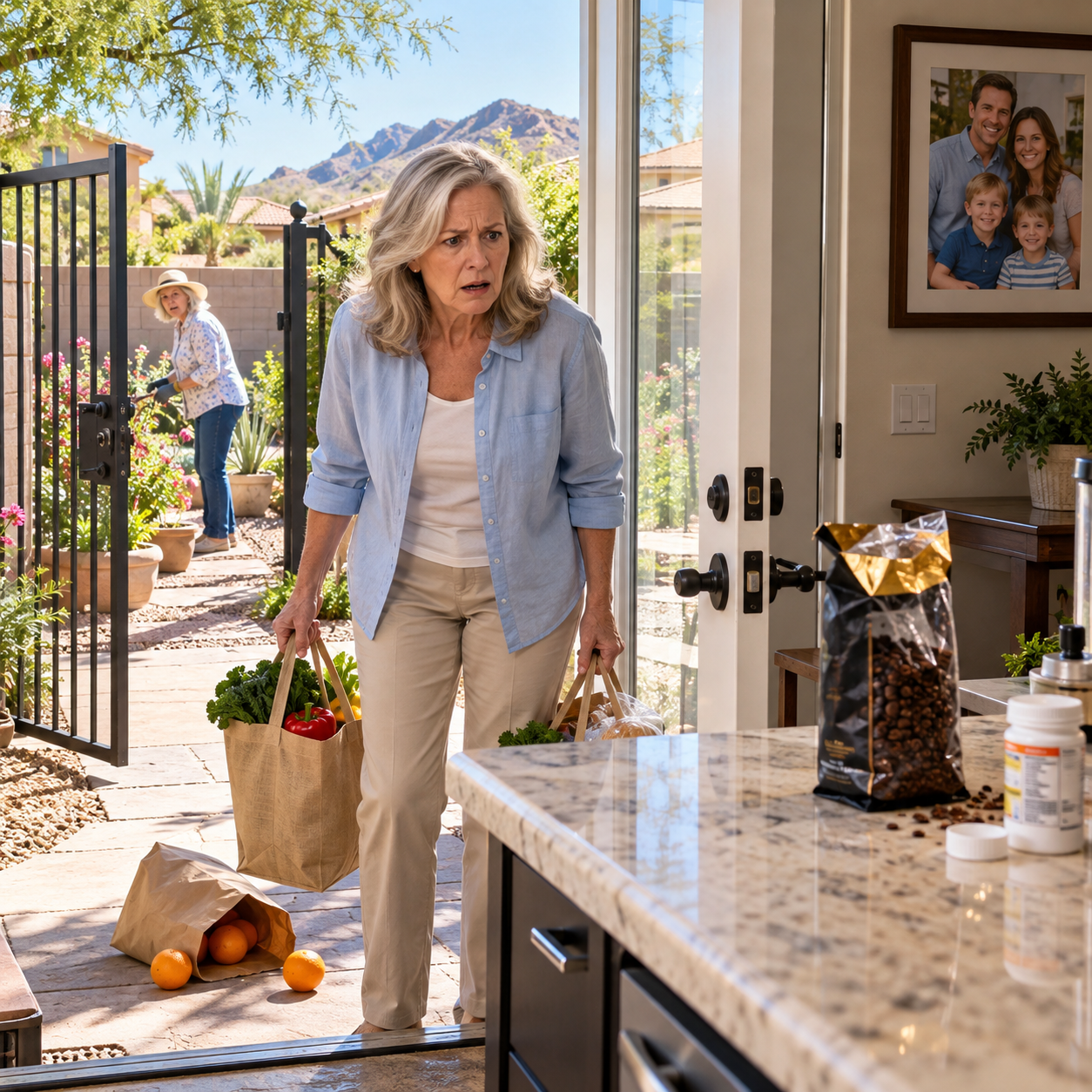
I knew I had latched that gate before leaving. A desert breeze could rattle it, but it couldn’t lift the heavy metal catch. I carried my grocery bags through the backyard and found the kitchen door unlocked, although I clearly remembered turning the key that morning.
Nothing expensive was missing. My jewelry box remained untouched, and Richard’s old watch still lay in its wooden case. But a nearly full bag of coffee had been emptied halfway, and a new bottle of ibuprofen had been taken from my medicine cabinet and left on the kitchen counter.
Ethan still had a house key. I’d given him one years earlier for emergencies, never imagining it might eventually become permission to enter whenever he pleased. I couldn’t prove he had been there, but I couldn’t think of anyone else who would help themselves to my coffee and medicine.
I called a locksmith instead of starting another argument.
By three that afternoon, every exterior door had a new deadbolt. I tested the front-door key twice, then placed my spare inside a small drawer beneath the hallway telephone. The locksmith handed me the invoice, wished me a pleasant afternoon, and drove away.
That evening, I opened my banking app. For sixteen months, I had been transferring $250 into Ethan’s checking account on the first of every month, money I’d offered when Briana complained that preschool expenses were becoming difficult to manage. At the time, I’d imagined easing their burden while ensuring the boys had a good place to spend their weekdays.
I had never requested receipts or asked whether the money reached the childcare center.
I canceled the next scheduled transfer.
On Saturday morning, Ethan’s truck pulled into my driveway shortly after nine. Noah climbed out wearing his favorite dinosaur shirt, while Ben followed clutching the stuffed elephant he rarely went anywhere without. Briana emerged from the passenger side in tennis clothes, her expression suggesting she’d already rehearsed the conversation.
From inside, I heard Ethan’s key scrape against the new lock. He tried again, rattled the handle, and knocked.
When I opened the door, he looked irritated. “Mom, what’s wrong with your lock?”
“Nothing. It’s new.”
“You changed it?”
“Yes.”
I knelt to hug the boys before turning back to him. Noah smelled faintly of strawberry shampoo, and Ben pushed his elephant into my hands as though introducing us after a long separation.
Briana stepped forward. “You changed your locks without telling us?”
“It’s my house, Briana.”
“We need you to take the boys,” she continued. “My mother’s visiting from Tucson, and we’re taking her to brunch at the Biltmore. Noah doesn’t do well sitting through fancy meals.”
I glanced toward the driveway. An older woman sat in the back seat, looking at her phone.
“Then perhaps you should choose somewhere Noah enjoys,” I suggested. “Or bring something to keep him occupied.”
Briana pressed her lips together. “We’ve already made reservations.”
“I hope you have a lovely time.”
“We drove all the way over here.”
“And I didn’t know you were coming.”
Ethan rubbed the back of his neck. He wouldn’t meet my eyes.
Briana moved closer, lowering her voice. “If you refuse to take them, don’t expect to see them at Christmas. I’ll make sure everyone knows you abandoned your own grandchildren when we needed you.”
I looked past her at Noah, who was tracing a crack in the walkway with his sneaker. Ben stood beside his father, patiently holding the elephant by one ear. Neither child understood the details, but Noah had become unusually quiet.
“All right,” I said.
Briana blinked. “All right, what?”
“I accept that you’re making that choice. I won’t argue with you in front of the boys.”
I crouched again and kissed their cheeks. “Grandma loves you both very much. Have fun today.”
Noah hugged me around the neck. “Are we coming for pancakes soon?”
“I hope so, sweetheart.”
When I stood, Ethan was watching me with an expression I couldn’t quite read. Briana turned sharply toward the truck, and I closed the door after the boys had returned safely to their car seats.
Through the window, I watched them drive away.
Then I went into my kitchen, opened my calendar, and wrote down the Sunday morning water aerobics class I’d been considering. I was putting the pen away when my phone rang.
The caller identified herself as Elena Pacheco, director of the childcare center where my grandsons were enrolled.
Part 3: An Overdue Childcare Bill Reveals Where My Money Went
“Mrs. Whitaker, I’m sorry to bother you,” Ms. Pacheco began. “You’re listed as an emergency contact for Noah and Ben. We’ve been trying to reach their parents about an enrollment matter, and we’re concerned about the children’s schedule.”
“Are the boys all right?”
“They’re perfectly safe. But there’s an outstanding balance, and unless arrangements are made, their attendance may be interrupted.”
I pulled out a chair at the kitchen table. “An outstanding balance?”
“Nearly three months’ worth. We have a payment that was returned, and the account hasn’t been brought current.”
She hesitated before discussing the details, explaining that she would ordinarily handle billing directly with the parents. I told her I’d been contributing toward tuition for more than a year and asked whether I could come in to discuss making a payment myself.
“I’d appreciate that,” she said. “We want to keep the boys’ routine as stable as possible.”
After the call, I opened the banking app again and scrolled through my transfers. Sixteen payments of $250 meant I’d given Ethan and Briana $4,000 toward childcare. I’d once seen an invoice showing the boys’ reduced preschool schedule cost approximately $600 monthly, and although my contribution wouldn’t cover everything, it should have made their bill considerably easier to manage.
Instead, the center was waiting for money that should have been available.
At the bank, a patient employee helped me print the transaction history and confirm that no additional transfers were pending. I placed the sixteen payment records in a folder, then opened a separate savings account.
When the employee asked how I wanted to identify it, I wrote a note on the account paperwork: For Noah and Ben’s future.
I drove to the childcare center that afternoon. Ms. Pacheco showed me the amount overdue, and I wrote a check covering it. We arranged for me to contribute directly toward future tuition while the boys remained enrolled, with any necessary billing confirmation handled through their parents.
“You’re a wonderful grandmother,” she said as she handed me a receipt.
“I’m trying to make sure the help reaches the children.”
I placed the receipt beside the bank statements when I got home.
The following Thursday, I was at Agnes’s house helping her sort through boxes in a spare bedroom when my phone buzzed.
The first message was from Ethan.
Mom, something’s wrong with our account. Did you stop the monthly transfer?
The second arrived less than a minute later.
Francis, my car payment didn’t go through because your deposit wasn’t there. Now there’s a late fee. You need to fix this.
Briana.
I read the message twice.
Her car payment.
For sixteen months, I’d believed I was contributing to preschool tuition. The children had fallen behind on their fees, while Briana had apparently built my monthly assistance into the budget for her leased SUV.
“Everything okay?” Agnes asked from the doorway.
I handed her the phone.
She read the messages, then looked toward the folder of bank records I’d brought with me. “Frances, did you ever agree to help pay for that car?”
“No.”
“Then she had no business treating your money as if it were hers.”
I sat on the edge of the guest bed, holding a stack of old Christmas cards. One showed Agnes and her late husband standing beside a lake, younger and laughing, their arms around each other.
“For years I’ve worried that saying no would cost me my family,” I said. “Now I’m wondering how much saying yes has cost me.”
Agnes sat beside me. “Some people would call this financial exploitation. Whatever name you give it, you don’t have to continue.”
That weekend, I traveled with two former nursing colleagues to a rented cabin in the pine-covered hills above Payson. We cooked salmon, watched sunset settle behind the ridge, and talked about everything from our grandchildren to the nurses we’d trained years earlier. I slept nine uninterrupted hours for the first time in months.
I didn’t answer Ethan or Briana’s repeated messages.
On Sunday afternoon, I turned into my driveway and found Ethan’s truck parked along the curb. They were sitting on my porch steps, waiting.
Briana stood when I got out.
“Four days,” she said. “You’ve ignored us for four days.”
I took my overnight bag from the trunk. “I was away with friends.”
“Well, we need to talk.”
I walked up the steps and unlocked my front door, keeping one hand on the handle.
“Then let’s talk.”
Part 4: My Son Finally Faces The Cost of His Silence
Briana folded her arms. “You cut off the money without warning, Frances. My car payment bounced. Do you understand how embarrassing that is?”
“I understand you had a late fee.”
“We depend on that transfer.”
“That’s what concerns me.”
Ethan shifted his weight beside her. His hair had begun graying at the temples, something I hadn’t noticed until that moment. He looked much older than the boy who used to sit at my kitchen table, asking his father to help him build model airplanes.
“Mom,” he said, “you could’ve called us before canceling it.”
I opened my overnight bag and removed the folder containing the bank statements and childcare receipt.
“I discovered the boys’ preschool fees hadn’t been paid for nearly three months,” I said. “I paid the overdue balance myself, and I’ve made arrangements to contribute directly to their tuition from now on.”
Briana glanced at the folder but didn’t reach for it.
“You went behind our backs to the preschool?”
“They called me because they couldn’t reach either of you.”
Ethan looked at his wife. “I thought you were paying them.”
“I was handling it,” she replied.
“Then why were they behind?”
“Because everything costs more than you think, Ethan. Groceries, gas, insurance. Your mother doesn’t understand what it takes to run our household.”
I watched her rub her thumb against the silver band of her wedding ring. She seemed less angry now than frightened, as though she were trying to calculate how many things might unravel if the conversation continued.
“I understand bills,” I told her. “I paid a mortgage, raised a child, and worked nights for thirty-one years. I also understand that money given for preschool shouldn’t quietly become part of a car payment.”
Briana stared toward the street.
Ethan took the receipt and examined it. “You paid all of this?”
“Yes.”
“Mom, that’s a lot of money.”
“It’s considerably less than allowing the boys to lose their childcare because nobody wants to tell the truth about the household budget.”
He read the total again.
Briana turned toward him. “Are you just going to stand there and let her lecture us?”
Ethan didn’t answer immediately.
Then he asked, “Did you use Mom’s money toward the lease?”
“We used it for expenses.”
“That’s not what I asked.”
Her face tightened. “The money went into our account, Ethan. I didn’t steal anything. We had bills, and I was trying to keep everything paid.”
I believed that last part. Briana had grown accustomed to looking successful, to having a particular car and eating at particular restaurants, and I suspected she’d been frightened of admitting their expenses had outgrown their income. But her fear didn’t change what had happened.
“I’m not asking you to live the way I live,” I said. “I’m asking you to stop making me responsible for choices I didn’t make.”
Briana’s voice became quieter. “So you’re just cutting us off?”
“I’m paying the boys’ childcare directly. I’m putting aside money for their future. But the transfers to your checking account are finished.”
She looked at Ethan, waiting for him to intervene.
He studied the receipt a little longer before handing it back.
“If you’re not willing to support us,” Briana said, “maybe we should reconsider how much time you spend with the boys.”
I put the folder inside my bag.
“That’s your decision as their parents. But I won’t purchase time with my grandchildren, Briana. And I won’t let you use them to negotiate my bank account.”
A car passed slowly along the street. Ethan watched it until it disappeared around the corner.
Then he said, “Let’s go home.”
Briana stared at him. “That’s it?”
“We need to talk about our bills,” he replied. “At home.”
She walked down the steps without another word.
Ethan followed, but stopped beside the truck.
“I’m sorry, Mom,” he said.
I could see that he meant it, although I also knew the words couldn’t undo two years of treating my availability as something his household owned.
“I love you, Ethan. But I need things to be different.”
He nodded once and got into the truck.
Over the following month, our family adjusted in ways that weren’t especially dramatic but mattered enormously. Ethan began calling to ask when I was free instead of telling me when the boys were coming. Briana traded her leased SUV for a less expensive vehicle, and Ethan admitted they’d finally sat down together to examine their finances.
He also acknowledged that he’d entered my house through the back door that morning to pick up some things he’d left there. He apologized for using his emergency key without asking, and I told him the locks would remain as they were.
There were difficult conversations, and some ended before we had resolved much. But gradually, Ethan began speaking to me as his mother again rather than as an inconvenient extension of his household.
On Sunday mornings, Noah and Ben now arrive at nine, with pickup planned for two. Noah likes his pancakes cut into triangles, while Ben insists his remain circles. After breakfast, we go into the backyard, where they take turns watering my potted herbs with a small green watering can.
One Sunday, Briana stepped inside instead of waiting in the driveway.
She stood near the kitchen doorway while I put Ben’s plate on the table. For a moment, she watched him carefully arrange his pancakes around a little pool of syrup.
“The boys really love coming here,” she said.
“I love having them.”
She brushed a loose strand of hair behind her ear. “Thank you for doing this, Frances.”
I looked at her. It was the first time in years she’d said my name correctly without being reminded.
“You’re welcome. They’ll be ready at two.”
She nodded, glanced once more at the boys, and left.
It wasn’t an apology. Perhaps a proper one will come someday, or perhaps we’ll simply continue learning to respect each other through ordinary actions. Either way, I no longer feel responsible for making everyone comfortable at my own expense.
The boys still have their grandmother, and I still have the pleasure of hearing their laughter in my kitchen. But now I also have mornings for swimming, afternoons with Agnes, and evenings when I can sit beneath Richard’s old blanket and watch whatever I please.
Last Sunday, Noah finished his pancakes and asked whether he could come back the following weekend.
“Of course,” I told him. “As long as your mom and dad arrange it with me.”
He considered that, then nodded solemnly.
“Because everybody has to ask first?”
I smiled and wiped a little syrup from his chin.
“That’s right, sweetheart. Everybody.”
And when he ran into the backyard to join his brother, I sat for a few minutes with my coffee, listening to the small, familiar sounds of a house that finally belonged to me again.
The End .
All characters and events in this story are fictional, created for storytelling and entertainment purposes. Thank you sincerely for reading. Your feedback and support are invaluable and motivate me to continue sharing more stories with you.


