
## Part 2: A Forgotten Military Call Sign Brings My Hidden Past Back
The veteran introduced himself as retired Command Sergeant Major Amos Bell, the foundation’s lifetime service honoree. His eyes moved from Nolan’s raised badge to my silver bracelet, and his expression changed. “Twelve initials?” he asked, and when I nodded, he quietly added, “What unit?”
“Task Force Meridian.”
He stopped moving. “Were you at Darun Pass?”
“Yes.”
“What convoy?”
“Lima Seven.”
Nolan immediately stepped between us, declaring that anyone could memorize military terminology from the internet. Bell ignored him and asked one final question, so softly that only those closest could hear. “What was your call sign?”
I looked toward Teresa, who stood holding Sophia’s hand. Matteo had written that name in letters home, but I had not spoken it aloud in years. Before I could answer, Nolan grabbed the registration tablet and searched the foundation’s directory again.
“Nothing,” he announced, rotating the blank results toward our parents. “Absolutely nothing.”
My father leaned closer. “Alina, if you have proof, why not show him?”
I met his eyes. “Would you believe me if I did?”
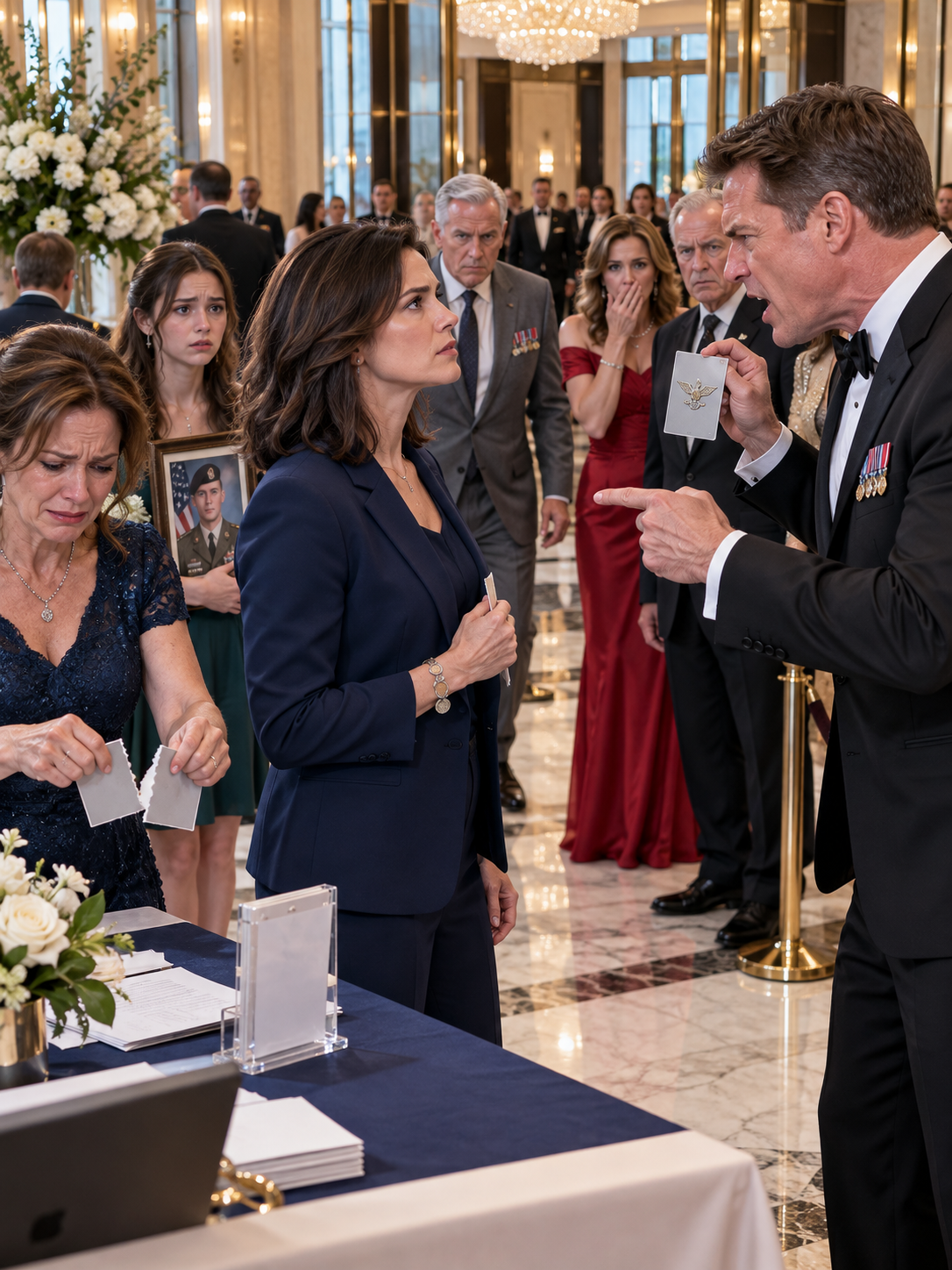
He said nothing. Nolan smiled, apparently satisfied, and pushed the community guest badge toward me with instructions to sit in the general section. Teresa snatched it up, tore it in half, and placed both pieces on the registration table.
“My husband didn’t follow a tourist through Darun Pass,” she said.
Nolan’s face tightened. “Well, your husband isn’t here to confirm that.”
Teresa went completely still, and Sophia’s fingers clenched around the photograph. I stepped between them before Nolan could say another word. “You will not use Matteo’s death to win an argument,” I told him.
He stared at me, anger breaking through his polished expression. “You’re jealous because people finally respect what I did,” he snapped. “You can’t stand one evening when you’re not important.”
“Your service never needed mine to be insignificant.”
For a second, I thought he might understand, but instead he reached forward and deliberately turned the badge clipped to my jacket backward. “Tourists don’t sit with veterans,” he announced, and several uncomfortable laughs escaped the people watching.
“Take your hand off me,” I said.
Bell moved closer, but before he could intervene, applause erupted at the lobby entrance. Retired Lieutenant General Judith Vale had arrived with her aide and foundation director Margaret Hsu. Nolan instantly straightened his jacket and hurried forward, his humiliation of me apparently forgotten as he prepared to welcome his celebrated guest.
“General Vale, what an extraordinary honor—”
She shook his hand without paying attention to his greeting. Her gaze had moved past his shoulder, settling on me, and I watched recognition slowly replace her practiced public smile. Then she stepped around Nolan.
“Rook?”
I felt fourteen years disappear in a single heartbeat. Dust, vehicle headlights, a damaged convoy, and Matteo Ruiz shouting over a radio flashed through my memory. Without thinking, I straightened my shoulders.
“Yes, ma’am.”
General Vale stopped directly in front of me, her expression softening. “Colonel Marlo,” she said, taking my hand warmly. “They told me you might be here, but I didn’t believe anyone could convince you to attend a ballroom dinner voluntarily.”
A few veterans laughed, but Nolan remained silent. General Vale covered my hand with her other hand and added, “It’s wonderful to see you, Colonel.”
Behind her, my mother’s champagne glass froze halfway to her mouth. Clare looked at me as though I had become a stranger. Nolan finally found his voice and tried to explain that my military credentials had raised concerns.
General Vale examined the backward badge on my jacket. “You questioned an active-duty brigade commander because a civilian charity directory had no listing for her?”
Her aide opened the official guest binder and read my name, rank, command, and twenty-two years of active service aloud. Nolan stared at the page, his face draining of color, while General Vale noticed Sophia’s photograph and turned toward her.
“You’re Matteo Ruiz’s daughter,” she said gently.
Sophia nodded, unable to speak. General Vale looked at the bracelet on my wrist, then back at the young woman.
“Your father was one of twelve soldiers whose actions saved that convoy,” she said. “And the woman standing beside you made certain the Army remembered every one of their names.”
Nolan swallowed. “What exactly happened at Darun Pass?”
General Vale looked at me, silently asking permission. I nodded, knowing there was no longer any reason to let my family misunderstand the person standing before them.
## Part 3: One General Reveals the Truth That Shatters Nolan’s Authority
General Vale turned toward the gathering crowd and explained that Lima Seven had been trapped after its lead and rear vehicles were disabled. Forty-three personnel were stranded with dwindling ammunition, wounded soldiers needing evacuation, and no immediate air support. I had been a captain commanding that convoy, and the planned withdrawal route had become impossible.
“Higher headquarters initially ordered her to maintain position,” the general said, “but Captain Marlo recognized that waiting meant losing the convoy.” I remembered spreading a damaged engineering map across an armored vehicle while Matteo held a flashlight steady. An unfinished service road appeared on an outdated overlay, and I knew it offered our only chance.
We established a protected casualty collection point behind a stone culvert, drained two damaged fuel vehicles to create obstacles, and divided the remaining convoy into groups. With intermittent communications, we coordinated a staggered withdrawal through terrain the operations center believed was impassable. The final vehicle escaped twelve minutes before the position was overrun.
“No one was left behind,” General Vale said.
Sophia looked at the twelve initials on my bracelet. Her father had worn its matching piece until the day he died, and I had never stopped carrying the memory of the soldiers who helped bring everyone home. General Vale explained that I had refused to let the first reports credit only senior officers when the twelve soldiers holding the eastern approach had made our escape possible.
My father lowered his head. Years earlier, I had briefly mentioned Darun Pass at dinner, but he had changed the subject when Nolan began describing a training accident. Now he was hearing what he had never bothered to ask.
General Vale faced me again, noticed the pale scar beneath my sleeve, and came to attention. Although she had always outranked me, she raised her hand in a deliberate gesture of personal respect. I returned it, and Sergeant Major Bell and the general’s aide straightened beside us.
The lobby fell completely silent. Five minutes earlier, Nolan had demanded proof that I belonged among veterans. Now the person he had invited to make his event prestigious was standing before me in respect.
“I was working with the information available,” Nolan finally muttered.
“No,” I answered. “You were working toward the conclusion you wanted.”
Clare tried to defend him, saying he had only been protecting the foundation, but Teresa turned to her with tears shining in her eyes. “He insulted my dead husband because he couldn’t bear to be wrong,” she said.
Nolan shifted uncomfortably and offered an apology for things getting out of hand. General Vale’s expression remained cold, and I told him an apology for public embarrassment was different from accepting responsibility for causing it. He lowered his voice and asked what I wanted from him.
“I want Sophia to receive her scholarship without another moment of this nonsense,” I said. “I want Teresa seated where she was promised, and I want you to leave them alone tonight.”
Nolan looked toward Margaret Hsu, the foundation director, expecting her to support him. Instead, the retired Navy captain stepped forward, removed the gala chairman’s ribbon from his lapel, and informed him that she would host the evening herself. The foundation board, she said, would review his conduct on Monday.
“I organized this entire event,” Nolan protested.
“And you no longer represent it tonight,” Margaret replied.
He looked around the lobby, searching for an ally, but Clare was staring at the floor and our parents remained motionless. Finally, Nolan walked toward the exit, his polished shoes striking the marble while nobody followed him.
The gala began twelve minutes late. A volunteer printed a new colonel badge, and Teresa insisted on clipping it to my jacket herself. We sat together at the Ruiz table, with Matteo’s framed photograph occupying an empty chair beside Sophia.
When Sophia received the scholarship, she unfolded a small sheet of paper she had concealed in her program. “My father said courage wasn’t always the loudest person in a dangerous place,” she told the audience. “Sometimes it was the person who could still think when everyone else was afraid.”
She looked directly at me. “He said Rook brought them home.”
The room rose to applaud her, and I stood with everyone else, grateful that the attention belonged to Matteo’s daughter. Later, General Vale changed her prepared keynote to speak about service, humility, and the danger of treating military experience like a competition. She reminded the audience that four honorable years deserved respect, but so did the support soldiers whose work kept others alive.
After dinner, Sergeant Major Bell approached and told me he had taught the Lima Seven operation as a military leadership case study without knowing Rook’s identity. Before leaving, General Vale asked why my family had never understood my career, and I admitted that I had grown tired of letting them turn my accomplishments into comparisons.
“Privacy is a boundary, Alina,” she told me. “But making yourself invisible so others remain comfortable is something different.”
I carried those words home with me.
## Part 4: The Truth Finally Changes My Family and Restores My Voice
The next morning, my phone displayed nineteen missed calls, including six from Clare and several from my parents. Nolan had sent a message asking whether we could handle his apology privately. I read it twice before replying that he had accused me publicly and insulted Teresa publicly, so he needed to apologize to her and Sophia without asking them to protect his reputation.
He didn’t respond.
That Monday, the foundation board removed Nolan as gala chairman and suspended him from public-facing volunteer duties for one year. He initially insisted he had been punished for an honest misunderstanding, but Sergeant Major Bell provided a statement describing the many opportunities Nolan had been given to stop. The board concluded that his failure wasn’t ignorance of my rank; it was his decision to humiliate someone rather than verify information respectfully.
Three weeks later, Teresa received his first written apology. It was four paragraphs long and repeatedly suggested that any hurt had been accidental, so she mailed it back with the conditional language circled. His second letter was shorter and finally admitted that he had invoked Matteo’s absence to win an argument, with no excuse for doing so.
Teresa kept that letter.
My parents’ apologies were more complicated. Mom wanted to know why I had kept my life from her, and I answered that I had never hidden my service; I had simply stopped describing it when nobody listened. Dad admitted that believing a blank computer screen over his daughter had been a terrible failure of trust.
Months later, he attended my next change-of-command ceremony. Afterward, instead of asking how important my rank was or whether a general had attended, he asked what responsibilities I was handing over and what I would miss about the soldiers I had led. It was the first question about my military career that made me feel he truly wanted to know me.
Clare resisted longer. She had spent years defending Nolan’s need to be admired, and accepting what happened meant admitting how often she had helped diminish me. Eventually, she visited my apartment alone and stopped before the photograph of my change-of-command ceremony, the same one our mother had once barely noticed.
“I thought you never talked about your career because you looked down on us,” she confessed.
“I stopped because everything became a contest,” I replied.
She looked at the shadow box beside the photograph, containing my brigade insignia, a medal, and the silver bracelet from Lima Seven. Tears gathered in her eyes as she whispered, “I helped him do that to you.”
“Yes,” I said.
We didn’t embrace and pretend that twenty years of resentment had disappeared. Instead, we began meeting for coffee once a month, talking honestly and learning how to be sisters without competing for our family’s approval.
Nolan and I are civil now. At family gatherings, he no longer introduces himself as the only real veteran, and when someone asks about my service, he lets me answer. It seems like a small change, but sometimes respect begins with learning when to remain silent.
Eight months after the gala, Sophia started college with the Ruiz scholarship. She sent me a photograph from campus, smiling beneath a bright autumn sky, with Matteo’s matching silver bracelet around her wrist. I placed the photograph beside my command picture and finally took another image out of the drawer where I had kept it for fourteen years.
It showed twelve exhausted soldiers standing in front of a dented military vehicle two days after Darun Pass. Matteo stood in the center, grinning despite the exhaustion on his face, and I remembered the relief of counting every person who had made it home. For years, I had hidden that photograph because explaining it meant opening memories I wasn’t ready to share.
Now it stands where anyone visiting my apartment can see it.
General Vale still calls me Rook when we speak, and sometimes her voice takes me back to that hotel lobby, where my family waited for strangers to decide whether my life was real. But the greatest revelation of that evening wasn’t that a general knew my name or that a public document confirmed my rank.
It was that I had allowed other people’s indifference to determine how much of myself I revealed.
I never needed Nolan’s permission to be a veteran, and my parents’ ignorance never made my service less meaningful. General Vale didn’t make me important when she recognized me that night; she simply recognized a person who had been standing there all along.
For twenty-two years, I had worn my uniform with pride, but I had mistaken silence for humility at home. Now I understand that dignity doesn’t require applause, and neither does it require disappearing.
The photograph of Lima Seven reminds me of that every morning. Twelve soldiers, one damaged vehicle, and a promise we kept to one another when everything seemed lost.
We brought our people home.
And at last, I stopped leaving myself behind.
THE END.
All characters and events in this story are fictional, created for storytelling and entertainment purposes. Thank you sincerely for reading. Your feedback and support are invaluable and motivate me to continue sharing more stories with you.


