
### Part 2: My Father’s Forgotten Agreement Exposed a Million-Dollar Neighborhood Deception
I spread the four-page agreement across my father’s workbench while party music thudded through the garage walls. Howard Prescott, the developer behind Stillwater Ridge, had negotiated recreational access to Copper Lake in exchange for four conditions: an annual $8,000 payment, no motorized boats, maintenance of the access road, and no permanent shoreline construction without written consent. The agreement required annual renewal and compliance with every condition. It granted permission to use the lake, not ownership of it.
A stack of bank statements revealed payments from 2015 through 2019, then nothing. My father had become seriously ill in late 2019, and the money stopped arriving when he no longer had the strength to demand it. Five years of missed payments meant $40,000 owed before considering anything else. I stared at his shaky signature, remembering how he’d always insisted that a person’s word was worth more than a contract.
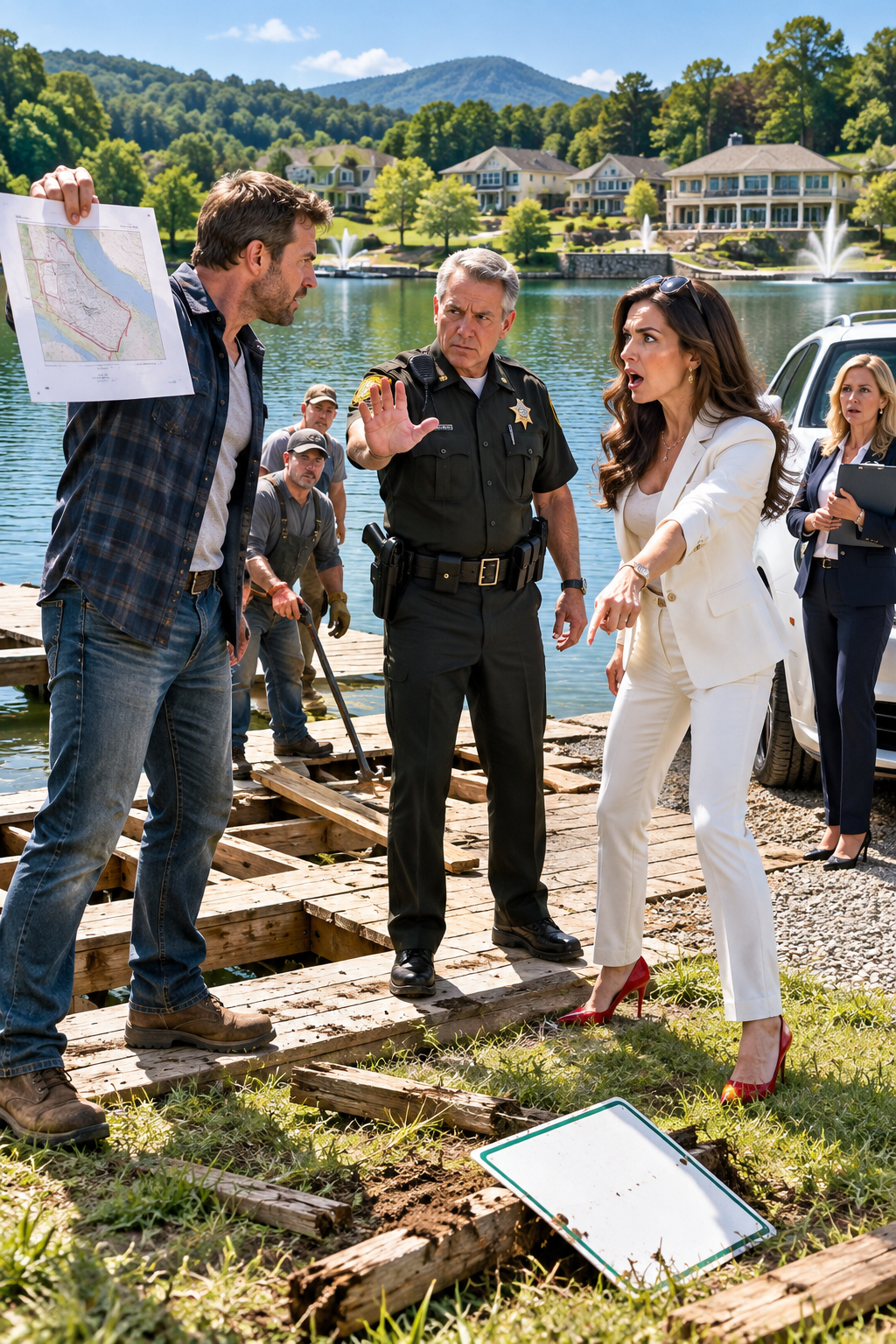
Then I counted the other violations. I’d already seen motorboats crossing the water, including one whose wake had slammed against my dock. The subdivision’s access road was deeply rutted, and a permanent stone-and-wood pavilion stood on the southern shore without authorization. Linda hadn’t merely ignored an old agreement; her entire community had treated my father’s generosity as something they could seize.
Behind the pavilion, I discovered a six-inch PVC intake disappearing beneath the waterline. I followed its route through nearly four hundred yards of brush to a concrete pump house concealed behind tall evergreen shrubs. Inside, a commercial centrifugal pump pulled lake water toward Stillwater Ridge around the clock. Fifteen years designing hydraulic systems told me precisely what the equipment was doing.
Approximately 500,000 gallons every month flowed toward eighty-four irrigation systems, an enormous pool complex, decorative fountains, and a fire-suppression reserve. I found no withdrawal meter, no backflow protection, and no evidence of a state withdrawal permit. The system had been drawing water without my father’s knowledge for roughly a decade. At that rate, the total approached sixty million gallons.
The final item in the box was Howard’s original sales brochure. Its glossy cover featured my grandfather’s lake beneath the words “Copper Lake Is Your Backyard.” Inside, buyers were promised exclusive access to their own private thirty-eight-acre lake. Howard had marketed somebody else’s property as a luxury amenity, and Linda had spent years enforcing that fiction.
I brought everything to Katherine Wells, a Knoxville attorney specializing in property and water disputes. She studied the agreement, bank records, photographs, and brochure, then removed her reading glasses. “Mr. Greer, this is much larger than an HOA disagreement,” she said. “We have material breaches of a contract, possible unauthorized water withdrawal, trespass, and serious questions about what these homeowners were told when they bought their houses.”
Over the following three weeks, we built our case. A licensed surveyor confirmed that the entire lake and fifty feet of surrounding shoreline belonged to the Greer family trust. The unauthorized pavilion stood thirty-two feet inside our boundary, and the buried intake entered my property near the dam. My own engineering assessment documented the pump’s capacity, missing safeguards, and fertilizer-laden irrigation runoff entering the watershed.
Katherine contacted the Tennessee Division of Water Resources, whose investigation found no withdrawal permit on record for Copper Lake. We prepared notices terminating the recreational agreement, demanding removal of unauthorized structures, and requiring the water withdrawal to stop. I also arranged for any shutdown to follow state instructions and appropriate safeguards for emergency water needs. Whatever Linda deserved, eighty-four households did not deserve to be put in danger.
Somehow, Linda learned I’d hired Katherine. Within days, Howard’s Nashville attorneys sent a letter promising an expensive legal fight, and Howard himself called me that evening. “You don’t want enemies like us, son,” he said after I confronted him about the pump. “We built this community. We can make things very complicated for you.”
“Then you should have treated the people who owned the lake with respect,” I replied, ending the call and saving the recording.
Linda retaliated by persuading county officials to inspect my property, but the inspector found no violations. A stranger photographed my house from a parked Honda, and the pictures appeared on Linda’s Facebook group beneath a headline questioning whether the neighborhood was safe beside a supposed squatter. Diane deleted comments from residents who questioned the accusation.
That evening, Tom arrived carrying two coffees. “She wants you gone, Wyatt,” he said, staring across the lake. “She’s telling people she can take your property.”
I handed him a copy of the survey showing my grandfather’s shoreline in unmistakable red. Tom studied it, then looked toward the illuminated fountains.
“Those belong to the HOA?”
“The fountains do,” I said. “But the water flowing through them doesn’t.”
### Part 3: Linda’s Biggest Celebration Became the Stage for Her Downfall
Linda filed a lawsuit in Monroe County Circuit Court, claiming Stillwater Ridge had acquired a prescriptive easement over my lake through years of continuous use. Katherine read the complaint twice, then turned it toward me with a disbelieving smile. The HOA had existed for only ten years, well short of Tennessee’s generally applicable twenty-year prescriptive period, and my father’s written agreement proved its use had originally been permissive. Linda had submitted evidence against her own position.
“She just acknowledged in a sworn filing that her association used your family’s property,” Katherine observed. “And the contract defeats the idea that they were using it without permission.”
Meanwhile, Linda celebrated the lawsuit on social media, promising residents she would protect “their” lake from an unreasonable neighbor. Her next announcement was even grander: the eighth annual Stillwater Ridge Summer Gala, scheduled for June 14. Two hundred guests were invited, including county officials, real estate partners, and local business owners. The HOA spent $40,000 on gourmet catering, white tents, a jazz band from Chattanooga, and miniature lake sculptures for the tables.
I watched workers string fairy lights around the clubhouse while Katherine called with news that changed everything. The state had issued its cease-and-desist order concerning the unauthorized withdrawal. Our survey was certified, our termination documents were ready, and the permitted sequence for isolating the lake intake had been arranged. For the first time since returning home, I felt the ground beneath my feet become steady.
On June 13, I sat beside my grandfather’s damaged dock until the last light disappeared behind the Smoky Mountains. Across the water, Linda’s Porsche shone beneath the clubhouse lamps while workers prepared the most elaborate party the subdivision had ever hosted. I placed my father’s agreement beside the survey and checked the morning schedule once more. Then I went inside and finally moved his boots away from the doorway, placing them carefully beneath his old coat.
At six the next morning, I walked through dew-covered grass toward the hidden pump house with the authorized shutdown crew. The large red gate valve turned under the technician’s hands, and the heavy mechanical hum slowly faded. After a final check, the unauthorized lake withdrawal stopped. Copper Lake remained perfectly still, its emergency safeguards accounted for and its water finally protected from an unpermitted system.
By noon, contractors were installing a black iron fence along my shoreline, with white PRIVATE PROPERTY signs marking the surveyed boundary. The gala began at six that evening, its music carrying across the lake as two hundred guests gathered beneath glowing lights. Through the trees, I could see Linda moving through the crowd in a white designer dress and bright red heels. She looked delighted with herself.
Katherine arrived at my house at 6:45 wearing a charcoal suit and carrying a leather portfolio. We took the public road around the lake and entered the community through its main gate. Nobody questioned us, and we walked past polished glasses, expensive flower arrangements, and a buffet costing more than some families’ monthly groceries. Howard Prescott stood near the back of the crowd, speaking quietly with two real estate agents.
At seven, Linda climbed onto the stage with a gold microphone. “Tonight we celebrate everything that makes Stillwater extraordinary,” she declared, sweeping her hand toward the water. “Our wonderful homes, our community spirit, and of course, our beautiful private lake.”
The left fountain suddenly sputtered as its remaining supply pressure failed. Its graceful stream collapsed into the basin, followed seconds later by the second and third fountains. Around the pool, maintenance workers began checking equipment while several irrigation controllers displayed supply faults. Linda stopped mid-sentence and stared at the three dry stone columns.
I stepped into the aisle with Katherine beside me. A few residents recognized me immediately, and whispers moved through the gathering. Linda lowered her microphone, her expression hardening as I approached the stage. “This is a private function,” she snapped.
I looked directly at her.
“So is my lake, Linda.”
And for the first time since we’d met, she did not call me sweetie.
### Part 4: The Truth Destroyed Her Authority and Gave My Father Justice
Katherine walked onto the stage and handed Linda a formal notice. I took the microphone only after the event coordinator offered it, while two hundred guests watched the fountains standing motionless behind me. “My name is Wyatt Greer,” I said. “My grandfather created Copper Lake in 1963. My father protected it for forty years, and my family still owns the lake, the shoreline, and the land where your association installed its water system.”
Linda tried to interrupt, but Katherine connected her laptop to the event projector. The first image showed our certified property survey. The next displayed my father’s signed recreational agreement, followed by the unpaid records, photographs of the hidden pump, and the state’s cease-and-desist order. Finally, Howard’s original advertising brochure filled the screen, promising buyers ownership of a lake his company had never possessed.
A man near the pool rose from his chair. His name was Phil Dawson, a retired accountant who lived on Cedar Lane. “Howard,” he called toward the back of the gathering, “you charged us twelve hundred dollars every year in lake fees. Eighty-four homes, eight years. That’s more than eight hundred thousand dollars!”
Howard’s face drained of color. Phil turned toward the documents again. “And you’re telling us the actual owner hasn’t been paid since 2019?”
“That’s what the records establish,” Katherine answered. “The larger question is what representations were made to you, and where those fees went.”
I watched Linda look toward her husband for help. Howard avoided her eyes, then quietly moved toward the service exit. She opened her mouth, closed it, and gripped the microphone so tightly her fingers whitened. When she finally let go, it struck the stage with a hollow thud that seemed louder than the entire jazz band.
Tom Hensley stood. “I move that this board initiate Linda Prescott’s immediate removal as president,” he announced, asking the assembled homeowners to support the motion. Hands rose across the pool deck, and even Diane Keller slowly raised hers. Linda stared at the people who had once applauded her every demand, unable to find a single familiar smile.
Sheriff Barnes arrived later to document the trespass and property damage complaints while Katherine ensured the state investigation had its evidence. Howard had already disappeared, leaving Linda alone on the stage as guests collected their coats. The fountains remained dry, and the miniature lake centerpieces stood untouched on the abandoned tables. I left without asking for an apology because the truth had already spoken more clearly than she ever could.
Over the next two weeks, fourteen Stillwater Ridge families filed complaints with the Tennessee Real Estate Commission concerning the developer’s representations. Howard placed two investment properties on the market as legal bills mounted, and his firm’s attorneys stopped representing the association. Linda’s prescriptive-easement lawsuit was dismissed nine days after the gala, with the court emphasizing that the written permission defeated the required claim of adverse use.
The judgment felt satisfying, but the next visitor to my dock mattered more. Tom arrived with two cups of coffee after becoming interim HOA president and asked whether the neighborhood could repair its relationship with my family. “People bought homes there in good faith, Wyatt,” he said. “Most didn’t know any of this.”
“I know,” I told him. “And I didn’t come home to punish eighty-four families for what two people did.”
We spent the afternoon developing a new lake stewardship program. Households that volunteered eight hours each quarter for shoreline cleanup, invasive species removal, or conservation work would receive recreational access for swimming, fishing, and kayaking. Motorboats remained prohibited, while any renewed irrigation withdrawal would require proper permits, metering, safeguards, and fair payment, with part of the revenue reserved for dam and spillway maintenance.
Forty-seven families enrolled during the first month. The unauthorized pavilion was removed in July, and the pump infrastructure was rebuilt under the appropriate permits. A settlement resolved the overdue lake payments, and I used part of the recovered money to establish the Earl Greer Conservation Scholarship for a Monroe County student pursuing environmental science or natural resource management.
My father had never attended college. But for forty years, he’d cared for that lake more faithfully than people with expensive degrees and polished titles had cared for their promises. When I signed the scholarship documents, I brought his old reading glasses and placed them beside me on the desk. I wished he could have seen what his quiet dedication had inspired.
Linda listed her house for sale in August, eventually accepting a price thirty percent below what she’d originally paid. Her realtor reportedly mentioned one peculiar condition: Linda didn’t want the buyer serving on the HOA board. Even while leaving, she apparently needed one last attempt at control.
I saw her for the final time on a September morning. Her white Porsche sped along the county road while I stood on my grandfather’s dock, watching mist lift from the water. She never turned her head toward Copper Lake, and I made no effort to catch her attention.
Across the shore, children were fishing at the new publicized access point under their parents’ supervision. The lawns of Stillwater Ridge had recovered, their green a little less perfect but far more honest. A neighbor waved from a kayak, and I raised my coffee in return.
The old gold sign announcing a private lake community was gone. A modest wooden marker now read, “Stillwater Ridge — A Good Neighbor Community.” At my dock, another sign hung from two brass hooks: “Copper Lake — Greer Family Land Stewardship. Access Welcome.”
I sat where my father used to sit and watched a blue heron settle into the shallows. For years, I had believed I’d failed him by not reaching home before he died, and no courtroom victory could change that Wednesday afternoon. But I’d finally protected what he loved, without becoming the kind of person who had tried to take it from him.
The lake had never needed Linda Prescott’s permission to belong to my family. And I no longer needed her defeat to prove that I belonged there.
For the first time since the funeral, I could hear the water moving against the cedar posts without feeling the weight of everything I’d lost.
I could almost hear Dad beside me.
“Looks good, son.”
I smiled at the empty place where he would have sat.
“Yeah, Dad,” I whispered. “We kept it.”
THE END.
All characters and events in this story are fictional, created for storytelling and entertainment purposes. Thank you sincerely for reading. Your feedback and support are invaluable and motivate me to continue sharing more stories with you.


