
Part 2: One lie left an innocent woman stranded with everything packed.
That afternoon, I asked Ryan to come alone.
We sat on the cottage’s screened porch, where the lake softened every sound except the truth.
“Did you know Megan was using my address?”
“Not the school part.”
“What part did you know?”
Ryan rubbed his jaw. “Tessa said Megan needed somewhere stable for mail.”
“And you thought my property was a mailing service?”
“Mom, come on.”
“No. You come on. Your wife keeps making plans with a house that isn’t hers, and every time I stop one, you act like I created the conflict.”
His eyes dropped toward the floor.
I recognized that posture. He had worn it at seventeen after backing my car into a mailbox—sorry, ashamed, and still hoping I would somehow make the consequences disappear.
“You need to tell Tessa clearly,” I said, “the cottage is not available.”
“I have.”
“Did you say, ‘My mother said no, and we are going to respect it’?”
Silence.
“Or did you say, ‘She’s being difficult. Let me work on her’?”
Ryan looked up.
That was my answer.
“You are not trapped between your wife and your mother,” I said. “You’re standing beside your wife while she pushes on my door, then telling me how uncomfortable you are when I hold it shut.”
He winced.
He promised he would tell her there would be no cottage.
Saturday morning, a furniture delivery arrived.
A sofa. Two twin bed frames. Six boxes.
All addressed to Megan.
I refused them.
Sunday, Tessa texted that Megan’s lease had ended and she was staying in a hotel.
Monday, Megan called me herself.
Her voice was exhausted, but not angry.
“Linda, I don’t want to be in the middle of whatever is happening between you and Tessa.”
“Neither do I.”
“She told me you offered the cottage months ago.”
My stomach dropped.
“I never offered it.”
Silence.
“She said Ryan spoke to you after Christmas.”
“He didn’t.”
Another silence, longer this time.
“I gave notice because I thought everything was settled.”
There it was.
The first real victim of Tessa’s lie.
For the first time, my anger changed shape. I felt deeply sorry for Megan. She had two daughters, boxes everywhere, a divorce unfolding, and now a hotel bill because she trusted her sister.
But pity and surrender were not the same thing.
“I’m sorry she told you that,” I said. “I mean that. But you still can’t move here.”
Megan swallowed audibly.
“I understand.”
For three days, everything stayed quiet.
Then Thursday evening, Ryan called.
“Mom, I need to warn you.”
I closed the book in my lap.
“About what?”
“Tessa wants Megan’s moving company to bring everything to your place tomorrow.”
“Why?”
“She thinks once the furniture is there, you’ll see it makes sense.”
I actually closed my eyes.
“And what did you say?”
“I said it was a bad idea.”
“A bad idea isn’t the same as no.”
“I know.”
“Do you?”
Ryan sighed.
Then he said the sentence that ended every remaining discussion.
“She thinks you’re bluffing.”
I stood up.
“Is your wife planning to bring a moving truck onto my property after I have told her in writing that she does not have permission?”
“Yes.”
“Thank you for telling me.”
“What are you going to do?”
“Use my property like an adult who owns it.”
That night, I called the gate company and disabled every remote except mine. I printed my messages about access, saved the internet installer’s call log, and wrote down the dates of the refused deliveries.
I wasn’t preparing for war.
I was preparing for clarity.
The next morning, I stopped at the sheriff’s substation and calmly explained that relatives might attempt to enter after being told not to.
The deputy listened.
“If they enter after you’ve told them they’re not allowed,” she said, “call us.”
At 9:15, I went home.
I made coffee.
I sat on my porch.
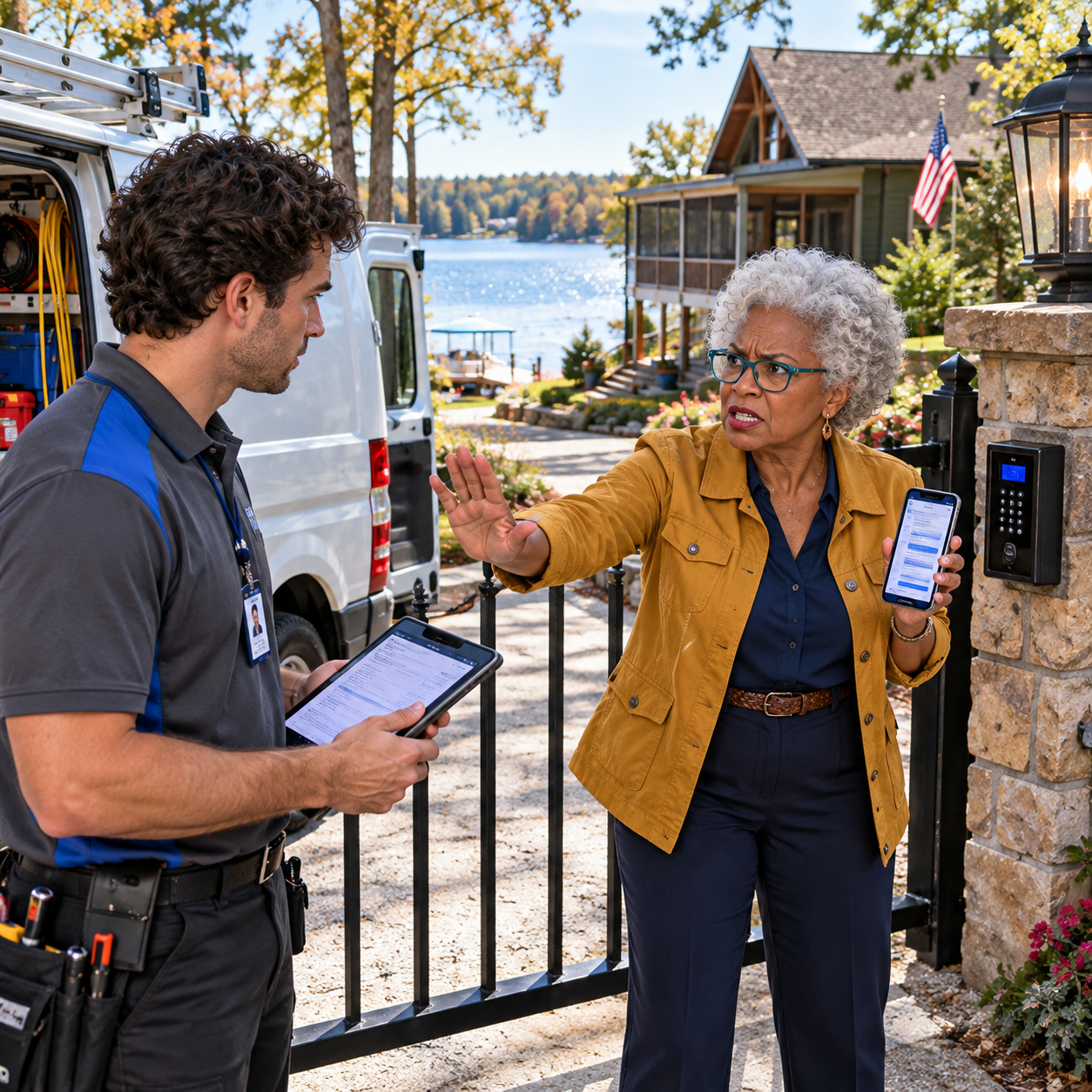
At 10:02, a yellow moving truck appeared at the end of my driveway.
Behind it came Tessa’s SUV.
Then Megan’s blue Honda.
And when Tessa climbed out and marched toward my locked gate, I knew the family had finally reached the moment where somebody would have to choose which version of the truth they were willing to live with.
Part 3: A locked gate forced my entire family to face Tessa’s lie.
The mover pressed the call button.
“Morning, ma’am. Delivery for Megan Ellis.”
“There is no authorized delivery at this address.”
He glanced toward Tessa.
“They said someone would let us in.”
“They were mistaken.”
Tessa stormed to the keypad and punched in the old family code.
Nothing.
She tried again.
Still nothing.
Then my phone rang.
“Open the gate.”
“No.”
“The truck is charging by the hour.”
“Then you should stop the clock.”
“Megan has nowhere to put this stuff!”
“That is what storage facilities are for.”
“You could fix this in twenty minutes.”
“You created this problem over several months.”
She hung up.
A minute later, Ryan’s truck arrived.
I watched Tessa run toward him, pointing at the gate, the cottage, the moving truck. Even from the porch, I could see anger in every movement.
Then Ryan called.
“Mom, can you come down here?”
I walked slowly toward the gate.
Tessa began before I reached it.
“This is ridiculous. Megan has court paperwork. The girls are exhausted. School needs an address. Open the gate for twenty minutes.”
“No.”
She threw up both hands.
“There it is again. Your favorite word.”
“It’s the answer you keep pretending you haven’t heard.”
Megan stood beside her Honda, pale and humiliated.
“Tessa,” she whispered, “let’s go.”
“No! We are not paying another thousand dollars because she wants to prove a point.”
I looked directly at Megan.
“Did you know I had said no before this truck was booked?”
Her face changed.
“Tessa told me Ryan had talked you into it.”
Every eye turned toward my son.
Ryan rubbed his forehead.
“I never told her Mom changed her mind.”
Tessa’s face flushed.
“You said you would talk to her.”
“I did.”
“And?”
“She said no.”
“Then you should have kept talking!”
Ryan stared at his wife.
And for perhaps the first time in his adult life, I saw something stronger than his need to avoid conflict.
Exhaustion.
“Why?” he asked.
Tessa blinked.
“Why what?”
“Why should I keep pressuring my mother after she said no?”
“Because my sister is standing here with two children and nowhere to live!”
“Then we help her with our money. Or she rents something smaller. Or stays with your parents temporarily. But we do not give away Mom’s house.”
Tessa stared at him.
“You told me we would help my family.”
“We can help without taking something that isn’t ours.”
Megan covered her mouth.
Tessa stepped closer to Ryan.
“So you’re choosing her?”
“No,” Ryan said. “I’m finally choosing not to make someone else responsible for promises we made.”
The words landed like a door closing.
Then Tessa turned toward me.
“You could fix all of this with one code.”
“You could have prevented all of it with one question.”
“You have more than enough.”
I looked past her toward the water shining through the trees.
“Enough does not mean available.”
“Thirty days, Linda.”
“No.”
“Two weeks.”
“No.”
“One week.”
“No.”
“Stop.”
The voice came from Megan.
Everyone turned.
“Stop asking her,” Megan said, shaking. “She said no.”
Tessa stared at her sister.
“I’m trying to help you.”
“Then help me find somewhere else. I should have called Linda before giving notice. I trusted you because you’re my sister, but that isn’t her fault.”
And suddenly the argument Tessa had created collapsed.
The person she claimed to be defending had stepped out of the role she had written for her.
Ryan asked the mover what it would cost to take everything to storage.
The man named a figure.
“I’ll pay the first month,” Ryan said.
“I’ll repay you,” Megan answered.
My instinct screamed at me to offer money too. I had spent most of my life ending discomfort with generosity.
But I kept my hands at my sides.
Because if I purchased peace again, we would learn nothing.
Tessa looked at me.
“I hope keeping that empty cottage warm at night is worth this.”
I met her eyes.
“The cottage isn’t the problem.”
She waited.
“The problem is that you believed my answer only mattered if you agreed with it.”
The moving truck turned around.
Megan followed.
Ryan remained long enough to say, “I’m sorry.”
“For what?”
“For making you repeat yourself.”
That apology was precise enough to matter.
“Don’t apologize because today was embarrassing,” I said. “Change what made today possible.”
He nodded.
Six weeks later, Megan had a two-bedroom apartment twenty minutes from her daughters’ school. Ryan helped with the deposit. Tessa’s parents watched the girls while Megan worked overtime.
Nobody asked me to solve the problem.
Then one October morning, Ryan arrived alone with a toolbox.
“Your dock board is loose,” he said. “Can I fix it?”
I smiled at one word.
Can.
Not will.
Not should.
Can.
Two hours later, sitting beside the lake, Ryan stared across the water.
“Tessa and I started counseling.”
“How’s that going?”
“Uncomfortable.”
“That’s usually where useful conversations begin.”
He laughed.
Then his face became serious.
“I realized I kept telling everyone different versions of what they wanted to hear. I told Tessa I would handle you. I told you I understood. I told Megan everything would work out.”
“You thought you were preventing conflict.”
“I was delaying it.”
“Yes.”
He looked toward the cottage.
“When that moving truck was at the gate, I finally understood something.”
“What?”
“You weren’t the person making us stand there.”
And that truth was about to change more than any of us expected.
Part 4: Respect returned only after everyone learned to ask first.
Two months later, shortly before Thanksgiving, Tessa called me directly.
Her voice was careful.
“Linda, I wanted to ask you something.”
I immediately noticed the word.
Ask.
“My parents are coming down the Saturday after Thanksgiving. Would you be comfortable if everybody came out for lunch by the lake?”
Six months earlier, I might have said yes instantly just because she had called properly.
Instead, I checked my calendar.
I considered what I actually wanted.
“Lunch is fine. Noon to four.”
“Okay.”
A pause.
“And Megan?”
“She’s welcome if she wants to come.”
Tessa exhaled.
“Thank you.”
They arrived that Saturday in three ordinary cars.
No moving truck.
No furniture.
No internet technician.
No boxes bearing my address.
Megan brought cornbread dressing. Tessa’s father brought a pecan pie from Gainesville. The girls ran toward the dock and argued over who got to throw sticks for my neighbor’s Labrador.
For nearly two hours, nobody mentioned the cottage.
Then Megan found me rinsing plates.
“I owe you an apology.”
“You don’t owe me one for believing your sister.”
“I should have called you.”
“Yes, you should have.”
She smiled because I had not softened the truth.
“I have my own place now.”
“I heard.”
“It’s small.”
“Small can be peaceful.”
She nodded.
“It is.”
A few minutes later, Tessa walked into the kitchen.
She looked uncomfortable, but stayed.
“I was wrong.”
I waited.
“Not about wanting to help Megan. I was wrong about deciding how you would help.”
That was enough.
“Thank you for saying that.”
She glanced toward the cottage.
“I still think leaving two bedrooms empty is strange.”
I smiled.
“You are allowed to think that.”
Tessa laughed.
“Fair enough.”
In January, I converted one cottage bedroom into an art room.
I had always wanted to learn watercolor painting. Retirement seemed like the perfect time to become bad at something without needing to improve on anybody’s schedule.
I painted the lake. The dock. The oak tree beside the driveway.
I painted one terrible heron that looked like a gray turkey.
And every time I unlocked that cottage, I remembered the moving truck waiting behind my gate.
Not as my victory over Tessa.
As the day I stopped treating other people’s urgency as authority over my life.
Ryan changed too.
When he and Tessa needed a new roof the following spring, he didn’t call asking for a loan. He told me proudly that they had saved enough.
When Megan needed help moving a dresser, he helped her himself.
When Tessa wanted to hold Easter at my house, she called before inviting anyone.
Sometimes I said yes.
Once, I said no because I had planned a weekend trip with retired friends from my school district.
Nobody collapsed.
Nobody stopped loving me.
Nobody appeared with a truck.
A year after that first phone call, Ryan and I sat on the dock watching sunlight break across Lake Lanier.
“You know what the strangest part was?” he asked.
“What?”
“We all thought the cottage was the issue.”
“It wasn’t.”
“No.” He shook his head. “We thought if we needed something badly enough, eventually you would become responsible for providing it.”
“That’s a dangerous habit in families.”
“I know.”
Then he smiled.
“Tessa says you trained us.”
“I spent thirty-two years as a principal. Apparently I wasn’t completely retired.”
Ryan laughed.
Then his expression softened.
“I’m glad you didn’t open the gate.”
“So am I.”
And that was the final twist none of us had understood while standing beside that moving truck.
My refusal had not broken the family.
It had forced us to rebuild one.
I loved Ryan. I cared about Tessa. I felt compassion for Megan and her daughters.
None of those feelings required me to surrender my home.
Generosity means I decide what I give. When somebody else makes that decision for me, it stops being generosity and becomes entitlement dressed in family obligation.
For most of my life, I believed kindness meant making room, paying the bill, fixing the problem, opening the door.
Retirement taught me something different.
Sometimes kindness means allowing grown people to carry the weight of their own decisions.
Sometimes love sounds like yes.
Sometimes it sounds like, “I’ll help you find another way.”
And sometimes, when what is being demanded belongs to your peace, your home, or the life you spent decades building, love can sound like one clear word that requires no second explanation.
“No.”
THE END.
All characters and events in this story are fictional, created for storytelling and entertainment purposes. Thank you sincerely for reading. Your feedback and support are invaluable and motivate me to continue sharing more stories with you.


