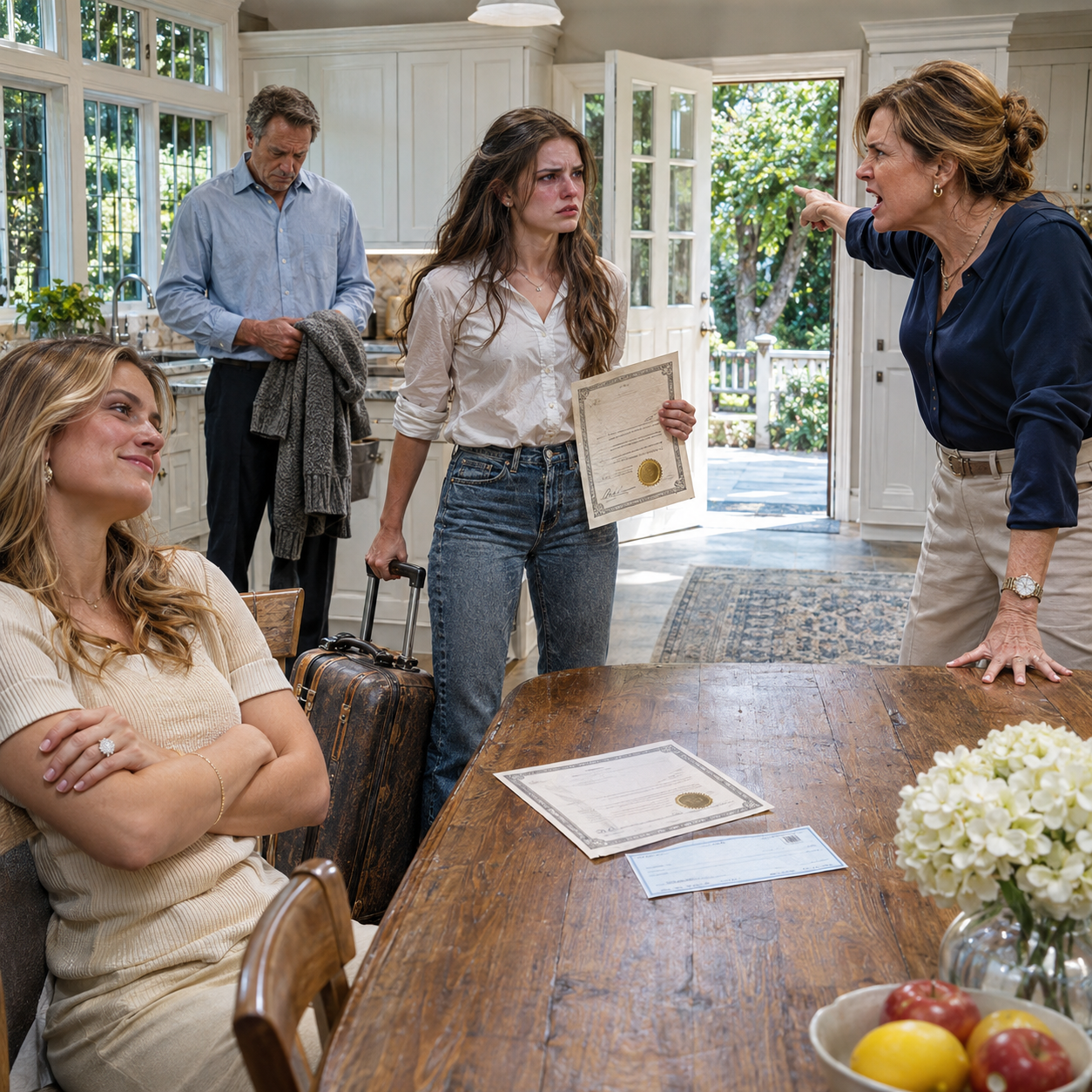
## Part 2: My Son’s Silence Forces Me To Finally Choose Myself
That afternoon, while Leo slept on my sofa, I spread my calendar and bank statements across the dining table. Over the past year, I had paid for groceries, art supplies, snacks, gasoline, and even a winter coat when Leo outgrew his old one. I had stopped attending choir rehearsals, neglected friendships, and missed medical appointments because Tiffany needed someone to cover her schedule. Looking at those receipts, I realized I hadn’t simply given away my time. I had gradually disappeared from my own life.
At five o’clock, Travis arrived to collect Leo. Without lifting his eyes from his phone, he announced that Tiffany was hosting a dinner for her regional team at Franklin Analytics the following Friday. “We need you there around five,” he said. “Feed Leo, put him to bed, and stay overnight so we don’t have to worry about the morning.”
“I won’t be staying overnight, Travis.”
He finally lowered his phone. “What else would you be doing on a Friday night?”
“Reading a book. Resting. Living in my own home.”
He rubbed his forehead and explained that Tiffany was trying to impress her new director. Hiring a sitter would cost more than a hundred dollars, and changing their plans would create unnecessary stress. I looked at the grown man I’d raised and asked, “When did keeping your wife comfortable become more important than respecting your mother?”
His face reddened. He said nothing, and that silence hurt almost as much as Tiffany’s words. I handed him Leo’s water bottle, kissed my grandson goodbye, and closed the door.
The following week, I began rebuilding the calendar I’d surrendered. I volunteered three mornings at the Guelph Public Library, joined a Tuesday evening walking group, and attended my pottery lessons. At the conservation area, retired teachers and widows walked beside me, discussing everything from garden tomatoes to local politics. Nobody handed me a chore list. They asked how I was feeling and actually listened.
On Wednesday afternoon, Tiffany sent a group message containing her four-day conference schedule. She expected childcare from eight until six every day, although she hadn’t discussed a single date with me. I replied that I could collect Leo on Tuesday and Thursday between two and four. The other hours were already committed.
Within ten minutes, she called repeatedly. I was making onion soup and allowed the phone to ring.
The following morning, her white SUV swept into my driveway while I watered the hanging ferns. Tiffany marched onto the porch carrying a printed planner, her sunglasses pushed into her hair. “Why didn’t you answer me?” she demanded. I offered her a chair, but she remained standing.
She explained that the conference was essential to her annual review and insisted that reliable family members supported each other during career milestones. “I need confirmation for all four days,” she said, tapping the planner. “I can’t put Leo in some chaotic drop-in daycare.”
“I can help Tuesday and Thursday for two hours each.”
Her jaw tightened. “You’re deliberately creating conflict in this family.”
“No, Tiffany. I’m simply telling you when I’m available.”
She stared at me as though she expected my resolve to dissolve. When it didn’t, she walked back to her vehicle without saying goodbye.
Friday evening brought another call. I was curled into my armchair with a mystery novel when Tiffany announced that she and Travis were attending an all-day seminar in Toronto the next morning. She expected me at their house by eight.
“I can’t tomorrow,” I said.
She interrupted before I could finish. “You’ll babysit because I said so. I’m his mother. I decide who watches him and when!”
I closed my book and placed it carefully on my knee. Then I spoke slowly enough that she couldn’t misunderstand a word.
“You have every right to decide what’s best for Leo. But you have absolutely no authority over my life, my time, or my home. My answer is no. If you need childcare tomorrow, you’ll have to arrange and pay for it.”
For several seconds, the telephone line went completely silent.
“Tiffany,” I added, “I love Leo. But loving him does not make me your employee.”
She drew a sharp breath, searching for another command. Nothing came.
“Goodnight,” I said, and ended the call.
I set my phone on silent and opened my book again. My hands were shaking slightly, but I wasn’t frightened.
For the first time in fourteen months, I had said exactly what I meant.
And I had no intention of taking it back.
## Part 3: One Expensive Saturday Reveals The Truth My Son Avoided
Saturday morning, I woke before sunrise and prepared coffee while chickadees fluttered through the maple tree outside my kitchen. At eight-twenty, I glanced toward the driveway. Nobody was waiting for me, and nobody had arrived to argue. I ate toast on the back deck, gathered my pottery supplies, and drove to the community center with an unfamiliar feeling of freedom.
For two hours, I sat at a pottery wheel, my hands covered in gray clay. The instructor showed me how to center the spinning lump, but every time I pressed too firmly, the walls folded inward. I laughed with the woman beside me and tried again. It occurred to me that I had spent the past year trying to hold an entire family together, yet here I was, perfectly happy learning to make one crooked bowl.
Around noon, I checked my phone. Travis had called twice and left a message explaining that they had hired a college student for thirty dollars an hour to watch Leo. The expense had triggered an argument between him and Tiffany before they left for Toronto. I called him from the parking lot, and he answered with a weary sigh.
“Mom, you really put us in a difficult position.”
“Travis, you knew about this seminar before yesterday. You chose not to arrange childcare because you assumed I’d surrender my plans.”
He didn’t answer immediately. I continued, “I want to be Leo’s grandmother, not the person responsible for keeping your household running. You and Tiffany are his parents. Planning ahead belongs to you.”
He exhaled slowly. “We’ve gotten used to taking you for granted, Mom.”
I stood beside my car, staring at the clay still caught beneath my fingernails. It was the first time my son had acknowledged what was happening without making excuses for his wife. He promised that things would change, although I told him promises meant little unless I could see them.
For the next two weeks, my phone was unusually quiet. Travis arranged childcare without asking me to cancel anything, and Tiffany stopped sending instructions. I wondered whether she was angry enough to keep Leo away from me. That possibility hurt, but I refused to apologize for having a life.
Then, one Sunday morning, someone knocked on my front door.
Tiffany stood on the porch looking exhausted, with red eyes and no makeup. Beside her was a silver-haired woman wearing a camel-colored coat, someone I recognized immediately from the wedding photographs. It was Bonnie Reed, Tiffany’s mother, who lived in Moncton, New Brunswick.
“Sharon,” Bonnie said gently, “may we come in? There’s something I need to tell you.”
I stepped aside and put the kettle on. Bonnie explained that she’d driven roughly sixteen hours, stopping overnight at a motel, because she wanted this conversation to happen face-to-face. Tiffany sat at my kitchen table, staring at the uneven pottery bowls lined up on my sideboard.
Then Bonnie revealed something I never expected.
Rita Sullivan had contacted her through a mutual church acquaintance. Troubled by Tiffany’s remarks at the neighborhood potluck, Rita had explained how much childcare I provided and how my daughter-in-law had described that generosity as charity. Bonnie had listened, then called Tiffany and demanded the truth.
“Roy and I have offered to help for years,” Bonnie said, referring to her husband. “We offered to visit every winter and take Leo for part of the summer. Tiffany kept telling us everything was handled.”
Tiffany looked down.
“Because Sharon was nearby,” Bonnie continued, “and because Sharon never asked for payment.”
My daughter-in-law pressed a tissue against her eyes. “I was terrified of falling behind at work,” she whispered. “Our mortgage was higher than we expected. My director kept pushing us harder, and every childcare bill felt like another problem we couldn’t afford.”
I glanced at the expensive watch around her wrist and thought about how I’d hesitated over forty-five dollars for a pottery course. I said nothing.
Tiffany continued, her voice breaking. “I started telling people you needed us because it made me feel better about depending on you. I told myself we were helping you through your grief.”
She finally looked into my eyes.
“You gave us everything, Sharon. And I turned your kindness into something pathetic because admitting the truth would mean admitting how selfish I’d become.”
For the first time since I’d known Tiffany, she wasn’t asking me to understand her schedule or accommodate her needs. She was looking at what she’d done without hiding behind another excuse.
But there was still something I needed to know.
“What happened after I stopped helping?” I asked.
Tiffany covered her face with both hands.
And Bonnie quietly said, “Tell her all of it.”
## Part 4: A Public Confession Finally Restores Our Family’s Lost Respect
Tiffany lowered her hands and began describing the weeks since our argument. The emergency sitter had cost more than expected, and the college student they’d hired canceled the following weekend. Without a backup plan, Tiffany had taken Leo to a client lunch, where he accidentally spilled a milkshake across a business partner’s portfolio. Her director had witnessed the entire incident.
Then came the four-day convention she’d demanded I cover. Tiffany arranged a drop-in daycare program, but Leo developed a fever and had to be collected halfway through the second day. She missed important meetings and was subsequently passed over for the team lead position she’d been working toward.
“I kept thinking everything would be fine if you would just help me again,” she admitted. “Then I realized I’d spent more than a year depending on you so completely that I hadn’t bothered to make another plan.”
Bonnie reached across the table and placed her hand over her daughter’s. “And what else did you do?” she asked.
Tiffany drew a trembling breath. “Last week, I stood up at the neighborhood association meeting and told everyone I’d lied about you.”
I stared at her.
“I told them you weren’t some helpless widow we were rescuing. I explained that you’d been sacrificing your own time, money, and happiness to help us raise Leo. I admitted that I’d made up those stories because I didn’t want people knowing how much we depended on you.”
Rita had been there, along with several other neighbors who’d heard the original gossip. Tiffany said nobody interrupted while she corrected every lie. She hadn’t asked Travis to defend her or blame anyone else.
“It was the most embarrassing ten minutes of my life,” she whispered. “But you deserved to have the truth told in front of the same people who heard me insult you.”
I looked toward the kitchen window, where sunlight fell across Ralph’s old wooden chair. Part of me wanted to comfort her immediately, the way I’d done so many times before. But forgiveness couldn’t mean returning to the arrangement that had caused all this pain.
“Thank you for correcting what you said,” I replied. “That matters to me. But I won’t go back to being available whenever you decide.”
“I’m not asking you to,” Tiffany said quickly. “I’m sorry, Sharon. I want Leo to have his grandmother, not someone his parents use.”
Bonnie nodded approvingly and explained that she planned to stay for two weeks. Roy would join her the following weekend, and together they hoped to take Leo to Moncton for August.
“It’s about time that boy learned how to pick blueberries,” she declared.
I laughed before I could stop myself. Tiffany gave a startled smile, and soon the three of us were sitting around the table laughing at the ridiculous things grandparents will do to entertain a four-year-old. Nothing had been magically repaired, but for once, no one expected me to surrender anything to keep the peace.
Three months passed.
My life settled into a rhythm I would never have believed possible the previous year. I continued volunteering at the library three mornings a week, joined my old choir again, and made enough pottery bowls to clutter the sideboard with lemons, dried hydrangeas, and spare buttons. My Tuesday walking group became a circle of friends, and sometimes we stayed out for coffee until the restaurant staff began stacking chairs.
Travis started visiting on his lunch breaks, occasionally bringing a coffee from Tim Hortons. We talked about his childhood, his marriage, and the mistakes both of us had made by avoiding difficult conversations. Most often, we talked about Ralph. One afternoon, Travis admitted that he’d used his father’s death as another reason to assume I’d be grateful for unlimited time with Leo.
“I thought keeping you busy meant keeping you happy,” he said.
“Being needed isn’t the same as being cared for,” I told him.
He reached across the table and squeezed my hand. Neither of us needed to say anything else.
Tiffany enrolled Leo in an afternoon enrichment program three days a week and established an account with a licensed weekend sitter. Their kitchen calendar no longer contained my name unless we’d discussed a visit beforehand. They adjusted their social plans around childcare, rather than adjusting my life around theirs.
Every Sunday afternoon, from one until four, Leo came to my house. We baked oatmeal-raisin cookies, visited the playground, or explored the children’s section at the library. Sometimes we made tiny clay animals that leaned sideways when they dried, and Leo insisted every one was a masterpiece.
When I brought him home, Tiffany greeted us at the front door. She looked me in the eye and said, “Thank you, Sharon,” with a warmth I had rarely heard before.
Last Sunday, she handed me a small jade plant in a plain clay pot. “I heard these are difficult to kill,” she said, smiling nervously. “I thought you might like something for your kitchen window.”
I turned the little plant in my hands, examining its glossy green leaves. “I’ll do my best,” I answered, and she laughed.
That evening, I placed it beside a photograph of Ralph, taken years earlier on our anniversary. He was standing beneath our maple tree, grinning at me as though I’d just said something foolish. I touched the photograph and wondered what he would think of the woman I’d become.
For years, I believed a good mother never refused her children. I thought a grandmother proved her love by being endlessly available, endlessly patient, and endlessly forgiving. But I’d discovered that generosity without boundaries eventually becomes an obligation, and obligations without gratitude can quietly destroy the very affection that created them.
The next morning, Leo called to tell me he’d drawn another orange dog. Tiffany was laughing in the background, and Travis shouted that he’d bring the picture over on Sunday.
I smiled and told them I’d be looking forward to it.
Then I hung up, put on my walking shoes, and stepped outside into a beautiful morning that belonged entirely to me.
Saying no hadn’t cost me my family.
It had finally taught my family how to love me without taking me for granted.
THE END.
All characters and events in this story are fictional, created for storytelling and entertainment purposes. Thank you sincerely for reading. Your feedback and support are invaluable and motivate me to continue sharing more stories with you.