
## Part 2: I Followed the Forged Signature and Took Back My Name
By the following morning, my phone was ringing with congratulations from neighbors, church acquaintances, and relatives I hadn’t heard from in years. My cousin in Green Bay wanted to know how I could afford such an extravagant gift, and Brittany’s aunt sounded almost offended when I explained that I hadn’t purchased anything. I shut down my Facebook account and made the others private, but the humiliation followed me into the kitchen. At eleven that night, Brittany emailed, “I know you’re upset, but appearances matter. Let’s not ruin the vibe.”
I closed my laptop so hard the silverware rattled in the drawer. There was a time when Austin worried about disappointing me, when one stern look from his father could bring an apology tumbling out of him. Now my own son had stolen my signature, and his wife was worried about appearances. I sat beneath Gary’s photograph, stared at his familiar smile, and whispered, “I wish you were here to tell me what to do.”
The next morning, I called my credit union and asked to speak with its fraud department. Wendy, the representative who answered, patiently helped me remove every authorized user, linked account, and shared access connected to Austin or Brittany. When she asked whether I was certain, I looked at the untouched quilt beneath the Christmas tree. “Honey,” I told her, “I’ve never been more certain.”
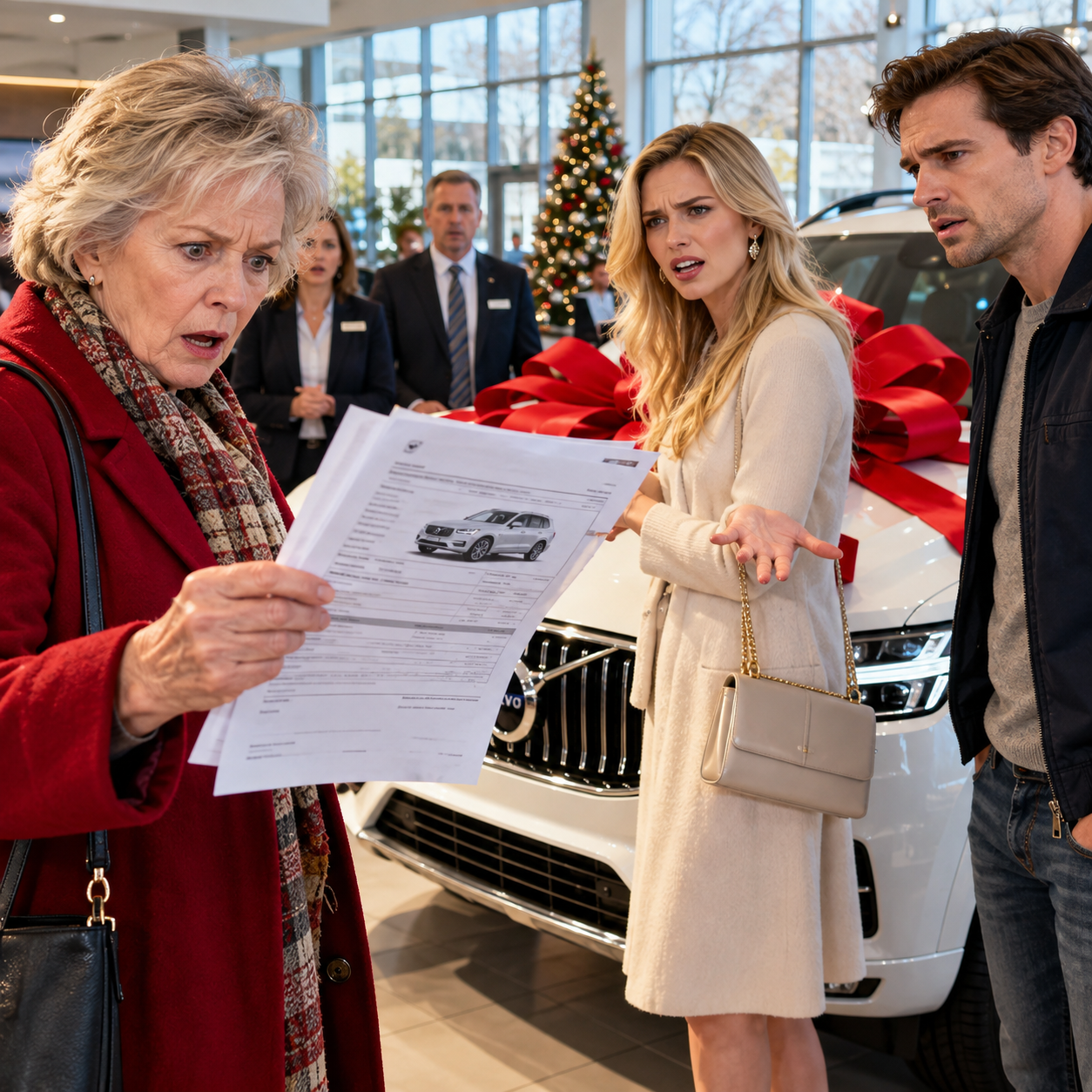
Then I called Victor in the dealership’s finance office and formally disputed the loan. I told him the signature had been forged, that I would file a police report, and that my attorney would contact the lender. He explained that the financing would need investigation and that vehicle recovery might follow. For the first time since Christmas, someone was treating the paperwork as evidence instead of an obligation.
My attorney, Julie Marshall, had helped settle Gary’s estate, and she listened without interrupting while I told her everything. She instructed me to report the identity theft to the Federal Trade Commission, freeze my credit with all three bureaus, obtain my credit reports, and change my passwords. That afternoon, I walked into the police station in Sturgeon Bay carrying the loan contract in a folder. When the young officer asked whether I knew who had signed it, my throat tightened. “It’s my son,” I said, and he looked at me with a sadness that told me he understood.
Three days later, my friend Kathy sent me a video from Brittany’s morning livestream. Brittany was standing in her Scottsdale driveway, speaking enthusiastically about abundance while her new Volvo gleamed behind her. A flatbed tow truck backed into the frame, and a man carrying a clipboard approached her. “Ma’am, I need the keys to this vehicle,” he said, while Brittany laughed in disbelief and insisted the SUV belonged to her.
The recording ended in confusion, with Brittany protesting and the camera swinging toward the driveway. Its final image showed the white Volvo secured on the truck, that enormous red Christmas bow still fluttering across its windshield. I watched the clip twice, not because I enjoyed her humiliation, but because I had spent so many years believing I was powerless to say no. Five minutes later, Austin called four times and left a furious message asking what I’d done.
I blocked his number, heated the oven, and baked lemon muffins. Then I carried a warm batch to Kathy’s house, where we drank tea and discussed her garden. She never asked me to explain, never demanded a favor, and never mentioned the money. It struck me how peaceful ordinary friendship could feel.
But the investigation wasn’t over.
While reviewing my accounts, I discovered two unfamiliar login attempts on my retirement account, including one successful login associated with Mesa, Arizona. I remembered the old tablet I’d given Austin three Christmases earlier and wondered whether my personal information had remained accessible. Julie arranged for a forensic accountant, Marcy Boyd, to examine the records.
A week later, Marcy called with news that made me lower myself into Gary’s old chair. “Cheryl, there were two additional loan applications using your identity. One for a truck, another for a travel trailer. Neither was completed.”
I pressed my palm against the desk. The Volvo hadn’t been a desperate, impulsive mistake; it was the first attempt that had succeeded.
That evening, I signed a new will. My house and savings would support a nursing scholarship at the local community college, the Door County Public Library, and the animal shelter where Kathy volunteered. Julie also prepared a sealed letter for Austin, to be delivered after my death.
It contained one sentence I’d written myself: “Family isn’t the one who sends you the bill; it’s the one who stays after it’s paid.”
I placed it in the folder, believing I’d finished the hardest part.
Two weeks later, Austin appeared at my front door.
## Part 3: My Son Came Begging as His Carefully Hidden Lies Collapsed
I saw his rental car pull into the driveway through my kitchen window. Austin climbed out wearing a jacket far too thin for the Wisconsin winter, his face drawn and his hair uncombed. For one terrible second, I saw the little boy who used to run through that same yard calling for his father. Then he knocked, and I opened the door without inviting him inside.
“Mom, you have to call the dealership,” he said immediately. “Tell them the whole thing was a misunderstanding.”
I kept one hand on the door. “You signed my name to a loan I never agreed to, Austin. Which part am I supposed to misunderstand?”
He shifted his weight, glancing toward the street as if someone might overhear. He claimed the arrangement was temporary, that he’d intended to make every payment, and that he and Brittany simply needed financial breathing room. Her livestream had destroyed her reputation, he said, and two companies had canceled their sponsorship agreements. Now the dealership was threatening legal action.
I watched him speak, waiting for him to ask whether I was all right. He never did.
Then he lowered his voice. “Mom, I could lose my job over this.”
Austin worked in the financial compliance department at Ward Systems. His responsibilities included detecting the very kinds of dishonest transactions he’d attempted against his own mother. I stared at him as the significance settled between us. “Did you think about your job before you stole my signature?”
His eyes filled, but he said nothing.
The district attorney had contacted me the previous day. Austin was facing two forgery counts and one identity-theft charge, and I’d agreed to cooperate with the prosecution. When I told him, he grabbed the porch railing as though the ground had shifted beneath his feet.
“Mom, please,” he whispered. “I’m your son.”
“I know.” My voice trembled, and I hated how much I wanted to reach for him. “That’s why I helped you every time you asked, even when I had to sacrifice something of my own.”
He started crying then, openly and helplessly, and I remembered holding him after Gary’s funeral. I could almost feel the weight of his head against my shoulder, the instinct to make everything better rising through me. But I held the door and said, “I’m not doing this to hurt you, Austin. I’m doing it because I’m finished paying for you to hurt me.”
He drove away without another word.
Within weeks, Ward Systems terminated his employment. Marcy’s investigation traced the fraudulent electronic signature through devices and accounts associated with Mesa and Scottsdale, including financial records bearing Brittany’s name. The dealership withdrew its claim against me, and the unauthorized truck and trailer applications were removed from my credit history. The white Volvo returned to the dealership, where, according to someone who spoke with Julie, the red bow remained attached for days.
In May, I walked into a beige courtroom in Sturgeon Bay with Julie beside me. A radiator clanked beneath the window, and an American flag stood near the judge’s bench. Austin entered wearing a borrowed suit whose sleeves covered his wrists, followed by Brittany, without her usual polished makeup or confident smile. When their eyes met mine, I recognized fear in both their faces, but I was no longer prepared to mistake fear for remorse.
The prosecutor read the charges. Austin pleaded guilty to one count of forgery, while the remaining two charges were dismissed under the agreement. The gray-haired judge adjusted her glasses and asked him how someone who had worked in financial compliance could justify using his mother’s identity to purchase a luxury vehicle.
“I can’t justify it, Your Honor,” he whispered.
She sentenced him to three years of probation, leaving him with a felony conviction, and ordered restitution for the fraudulent transaction and associated expenses. The repayment arrangement also included documented financial help I’d provided over the years, from the emergency transfers to the rent and tuition. Julie rested her hand lightly over mine when the judge finished speaking.
Brittany’s turn came next. The prosecutor presented messages establishing that she knew I hadn’t approved the purchase, even while she’d publicly advertised it as my generous Christmas gift. She pleaded guilty to a misdemeanor theft-by-fraud charge and received one year of probation, two hundred hours of community service, and responsibility for her share of restitution.
As she turned to leave, Brittany stopped and looked directly at me. “Cheryl, I never thought you’d actually do it.”
I met her eyes. “I know. That’s why you thought you could.”
Outside the courtroom, Austin caught up with me near a water fountain. His hands shook, and he looked painfully thin. “Mom, I’m sorry,” he said, his voice breaking. “I really am.”
For once, I believed he meant it. But an apology wasn’t the same as a changed life, and I couldn’t give him forgiveness in exchange for another promise.
“Complete your probation,” I told him. “Pay back what you owe. Show me, over the next three years, that you’re willing to become someone I can trust again. Then we can talk about having a place at my table.”
“Not now?” he asked.
“Not now.”
I touched his sleeve for one brief moment, then walked into the May sunshine beside Julie. My heart ached, but I didn’t turn around.
## Part 4: A Grandson’s Letter Revealed the Family Love Still Worth Saving
By summer, Austin and Brittany had lost their Scottsdale house and moved into a small apartment above a dry cleaner. Brittany took a front-desk job at a dental office, and Austin began making restitution payments from a new bank account. Every fifth of the month, a modest amount arrived, sometimes so small that the old version of me would have felt tempted to tell him to keep it. But I wasn’t collecting money to punish my son; I was allowing him to experience what responsibility actually required.
The strangest part was that I didn’t feel victorious. I had watched my son lose his career, his home, and the comfortable life I’d helped finance, and none of it gave me pleasure. Some nights I still reached for my phone when I remembered something funny he’d said as a child. Then I’d remember the forged signature and put the phone down, because loving someone didn’t mean pretending their choices hadn’t happened.
There was one part of my family I refused to surrender.
Back in March, before the hearing, a small envelope had arrived with a child’s drawing inside. It showed a blue house, a yellow sun, and a stick-figure grandmother holding a plate of cookies. Beneath the picture, in crooked first-grade letters, Noah had written, “Dear Grandma, I miss yous. Love, Noah.”
I sat at the same oak table where I’d opened the Volvo paperwork and cried until the drawing blurred. I’d managed to withstand the betrayal, the investigation, and the angry phone calls without shedding more than a few tears. But the picture of that little blue house broke through every wall I’d built around my heart.
I wrote Noah a letter telling him how much I loved him and that one day, when he was older, I hoped we’d bake cookies together again. I enclosed ten dollars for ice cream and decorated the envelope with a little school-bus sticker. I said nothing about his parents’ behavior, because six-year-old children should never have to carry the weight of adult betrayal. I also kept a separate post-office box, a quiet way to remain reachable without reopening my finances or surrendering my peace.
The quilt I’d made him remained carefully folded in my linen closet. Sometimes I ran my fingers over the tiny pine trees stitched into its border, thinking about how love could survive even when trust could not. I hadn’t closed that door forever. I was simply refusing to let the adults in his life use my love for him as another bargaining chip.
In July, Kathy invited me to her cabin on the North Shore. We spent a long weekend sitting on the dock with our feet in the cool water, drinking iced tea from mismatched jars while her granddaughters, Grace and Mabel, laughed nearby. The evening sky turned orange and rose-colored, and somewhere along the shoreline, early fireworks flickered above the lake.
Kathy leaned toward me, studying my face. “Cheryl, you’re the calmest I’ve seen you in years.”
I watched the last golden streak disappear over the water. “I spent so long trying to be needed,” I told her, “that I forgot what it felt like to be loved without an invoice attached.”
She reached across the dock and squeezed my hand. Neither of us spoke for a while, and for the first time in years, the silence didn’t feel like loneliness.
I thought about Gary, our old oak table, the empty chairs at Christmas, and the small folded quilt waiting for Noah. I still loved my son, but I finally understood that I couldn’t purchase his affection, protect him from every consequence, or sacrifice the rest of my life hoping he’d become grateful. If Austin ever returned to my table, it would have to be because he’d learned to respect the person sitting across from him.
Kathy raised her glass toward mine, and I smiled as the ice clinked softly between our fingers.
“To knowing when enough is enough,” I said.
“And to knowing you’re worth more,” she replied.
We watched the lake turn violet, and I felt the breeze move gently through my hair. My name was mine again, my home was safe, and the people beside me wanted nothing more than my company.
At sixty-eight, I hadn’t lost my family by refusing to pay for a Volvo. I’d finally learned that being a mother didn’t require me to be a bank, and that the greatest gift I could leave my grandson wasn’t money or a car.
It was the example of a woman who knew how to love without abandoning herself.
THE END.
All characters and events in this story are fictional, created for storytelling and entertainment purposes. Thank you sincerely for reading. Your feedback and support are invaluable and motivate me to continue sharing more stories with you.


