
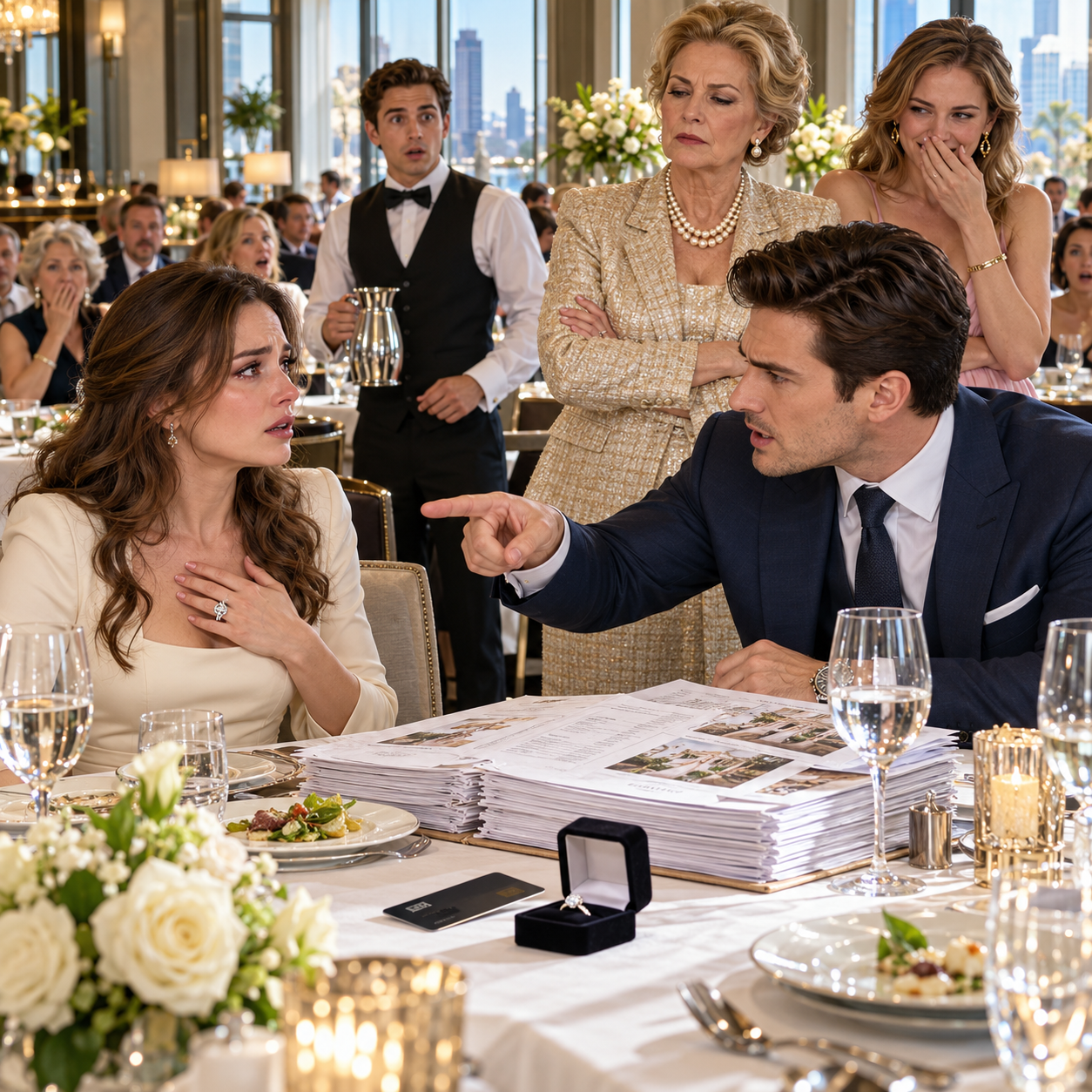
## Part 2: Hidden Debts Reveal the Real Purpose of His Proposal
Noel pushed the first contract toward me and pointed to the revenue column. Vale Meridian had reported the agreement with a regional telecommunications company at nearly forty percent above its documented value. The second contract, supposedly one of the firm’s largest, had been terminated four months earlier without disclosure to its six investors. The third agreement, which Adrien had celebrated at our engagement party, had never been signed.
I stared at the figures. “And my father’s company?”
“Your father extended Vale Meridian a consulting credit eleven months ago,” Noel said. “Adrien arranged it directly with him, before his hospitalization.” She slid over a copy of the agreement, and I recognized my father’s signature immediately. I’d been overseeing two commercial property closings when the arrangement was made, trusting Adrien to treat my family with the same loyalty I had shown his.
“Does Dad know what happened to the money?” I asked. Noel shook her head. “Not yet. But Dominic believes the exposure may be considerably larger than the original agreement.”
I leaned back, remembering the flowers Adrien had sent after Dad returned from the hospital. He’d called them a gesture of gratitude for the man who would soon become his father-in-law. Now I wondered how much that gratitude had cost.
Dominic arrived an hour later carrying preliminary findings from his investigation. He explained that Adrien had obtained a private bridging loan six months earlier using projected business revenue that his company could not substantiate. The lender had issued a default notice, and the financial disclosures contained discrepancies serious enough to trigger a broader investigation. Then Dominic turned to the security documents.
My family name appeared in the agreement.
Not as an authorized guarantor, but as a reference to the wealth Adrien expected to access after our marriage.
“He borrowed against the expectation of marrying you,” Dominic said, placing the document between us. “That doesn’t give him a legitimate claim to your assets, but it tells us what he represented to his lender.” I looked at the projected wedding date printed beside the financing timeline. Adrien hadn’t been rushing toward a life with me. He’d been racing toward a financial rescue.
Noel hesitated before removing one final item from her portfolio. It was a photograph taken near a hotel service elevator, showing Adrien standing intimately close to Tessa Ror. Tessa was Camille’s best friend, a woman I’d welcomed into my home, taken to lunch three times, and asked to be a bridesmaid.
I turned the photograph over.
For several seconds, all I could hear was the ventilation humming above my desk. “How reliable is this?” I asked. “The photograph is genuine,” Noel replied, “and we have corroborating information about their relationship.” I pressed my fingertips against the cool glass of my desk, remembering how Tessa had complimented my engagement ring while Adrien stood beside her.
“Does Camille know?” I asked.
“We can’t establish that,” Noel answered. “But the photograph was taken during the weekend Camille told you Adrien was away with his business partners.”
That afternoon, Petra reviewed the wedding contracts with me. She confirmed that the deposits were largely recoverable, the engagement could be ended without significant legal complications, and my family’s business interests could be protected through proper legal action. She also warned me against sharing unverified allegations publicly, no matter how convincing the evidence appeared.
“I don’t want revenge,” I told her. “I want every person who trusted him to know what the documents actually show.”
By Thursday morning, Dominic had prepared a twelve-page preliminary report. It identified inflated revenue, an undisclosed contract termination, an unsigned agreement represented as completed business, and serious concerns about Adrien’s financing disclosures. The false revenue projections had appeared in an investor presentation delivered in January, complete with a polished bar chart designed to make nonexistent earnings look inevitable.
I signed the authorization for Dominic’s full investigation.
Then Noel and I began dismantling the wedding.
The Harlo Grand canceled both hotel room blocks and initiated the return of eligible deposits. The florist acknowledged my withdrawal from the agreement, and Bellamy House confirmed that I was the primary contracting client. Adrien’s authorization to make decisions through my account ended immediately.
Cyril Acheson, Bellamy House’s managing director, listened quietly when I explained what had happened. He had known my grandmother for twenty-two years and still remembered how she insisted that every employee be treated with dignity. When I finished speaking, he said only, “Consider it done, Miss Hendrick.”
By Thursday evening, Petra had drafted the formal dissolution notice, and Dominic’s summary was ready for the affected investors. Noel printed the hotel photograph on matte paper and placed it beside the legal correspondence. I slipped everything into a cream envelope and sealed it with black wax using my grandmother’s signet ring.
Our family had reserved the garden room at Bellamy House for Friday’s wedding-planning luncheon. Adrien expected to sit at the head of the table, surrounded by his relatives, friends, and business investors.
I made one final adjustment to the seating plan.
His chair would remain empty until he arrived.
And the envelope would be waiting.
## Part 3: A Sealed Envelope Exposes His Betrayal Before Everyone Who Matters
On Friday morning, I wore an ivory dress with a high collar and my grandmother’s watch. I left the engagement ring in its velvet box beside my bedroom mirror. When I arrived at Bellamy House at 11:45, the staff escorted me through the side entrance and into the garden room. Above the fireplace hung my grandmother’s portrait, painted in 1983, her steady eyes looking down upon the table she had loved.
Cyril had removed Adrien’s elaborate place cards. My father’s longtime business partner, Louisa Brandt, sat to my left, Petra sat to my right, and Noel joined two directors who had already received a confidential briefing about my family’s financial exposure. The remaining seats were arranged for Adrien’s guests, who had received no cancellation notice. I wanted them to hear the truth from those directly involved, rather than from the rumors he would inevitably spread.
At 12:10, Vivien arrived wearing an immaculate designer suit and enough perfume to announce her presence before she entered. She surveyed the room, noticed the altered seating, and approached François, the head waiter who had served my grandmother for more than three decades. “Where is my son’s place?” she demanded. François inclined his head toward the empty chair. “It is waiting for him, Mrs. Vale.”
“My son sits at the head of the table.”
“Not today, madam.”
Camille entered behind her mother and gave a sharp, incredulous laugh. “Do you have any idea who we are?” she asked François, as though his years of service entitled him to less respect than her surname. He looked at her with perfect composure. “Yes, miss. I do.”
The laughter vanished when Camille saw me beneath my grandmother’s portrait.
Adrien’s groomsman arrived next, followed by an editor he considered influential and two of his company’s investors. François seated them professionally and offered water, bread, and menus, while their uncertain glances moved between the empty chair and the cream envelope. Nobody had explained the rearrangement. That silence was intentional.
At 12:27, Adrien walked in speaking into his phone. “No, the wedding is absolutely fine. Mara gets emotional sometimes, but she always—” He stopped when he saw me, and the unfinished sentence hung between us. I glanced at my grandmother’s watch while he ended the call.
“Mara.” His smile was immediate, almost convincing. “There you are.”
I gestured toward the chair. “We’ve saved your place.”
He crossed the room, smiling at the guests until he noticed the envelope bearing his name. The black wax caught the daylight coming through the tall windows. He picked it up and looked at me, his expression shifting from curiosity to irritation. “What’s this supposed to be?”
“Something you need to read.”
He broke the seal.
I watched the familiar calculation begin behind his eyes as he unfolded the first page. He read the dissolution notice, then turned to Dominic’s findings. His jaw tightened when he reached the defaulted loan, and the color drained from his face when he saw the fabricated revenue figures. By the time he reached the photograph, his hands had begun to tremble.
“Mara,” he whispered.
“The engagement is over,” I said. “A formal announcement will be issued at two o’clock, and the completed forensic report will be provided confidentially to the appropriate investors and legal representatives.”
He glanced toward the two investors sitting nearby. One was already reaching for his phone. The other was watching Adrien with an expression I had seen in boardrooms when confidence finally gives way to suspicion.
Vivien stood abruptly. “What is the meaning of this?”
I turned toward her. “Your son borrowed money while representing that our marriage would give him access to my family’s wealth. His company presented financial information that doesn’t match its underlying contracts. And he has been involved with another woman while asking me to pay for our wedding.”
Camille snatched the photograph from the table.
Her face changed.
“Tessa?” she whispered, staring at the image of her closest friend beside her brother. Whether she had known about their relationship, I still couldn’t tell, but her hand tightened visibly around the photograph.
Adrien placed the papers down with exaggerated care. “You’ve misunderstood the financial arrangements,” he said, recovering some of his practiced composure. “Those projections were standard business forecasts.”
“Then your lawyers can explain the missing signatures and undisclosed termination,” I replied. “Dominic has preserved the supporting records. My father’s company will review its exposure independently.”
His eyes narrowed. “You had me investigated?”
“Yes.”
“All of this was planned?”
I held his gaze. “I verified what you told me, Adrien. You should have been able to survive that.”
He looked toward the entrance, then back at the guests who had once rushed to shake his hand. His groomsman stared at his plate, while the investors quietly exchanged a few words. For a moment, I thought Adrien might apologize, but instead he straightened his jacket and asked, “Do you realize what you’ve done to my reputation?”
I rose slowly.
“Your reputation is the one thing I never owned.”
Nobody moved.
Then I added, “The wedding is canceled, and the hotel and vendor arrangements made under my name have been withdrawn. You’re welcome to stay for lunch, but you will no longer make decisions on my behalf.”
He studied me for a long moment. “I underestimated you,” he said.
“Yes,” I answered. “You did.”
Adrien walked out without looking back. His mother remained standing, one hand gripping her handbag, while Camille lowered the photograph as though the paper had suddenly become too heavy. Behind them, my grandmother’s portrait watched over a table that no longer belonged to Adrien’s performance.
François approached with the lunch menus.
“Shall we proceed, Miss Hendrick?”
I sat down and opened mine.
“Yes, François. I believe we should.”
## Part 4: The Final Revelation Restores Everything His Lies Nearly Destroyed
At 3:45 that afternoon, Dominic delivered his completed forensic report to Vale Meridian’s investors through their legal representatives. By five o’clock, two investors had retained independent counsel, and by Monday, another had initiated civil proceedings. My father’s architectural firm began its own legal review, focusing on the consulting credit Adrien had arranged before Dad’s hospitalization. For the first time, every questionable promise had a document beside it.
Six weeks later, Vale Meridian entered voluntary administration.
The bridging lender pursued Adrien personally for a debt approaching eight hundred thousand pounds. His company name disappeared from its office building, and the expensive business events that had once filled his calendar stopped appearing in society photographs. Allegations involving the fabricated contract were referred for further legal consideration, although I left the questions of criminal liability to the proper authorities.
I had no interest in watching him suffer. I only wanted the lies separated from the facts.
The affair with Tessa eventually became public within our social circle, largely because Camille began telling her own version of events. She insisted she had been deceived just as completely as I had, despite having helped conceal Adrien’s supposed business trip. I never challenged her account. By then, I understood that people who had spent years living behind appearances would cling to them even after everything else collapsed.
One afternoon, Petra brought the final wedding-account reconciliation to my office. The recoverable hotel and vendor deposits had been returned, and the remaining cancellation costs were documented. I signed the last page, then asked her to arrange for my engagement ring to be returned to Adrien by insured courier.
“Would you like to include a note?” she asked.
“No. A receipt will be enough.”
My father visited that evening, carrying an old architectural drawing he’d found while cleaning out his office. It showed the first building my grandmother had purchased in 1971, its windows drawn in pencil and its foundation marked with measurements in his familiar handwriting. He spread it across my dining table, smoothing one curled corner with his palm.
“I should have asked more questions about that credit agreement,” he said quietly.
I looked at the drawing. “We both should have.”
He reached for my hand. “I thought he loved you.”
“So did I,” I answered.
Dad studied me for a moment, then nodded. “Your grandmother would have liked how you handled this.”
I laughed softly. “She would have hated that I needed to.”
“She would have reminded you that the most expensive mistake is the one you refuse to correct.”
For the first time since Aurelio’s, I felt my shoulders loosen.
Seven months passed. Adrien’s belongings were gone from my penthouse, and the room he’d occupied had been repainted in the deep ivory my grandmother had originally selected. Noel found the color in an old restoration catalog, and when the painters finished, I stood in the doorway with a cup of coffee, astonished by how different familiar walls could feel without another person’s expectations pressing against them.
Then one last detail about Adrien came to light.
Cyril called me about a membership inquiry involving Bellamy House. Adrien had apparently described himself publicly as a longtime member whose standing had been damaged by our separation. Cyril wanted to confirm how the club should respond if the matter arose again.
“His membership?” I repeated.
There was a pause.
“Miss Hendrick, Mr. Vale was never a member of Bellamy House. He attended exclusively under your family’s guest privileges.”
I stood beside my grandmother’s portrait in my own living room, remembering the countless times Adrien had discussed his influential club connections. He’d spoken of the dining room as though he’d earned his place there, correcting staff and announcing seating arrangements with complete confidence. Even that small symbol of his importance had belonged to a life I had allowed him to borrow.
“Thank you, Cyril,” I said. “Please make sure your records remain accurate.”
He assured me they would.
A few weeks later, I heard Adrien had begun working as an independent consultant. On a business podcast, he attributed his former company’s collapse to an unfavorable economic climate. I listened to less than a minute before switching it off. The host hadn’t questioned him, but the facts were already in the hands of people responsible for examining them.
That evening, I returned to Aurelio’s for dinner with Louisa.
Theo recognized me immediately. He approached our table carrying a bottle of sparkling wine, poured a small glass, and set it beside my plate. “From the house, Miss Hendrick,” he said with a discreet smile. There was no mention of Adrien, no sympathetic question, and no attempt to turn my private humiliation into conversation.
I lifted the glass toward him. “That’s very kind. Thank you.”
After dinner, I walked home beneath the lights of the city, my grandmother’s signet ring resting comfortably on my right hand. I’d had the black wax cleaned from its engraved surface after the luncheon, and the gold now shone as it had in the photographs of Elsa signing her first property agreement.
When I reached the penthouse, I stopped beside the window overlooking the financial district. Somewhere beyond those buildings stood the first property she’d bought with her savings and an unreasonable amount of courage. She had taught me that integrity wasn’t something people could borrow indefinitely without consequences.
For months, I’d replayed that dinner at Aurelio’s, hearing Adrien’s voice each time I remembered how casually he’d dismissed me. I’d wondered whether he had ever loved me, whether he’d confused affection with opportunity, or whether the entire engagement had been a calculated arrangement from the beginning. I eventually accepted that no explanation he offered could restore the trust he’d destroyed.
What mattered was the choice I’d made when the truth appeared.
I had protected my father’s firm, allowed the investors to make informed decisions, and recovered the parts of my life I’d placed in another person’s hands.
I took one final look at the photograph of my grandmother on the mantelpiece, then turned off the lights.
Adrien had told me not to call him my future husband.
I had listened.
And I had made certain he never would be.
THE END.
All characters and events in this story are fictional, created for storytelling and entertainment purposes. Thank you sincerely for reading. Your feedback and support are invaluable and motivate me to continue sharing more stories with you.

