
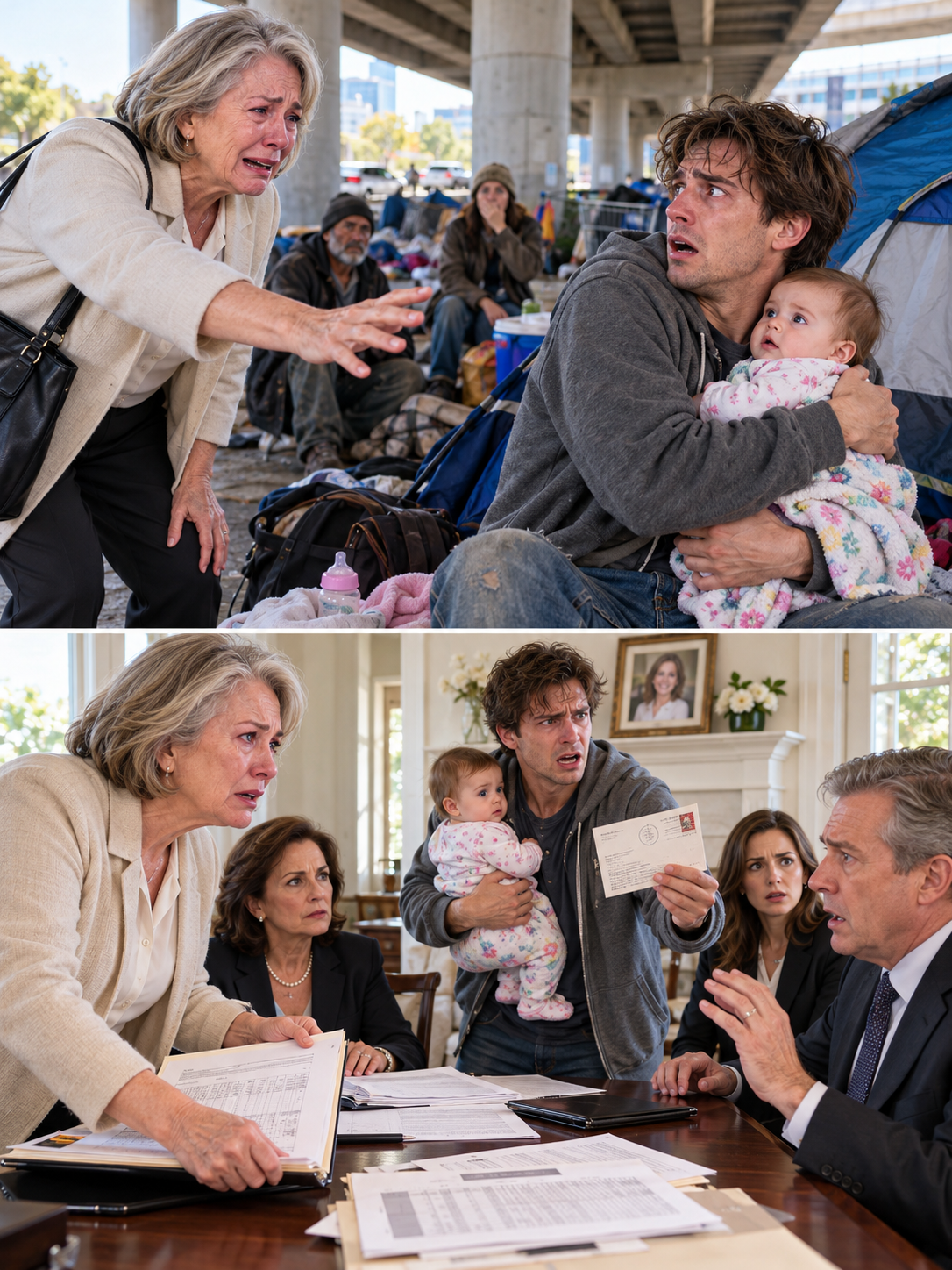
Part 2: At My Kitchen Table, His Father’s Lies Took Shape
That first night, Rosie slept briefly in a laundry basket lined with blankets while I drove to a twenty-four-hour store for a portable crib, diapers, formula, baby clothes, and a stuffed elephant with one floppy ear. By morning, she had claimed the elephant as if it had always belonged to her.
Owen barely slept. At breakfast, he watched me make eggs as if I might disappear when he blinked. He asked before opening cabinets, before showering, even where to place his coffee mug. The carefulness of it told me how long he had lived expecting every kindness to come with conditions.
Rosie crushed scrambled egg between her fingers in a booster seat borrowed from my neighbor. I poured Owen more coffee and sat across from him.
“Tell me what happened after your mother died.”
The story came slowly. Clifton controlled Nadia’s belongings, Owen’s school records, money, and even which memories were allowed inside the house. He told school counselors her family had abandoned them. Mail from me disappeared. Questions about Nadia were discouraged because talking about her, he said, kept people from moving on.
I called Dolores that afternoon. She had handled my husband Gerald’s estate years earlier and was the kind of attorney who never raised her voice because she never needed to. When I said Clifton’s full name, she paused.
“I’ve heard of him,” she said.
“Socially?”
“No.”
Within days, Dolores called back about a life-insurance policy Nadia had carried.
“The beneficiary designation appears to have changed six weeks before her death,” she said.
“To whom?”
“To an account controlled by Clifton. That does not prove wrongdoing, but the timing deserves examination.”
“Then examine it.”
The next discovery involved a trust Gerald had established for Owen as a child. My husband believed children should not build their lives around future money, so Owen had never been told about it. After Nadia died, Clifton had apparently gained authority to administer the trust while Owen was a minor.
For eight years, money had been withdrawn as educational or developmental expenses. Owen attended public school, with no special programs, tutors, trips, or accounts that explained the spending.
Dolores brought in a forensic accountant.
Three weeks after I found Owen, I placed a thick folder on the kitchen table between us. Rosie was asleep upstairs. Owen looked at the folder but did not touch it.
“What is that?”
“Your trust records.”
I explained the withdrawals, the insurance records, and the school notes describing me as voluntarily absent. Owen rested both palms flat on the table.
“He took money from me.”
“Yes.”
“And told me you were dead so I wouldn’t go looking for you.”
“That is what the evidence suggests.”
His gaze shifted toward the dark window. “And Mom’s insurance?”
“We know the beneficiary was changed. We do not know why or under what circumstances.”
He stayed quiet for several seconds.
Then he said, “I want to face him.”
“You will.”
“No. I want to ask him where he can see my face.”
I understood exactly what he meant.
“Then Dolores will be there,” I said. “And we wait until the paperwork is ready.”
Part 3: Paper Trails Exposed What Years of Silence Had Hidden
Six weeks later, Clifton walked into my house with an attorney named Silvana and the same composed expression I remembered from the hospital corridor fourteen years earlier. Dolores had requested a formal trust accounting, something Owen had every legal right to demand. Clifton could refuse only by making himself look worse, so he came.
He saw Owen first. For half a second, his face changed—not remorse, but recalculation. Then he noticed me near the fireplace.
“Helen,” he said. “This is unnecessary.”
“My name isn’t Helen.”
He knew that. That was the point.
We sat at the dining table. Dolores placed documents in front of him one at a time: trust statements, withdrawal records, the beneficiary change, the account opened after Nadia’s funeral, and school counseling notes. Silvana said the papers lacked context. Dolores calmly agreed and said that was why they were there—to obtain it.
For most of the meeting, Owen said little, holding Rosie while she played with her stuffed elephant. When Dolores reached the school records, he leaned forward.
“Why did you tell me she was dead?”
Clifton folded his hands. “I was protecting you.”
“From what?”
“From instability.”
“She sent me birthday cards every year.”
“You were a grieving child. Your grandmother was angry. There was conflict. I made a judgment.”
“You told me she had a stroke.”
“I simplified a situation you were too young to understand.”
“What situation?”
Silvana touched Clifton’s sleeve, but he pulled his arm away.
“A woman inserting herself into every decision,” he said. “A woman who would have complicated things.”
The words exposed more than he meant them to. Not harmed Owen. Not confused him. Complicated things. The trust, the insurance, the school records, the intercepted mail—all of it had depended on there being no other adult close enough to ask questions.
Owen’s voice remained low. “She’s my grandmother.”
“I made the decisions I believed were necessary.”
“You stole from me.”
“That is your characterization.”
“You stole years too.”
For a moment Clifton looked like a man who had repeated his excuses so long he considered them history. Being the surviving parent had become, in his mind, ownership over the people, memories, and money around his son.
“You’ll understand when you’re older,” he said.
Owen shifted Rosie higher against his chest. She curled one hand into his collar.
“I’m holding my daughter right now,” he said. “I understand perfectly.”
Clifton looked at the child. Something passed over his face—perhaps the first glimpse of what his choices had cost him—but he did not apologize.
Dolores closed the folder.
That afternoon, she sent the forensic report and supporting records to the appropriate financial investigators. Within a week, formal inquiries began. Silvana became harder to reach. Clifton changed attorneys twice in the following weeks.
Paperwork moves slowly, but it remembers what people expect everyone else to forget.
Part 4: My Grandson Faced His Father and Chose Differently
The case did not end with sirens or a clean television moment. Consequences arrived through account reviews, interviews, sworn questions, and lawyers arguing over dates. Owen was told he had a strong path toward recovering at least part of what had been taken from his trust. The insurance issue remained under examination.
He stayed with me.
A logistics company downtown hired him after a supervisor noticed how quickly he learned scheduling systems. The first Friday he came home with a paycheck, he stood in my kitchen holding the deposit receipt.
“I put some away,” he said.
“Good.”
“And I bought Rosie shoes.”
“That is also good.”
He smiled. “They have little strawberries on them.”
We turned Gerald’s old study into a nursery. Owen painted the walls sage green while I sorted baby clothes on the floor. Above the crib, he hung a small mobile that played a melody Nadia used to hum. The first time it chimed, he stopped with a screwdriver in his hand.
“I know that song.”
“She sang it constantly.”
“I thought I made it up.”
I kept folding onesies because speaking just then would have been difficult.
At night after Rosie went to sleep, we talked about Nadia—not the perfect saint people turn the dead into, but the real woman. She was impatient in traffic, terrible at keeping plants alive, and incapable of telling a joke without laughing before the punch line. Owen had been taught that mentioning his mother upset people, so he had carried most of his memories alone.
One evening, I brought down a box of photographs. Owen picked up one of Nadia holding him as a newborn. Her hair was unwashed, her face exhausted, her smile enormous.
“I forgot how much she laughed,” he said.
“She laughed at her own jokes more than anyone else did.”
He smiled. “I want Rosie to know her.”
“She will.”
Rosie learned to walk at thirteen months and immediately decided walking existed so she could follow me everywhere. By twenty-two months, she had perfected the word Grandma and used it with such confidence that Owen started keeping count for amusement.
“Thirty-seven,” he called from the backyard one afternoon.
Rosie ran toward me with both arms raised. “Grandma!”
“Thirty-eight.”
The legal case is still moving. Clifton’s lawyers challenge figures, dates, and intent, but the documents remain: the withdrawals, the school notes, Owen’s birthday card, the beneficiary change. A lie can survive for years when everyone is trapped inside one version of events, but evidence opens doors.
Some losses cannot be repaid. No court can return the Christmas mornings I missed with Owen or the years he believed his mother’s family had vanished. No settlement can restore the conversations Nadia and I might have had about raising her son after she was gone.
But a family is not only what was stolen from it.
I see what remains in Owen’s jacket hanging by my front door. In the second cup of coffee he pours without asking permission. In Rosie’s stuffed elephant wedged beneath the sofa, the sage-green nursery, and the photograph of Nadia that now sits in the center of our kitchen table instead of hidden in a box.
A few nights ago, Owen picked up that photograph and traced one finger along the edge.
“I used to think losing somebody meant everything connected to them disappeared too,” he said.
“And now?”
He looked toward the hallway where Rosie was sleeping.
“Now I think they stay in strange places. In stories. In habits. In the way she holds her shoulders.”
I knew exactly what he meant.
Months earlier, under an overpass, that familiar curve of a tired young man’s shoulders had made me stop my car when reason told me to keep driving. I had almost dismissed what I saw as an old woman searching strangers for her daughter.
Instead, I opened the door.
That decision did not restore the fourteen years behind us. It did something smaller and more important.
It gave us the years ahead.
The End .
All characters and events in this story are fictional, created for storytelling and entertainment purposes. Thank you sincerely for reading. Your feedback and support are invaluable and motivate me to continue sharing more stories with you.

