
### Part 2: The Morning My Tree Disappeared and His House Fell Apart
I walked to the stump without putting on shoes. The exposed wood was pale and damp, and the familiar ridge where my father had once carved his initials was gone. A few broken branches lay against the sidewalk. Buddy came running behind me, stopped beside the stump, and sniffed the scattered bark as though searching for something he’d misplaced.
“Well,” a woman called from the sidewalk, “doesn’t it look better already?”
Karen stood beside her silver SUV, holding a coffee cup. She wore another pink blazer and had the composed expression of someone inspecting a completed home renovation. I asked her where the tree was. She looked toward the open patch of sky above my roof. “The removal crew is finishing the disposal arrangements. You should have much better sunlight now.”
“You hired somebody to cut down my tree?”
“The board authorized emergency removal.”
I took out my phone. “Show me the permit.”
Karen shifted the coffee cup to her other hand. “Daniel, please. We obtained a professional safety assessment. The tree was leaning dangerously, and delaying action would have exposed the association to liability.”
“That tree was inspected and declared healthy.”
“Then perhaps your inspector missed something.”
I looked at the saw marks again. “You knew I wouldn’t agree to this.”
She said nothing for several seconds. Then she brushed a speck of lint from her sleeve. “Sometimes leadership means making unpopular decisions.”
Sheriff Hale answered my call before the second ring. He was on my lawn less than ten minutes later, dressed in uniform, with his notebook and phone in hand. He studied the stump, photographed the tire tracks, and asked whether I’d authorized any work. When I shook my head, he looked toward Karen’s house. “Stay here, Daniel. I’m calling a deputy and county environmental services.”
Karen returned while he was making those calls. She repeated her claim about an emergency board authorization and a structural danger report. Hale asked for the names of the inspectors and the removal contractor. She promised to provide everything by the end of the day.
Then a diesel engine sounded from the corner.
An aging flatbed truck turned onto Oak Hollow Lane, carrying the enormous trunk of my oak. Its cut ends extended beyond the bed, secured with chains that looked terribly inadequate for the weight. A younger man in a work shirt stood beside the passenger door, watching the load shift as the driver eased around the corner.
Hale stepped into the street and raised one hand. “Stop there. I need to speak to whoever’s responsible for this vehicle.”
The driver braked. Karen hurried toward him, her heels clicking against the asphalt. “We’re nearly finished. The disposal site is expecting us, and they’re charging for the delay.”
The driver leaned through his open window. “Ma’am, I told you we needed a bigger trailer. This load isn’t sitting right.”
“Then take your time,” Karen replied.
“I’m not moving it until it’s secured.”
“You’ve already been paid. Just get it out of here.”
Hale approached the driver’s door. “Nobody moves this truck until—”
The driver, apparently trying to pull completely out of the intersection, released the brake and let the vehicle creep forward. Its rear wheels crossed the shallow slope beside my driveway. One chain snapped taut, another slipped against the bark, and the enormous trunk began rolling toward the outside edge of the bed.
The driver’s assistant shouted for him to stop.
Metal scraped against wood. The load tipped, struck the side rail, and broke free.
Hale grabbed my shoulder and pulled me backward as the trunk hit the pavement. It rolled across the street with a terrible grinding sound, gathering speed down the incline. Its leading end struck the sheriff’s front porch, smashed through the railing, and drove into the outer living room wall. The upper portion tore through the roofline, sending shingles, insulation, and broken lumber into the yard.
For several seconds, all I could hear was the truck’s idling engine and the alarm sounding from Hale’s house.
His wife, Ellen, appeared at the side door in her bathrobe, coughing from the dust. “Tom? What happened?” She looked toward the front of their house and covered her mouth.
Hale ran to her. He guided her down the steps, checked that she wasn’t injured, and radioed for emergency assistance. Only after making certain Ellen was safe did he turn toward Karen.
She stood beside the truck, staring at the wreckage. “The driver moved before I told him to,” she said. “I warned him about that slope.”
The young assistant shook his head. “You told us to hurry.”
Karen turned sharply. “Don’t start blaming me because you don’t know how to secure a load.”
Hale walked back toward us, his expression strained. “Nobody’s assigning blame on the sidewalk. My deputies will take everyone’s statements, including mine.” He looked toward the broken wall. “I’m personally involved now. Someone else will lead the investigation.”
Neighbors emerged from their houses carrying phones, jackets, and blankets. Sandra hurried over to sit beside Ellen on the curb. Ron directed traffic away from the damaged property while firefighters checked the structure. Karen kept trying to speak to the driver, but a deputy separated them to obtain independent statements.
I stood beside the stump, watching pieces of my grandfather’s tree protrude from the sheriff’s living room. Hale came over after the firefighters confirmed nobody had been inside the damaged section.
“I’m sorry about your house,” I told him.
He looked at me, then at the wreckage. “Daniel, you didn’t put that tree on a truck.”
Across the street, Karen was insisting that every decision had been approved by the HOA board. Sandra heard her and stopped walking.
“Approved by whom?” she demanded. “We voted to postpone everything until the county inspected it.”
Karen stared at her.
Sandra took out her phone. “I have the minutes right here. Nobody authorized cutting down that tree.”
For the first time that morning, Karen had no prepared answer.
### Part 3: Receipts and Recordings Exposed the Woman Behind the Chainsaws
By afternoon, a county investigator had joined the deputies examining my yard and the sheriff’s damaged house. Mr. Jensen, whose doorbell camera faced the street, approached me with his phone. He’d found footage from 2:43 that morning showing Karen handing a thick envelope to a contractor. Another clip, recorded shortly after three, showed her pointing toward my driveway while workers unloaded chainsaws.
“You can hear what she’s saying,” Jensen told the investigator.
On the recording, Karen’s voice was unmistakable. “Get it finished before sunrise. The homeowner’s out of town, and I don’t want neighbors interfering.”
I watched the screen twice. I hadn’t been out of town. I’d been asleep twenty feet from where those men were working, trusting that my own yard was safe.
The contractor’s assistant provided another recording. Karen had called him the previous afternoon, claiming she owned my property and had approved the removal months earlier. She’d offered extra money for an overnight job and promised the permit situation was handled. The driver admitted he’d accepted her assurance without verifying ownership or obtaining the required paperwork.
Meanwhile, Sandra examined the HOA’s bank statements. She arrived at my kitchen table that evening carrying a folder and wearing the expression of someone who hadn’t slept. “Eight thousand dollars,” she said, sliding a statement toward me. “That’s what’s missing from our emergency maintenance reserve.”
The records showed that Karen had transferred the money into an account under her control, labeling the expenditure emergency landscaping remediation. Attached was a supposed board authorization bearing Sandra’s signature, Miguel’s signature, and a third name neither of them recognized: John Boardman. Sandra tapped the unfamiliar signature with one finger. “There is no John Boardman on our board. There never has been.”
The next morning, Miguel discovered something worse in the HOA’s shared records. Karen had uploaded meeting minutes approving several landscaping expenses, although no such meetings appeared on the official calendar. One supporting video showed Karen alone at a conference table, reading an agenda into her laptop and announcing unanimous approval while three chairs beside her remained empty.
I watched Sandra replay the clip. Karen paused after calling for objections, looked toward the empty chairs, and declared the motion carried. Sandra shut the laptop and pressed both palms against its lid. “She didn’t even bother finding somebody willing to sit beside her.”
Ron supplied the final piece. Karen had visited his house the previous week and offered to waive three months of HOA dues if he’d submit a written complaint describing my oak as dangerous. He’d recorded their conversation after becoming suspicious of her repeated requests. In his quiet voice, he told the investigator, “I didn’t agree. I thought she was bluffing about removing it.”
The deputy coordinating the investigation collected the recordings, financial statements, contractor agreements, and my county documents. My security system had also retained footage showing an indistinct figure approaching the camera shortly before its view turned skyward. The physical evidence would require further examination, but the broader sequence was becoming difficult to dispute.
Karen continued insisting that she’d intended to protect the community. When Sandra confronted her about the missing money, she said delaying the removal would have put the association at risk. When asked why she’d claimed to own my property, she called it a communication misunderstanding.
That evening, the remaining board members scheduled an emergency meeting at the community center. Karen received formal notice that her authority as president was being challenged. Every homeowner received the same notice, together with a request to preserve any relevant messages or records.
At the bottom, Sandra had added one sentence: No additional HOA funds may be spent without independent board approval.
### Part 4: Our Neighbors Chose New Roots Over Her Old Rules
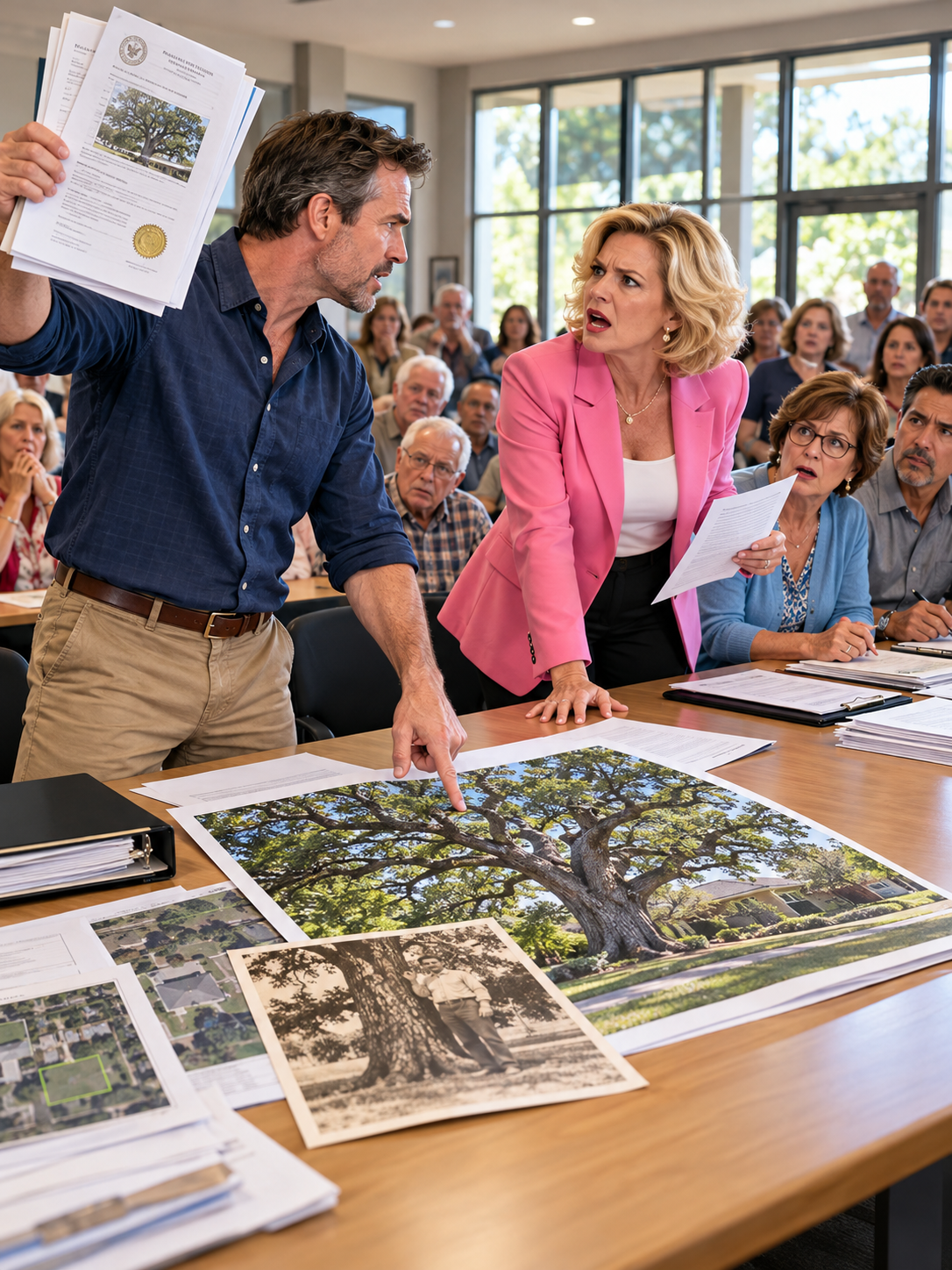
The community center was crowded the following evening. Sandra and Miguel sat at the front beside a stack of financial records, while neighbors filled every folding chair and lined the walls. Karen arrived carrying a thick pink binder and walked directly toward the president’s seat. Sandra stopped her with a raised hand.
“That chair is reserved for the acting chairperson tonight.”
Karen glanced around. “You can’t remove an elected officer simply because people are upset.”
“You’re right,” Sandra replied. “That’s why we’re following the bylaws.”
For the next hour, the board reviewed the unauthorized expenditure, the disputed meeting minutes, and the contractor’s written statement. Karen maintained that she had acted to prevent a potential lawsuit over a dangerous tree. But when Miguel asked her to produce the arborist’s original safety report, she could only provide an unsigned summary.
“I was trying to improve this neighborhood,” she said, gripping her binder. “Every time I suggested something, somebody complained. Nobody appreciates how much work it takes to maintain standards.”
I stood when Sandra invited me to speak. “My grandfather planted that oak in 1921. My father grew up beneath it. My wife and I spent our happiest afternoons sitting in its shade.” I looked at Karen. “You could’ve disagreed with me for another hundred years. You didn’t have the right to take it.”
Karen lowered her gaze to the documents in front of her. She didn’t apologize.
The board voted unanimously to remove her as president, pending the separate homeowner process required to remove her from the board itself. An independent financial audit was approved, along with new rules requiring documented votes and dual authorization for significant expenditures. Several weeks later, after proper notice, homeowners voted overwhelmingly to remove Karen from the board altogether.
The legal proceedings took longer. Investigators examined the forged signatures, the financial transfers, and the recordings, while the county pursued penalties for destroying the protected oak. Insurance adjusters handled the damage to Hale’s house, and the contractor faced scrutiny for transporting an unsecured load. Karen challenged several findings, but the documentary evidence supported the county’s case, resulting in substantial fines, restitution, and financial liability.
One afternoon, I found a pink envelope taped to my front door. Inside was a handwritten note from Karen containing four words: You ruined my life.
I put it with the other evidence rather than answering.
By then, Hale’s house was being repaired. Ellen had chosen new siding, and the broken living room window had been replaced. One morning, Hale crossed the street while I was cleaning sawdust from the remaining grass. He studied the stump before speaking.
“The county arborist wants to help arrange a replacement planting,” he said. “They can’t give you back that tree, Daniel. But they can help you start another.”
A few weeks later, a young heritage oak arrived from a county-supported restoration program. Sandra brought shovels, Miguel helped prepare the soil, and Ron appeared with a watering can he’d owned since the seventies. Neighbors who had barely spoken to one another under Karen’s presidency worked side by side until the sapling stood straight.
Hale held it steady while I filled the last space around its roots. “Your grandfather would’ve liked this,” he said.
I looked at the small leaves trembling above his hands. “He would’ve asked why we planted it so close to the sidewalk.”
Hale laughed. “Then we can move it six inches.”
Eventually, a restoration grant and the compensation arranged through the case helped fund two additional young oaks and repairs to my damaged lawn. When the HOA held its next election, Sandra asked whether I’d consider serving as president. I declined, but agreed to take an ordinary board seat, provided every meeting and expenditure would remain open to proper review.
Months later, I sat on my porch with Buddy resting against my feet. Across the street, Ellen was arranging flowers beneath her repaired window, and Ron was teaching a neighbor’s grandson how to water the new saplings without flooding their roots. The old stump remained nearby, carefully preserved as a reminder rather than hidden beneath fresh grass.
My grandfather’s oak had stood for more than a century. No settlement, fine, or replacement planting could give me another afternoon beneath its branches.
But the young trees were growing, and for the first time in months, I could look across Oak Hollow Lane without remembering only what had been destroyed. I saw people who had finally learned to protect what belonged to one another.
And when Buddy settled beneath the smallest oak, resting his head between its new roots, I pulled my chair into the sunshine and stayed there awhile.
The End .
All characters and events in this story are fictional, created for storytelling and entertainment purposes. Thank you sincerely for reading. Your feedback and support are invaluable and motivate me to continue sharing more stories with you.


