
Part 2: The Letter On The Doorstep Exposed A Secret Ownership
At nine the next morning, I sat across from Margaret Ellis, the attorney who had handled my father’s estate planning. She spread the documents across her desk and pointed to the recorded deed showing that, when I turned twenty-one, Dad had transferred the house into a trust naming me as its sole beneficiary and trustee. “Your father bought this property before he married Lisa,” Margaret explained. “He wanted to make certain you would always have somewhere to live, regardless of what happened in his marriage.”
I remembered that birthday because Dad had flown home unexpectedly and taken me to breakfast at a diner near the university. He’d handed me a blue folder and said it contained something my mother would have wanted me to have. The house was paid off, he explained, and the transfer had been completed legally, but he asked me not to turn it into an argument with Lisa. I’d honored that request for six years, even paying household bills while Lisa behaved as though she owned everything.
Margaret studied the messages Lisa had sent me and asked whether I’d been allowed to retrieve my belongings. When I shook my head, she picked up her telephone and began preparing a formal notice terminating their permission to occupy the property. She explained that Lisa and the others had legal occupancy protections and that any forced removal would require the appropriate court process. “We will follow the law,” she said, “but you do not have to purchase access to property you already own.”
The following morning, I drove to the house with an envelope containing a copy of the recorded deed and the notice giving Lisa thirty days to vacate. A process server would deliver the official papers separately; the envelope was my courtesy copy. I placed it on the welcome mat and returned to my car, parking far enough away to avoid another argument. Fifteen minutes later, Lisa opened the door wearing fuzzy slippers and carrying her favorite coffee mug.
She unfolded the papers on the porch, read the first page, and immediately called for Kayla. Her voice rose sharply enough that Mrs. Patterson, our elderly neighbor, came outside to investigate. Kayla appeared with her hair twisted into a messy bun, snatched the papers from Lisa, and examined the deed with both hands. Even from across the street, I could see the moment she found my name.
My phone rang less than a minute later. “You forged this,” Lisa said without greeting me. “Your father would never give you this house without telling me.” I watched her pacing the porch and replied, “Call the county recorder’s office. Margaret’s number is on the notice if you’d rather speak with her.”
Lisa started to answer, then lowered the phone and stared at the document again.
That evening, I moved into the spare bedroom of my friend Jordan, another doctor I’d known since medical school. He handed me a clean blanket, cleared space in his refrigerator, and said I could stay until things settled. I told him about the house while he made scrambled eggs, and when I finished, he asked only, “Have you eaten today?” I realized I hadn’t.
The calls continued through dinner. Kayla accused me of making her homeless, Derek left a rambling voicemail about family loyalty, and Lisa insisted I’d humiliated her in front of the neighbors. I saved every message, including the one where she repeated her demand for $36,000.
Then Dad called from overseas.
“I received the documents from Margaret,” he said. “Noemi, I need you to tell me exactly what happened.”
I described the changed locks, the money, and the night I’d slept at the hospital. My father listened without interrupting, although I could hear him moving around his office. When I finished, he said quietly, “I knew Lisa was asking you for more money. I didn’t know she’d do this.”
“You knew she was asking?” I repeated.
He took several seconds to answer. “I should have asked more questions.”
Part 3: Public Accusations And Hidden Threats Forced My Father To Choose
Two days later, Lisa posted a photograph of herself on Facebook beside a message about the cruelty of ungrateful children. She described raising a daughter who had become successful and then abandoned the people who supported her. Kayla followed with a TikTok filmed from my former bedroom, claiming I’d decided to evict my family simply because someone had finally asked me to pay rent. Neither mentioned the money I’d contributed or the locks they’d changed while I was working.
Relatives began contacting me, some concerned and others openly critical. Aunt Denise, who hadn’t visited the house in years, wrote that throwing out the woman who raised me was shameful. I typed three angry responses before deleting them and sending Margaret screenshots instead. She advised me not to argue online, particularly while the property dispute remained unresolved.
A week later, Lisa called from an unfamiliar number. She said she’d spoken to a lawyer who believed marriage gave her a claim to the property, and she wasn’t leaving. I told her that her attorney could contact Margaret directly. Her voice softened unexpectedly. “Noemi, I kept that house together while your father was away. Do you think I didn’t sacrifice anything?”
I knew she’d cooked dinners, paid certain bills from Dad’s money, and managed a household while he worked thousands of miles away. Those things mattered, but they didn’t erase the years she’d treated me like an unwanted expense. “I never asked you to pretend those years meant nothing,” I said. “But you changed the locks on me, Lisa.”
She remained quiet long enough that I thought she might apologize. Instead, she asked whether I’d consider withdrawing the notice if we worked out a payment arrangement.
Three days before the deadline, I found a typed warning taped to my windshield outside the hospital. It promised that everyone would learn what kind of person I was if I continued with the eviction. I photographed the note, preserved it in a plastic folder, and reported the incident to hospital security before giving Margaret a copy. She prepared the necessary court paperwork in case Lisa refused to leave after the notice expired.
That afternoon, Mrs. Patterson called me. She said Lisa had been telling neighbors the deed was fraudulent and that my father planned to overturn it when he came home. “I don’t know what happened between you girls,” she said, “but your mother would have hated seeing you locked outside that house.” I thanked her and spent several minutes looking at the old family photographs on my phone.
Dad called again that evening, this time from an airport. He’d spoken with Margaret, reviewed the financial records, and discovered that Lisa had told him for years that my contributions barely covered my personal expenses. When I forwarded him bank statements showing utility payments, grocery purchases, and repairs totaling thousands of dollars, he asked me to send the originals. He admitted he’d avoided difficult conversations because being overseas made it easier to believe everyone was getting along.
“I thought sending money home meant I was taking care of you,” he said.
“It meant you were paying the bills, Dad. It didn’t mean you knew what was happening.”
He didn’t defend himself. Instead, he told me he’d arranged to come home before the notice expired.
On the last evening before the deadline, I packed the remaining photographs and documents I’d recovered from my old storage boxes and placed them beside my bed at Jordan’s apartment. Margaret confirmed that Lisa could still leave voluntarily, although an actual forced eviction would require further legal proceedings. I sent one final written message offering to coordinate a peaceful move and arrange access for their belongings.
Lisa answered after midnight.
“We’re not going anywhere. Your father will put an end to this when he gets here.”
Part 4: My Father’s Return Finally Revealed Who Truly Belonged In Our Home
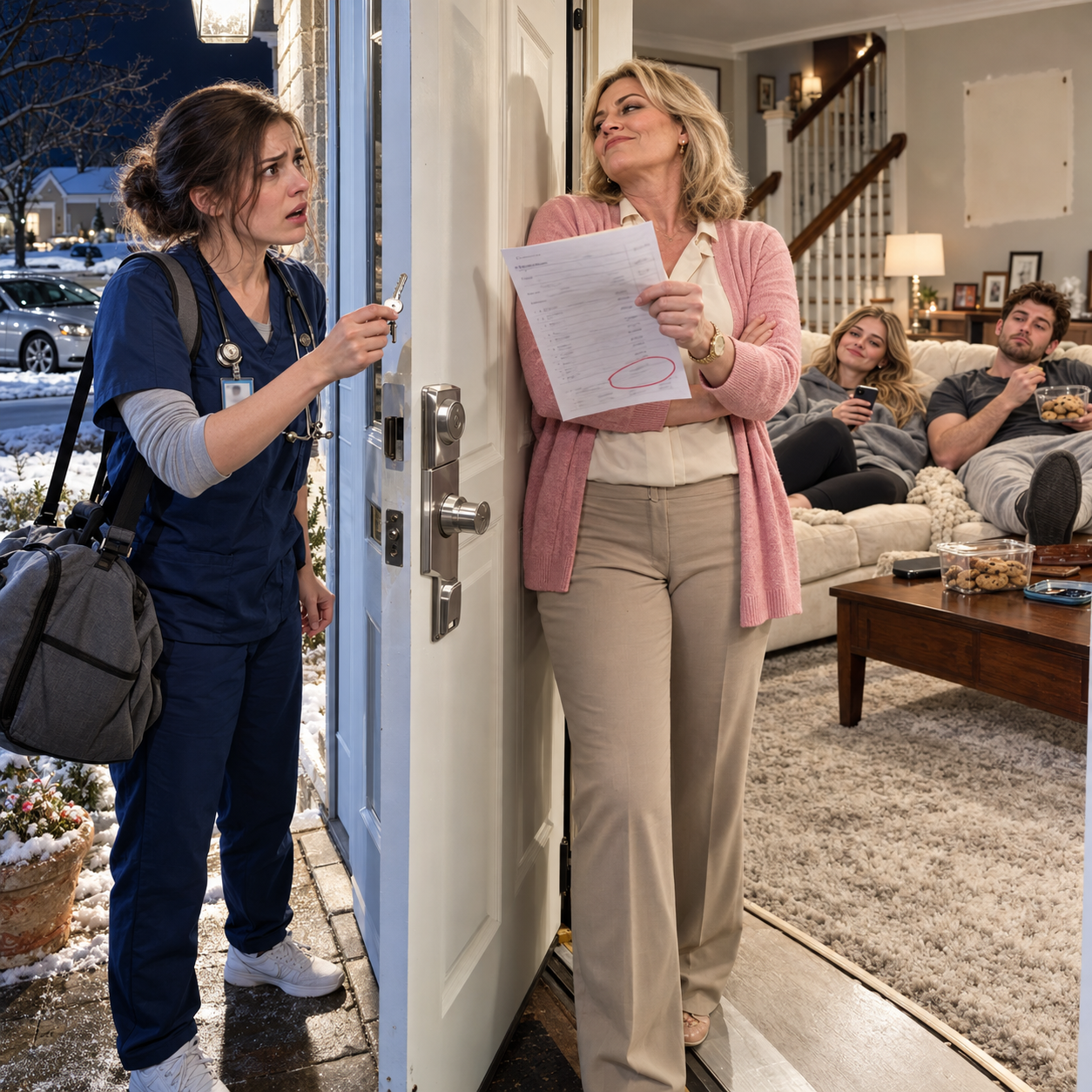
I arrived at the house shortly after ten the following morning, carrying the trust documents and a folder of bank statements. Lisa answered wearing the same cardigan she’d worn when she locked me out, although her hair was uncombed and dark circles showed beneath her eyes. Kayla stood behind her, gripping her phone, while Derek watched from the living room. Nobody had packed.
“We received your message,” Lisa said. “We’re waiting for your father.” I told her the notice period had expired and that Margaret was prepared to proceed through the court if necessary. Lisa leaned against the doorframe and gave me a tired, impatient look. “You’re really prepared to put us through all that?”
Before I could answer, a car stopped along the curb.
Dad stepped out carrying a small overnight bag. He looked older than he had on our last video call, with more gray in his hair and a stiffness in his walk after the long flight. He hugged me beside the driveway, holding on for a moment longer than usual, then asked whether we could speak privately. From his bag, he withdrew an envelope containing copies of a separation agreement and a divorce petition his attorney had prepared.
“I’ve started the process,” he said. “Lisa doesn’t know yet.”
I looked toward the front porch, where Lisa was watching us through the railing. Dad explained that our conversation had forced him to examine much more than the property dispute, including years of unanswered complaints and the increasingly separate lives he and Lisa had been living. He also admitted he’d developed a friendship with another physician overseas, a woman named Catherine, and that the possibility of a different future had made him question why he’d continued a marriage he no longer trusted. “I should have dealt with my marriage before it reached this point,” he said.
“Did you know how she treated me when I was younger?” I asked.
Dad rubbed a hand over his face. “I knew more than I wanted to admit.”
That answer hurt more than any excuse he could have offered. I told him that Lisa had done what he allowed her to do while he stayed safely distant from every uncomfortable conversation. He nodded, looking down at the envelope in his hands, and said, “You’re right. I’m sorry I left you to manage it alone.”
We walked back to the porch together. Lisa immediately reached for his arm, asking him to explain that I’d misunderstood the ownership papers. Dad told her the deed was genuine, that he’d transferred the property years earlier, and that I had every right to ask its occupants to leave through the proper process. When she realized he wasn’t going to challenge me, she released his sleeve.
“Where am I supposed to go?” she asked. “I spent twelve years being your wife.”
Dad acknowledged that she’d helped maintain the household and said he would address their financial obligations fairly through their attorneys. But the house wasn’t part of their marital property, and he wouldn’t support her attempts to demand money from me. Then he handed her the divorce paperwork.
Lisa read the first page without speaking. Kayla moved closer to her mother, looking from the papers to my father with a bewildered expression. “You’re leaving Mom because of Noemi?” she demanded. Dad shook his head and said, “I’m responsible for my marriage, Kayla. And I’m responsible for how long I ignored what was happening in this family.”
Lisa sat on the porch steps, the documents resting across her knees. For the first time, she didn’t seem interested in arguing about who deserved what. She asked whether she could have a few days to arrange somewhere to stay, and Margaret, whom I called from the driveway, helped us agree on a brief, documented extension for a voluntary move.
Over the next several days, Lisa and Kayla packed their belongings while Derek borrowed a truck from his father. I stayed with Jordan until they’d removed their furniture and returned the keys. Lisa made one final attempt to challenge the ownership documents through an attorney, but after reviewing the recorded deed and trust, her claim went nowhere. She eventually moved into a small apartment, while Kayla and Derek stayed temporarily with his parents.
When I finally returned, the living room looked larger than I remembered. The walls had pale rectangles where Lisa’s framed pictures had hung, and the kitchen cupboards were almost empty. I spent the afternoon cleaning, replaced the damaged lock, and carried my mother’s photograph into the hallway. It was the picture of her laughing beside our old oak tree, taken the summer before she died.
Six months have passed since that night outside the locked door. Dad still works overseas, and our relationship remains complicated, although we speak regularly now without pretending the past was harmless. He’s continuing with his divorce, and Catherine has become part of his life, but I’ve made it clear that rebuilding trust between us will take more than apologies and occasional visits. He hasn’t argued.
Lisa no longer contacts me directly, and Kayla’s social media posts about the house have stopped. I still work exhausting hospital shifts, sometimes long enough that dawn and midnight seem to run together. But I no longer dread the drive home.
Last week, after a difficult night at the hospital, I opened the refrigerator and found an orange Gatorade I’d bought on my way back. A cinnamon candle was burning beside my mother’s photograph, and the house smelled faintly of the childhood I’d nearly forgotten. I sat at the kitchen table, still wearing my scrubs, and watched sunlight move across the floor.
For years, I’d mistaken keeping everyone else comfortable for keeping the peace. I finally understood that a home shouldn’t require someone to surrender their dignity just to be allowed inside.
And when I turned my key in the front door that evening, it opened without resistance.
The End .
All characters and events in this story are fictional, created for storytelling and entertainment purposes. Thank you sincerely for reading. Your feedback and support are invaluable and motivate me to continue sharing more stories with you.


