
Part 2: The Missing Bracelet Turned My Sister’s Perfect Party Into an Accusation
Thirty minutes later, Grandma asked for her bracelet. Mom went to the bedroom, then returned with an expression that made Grandma rise from her chair. The velvet pouch was gone from the dish. Grandma checked the dresser herself, opened her handbag, and searched beneath her coat before calling out, “Where is my bracelet?” My father began telling everyone to stay calm while Uncle Gus, who had appointed himself birthday security, moved toward the patio gate.
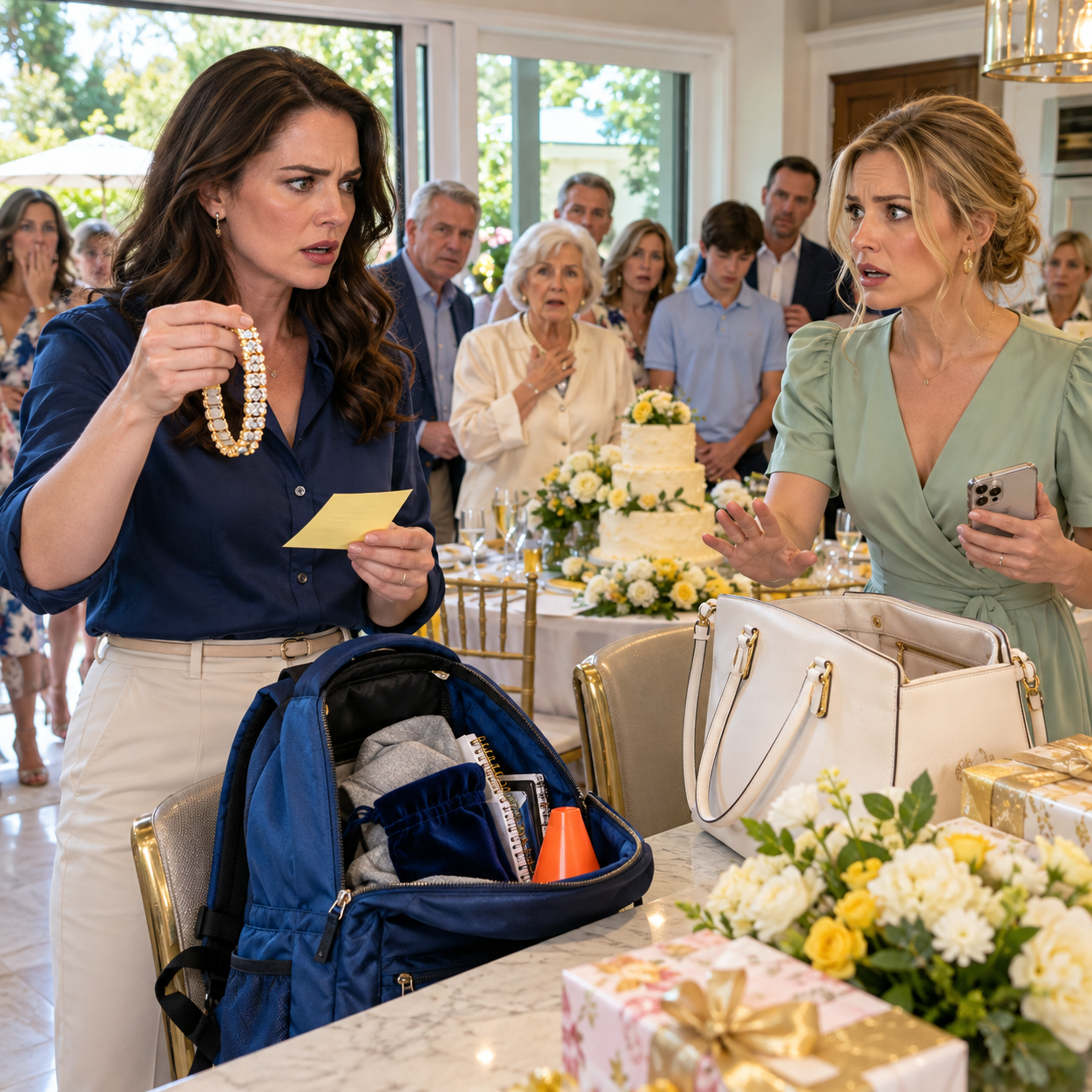
Daphne stepped forward, her voice remarkably steady. “Nobody needs to panic. We should all empty our bags so we can rule things out.” Her eyes moved directly to my blue backpack, and Dad immediately reminded everyone that I had helped Grandma remove the bracelet. Mom touched my shoulder and whispered, “Just cooperate, honey.” I looked at Daphne and said, “Of course. Since it was your idea, you can go first.”
She smiled as she lifted her white purse onto the dining table. Then her fingers reached inside and touched the velvet pouch. She looked at me, glanced down again, and tried to move it beneath her compact, but the yellow note slipped onto the table. Grandma reached into the purse herself and retrieved the bracelet. “Daphne,” she asked, holding it against her chest, “why was this in your bag?”
“I was keeping it safe,” Daphne said. “With everything going on, I forgot.” Aunt Bea picked up the note and read it aloud, slowly enough for everyone to understand. Daphne reached for the paper, but Grandma stopped her. When Grandma asked me what had happened, I showed her the photographs on my phone and explained that I’d discovered the bracelet in my backpack and moved it into Daphne’s purse. “I shouldn’t have handled it that way,” I admitted. “But I didn’t write that note, and I didn’t put the bracelet in my own bag.”
Daphne immediately accused me of framing her. Before I could answer, Eli whispered, “Mom, you told me.” Reed turned toward his son, while Daphne ordered the boy outside. Eli remained beside his father and explained that Daphne had called it a birthday treasure hunt. She told him I was participating and instructed him to put the pouch in my backpack, then tell Grandma the bracelet was missing. “I thought everybody knew,” he said, looking at the floor. “But when Grandma asked about it, I couldn’t do it.”
Nina, the photographer, quietly approached with her camera. She had taken several pictures through the kitchen doorway, and in the background of one frame, Eli was crouched beside my backpack while Daphne watched from a few feet away. The image didn’t show the bracelet itself, and I said so, but it supported Eli’s account. Daphne looked at the photograph, then finally admitted she’d wanted to teach me a lesson about keeping receipts and taking family disagreements too seriously. She claimed she’d intended to reveal the bracelet as a joke after I became upset.
Grandma listened without interrupting. Then she said, “You used something your grandfather gave me to humiliate your sister, and you made your own son help you.” Daphne started crying, accusing everyone of automatically taking my side. Grandma turned to me and said I should have returned the bracelet directly to her. I agreed. Then she looked back at Daphne. “Felicia’s poor decision came after she found out what you had done. Don’t confuse the two.”
Reed took Eli outside, and I followed a few minutes later. My nephew was sitting on the garden wall, rubbing his palms against his jeans. “Did I steal from Grandma?” he asked. I sat beside him and told him he’d been misled by an adult he trusted, and that we would work through what had happened without blaming him for his mother’s plan. When he asked whether I’d stop visiting, I promised we could arrange time together through his dad.
Inside, Grandma was eating birthday cake with Aunt Bea. Daphne stood near the hallway, looking toward me, but Grandma pulled out a chair and handed me a plate. “I won’t let anybody take the rest of my birthday,” she said. At two-ten, she asked me to drive her home. I gathered her presents while Daphne argued that we hadn’t finished the schedule, and Grandma answered, “Then the schedule will have to survive without me.”
Part 3: The Photographs Followed Me Home, Then Reached My Workplace
At Grandma’s house, I helped her put the bracelet in her safe before making tea. My phone filled with messages from my parents, who wanted the matter handled privately and believed everyone should apologize. Daphne wrote that an innocent surprise had been turned into an attack on her character. I sent one factual account to the family group, acknowledging my own actions, explaining Eli had been misled, and asking everyone to leave him alone. Grandma read it before I sent it and nodded.
The following Monday, Daphne posted party photographs online with another explanation about a harmless prank. This time, I corrected the account publicly, sharing cropped photographs of the bracelet and note, along with my original contribution message and catering receipt. I excluded Eli’s name and photograph. Grandma commented that she had never agreed to a prank involving her jewelry, and that I had been truthful about moving it. Daphne deleted her post shortly afterward.
On Thursday, an email arrived at my college’s athletics office. Daphne described my behavior as alarming, emphasized that I had placed expensive jewelry in her purse, and suggested that my employer should be concerned about my judgment. June stood beside my desk while I read it. “Take your photographs and the emails to Iris,” she advised, referring to our athletics director. “Don’t argue with your sister through a workplace address.”
Iris met with me that afternoon. She examined the photographs, read Daphne’s note, and listened while I explained my own part without leaving anything out. Then she closed the folder. “This is a personal family dispute,” she said. “Your sister had no reason to involve the college, and nothing you’ve shown me raises an employment concern.” She assured me that further correspondence would be handled discreetly, and I left her office feeling as though a door I’d feared losing had remained firmly open.
My father arrived at my apartment the next morning carrying leftover party napkins. He began explaining that Daphne had felt criticized and that families shouldn’t keep accounts. I placed the catering receipt, chair authorization, florist email, and bracelet photographs on the table. “Dad, she tried twice to charge me for things I never agreed to buy. Then she tried to make Grandma believe I’d taken her bracelet.” He studied the papers, folded one of the napkins, and finally admitted, “I should have asked more questions.”
Reed called that evening. He’d spoken with Daphne, who had described the plan as a joke meant to make me look unreasonable about the party. He also admitted he hadn’t known she’d used my name for the chairs and asked for the catering receipt so he could understand their expenses. Before hanging up, he asked whether Eli could still help at my summer soccer clinic. “Absolutely,” I said. “Just make sure he knows exactly what he’s being asked to do.”
Part 4: I Stopped Paying for Peace and Started Choosing My Family
Over the next few weeks, I changed passwords, removed shared account access, stopped paying recurring family expenses, and limited my communication with Daphne. I still visited Grandma and spoke with Reed about Eli, but I no longer agreed to plans simply because someone had already made them for me. My parents struggled with the adjustment. Then, one Saturday, they came to a soccer match and watched me work for the first time in years.
Afterward, Dad waited by the fence while June and I collected equipment. He mentioned how much responsibility I’d carried during the game and admitted he hadn’t understood my job. “I’ve been doing this for years,” I reminded him. He looked down at the field before saying, “I’m sorry I made you responsible for fixing what your sister did.” I thanked him without pretending one apology repaired everything, and he accepted that we would need time.
Our summer clinic opened a few weeks later. Gus volunteered at registration, Reed brought Eli to help with equipment, and Grandma watched the younger players from a folding chair beneath a tree. Mom asked before bringing sandwiches, and Dad helped fold chairs without being instructed. Those small changes mattered more than another dramatic family meeting. Eli seemed especially pleased to have a job with clear instructions and a paycheck at the end of the day.
Two days after our first clinic, a letter from Daphne arrived. She admitted writing the note, telling Eli I knew about the plan, and wanting to embarrass me because she resented my refusal to finance more of the party. She apologized for contacting my workplace but also wrote that she’d felt abandoned when I stopped helping her. She wanted to meet for coffee and reminded me that we were sisters before anything else. I read the letter twice, then placed it in the folder with the photographs and receipts.
Three days later, I replied that I appreciated her acknowledging what she’d done, but I wasn’t ready to resume contact. I told her that arranging practical matters involving Eli should remain Reed’s responsibility, and that my boundaries were not abandonment. Daphne replied, “I understand.” I hoped she meant it, but I didn’t ask for another explanation.
By fall, Eli was helping regularly at the clinic and occasionally attending matches with Reed. Grandma had chosen a new red pouch for her bracelet and made it clear that nobody would be borrowing it or discussing its inheritance. She continued to wear it whenever she pleased. Daphne remained part of the family, but no longer had the same access to my time, money, or decisions.
When Grandma turned eighty-one, she planned a small lunch at home. Daphne was invited to a separate gathering, and I visited the morning before with flowers and coffee. Grandma wore the bracelet, served me a slice of cake, and asked about my players. We talked for nearly an hour without anyone mentioning money, favors, or family obligations. Before I left, she glanced toward my blue backpack.
“Anything expensive in there today?” she asked. I laughed and opened it to show her my notebook, sweatshirt, and an orange training cone I’d somehow brought home again. Grandma shook her head, reached into a drawer, and wrote four words on a yellow sticky note. She pressed it firmly onto the cone: “This one is yours.”
For a moment, I simply looked at the paper. A year earlier, another yellow note had been used to make me responsible for something I hadn’t done. This one marked an ordinary little object that actually belonged to me. Grandma touched my hand and said, “You know, sweetheart, loving people doesn’t mean letting them decide what you have to carry.” I slipped the cone back into my backpack, kissed her cheek, and drove to the soccer field.
June was waiting beside the bench when I arrived. “We’re short one cone,” she called. I opened my backpack and handed it to her, the yellow note still attached. She read the four words and grinned. Then I took the cone onto the grass, placed it where the next drill would begin, and called my players together. For once, everything I was carrying was mine to carry, and nothing more.
The End .
All characters and events in this story are fictional, created for storytelling and entertainment purposes. Thank you sincerely for reading. Your feedback and support are invaluable and motivate me to continue sharing more stories with you.


