
## Part 2: A Wedding Accusation Exposed Twenty-Two Missing Prescriptions
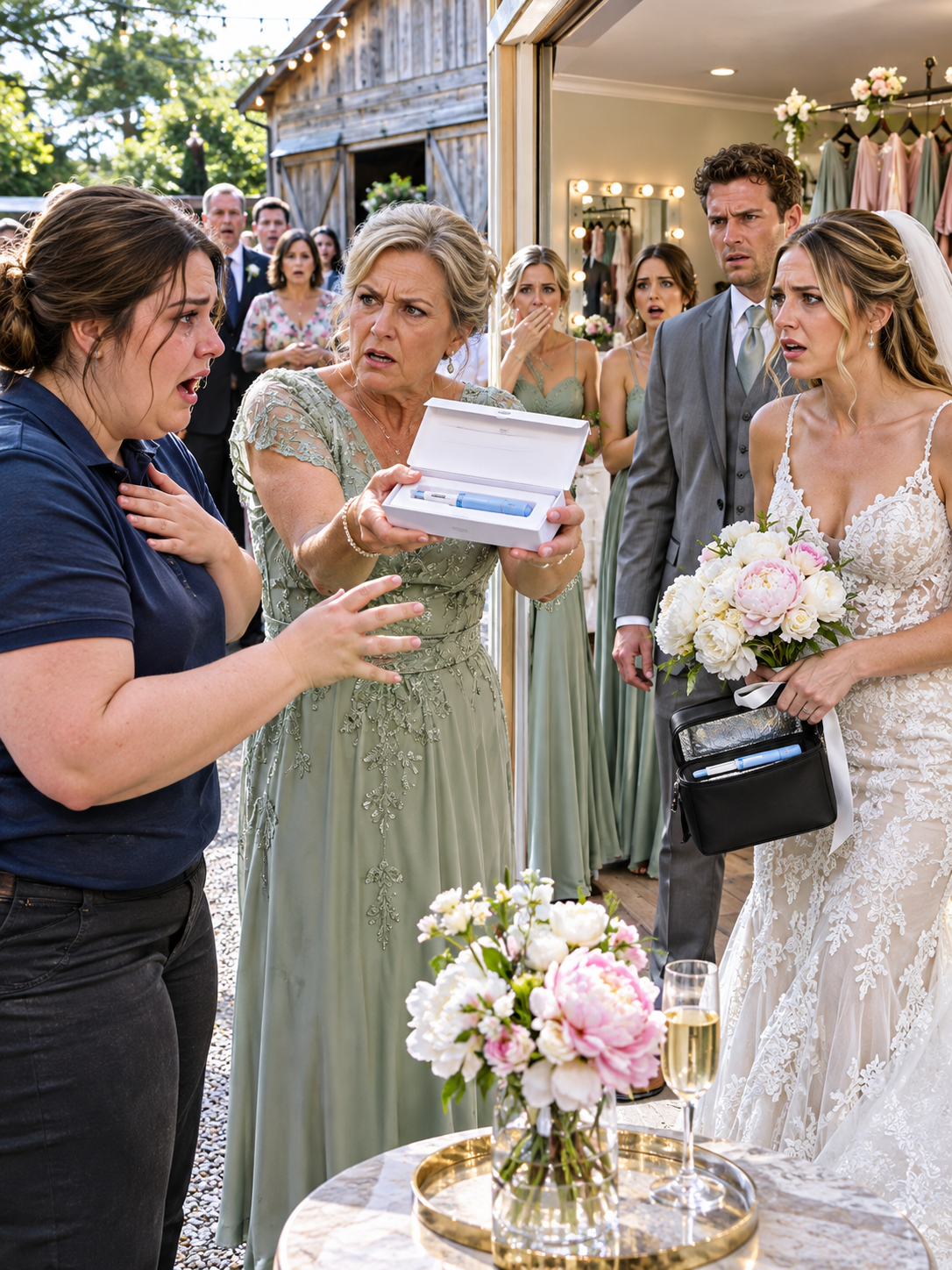
Britney stood beneath the bridal suite’s fairy lights in a white mermaid gown, holding a bouquet of peonies while a photographer adjusted his camera. Three bridesmaids surrounded her, smoothing the lace and laughing about something on a phone. When she noticed me beside Diana, her smile disappeared so suddenly that the photographer lowered his camera. “Leila? What are you doing here?” she asked. Diana stepped forward, lifted the prescription box, and said, “I’d like you to explain why my daughter’s medicine is in your refrigerator.”
For two seconds, Britney looked trapped. Then her eyes filled with tears, and she pressed a hand against her chest. “Oh, Leila, don’t do this,” she whispered. “You gave those to me months ago, remember? You said you were embarrassed because you’d stopped trying, and you wanted me to keep it secret.” I felt eighteen years of friendship collapse inside that one sentence. “I’ve never touched that medicine,” I answered, my voice trembling. “You’ve been telling me it was unavailable since September 2024.”
Before she could answer, Colin charged up the stairs in his gray wedding suit, his face flushed with anger. He barely glanced at the box before accusing me of coming to ruin their wedding. “Colin, look at her name on the label,” Diana demanded, but he turned toward his mother with a look I’d never seen before. “Stay out of it, Mom,” he snapped. A bridesmaid named Mandy suddenly grabbed the box, disappeared into the bathroom, and closed the door, while the venue coordinator appeared and politely instructed me to leave.
I walked through the gravel parking lot as guests in expensive summer clothes hurried toward the ceremony. My hands shook so badly that I missed the ignition twice before Diana appeared beside my car with her purse. “I’m not staying,” she said, opening her phone. She’d photographed the pharmacy label before Mandy took the box, and she sent the picture to me. We drove away separately, leaving Colin to marry the woman whose wedding refrigerator had held my missing prescription.
On Monday, I called Evergreen Pharmacy and asked to speak to the manager. After several minutes of hold music, she returned with information that made the room tilt around me. My semaglutide prescription had been filled twenty-two times since September 9, 2024, and every refill had been collected by my authorized representative: Britney Latham. When I explained that none of it had ever reached me, the manager reminded me that I’d authorized Britney to pick up prescriptions. “As far as our system shows,” she said carefully, “these were completed transactions.”
That evening, I opened my insurance portal and examined every claim. Twenty-two payments of approximately $940 appeared on my record, totaling $20,680, with a $25 copayment marked paid each time. I hadn’t paid a cent, which meant someone else had quietly covered those copayments while keeping me convinced there was nothing to collect. At Dr. Posey’s office, she pulled up five visits documenting my inability to obtain the medication, including the months when my blood sugar had grown dangerously high. She promised to write a signed statement confirming everything I’d reported.
A Spokane police officer came to my apartment that Thursday and listened patiently as I spread the records across my kitchen table. He gave me a case number but warned that Britney’s authorization to collect my prescriptions complicated the situation. Without evidence proving she’d lied about having my permission to keep them, prosecutors might see a dispute between former friends. I understood what he meant, although it made me feel as helpless as I’d felt whenever Britney announced another delay. Before he left, he told me to call if I discovered anything showing intentional deception.
I had already written to Evergreen’s privacy office on June 23, asking for every prescription record, pickup signature, and change made to my profile. On June 26, after transferring my prescription to another pharmacy, I finally received my first legitimate supply. A pharmacist named Corrine patiently showed me how to use the injection pen, and I began crying before she finished explaining the instructions. She quietly handed me tissues and waited until I could steady my hands. For the first time in nearly two years, the medication my doctor had prescribed was actually mine.
But Britney wasn’t finished with me. After returning from her Maui honeymoon on July 3, she filed for an anti-harassment protection order, claiming I’d threatened her and tried to sabotage her marriage. Three desperate messages I’d sent after the wedding became her evidence: “How many?” “How many did you take?” “Tell me how many.” A temporary order prohibited me from contacting her until our July 20 hearing, and because my leasing job gave me master-key access to 212 apartments, the court case triggered a corporate review.
I sat behind my closed office blinds, staring at the letter from human resources. Losing Colin had broken my heart, and losing Britney had destroyed my trust, but this could cost me the job I’d worked years to build. She had already taken the treatment I needed to protect my health. Now she was trying to use the court system to make me look like the dangerous one.
## Part 3: A Hidden Phone Number Revealed The Cruelest Betrayal
During the second week of July, a thunderstorm knocked out electricity across North Spokane, leaving several buildings in my apartment complex without power. That afternoon, Mr. Carlo Nobles, a 78-year-old widower from unit 14, came into my office carrying his insulin pens. His refrigerator had been without electricity since morning, and he was terrified the medicine had been ruined. “My wife always handled things like this,” he admitted, looking down at the box in his hands. I called his pharmacy, then drove him there myself when they offered to replace the affected pens.
The pharmacist helped us without hesitation, and Mr. Nobles thanked me repeatedly as we walked back to my car. “My wife used to say there’s nothing worse than medicine you can’t get,” he told me, clutching his replacement supply. I drove him home, helped him arrange temporary cold storage, and then sat alone in the parking lot. He’d needed help for a single afternoon, and strangers had made sure he received it. I’d needed help for twenty-one months, and the person I trusted most had made certain I didn’t.
On Friday, July 17, Evergreen’s privacy office finally sent my records, a thirty-one-page PDF that I printed at my kitchen table. Every prescription appeared with its dispensing date and pickup signature, and every one carried the same name: B. Latham. I followed the entries backward until I reached September 9, 2024, the first day Britney had supposedly helped me update my account. Under a section labeled Profile Change History, I found a phone number modification made at 10:42 that morning. My number had been replaced with Britney’s personal cell number, and the employee identification attached to the change was hers.
I read the entry three times before understanding what it meant. Every notification telling me my prescription was ready had been sent to Britney, while she’d continued sending me personal messages claiming the medicine was unavailable. I spread my printed records beside my phone and began comparing dates, searching for proof that she hadn’t simply misunderstood our arrangement. On March 12, 2025, she’d collected my medication at 9:14 a.m. At 9:40 that same morning, twenty-six minutes later, she’d texted me that it was still back-ordered and promised she was fighting to get it.
I found three more contradictions before my hands started shaking. Those messages weren’t misunderstandings or forgotten conversations; they were lies sent after she’d personally signed for the medicine. I remembered Britney’s cooler bag, the way she handled it carefully, the weight she’d lost, and the quiet confidence with which she’d told Colin I lacked discipline. I couldn’t prove what had happened to every dose, but I could prove that she’d kept the medication from me while claiming to be my advocate. The woman who’d watched me struggle had controlled the very information that might have helped me.
That night, I submitted a formal complaint to Washington’s Pharmacy Quality Assurance Commission, attaching the pickup records, insurance claims, text messages, and Dr. Posey’s signed letter. I sent the same evidence to Evergreen’s corporate ethics department, where a regional loss-prevention manager named Burke Tabor contacted me. He couldn’t discuss another employee’s status, but he asked me to describe the entire situation from the beginning and provide the original messages. His calm, careful questions sounded different from the pharmacy manager’s earlier dismissal. For the first time, somebody was looking beyond the fact that Britney had been authorized to collect prescriptions.
On July 20, I entered a Spokane County courtroom carrying a three-ring binder organized with colored tabs. Diana sat behind me in her Sunday church clothes, while Colin sat across the aisle beside Britney, refusing to look in my direction. Britney wore a pale blue dress and listened solemnly as her attorney portrayed me as an obsessed former girlfriend who couldn’t accept her marriage. When asked about the medication, she repeated the same story she’d told in the bridal suite: I’d voluntarily given it to her because I was ashamed of quitting treatment.
I waited until the judge invited me to speak, then admitted sending the three messages after the wedding. I didn’t deny my anger or pretend I’d been calm when I discovered the box, but I explained why I’d demanded answers. Then I opened my binder and placed Dr. Posey’s letter, twenty-two insurance claims, and the pharmacy’s profile-change history before the judge. Finally, I laid down two pages side by side: the pickup record signed by Britney at 9:14 a.m. and her message telling me the medicine was unavailable at 9:40.
The judge adjusted her glasses, examined both pages, and turned toward Britney. “Ms. Latham,” she said, “I’d like you to explain how you collected this medication and then told its owner it was unavailable twenty-six minutes later.” Britney’s attorney leaned toward her and whispered something. Across the aisle, Colin finally raised his head. For the first time since he’d walked out of our kitchen, he was looking at evidence instead of listening to somebody else’s explanation.
## Part 4: The Truth Destroyed Their Marriage And Finally Set Me Free
Britney stared at the documents until the color drained from her face. “I don’t remember,” she whispered, barely loud enough for the judge to hear. Her attorney requested a moment, but no explanation followed, and the courtroom remained silent while the judge reviewed the evidence again. She denied Britney’s protection-order petition, observing that it appeared intended to interfere with my legitimate complaint, and announced that she would forward the transcript to the prosecutor’s office. Behind me, Diana released a long breath, while Colin sat motionless, staring at the message his new wife had sent me twenty-six minutes after collecting my medicine.
Two days later, a detective from Spokane’s financial crimes unit contacted me. By August, Evergreen was cooperating with investigators, and Burke Tabor confirmed that the employee involved no longer worked for the company. The state pharmacy commission suspended Britney’s technician credential and subsequently revoked it. What she’d dismissed as a disagreement between friends had become a documented investigation involving prescription records, insurance payments, and deliberately misleading messages. For the first time, the people she’d deceived were no longer relying on her version of events.
Diana told me Colin had moved out of their apartment in August, but I didn’t ask where he’d gone. A week later, he appeared outside my leasing office just after closing, looking exhausted and unshaven. He stood inside the doorway with his shoulders slumped and asked one question that nearly made me laugh. “Were you really trying all that time?” I looked at the man I’d once planned to marry and wondered how someone could live beside another person for years without ever learning to believe her.
“Five times I told my doctor I couldn’t get my prescription,” I answered. “You drove me to two of those appointments, Colin, and waited outside while I begged for help.” He stared at the floor and admitted that Britney had told him she’d checked my pharmacy records and discovered I wasn’t even filling my prescriptions. “She said you preferred complaining to making an effort,” he whispered. I stepped closer and watched him struggle to understand what I was about to say. “She was looking at those records, Colin, because she was the person collecting every prescription.”
He covered his face with both hands. Eventually, he looked up, tears gathering in his eyes, and apologized for leaving me and believing Britney’s accusations. “I told you that you didn’t even try,” he said, shaking his head. “I can’t believe I said that.” I remembered the coffee pot in my hands on the morning he’d walked out, the awful pills I’d swallowed because I was desperate, and the months I’d spent thinking I deserved his contempt. “You were living with the reason I couldn’t get help,” I told him, opening the door.
Colin apologized again, but I didn’t offer forgiveness just to make him feel better. I watched him walk across the parking lot to his truck, then locked my office and switched off the lights. There had been a time when seeing him cry would have been enough to make me run after him. That evening, I drove home without wishing he’d turn around.
In September, Dr. Posey called me into her office and turned her computer screen toward me. My A1C had fallen to 6.9, and she smiled as she explained how much progress I’d made since receiving proper treatment. I’d also begun walking around the apartment complex every evening, passing the pool, mailboxes, and garden beds as the summer light faded. The medication hadn’t magically repaired my life, but having access to medical care and making choices without shame had given me something I’d almost forgotten: confidence in myself.
The following spring, Britney pleaded guilty to second-degree theft. She received probation and was ordered to pay $20,180 in restitution to my insurance company. Her pharmacy technician credential was permanently revoked, and the official records established what she’d spent nearly two years concealing. I never learned what happened to every individual dose, and I eventually stopped needing to know. The evidence had already answered the question that mattered most: she’d deliberately kept my prescribed medication from me while telling everyone I wasn’t willing to help myself.
One Sunday morning, I met Diana at our usual diner, where Verla poured our coffee before we even ordered. Diana had brought a slice of homemade huckleberry pie, wrapped carefully in foil, because she knew it was my favorite. We talked about her garden, my tenants, and the ridiculous novel her book club had chosen that month. Not once did she ask whether I missed Colin, and not once did I feel the need to explain why I didn’t want him back.
Driving home, I thought about how desperately I’d wanted to become thinner so a man would love me, and how my closest friend had exploited that fear while pretending to protect me. I’d lost a relationship, a friendship that had lasted eighteen years, and almost two years of treatment I should have received. But I’d also discovered that my worth had never depended on a number on a scale or on whether Colin Beasley found me attractive.
He left because he believed I wasn’t trying. Britney helped convince him of that lie while taking the very medicine I was trying to obtain.
And when the truth finally came out, I didn’t need to become someone else to win my life back.
I only needed the chance to live it as myself.
THE END.
All characters and events in this story are fictional, created for storytelling and entertainment purposes. Thank you sincerely for reading. Your feedback and support are invaluable and motivate me to continue sharing more stories with you.


