
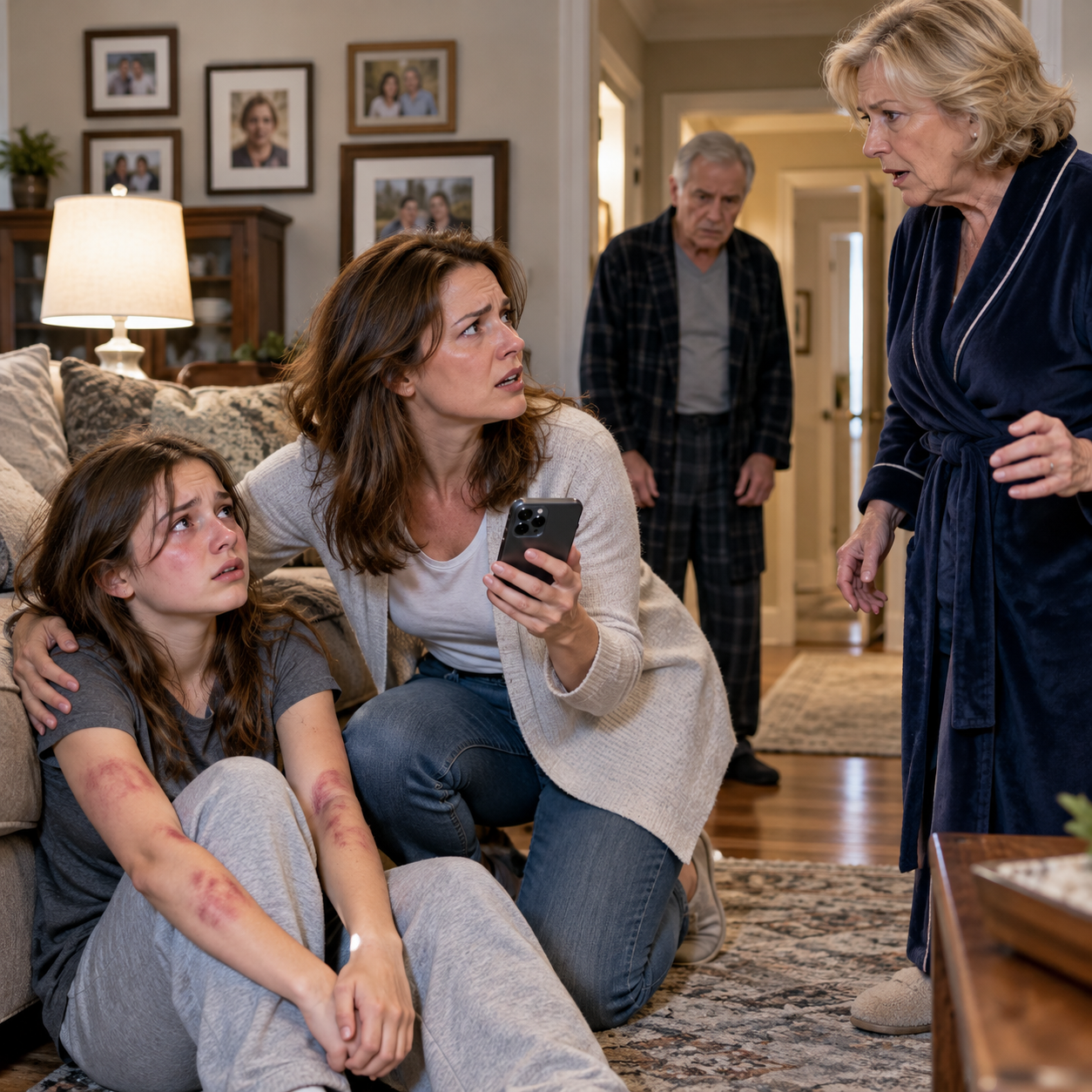
Part 2: Hospital questions uncover how Grandma silenced Emma’s escape
Emergency responders transformed my parents’ familiar den into something clinical.
A blood-pressure cuff appeared. Then a flashlight. Questions were asked one at a time.
My mother kept trying to supply answers.
“She had some kind of panic episode.”
“She slipped.”
“She hadn’t eaten enough.”
One paramedic finally said, “Ma’am, I need her to answer if she can.”
My mother looked offended, as though professionalism itself had become an accusation.
Emma remembered her name and where she was. She complained of a headache and dizziness, so they took her to the hospital.
Dad followed in his car.
Mom stayed home.
In the emergency department, fluorescent lights made four in the morning feel like a place outside ordinary time. I answered questions about medications, previous fainting, anxiety, allergies.
Mostly, I kept saying, “No,” and “I don’t know.”
The doctor eventually told me Emma had not suffered a serious head injury. She was exhausted and dehydrated and had likely hyperventilated before collapsing near the couch.
The marks on her arms were photographed and entered into her medical record.
That detail mattered more than I expected.
A photograph could not be persuaded that Mom had meant well.
When Emma and I were finally alone, I pulled my chair close to the bed.
She studied my face.
“Are you mad?”
“At you?”
She nodded.
I wanted to cry, but I knew that would make her take care of me.
“No.”
“Grandma said you’d be furious when you heard how I behaved.”
I rested my hands in my lap.
“Tell me what happened. Start wherever you want.”
Emma picked at the edge of the hospital blanket.
“My phone lit up at dinner.”
“With what?”
“A message from Sophie.”
“What did it say?”
Emma looked embarrassed.
“We were complaining about our families.”
Despite everything, I almost smiled.
“What did you write?”
“That Grandma thinks privacy is a criminal activity.”
That sounded exactly like Emma.
“She saw it,” Emma continued. “She wanted to read the whole conversation. I said no, so she took my phone.”
“What happened after that?”
“I told her I wanted to come home.”
I leaned closer.
“She said you were sleeping and I wasn’t waking you over teenage attitude.”
“Did you ask her to call me?”
“Three times.”
Emma swallowed.
“I tried Grandpa’s phone. She took that too.”
I looked toward the hospital room door.
“What did Grandpa do?”
“He kept saying we should both settle down.”
Both.
My fifteen-year-old daughter asking to call her mother, and my sixty-eight-year-old mother refusing her.
Equal participants, according to my father’s version of peace.
Emma said she packed her overnight bag anyway.
When she headed downstairs, Margaret followed.
“I tried to go past her,” Emma said. “She grabbed me.”
“One arm?”
“First one. Then both when I tried to pull away.”
“Did she hit you?”
“No.”
The answer was immediate.
“She didn’t hit me, Mom.”
“I believe you.”
“I don’t want anybody saying she did.”
“They won’t hear it from me.”
Emma stared toward the dark window.
“She kept saying I was acting crazy. Then I couldn’t breathe right. Grandpa got me water. Grandma went upstairs. My phone was on the kitchen counter, so I took it.”
“And called me.”
She nodded.
“When she came back down, I thought she was going to take it again. I tried to get to the door.”
Her fingers tightened around the blanket.
“Then everything got blurry.”
I reached for her hand.
She let me hold it.
Later, I found Dad in the waiting area beside a vending machine.
“Did you hear Emma ask for me?”
He rubbed both palms over his knees.
“Claire, there was a lot happening.”
“Did you hear her?”
“Yes.”
One word, spoken quietly.
“Why didn’t you call?”
“Your mother thought it would reward the behavior.”
“What did you think?”
He looked tired enough to be eighty.
“I thought Margaret would calm down.”
“And while you waited?”
His eyes filled.
“I should have called you.”
Normally, that would have been the moment when I comforted him.
Instead, I said, “Yes. You should have.”
And I let him sit with it.
Part 3: Old family patterns surface as blame spreads outward
Emma slept almost twelve hours after we got home.
I spent most of that day noticing things I had previously filed under Grandma being Grandma.
Mom opening Emma’s backpack without asking.
Mom demanding passwords for devices she had not purchased.
Emma requesting that I knock before entering her room because “Grandma never does.”
Once, after an argument the previous spring, Emma had asked not to stay overnight at my parents’ house.
I had asked, “Did Grandma hurt you?”
Emma had said no.
I had treated that answer as proof that everything was fine.
Now I understood how narrow my question had been.
My childhood had trained me to accept inspection as love. Closed bedroom doors were suspicious. Private diaries invited questions. If Mom became angry, Dad’s solution was always some version of, “Don’t give her more to react to.”
I had grown up.
The instruction had survived.
Three days after the hospital, Mom called.
“Claire, this cannot continue.”
I stood at my kitchen sink, watching Emma through the window as she sat on the back steps with a sweatshirt around her shoulders.
“How is your granddaughter?” I asked.
Mom paused.
“I assume she’s recovering.”
“She is.”
“I love that girl more than anything.”
“I know.”
“Then stop treating me like I deliberately harmed her.”
I dried my hands slowly.
“I’m not talking about your intentions.”
“She was trying to storm out of my house in the middle of the night.”
“She was trying to come home.”
“She was hysterical.”
“She asked for me before she became hysterical.”
Silence.
Then Mom said, “I see Thomas has decided to make me the villain.”
“Emma told me.”
“You have no idea what she said to me.”
“I’m not asking whether she was respectful enough to earn permission to call her mother.”
Mom’s breathing sharpened.
“She was in my care.”
“Yes.”
“That means I had responsibilities.”
“It did not mean you became her parent.”
“I knew you would come running the second she called.”
There it was.
Not misunderstanding.
Not bad timing.
A decision.
“You knew I would come get her?”
“Of course I knew.”
“And that’s why you wouldn’t let her call?”
Mom hesitated.
“I knew you wouldn’t support me.”
I closed my eyes.
“Thank you.”
“For what?”
“For finally answering the question.”
Relatives began contacting me within days.
An aunt wrote that family conflicts should remain private.
A cousin reminded me that my parents had given me years of free child care.
Emma saw one message over my shoulder.
“Would it be easier if we just called it an accident?” she asked.
We were at the kitchen table eating grilled cheese.
“Easier for who?”
She tore a corner off her sandwich.
“Everybody.”
“For you?”
She shook her head.
“Then everybody doesn’t get to purchase comfort with your silence.”
Her eyes became wet.
“I still miss her sometimes.”
That sentence hurt more than anger would have.
“You’re allowed to.”
“Even after what happened?”
“Yes.”
Emma looked toward the hallway, where an old photograph showed Mom teaching her to decorate Christmas cookies when she was six.
“Does missing her mean I have to forgive her?”
“No.”
“What if she really thought she was helping?”
“Then she can still take responsibility for what she did.”
Two weeks later, Dad visited us alone.
Emma agreed to see him only if I stayed.
He sat on the edge of the armchair, hands clasped.
“I failed you,” he told her.
Emma watched him cautiously.
“You asked for your mom. I heard you. I told myself staying calm was helping, but really, I didn’t want your grandmother angry with me.”
Emma glanced at me.
Then back at him.
“You’ve done that before?”
Dad swallowed.
“Yes.”
“With Mom?”
Another pause.
“Yes.”
He did not ask Emma to forgive him.
He did not ask for a hug.
When he left twenty minutes later, Emma leaned back against the couch.
“That was uncomfortable.”
“Very.”
She considered it.
“But not fake.”
“No.”
That was the beginning of something with him.
Not trust restored.
Just honesty finally given a place to start.
Part 4: A mother chooses safety without erasing complicated love
A month after the hospital, Mom asked to meet me.
I chose a coffee shop halfway between our houses.
She was already there when I arrived, turning a paper cup between both hands.
Seeing her almost undid me.
This was the woman who had stayed beside my bed through childhood fevers. The woman who taught me to parallel park, cried at my wedding, and held newborn Emma against her chest like she had been handed something sacred.
Love had never been the missing ingredient.
That was what made the damage so difficult to understand.
“I miss her,” Mom said.
“She misses parts of you too.”
Hope rushed across her face.
“Then enough is enough. Bring her over. We’ll talk this through.”
“What happens during this talk?”
Mom straightened.
“I apologize for the night getting out of hand. Emma apologizes for screaming at me. We put this behind us.”
I looked at her for several seconds.
“No.”
Her expression tightened.
“She does not apologize for trying to leave.”
“I didn’t say that.”
“You want her to apologize for what happened while you were refusing to let her leave.”
“She said cruel things.”
“She was scared.”
“She acted as though I were holding her prisoner.”
“You took her phone. You refused to contact me. You stopped her physically.”
Mom’s eyes flashed.
“I was keeping her from charging into the street.”
“You could have called me.”
“You would have taken her home.”
“Yes.”
“Exactly.”
The word sat between us.
Mom seemed to realize too late what she had admitted.
I leaned back.
“That’s the problem.”
“What is?”
“You weren’t stopping an emergency. You were stopping me from making a parenting decision you disliked.”
Her face reddened.
“I am her grandmother.”
“And I’m her mother.”
“So where does that leave me?”
“For now? No time alone with Emma.”
Mom stared at me.
“You’re punishing me.”
“No. I’m changing the conditions under which you see my daughter.”
“For how long?”
“I don’t know.”
Tears gathered in her eyes.
“I gave you everything, Claire.”
My throat tightened.
“You gave me a great deal.”
“I gave Emma everything too.”
“You gave her many good things.”
“And none of that matters?”
“It matters.”
I reached across the table but stopped before touching her hand.
“So does what happened.”
She covered her mouth.
For most of my life, tears from my mother had functioned like an alarm. Fix this. Surrender something. Make her feel better.
I let the feeling pass without obeying it.
“I love you,” I said.
Mom shook her head.
“People who love each other don’t do this.”
“People who love each other still need limits.”
“You’re choosing your daughter over your mother.”
The sentence was meant to wound me.
Instead, it clarified the whole problem.
“She’s my child. You were never supposed to be competing with her.”
I left before either of us could turn the conversation into something else.
There was no dramatic reunion afterward.
Dad slowly rebuilt contact because he accepted rules he did not control. He called before visiting. He listened when Emma was angry. When she said no to a visit, he did not ask me to override her.
Mom remained outside our daily life.
Three months later, she mailed Emma a birthday card.
There was no lecture inside. No request for forgiveness.
Only: I love you. I hope you’re doing okay.
Emma read it twice at the kitchen counter.
“Do I have to answer?”
“No.”
“Can I answer?”
“Yes.”
She put the card back in its envelope.
“Maybe later.”
“Okay.”
Months after that terrible night, Emma and I were eating Chinese takeout on the couch while a ridiculous game show played on television.
She laughed so hard at one contestant that a noodle slipped from her chopsticks.
“If that lands on the couch, you’re buying me a new one,” I said.
“With what money?”
“Sounds like a you problem.”
She threw a napkin at me.
Then she carried our empty cartons into the kitchen.
Her phone remained plugged into the charger across the room.
For weeks after the hospital, she had carried it everywhere. Into the bathroom. Out to the mailbox. From one end of the couch to the other.
She used to sleep with it beneath her pillow.
That night, she walked away from it without thinking.
I watched the dark screen beside the charger.
Then Emma called from the kitchen, asking whether I wanted ice cream.
“Obviously,” I said.
She returned with two bowls and dropped beside me.
“What are you smiling about?”
“Nothing.”
“You’re weird.”
“Probably.”
Her phone stayed six feet away.
I never mentioned it.
I understood what it meant.
My daughter no longer believed she had to keep an escape route in her hand every second she was home.
The End .
All characters and events in this story are fictional, created for storytelling and entertainment purposes. Thank you sincerely for reading. Your feedback and support are invaluable and motivate me to continue sharing more stories with you.


