
## Part 2: Behind the Marble Pillar, My Brother Tried Buying Our Silence
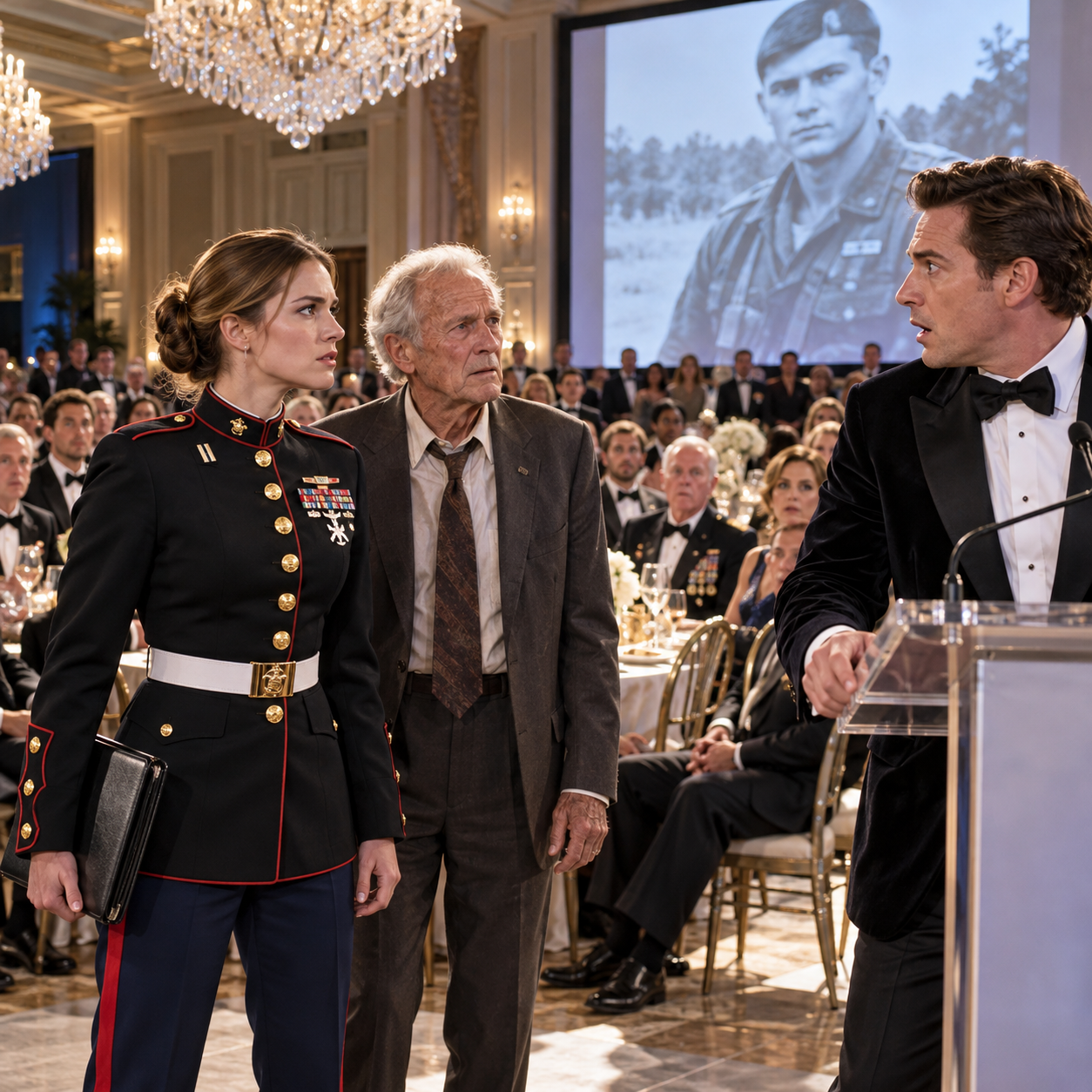
Garrick recovered quickly enough to gesture toward the audiovisual technician. A promotional video began playing, filling the ballroom with orchestral music and carefully edited images of veterans shaking hands with smiling executives. While the guests turned toward the screen, my brother hurried down the stage steps, weaving between tables until he intercepted us beside a marble pillar. His fingers closed around my uniform sleeve. “Bryn, what in God’s name are you doing? I told you I handled Dad’s transportation.”
I looked at his hand until he released me. “You had hotel security put our father outside in the freezing cold.”
“Lower your voice.” His eyes darted toward the front tables. “You have absolutely no idea how much money is at stake tonight.”
Dad stood beside me, holding the handle of his old duffel bag. “Son, I didn’t mean to cause trouble. I just wanted to hear your speech.”
Garrick barely looked at him. “Dad, we’ve discussed this. These people expect a certain presentation, and showing up dressed like you’re visiting a hardware store doesn’t help.”
I felt Dad’s shoulders sink. He had once spent an entire winter working overtime to buy Garrick his first car, and now that same son couldn’t bear the sight of him in a room full of strangers.
Garrick stepped closer. “Listen carefully. The executives from Aegis Dynamics are sitting at table one. Colonel Harlan Sterling is about to approve a two-hundred-fifty-thousand-dollar matching endowment. If Dad starts talking about factory work instead of our corporate mission, he’ll undermine months of negotiations.”
“Your mission?” I asked. “Or your image?”
His jaw tightened. “This is how major philanthropy works, Bryn. You wouldn’t understand.”
I nearly laughed. I’d spent years following procurement records, checking financial discrepancies, and explaining why impressive presentations meant nothing without supporting documentation. But I didn’t want to humiliate him for the sake of humiliation. I wanted him to explain why he’d used our father’s name to collect donations for a machine shop Dad knew nothing about.
“Where is the vocational training center, Garrick?”
His expression changed.
“What?”
“The one your foundation says Dad supervises. Where is it?”
For a moment, the only sound between us was the music playing from the promotional video. Then Garrick pulled his phone from his pocket and began tapping its screen with shaking fingers.
“I’ll transfer Dad twenty thousand dollars tomorrow,” he said. “Call it compensation for the transportation misunderstanding. Just take him home before Sterling notices.”
Dad recoiled slightly. “I don’t want your money.”
Garrick ignored him. “Bryn, I’m asking you as your brother. Please don’t destroy everything I’ve built over one uncomfortable evening.”
Before I could respond, a deep voice sounded behind us.
“Arthur Vance?”
A silver-haired gentleman in a charcoal suit stood a few feet away, accompanied by the foundation’s chief legal counsel. His face showed unmistakable recognition as he compared Dad with the younger soldier projected above the ballroom.
“I’m Harlan Sterling,” he said, extending his hand. “It’s an honor to finally meet you, Mr. Vance.”
Dad shook it firmly. “Pleasure’s mine, Colonel.”
Sterling studied him. “Your son just told three hundred people you were bedridden in Peoria.”
Garrick moved between them, forcing a laugh that sounded painfully unnatural. “Dad decided to surprise us. Unfortunately, he gets a little disoriented late at night. My sister was just helping him back to the car.”
Dad looked at Garrick as though something inside him had finally broken.
“Disoriented?” he repeated softly.
I stepped beside my father. “Colonel Sterling, my father knows precisely where he is. He also knows his own son had security remove him from this hotel.”
Sterling’s expression hardened. Behind him, the foundation’s lawyer stopped adjusting his cufflinks.
Garrick leaned toward me. “Bryn, don’t.”
But Sterling was no longer looking at my brother.
He was looking at the leather portfolio beneath my arm.
“Captain Vance,” he said, “is there something about this foundation that I should know before my company signs that endowment?”
I opened the portfolio.
“Yes, Colonel. There are several things.”
## Part 3: The Evidence Exposed a Four-Hundred-Thousand-Dollar Lie Before Three Hundred Donors
I placed the first document in Colonel Sterling’s hands: an enlarged printout of the security-camera photograph, complete with its 11:45 p.m. timestamp. Dad sat in the center of the image, alone on the concrete, while the hotel’s service dumpsters stood behind him. Sterling studied the picture without speaking. When he finally looked up, I saw his eyes move from Dad’s worn shoes to Garrick’s expensive tuxedo.
“My brother told you our father was too ill to travel,” I said. “But Dad was here all along. Garrick had him removed because he didn’t want you asking questions.”
Garrick reached toward the photograph. “That image is completely out of context.”
“Then explain the context,” Sterling said.
My brother opened his mouth but found nothing to say.
I withdrew the foundation’s tax filings, the corresponding state business registrations, and copies of its fundraising materials. “Two weeks ago, Dad asked me to review paperwork naming him an honorary director. I began comparing the foundation’s public financial reports with its claims to donors. The records raised questions I couldn’t ignore.”
I laid the highlighted pages across a vacant table. “The foundation reported consulting expenses amounting to approximately seventy-eight percent of its charitable contributions. The payments were directed to three private companies, all registered under Garrick’s ownership.”
The legal counsel leaned forward and examined the numbers. His expression tightened as he turned through the supporting documents.
“These aren’t ordinary administrative expenses,” he murmured.
“Not if the services were never provided,” I replied. “And your fundraising materials say four hundred thousand dollars was raised to establish a vocational machine shop under Arthur Vance’s supervision. Dad has never supervised that program, and I haven’t found evidence that a single machine was purchased.”
Sterling slowly turned toward Garrick. “Where is the facility?”
“We’re still finalizing the operational phase.”
“Your brochure says it opened eight months ago.”
“That was a projected launch date.”
“Then why does your website include photographs of veterans supposedly training there?”
Garrick wiped his forehead with a folded handkerchief. “Those were illustrative images. This is becoming a misunderstanding about marketing language.”
Dad stepped forward. His voice was quiet, but every word landed heavily. “Garrick, you told me those donations would teach injured boys how to work with their hands again. You said they’d have somewhere to go when they came home.”
My brother couldn’t meet his eyes.
“Did you ever build that shop, son?”
Garrick stared at the carpet.
The promotional video ended, leaving the ballroom abruptly quiet. Guests at the nearest tables had stopped eating, their attention fixed on our conversation. Word traveled outward until the whispering faded beneath the chandeliers and the enormous room fell still.
Sterling studied the documents for another moment. “Counsel, preserve these records. I want our compliance department involved before another dollar moves.”
The attorney nodded. “I’ll need the foundation’s complete accounting, including invoices, bank transfers, and related-party contracts.”
Garrick took a desperate step toward Sterling. “Harlan, we’ve known each other for years. Surely we can handle this privately.”
Sterling looked past him toward the portrait of Arthur Vance towering over the stage.
“You asked me to donate because you said your father taught you honor,” he replied. “I’m beginning to wonder whether you ever listened.”
Then he climbed the three carpeted steps to the podium and tapped the microphone.
The sharp sound echoed through the room.
“Ladies and gentlemen,” he began, “on behalf of Aegis Dynamics and our participating defense industry partners, I am announcing an immediate administrative hold on tonight’s proposed two-hundred-fifty-thousand-dollar matching endowment, pending an independent forensic review of the Valor Horizon Foundation.”
Someone dropped a spoon. At table six, a businessman closed his checkbook. Chairs scraped against the marble floor as donors began standing, whispering urgently to one another.
Sterling continued, “Our commitment to wounded veterans remains unchanged. But every organization seeking that funding must demonstrate that its promises are supported by its records.”
The foundation’s legal counsel approached Garrick and spoke within my hearing. “These discrepancies require formal reporting. I’ll be contacting the board and the state attorney general’s charitable oversight office on Monday.”
Garrick stared at him. “You’ll destroy us.”
“No,” the attorney answered. “I have a responsibility to establish what happened.”
My brother turned toward Dad, searching for the familiar forgiveness that had rescued him throughout his life.
“Dad, please. Tell them this is a misunderstanding.”
My father said nothing.
For the first time, Garrick’s expensive ballroom had become a place where money couldn’t purchase the answer he wanted.
## Part 4: My Father Finally Spoke, and the Truth Changed Everything
Garrick followed Dad toward the ballroom entrance, his polished shoes clicking against the marble. The guests were leaving in scattered groups, abandoning half-finished desserts and untouched champagne beneath the enormous photograph of a young soldier. My brother caught Dad beside an arrangement of white roses. “If they freeze the accounts, the foundation could collapse. Everything I’ve spent ten years building will be gone.”
Dad turned slowly. “You mean everything other people paid for?”
Garrick flinched. “I built this to honor you.”
“No, son.” Dad buttoned his wool coat with fingers stiffened by years of labor. “You built something that looked like honor. There’s a difference.”
For several seconds, neither of them moved.
Then Dad lifted his duffel bag. “I spent forty years working with steel, Garrick. When a frame’s rotten underneath, another coat of paint won’t keep the roof standing. You knew that machine shop wasn’t there, but you kept collecting money from people who believed you.”
My brother’s eyes filled. “Dad, I can fix this.”
“Then tell the truth. Every bit of it.”
Dad walked away before Garrick could answer.
Outside, the wind struck us as we crossed beneath the hotel’s glowing entrance lights. I offered to carry his bag, but he shook his head and held it tighter. When we reached my car, he stopped and looked through the glass doors at the ballroom where his photograph still hung.
“I should have known,” he whispered.
“You trusted your son.”
“I gave him money because I wanted him to have opportunities I never had.” Dad swallowed. “I never imagined he’d use my name to take opportunities away from other veterans.”
I placed my hand over his. There was no speech I could give that would repair the hurt in his face.
The months that followed were difficult. An independent review and subsequent state investigation confirmed the financial discrepancies in Valor Horizon’s records. Investigators traced charitable donations through Garrick’s consulting companies and established that the advertised vocational machine shop had never operated as represented. The foundation was dissolved, and its remaining assets were directed toward restitution for misused charitable funds.
Garrick eventually entered a plea agreement involving the diversion of restricted charitable money. He received probation, was barred from holding a leadership position in charitable organizations under the terms of his agreement, and sold his downtown condominium to help satisfy his repayment obligations. The newspapers described his downfall as a dramatic financial scandal.
But Dad never called it that.
He called it a waste.
For several weeks, Garrick sent long letters explaining how financial pressure, ambition, and the need to appear successful had gradually overtaken his judgment. Dad read every one without answering. Then he sent a single handwritten response: “I still love you. But loving you doesn’t mean pretending you didn’t hurt people. Do the work of making it right.”
I didn’t ask Dad whether he would ever forgive him. That decision belonged to him.
Meanwhile, Colonel Sterling and the defense industry coalition refused to abandon the veterans they’d intended to support. After reviewing several established programs, they redirected the proposed $250,000 endowment to a properly audited vocational apprenticeship initiative on Chicago’s South Side. The new facility offered practical training, certified instruction, and job placement assistance for former service members struggling to return to civilian employment.
Sterling personally called Dad and asked whether he knew an experienced machinist who might help supervise the shop floor.
Dad laughed. “Colonel, I know an old fellow with a bad knee who still remembers how to use a lathe.”
“Would he happen to be available Monday morning?”
For the first time in weeks, I heard genuine excitement in my father’s voice.
Last Saturday, I arrived at the new training center carrying two cups of black coffee. Through the safety glass, I watched Dad standing beside a heavy steel lathe, wearing a clean blue shop apron and explaining a calibration adjustment to two young Marine veterans. One of the men had a prosthetic leg. The other was learning to trust his hands again after a difficult transition out of military service.
Dad demonstrated the adjustment, then stepped aside so they could repeat it themselves. When the machine began turning smoothly, both men grinned. Dad smiled wider than either of them.
I stood there for a moment, remembering his hunched shoulders beneath the hotel security camera, his duffel bag resting on the freezing curb. That night, Garrick had treated him as an embarrassment because his clothes were worn and his walk was imperfect. Yet here, surrounded by people who actually needed his knowledge, my father seemed taller than he ever had beneath those chandeliers.
He spotted me through the glass and waved me inside. “Coffee’s getting cold, Captain.”
I handed him a cup. “How’s the new job?”
He looked across the shop at the veterans examining their first finished piece of work. “Best one I’ve ever had.”
Then he reached into his apron pocket and handed me a small brass nameplate. The men had made it for his workbench, polishing the edges until they shone. It read: ARTHUR VANCE — MASTER MACHINIST, VETERAN, MENTOR.
Dad ran his thumb across the lettering.
“Funny thing,” he said. “Your brother spent all that money putting my face on a giant screen. These boys put my name on a little piece of brass, and somehow it means more.”
I wrapped an arm around his shoulders.
People have asked whether I regret what happened to Garrick that night, whether nineteen minutes was too short a time to dismantle a man’s reputation. I always tell them the same thing: those nineteen minutes didn’t destroy my brother’s accomplishments. They revealed the difference between what he’d promised and what he’d actually done.
I didn’t take my father’s honor away from Garrick. It had never belonged to him.
And as I watched Dad return to the lathe, guiding two younger veterans toward their own futures, I finally understood something my brother had missed for years.
Real honor doesn’t require a velvet tuxedo, a charitable foundation, or a room full of wealthy people applauding your name.
Sometimes it wears an old wool coat, carries a patched canvas bag, and waits quietly on a curb, still hoping the people it loves will remember what matters.
THE END.
All characters and events in this story are fictional, created for storytelling and entertainment purposes. Thank you sincerely for reading. Your feedback and support are invaluable and motivate me to continue sharing more stories with you.


