
Part 2: Seven Years Of Ordinary Love Concealed An Extraordinary Family Secret
That summer, I joined the county highway department, where my supervisor, Gunner, taught me to operate snowplows, maintain equipment, and recognize dangerous roads before they became impassable. By my second winter, I had a regular route that passed near Grandma’s ridge. Whenever a storm came through, I made sure her road was cleared early, even when the official route placed it farther down the list. Gunner noticed, of course, but apart from one raised eyebrow over my mileage sheets, he never complained.
Life with Grandma settled into routines that seemed unremarkable until I lost them. Every Saturday we ate breakfast at Dee’s Café in Henning, where she ordered eggs, dry wheat toast, and coffee she invariably complained was too weak. Dee would threaten to stop refilling her cup, Grandma would insist she was a paying customer, and somehow four cups disappeared before we left. On Sundays, we attended church, and afterward she made me help with dinner while explaining which neighbors were arguing, getting married, or pretending their children had better manners than they did.
She also taught me to bake pie, a skill that required more patience than repairing a snowplow. After I ruined several crusts, she examined my flour-covered hands and said they reminded her of Grandpa’s, always too warm for delicate pastry but dependable when something heavy needed carrying. One winter morning, she persuaded me to take her along for part of a plow run, sitting proudly beside me with a thermos tucked between her boots. When Gunner discovered my unauthorized passenger, he stared at me across his desk and finally declared that Grandma must have been conducting a county safety inspection.
Then there was Lena, our rural mail carrier. She was my age, drove a white postal Jeep, and had a laugh Grandma could recognize before the vehicle came around the bend. Whenever I happened to be home near delivery time, Grandma suddenly needed somebody to take letters down the driveway because her hip was bothering her. Lena and I exchanged awkward conversations about snow, road conditions, and whatever other subjects two shy people could invent in thirty seconds, while Grandma watched shamelessly from the kitchen window.
“Your grandfather asked me to dance the first evening we met,” she reminded me whenever I returned without Lena’s phone number. I pointed out that delivering the mail wasn’t exactly a social occasion. Grandma would shake her head, reach for her knitting, and mutter that some men required more encouragement than others.
There was one habit she never explained. Every December, she wrote a Christmas card to my father, made an identical copy, and placed the duplicate inside a large envelope in her locked desk drawer. She mailed the original herself, regardless of the weather, and when I asked what the cards contained, she told me they were part of an offer she’d made him. After the third Christmas passed without a response, I stopped asking.
My mother called occasionally, usually before holidays, and each conversation began with polite questions about Grandma’s health before drifting toward the property. Had Grandma mentioned her plans? Was she talking about selling? Had she become more reasonable about Kenna? Mom never asked whether I was happy, whether work was going well, or whether I needed anything, so eventually I learned to end the conversations before those questions arrived.
Every July, my parents visited for Grandma’s birthday, bringing supermarket cake and the uncomfortable atmosphere of a business meeting. Dad barely acknowledged me, although he never missed an opportunity to ask about property taxes or whether Grandma could still manage the stairs. Kenna behaved pleasantly enough, but she wandered through the rooms inspecting furniture and windows, as though evaluating a place she had already reserved. Brady usually followed her, looking increasingly embarrassed.
I discovered what my parents were telling people during a church supper in my second year away. Dad’s cousin Mara approached me beside the casserole dishes and casually mentioned that Darren was worried I’d moved in with Grandma to secure an inheritance. When I explained that my father had ordered me out of his house, Mara merely pursed her lips and said families often remembered arguments differently. By the following summer, people I barely knew were making jokes about how convenient it must be to have free housing.
The fourth year, Dad cornered me at a gas station while I was filling my truck. His tile-company van stood at the next pump, its blue lettering reminding me of the spring years earlier when Grandma had visited our old house repeatedly, shortly before Dad suddenly purchased new equipment. He asked whether I could put one more document in front of Grandma, promising it would take only a few minutes. When I refused, he leaned across the pump and told me I was nothing more than unpaid help, somebody who would be homeless again the moment she died.
“Have you considered visiting her without bringing paperwork?” I asked. Dad’s mouth tightened, and he said he didn’t need advice from somebody who drove a snowplow for a living. I finished pumping gas, got in my truck, and left him standing beside the business Grandma had once seemed unusually interested in. That evening, when I described the encounter, Grandma listened from her chair, her unfinished word puzzle resting on her knees. “He’s making a terrible mistake with the time he has left,” she said, without explaining further.
At her eighty-fourth birthday, Kenna arrived carrying her six-month-old daughter, Ivy. While Brady helped me clear plates, Kenna stood in the upstairs hallway studying the small bedroom that caught the morning sunlight. “This would be perfect for a nursery,” she told Grandma, bouncing Ivy against her shoulder. Grandma wiped her hands on her apron and reminded her that it was my room, but Kenna smiled and said arrangements could always change.
Grandma said nothing further, although she cut the birthday visit short by announcing she needed to rest. Three months later, on a golden October afternoon, she asked me to drive her around the countryside. We passed the dance pavilion where Grandpa first stepped on her feet, the elementary school where she’d cooked lunches for thirty-one years, and the church where they’d married with forty dollars and a borrowed dress. Finally, we stopped across a field from the farmhouse, and she produced an apple pie, two forks, and a folded dish towel from her picnic basket.
We sat on the tailgate watching the evening light spread across the roof Grandpa had built. Grandma told me the previous seven years had been among the happiest of her life, then squeezed my hand when I tried to dismiss the compliment. “Everything important is taken care of,” she said, glancing toward the house. “You don’t need to worry about what comes afterward.”
Before we drove home, she asked whether Lena was still single. I groaned, and Grandma laughed until she had to wipe her eyes with the corner of her sleeve. The next morning, for the first time in seven years, I came downstairs before her and found the coffeepot empty. She had passed away peacefully during the night, in the bedroom she’d shared with Grandpa.
At eighty-four, Grandma had managed to leave this world exactly where she wanted to be. She had even arranged and prepaid her funeral months earlier, selecting the hymns, the flowers, and the food for the church luncheon. I thought she had simply been practical. I didn’t yet understand that she’d also spent those final months making sure certain people could no longer rewrite her wishes.
Part 3: Grandma’s Will Revealed The Debt My Father Had Hidden
Grandma’s funeral filled the little Lutheran church with people whose lives she’d touched in ways I was still discovering. The five Lindberg brothers, whom she’d fed at elementary school decades earlier, occupied an entire pew, and Dee closed her café so she could attend. Gunner appeared in an old brown sport coat, while Lena arrived in her postal uniform and squeezed my hand as the congregation filed outside. My parents sat near the front, but Dad seemed more interested in speaking with the funeral director about estate arrangements than sharing memories of his mother.
During the luncheon, Kenna approached me with Ivy asleep against her shoulder. She wanted to know whether Grandma had stored any leftover paint from the upstairs bedroom, since she and Brady were considering lighter colors for the nursery. I told her we hadn’t even buried Grandma long enough for the flowers to wilt. Kenna looked embarrassed for a moment, then insisted she was only trying to plan ahead.
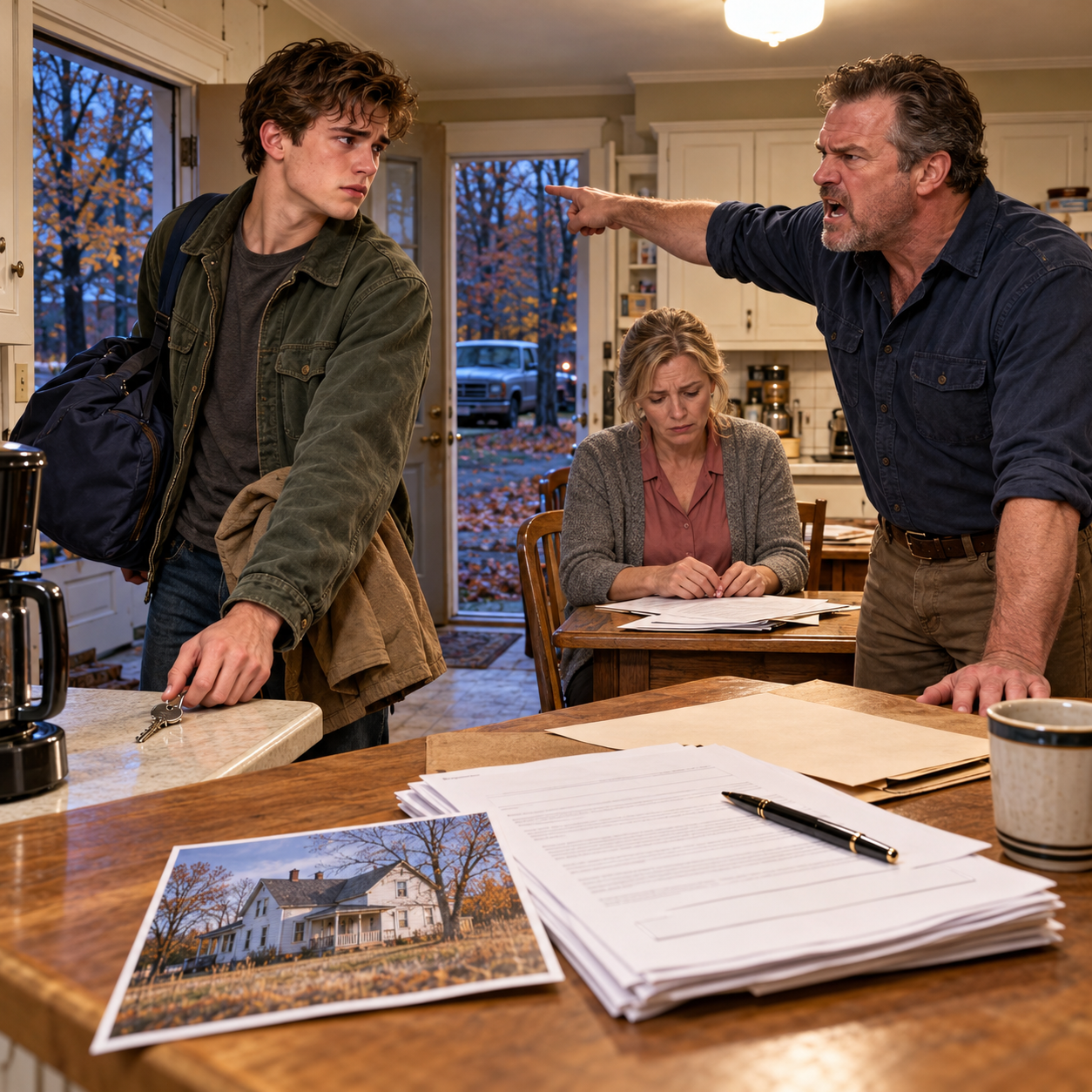
Two mornings later, Brady’s pickup climbed the ridge pulling a sixteen-foot enclosed trailer, followed closely by my parents’ car. Inside the trailer were cardboard boxes marked KITCHEN and IVY, along with the pieces of a baby’s crib. Mom climbed onto the porch and explained that Kenna had already given notice on her duplex, so they hoped to begin moving things inside. When I told her Grandma’s attorney had instructed me to keep the house secured until Thursday’s family meeting, Dad reminded me that he was Grandma’s only son.
“Then Thursday should clear everything up,” I answered, keeping the screen door between us. Dad wanted Brady to leave the trailer in the yard, but I refused, and Brady quietly returned to his truck. Mom informed me that Kenna needed the house by the first of the month and suggested I begin searching for an apartment. I watched them disappear down the driveway, then returned to Grandma’s kitchen, where her unfinished word-search book still occupied her usual place.
Mr. Strand’s office in Fergus Falls smelled of old paper and furniture polish. My parents, Kenna, and Brady were already seated when I arrived, and Mom announced that my sister and the baby needed the property more than somebody who spent his winters driving a snowplow. Mr. Strand adjusted his glasses and opened a brown folder, explaining that Grandma had specifically requested everyone hear her wishes together. He first named me personal representative of her estate, then read that the farmhouse, its outbuildings, forty acres, and their contents belonged to me.
Dad immediately questioned Grandma’s mental condition, accusing me of taking advantage of an elderly woman. Without raising his voice, Mr. Strand produced her signed March will, the witnesses’ documentation, and a physician’s letter confirming her capacity when she executed it. Kenna received Grandma’s sewing machine and wedding photographs, while Dad inherited Grandpa’s old pocketknife. Then the attorney placed a separate document on the table and began reading about an April 2015 loan.
Grandma had lent Dad $58,000 to rescue his failing tile business, secured by a recorded mortgage against my parents’ house. The signed promissory note made the unpaid balance due after her death, and Grandma had transferred her rights to that debt to me through her estate plan. Dad protested that she’d forgiven the loan years earlier, but Mr. Strand opened another envelope. Seven Christmas cards slid onto the table, each an exact copy of one Grandma had mailed him between 2019 and 2025.
Mr. Strand read them chronologically. The first offered to forgive the entire debt if Dad would simply call me and begin repairing our relationship; the following cards repeated that offer, sometimes mentioning my work, sometimes reminding him how much time had passed. By the final Christmas, Grandma had written that she was growing old and could not keep offering forever. Kenna turned toward Mom and demanded to know why she’d been promised the farmhouse when a substantial mortgage debt still existed.
Mom couldn’t answer, and Brady stared at the floor. Mr. Strand unfolded one last letter, dictated by Grandma that March, explaining that she’d eventually understood her son was waiting for her death because he expected both the house and the unpaid loan to return to him. She had given him seven years to prove that his family mattered more than his pride. Instead, she had chosen to leave the property and money to the grandson who had stayed, adding a reminder that I should repair the aging roof and finally invite Lena to breakfast.
Dad pushed his chair backward, insisting the arrangement was vindictive, but Mr. Strand calmly explained the ninety-day payment terms and his right to seek independent legal advice. My father left Grandpa’s pocketknife behind, and Mom silently collected it before following him outside. For seven Christmases, Grandma had offered him fifty-eight thousand dollars in exchange for one phone call to his son. He had never made that call.
Part 4: The Final Payment Closed A Debt But Not Our Family Wounds
My parents were waiting in the parking lot when I came downstairs. Dad approached me, asking me to forget the debt because family shouldn’t treat one another like creditors, while Mom wanted to know where they were supposed to find that much money. I reminded Dad that Grandma had offered to forgive every dollar, year after year, and that he could have accepted without spending a penny. He accused me of choosing money over family, but I left without arguing, carrying the attorney’s folder against my chest.
A month later, Mom called to explain that their bank had refused to refinance the property on terms they could manage. She asked whether I would accept monthly installments spread across twenty years, promising that Dad would eventually find a way to make things right. I told her I would handle the note through Mr. Strand and honor its existing terms. She asked whether I was enjoying this, and I said nothing because there was no answer that would satisfy her.
Dad eventually withdrew money from his retirement savings, accepting the financial consequences, then sold his business van and several expensive tools to cover the remaining balance. He closed his tile company and took a job with a contractor near Alexandria, working on somebody else’s schedule with the same painful knees. Kenna and Brady lost their duplex after the landlord found another tenant, and they moved into a smaller apartment near the highway. She sent me one message asking whether I’d known about Grandma’s Christmas cards, and when I told her I hadn’t, she never replied.
The story spread through town, largely because Kenna told Mara, who apparently considered private family business an appropriate subject for church conversation. One Saturday at Dee’s Café, Dee mentioned hearing that Dad had sold his van and asked whether the seven Christmas cards were real. When I confirmed it, she rested both hands on the counter and looked toward Grandma’s empty booth. “Forty years she ate breakfast here,” Dee said quietly, “and she never spoke badly about that boy, not once.”
On January 23, the ninetieth day, Dad drove up the ridge carrying a cashier’s check for $58,000. We signed the mortgage-release paperwork Mr. Strand had prepared, using Grandma’s good pen on the porch railing. Dad lingered afterward, staring toward the upstairs window, and said I could have called him during those seven years, too. I told him I had been eighteen when he sent me away, and that Grandma had offered him seven separate chances to come back.
He tucked his hands into his coat pockets and walked down the steps without replying. I watched until his car disappeared around the bend, then went inside and placed Grandma’s pen back in its drawer. The money would pay for the roof she had warned me about, and the remaining amount would help maintain the house and land she loved. It couldn’t replace her, and collecting it hadn’t given me the father I’d wanted.
That night, fourteen inches of snow covered the ridge. I was operating my plow before sunrise, clearing the roads while the rest of the county slept, and although Gunner had changed my assigned route months earlier, I made sure the road to Grandma’s house was passable. He signed my work log without comment. When I returned home that afternoon, I filled a thermos with fresh coffee and walked down to the mailbox just before Lena’s Jeep appeared.
She rolled down her window, saw the thermos, and glanced toward the empty kitchen window where Grandma used to stand watching us. “She isn’t up there sending you anymore,” Lena said gently. I handed her the coffee and admitted that this time I’d come down because I wanted to. Then, after seven years of weather reports and missed opportunities, I asked whether she’d have breakfast with me on Saturday.
Lena laughed, that wonderful laugh that carried all the way up the driveway, and told me Grandma had been asking her about it every week for nearly a year. Saturday morning, Dee seated us in Grandma’s favorite booth without needing directions. I ordered two eggs over medium, dry wheat toast, and coffee, exactly as Grandma had ordered for decades. After the first sip, I complained that the coffee tasted weak, and Dee shook her head with a smile before filling my cup again.
Lena reached across the table and took my hand. Outside, sunlight glittered on the snow-covered street, and for the first time since Grandma’s funeral, I could picture a future in that farmhouse without feeling that I was leaving her behind. Grandpa’s crooked bedroom wall was still there, the roof would soon be repaired, and Grandma’s old kitchen would be ready for every ordinary Saturday still to come. I finished four cups of coffee, just as she always had.
The End .
All characters and events in this story are fictional, created for storytelling and entertainment purposes. Thank you sincerely for reading. Your feedback and support are invaluable and motivate me to continue sharing more stories with you.


