
## Part 2: A Hollow Wall And The Letters Raymond Hid
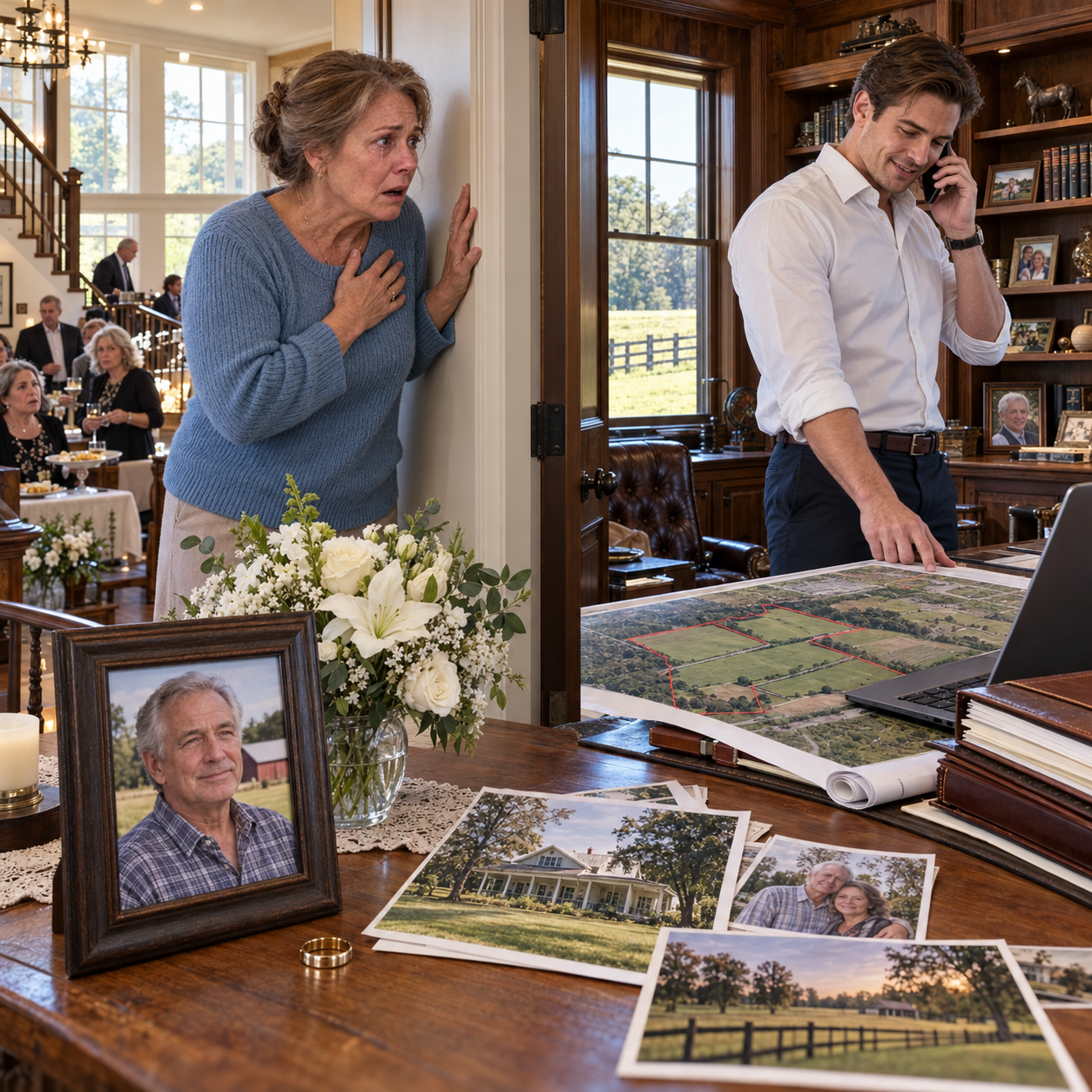
Over the next several mornings, I began paying attention to things I’d previously dismissed. Raymond had spent unusually long hours in his study during his final months, sometimes closing the door when Marcus called. He had visited Arthur Bolden more than once and brought home folders he wouldn’t leave on his desk. When I asked about them, he always promised we’d talk after he finished organizing everything.
On the sixth morning after the funeral, I woke before five and heard Marcus moving around downstairs. At breakfast, he mentioned that selling some of the property might make my retirement easier. Tanya nodded and talked about the expense of maintaining an older house.
“Your father handled the repairs,” Marcus said. “You shouldn’t have to worry about all that now.”
“I’ve lived here nearly forty years,” I reminded him. “I know what the house needs.”
He smiled as if I’d said something sweet but impractical. I excused myself, telling them I wanted to sort through Raymond’s clothes alone. Tanya offered to help, but I declined before she could stand.
Raymond’s closet stretched along our bedroom’s north wall, with pine shelves he’d built before Derek was born. His work shirts still smelled faintly of cedar soap and sawdust. I removed his fishing vest, folded two flannel shirts, and sat on the floor holding the worn brown boots he’d refused to replace. For several minutes, I could do nothing except remember him tying those boots every morning beside our bed.
Eventually, I reached for a cardboard box tucked behind his winter coats. As I pulled it toward me, my knuckles struck the back wall, producing a hollow wooden sound. I tapped again, then moved the box aside.
A narrow seam ran vertically beside the baseboard, almost invisible beneath the paint. I followed it with my fingers until I felt a small recessed metal catch. When I pressed it, something clicked, and the entire panel swung inward.
Beyond it was a narrow hidden room, scarcely larger than our bathroom. A folding chair stood beside a small workbench, with a steel file box and a desk lamp arranged neatly on top. I switched on the overhead light and immediately recognized Raymond’s block handwriting on a thick accordion folder.
“For Loretta.”
I sat down before opening it, suddenly afraid of what my husband had been preparing for.
Inside the first section were bank statements from an account in my name at a financial institution in Columbia. The balance was $240,000, accumulated through carefully recorded transfers over eleven months. Raymond had attached explanations of where the money originated and copies of the account documents, with a note directing me to verify everything with Arthur.
The second section contained a private investigator’s report. Forty-three pages described Marcus’s financial troubles, including roughly $160,000 owed to three creditors after several anticipated real estate commissions failed to materialize. His employer was also under investigation by the North Carolina Attorney General’s office over fraudulent zoning disclosures in Cabarrus County.
Raymond had underlined one sentence in the report: “Subject has repeatedly identified family property as a potential source of liquidity.”
My husband had discovered that Marcus wasn’t merely interested in our land. He was depending on selling it to escape debts that had already begun consuming his income.
The third section held correspondence from Arthur Bolden’s office confirming a revised estate plan. Raymond had transferred the farmhouse and all eight acres into a revocable living trust, arranging for me to become the sole successor trustee and beneficiary after his death. The documents included instructions concerning any attempt to challenge my capacity, along with records identifying the suspicious circumstances Raymond wanted our attorney to investigate.
At the bottom of the folder lay a sealed envelope bearing my name.
I recognized Raymond’s handwriting before I touched it. He had written the letter one rainy Wednesday evening while I slept down the hall. He reminded me of the first time we’d seen the property, when I’d stood in the field wearing my yellow coat and told him we should buy it before he’d finished showing me around.
Then his words became harder to read.
He explained that Marcus had contacted developers months earlier and made inquiries about zoning changes. Raymond had confronted him, but Marcus insisted he was only exploring opportunities. When Raymond discovered the extent of his debts and learned that someone had been asking about my health and ability to manage money, he went to Arthur.
“I should have told you sooner,” he wrote. “I thought I could settle it without making you afraid of your own son.”
A tear fell onto the paper. Raymond had spent his final months trying to protect me from a betrayal he could barely bear to name.
Near the bottom, he’d written that Arthur knew what to do, that the trust and money were meant to give me choices, not make decisions for me. His last words were the ones that finally broke through the careful composure I’d maintained since his death.
“You were always the stronger one, Loretta. I was simply fortunate enough to stand beside you.”
I held the letter against my chest and cried for the man who had carried this terrible knowledge alone.
Then my phone rang.
Marcus’s name filled the screen. When I answered, he sounded impatient beneath his practiced concern.
“Mom, Arthur’s office sent over some estate documents. I need you downstairs to sign them.”
I looked at the folder spread across Raymond’s workbench.
“Give me an hour,” I said. “I’m not feeling very well.”
He sighed. “All right. But we can’t keep putting this off.”
After the call ended, I opened my contacts and found Arthur Bolden’s number.
## Part 3: My Husband’s Last Instructions Became My First Defense
Arthur answered on the first ring. When I told him who was calling, he went quiet for a moment and asked whether I was somewhere private. I looked around Raymond’s hidden room, at the files arranged precisely where he had left them.
“I’m in a place my husband apparently thought I might need,” I said.
Arthur listened while I described the concealed room and everything I’d overheard after the funeral. He confirmed that Raymond had revised the trust and established safeguards after becoming concerned about Marcus’s intentions. A protective notice had already been submitted to the appropriate court officials, he explained, documenting Raymond’s concerns and ensuring that his office would be alerted if certain proceedings began.
“Your son cannot simply sell property held in that trust,” Arthur said. “And he cannot appoint himself your decision-maker by getting someone to sign a questionable assessment.”
I told him about Leonard Pratt. He asked me to repeat the name, then explained that Pratt had been associated with two earlier elder-fraud complaints in Spartanburg County. His supposed medical credentials were already under scrutiny.
Arthur’s voice softened. “Raymond worried you might spend so much time grieving for him that you wouldn’t recognize what Marcus was trying to do.”
“He was right about the grieving,” I said.
“He wasn’t wrong about your judgment.”
Arthur recommended a colleague named Nora Gaines, an attorney specializing in elder-law litigation. He offered to arrange a consultation that morning and instructed me not to sign anything Marcus presented. Before hanging up, I asked whether Raymond had seemed frightened during their last appointment.
“He was worried,” Arthur answered. “But he was also remarkably confident in you.”
I sat with those words for a moment before gathering the documents into my canvas tote bag. I photographed the contents of the hidden room and carefully closed the panel behind me. In the bathroom mirror, my face still looked exhausted, but I brushed my hair, washed my hands, and changed into a clean blue cardigan.
Downstairs, Marcus and Tanya were sitting at our kitchen table with a stack of papers between them. Bright yellow sticky flags marked several signature lines. Tanya had uncapped a pen and placed it beside an untouched cup of tea.
“There you are,” Marcus said, standing. “I was getting worried.”
“I’m sorry to keep you waiting.”
He moved a chair out for me. “These are standard probate and estate administration documents. They’d allow me to handle things while you’re recovering.”
I sat down and picked up the first page. The language was broader than his explanation, granting extensive authority over financial transactions and property decisions. Several provisions referred to powers that were not limited to helping with routine bills.
“Where did these come from?” I asked.
“Arthur Bolden’s office.”
“Did he send them directly to you?”
Marcus hesitated. “We discussed what needed to happen.”
“That’s interesting, because I spoke with Arthur this morning.”
Tanya stopped moving her pen. Marcus looked toward her, then back at me.
“There must be some misunderstanding,” he said. “I was trying to save you the trouble of all this.”
I pushed the documents away. “Arthur says he didn’t prepare them or authorize you to act on my behalf.”
Marcus’s expression tightened. “Mom, I don’t think you understand how complicated an estate can get.”
“I taught school for thirty-two years, Marcus. I know when somebody is answering a different question from the one I asked.”
He leaned back and rubbed his forehead. For the first time, I saw something beyond confidence in his face. He looked tired, the way Raymond sometimes had after a week of unpaid bills and equipment repairs.
“I have people depending on me,” Marcus said quietly. “You don’t know what’s happening with work.”
“Then tell me.”
He glanced at Tanya. “The company has problems. Some projects didn’t close. I’ve been carrying expenses I thought would be reimbursed.”
“One hundred and sixty thousand dollars?”
His eyes lifted sharply. Tanya turned toward him, and I realized she hadn’t known the exact figure.
“Where did you hear that?”
“Your father knew.”
The kitchen clock ticked above the refrigerator. Marcus stared at me, apparently trying to decide how much he could still deny.
I reached into my bag and placed Raymond’s accordion folder on the table. Marcus recognized the handwriting immediately, but Tanya leaned forward to read the label.
“Your father hired an investigator last October,” I said. “He knew about the creditors, the zoning inquiries, and the developer who wanted our property.”
Marcus made a faint sound of disbelief. “Dad had me investigated?”
“He tried talking to you first.”
“He didn’t understand what I was building.”
“He understood that you intended to sell land you didn’t own.”
Marcus pushed back his chair. “I was trying to make something out of an opportunity. That property could support a whole commercial project, and you’d have enough money to live comfortably anywhere.”
“Did you ask where I wanted to live?”
He looked toward the window. Beyond it lay the garden Raymond and I had cultivated for decades, the porch steps he’d repaired the previous summer, and the tree line where he’d spent his final morning.
“Mom, you can’t maintain all this forever.”
“Perhaps not,” I said. “But that decision belongs to me.”
I withdrew another document, the confirmation of the trust, and turned it toward him.
“Your father made certain of that.”
## Part 4: I Kept The Land And Lost My Illusions
Marcus read the first page slowly, then flipped to the second. He checked the signatures and dates, searching for something that might give him room to argue. Tanya leaned over his shoulder, but he moved the pages away from her.
“Since when did Dad set up a trust?” he asked.
“Four months before he died.”
“Without telling me?”
“Apparently he believed you might try to interfere.”
Marcus lowered the papers. “That’s ridiculous. I was his son.”
“So was Derek. Neither of you was entitled to the house while we were living in it.”
He pushed the folder toward me. “If this is because I mentioned selling, you’re making it sound worse than it was.”
I took a folded sheet from the last section and placed it beside his hand. It listed the name Leonard Pratt, along with copies of communications Raymond’s investigator had gathered concerning assessments and possible conservatorship proceedings.
“Tell me about this man,” I said.
Marcus didn’t touch the paper.
“He was supposed to help us understand your situation,” he finally answered.
“What situation?”
“You’ve barely slept. You forget meals. You couldn’t even handle the funeral arrangements without Derek.”
I watched him trying to make grief sound like incapacity. There was enough truth in his observations to make the dishonesty harder to forgive. I’d forgotten meals, lost track of dates, and stood in grocery aisles unable to remember why I’d gone there, but none of that meant I’d forgotten how to think.
“Did you tell Leonard Pratt that I couldn’t manage my own affairs?” I asked.
Marcus looked down. “I asked what options were available.”
“Before you ever asked me whether I wanted help.”
Tanya set her pen down and stood. She asked Marcus whether the conversations with Pratt were connected to the development proposal he’d shown her weeks earlier. He said it wasn’t her concern, but she didn’t sit again.
I explained that Arthur Bolden had already documented Raymond’s concerns and referred me to Nora Gaines. I also told Marcus that Nora was reviewing the records and would arrange for independent examination of the papers he’d brought into my home.
“The attorneys will decide what happens next,” I said. “I’m not going to threaten you, Marcus. But I won’t hide what you’ve done to protect your reputation.”
His face lost its color.
“You’d really take legal action against your own son?”
“I would rather have spent this morning choosing which of your father’s shirts to keep.”
He stared at the table for so long that I began noticing the little things around us. The coffee stain on Raymond’s favorite placemat. The chipped handle of the sugar bowl we’d received as a wedding present. The kitchen window through which I’d watched Marcus and Derek race across the backyard when they were boys.
Finally, Marcus spoke.
“I didn’t think he’d die so soon.”
I held his gaze. “What?”
“Dad had been talking about slowing down. Selling some equipment, maybe hiring somebody for the fields. I thought we’d have time to work something out.”
“He told you no.”
“He never listened to anything I said about the business.”
“Because it wasn’t your business.”
Marcus covered his eyes with one hand. He looked exhausted, frightened, and terribly young. For one fleeting moment, I remembered sitting beside his bed during thunderstorms, promising that nothing bad could reach him while I was there.
I still loved him. That was the part no amount of paperwork could erase.
But love couldn’t make his actions harmless.
Tanya collected her handbag and said she needed some air. When the back door closed behind her, Marcus turned toward me with red eyes.
“Mom, I’m in real trouble.”
“I know.”
“I thought the land could fix it.”
“You were willing to take away my home to fix your mistakes.”
He didn’t answer.
I stood and gathered the documents into my bag. I told him he needed to leave the farmhouse that afternoon and direct any further discussion of the estate through the attorneys. When he asked whether he could call me later, I said he could, but I couldn’t promise what I would be ready to say.
Six days later, Nora Gaines filed a formal elder-fraud complaint supported by the financial records and the suspicious paperwork. Marcus received notice of the investigation the following week. His proposed conservatorship petition was never filed, and the investigation into Leonard Pratt’s credentials was referred to the relevant licensing authorities and law enforcement.
Over the next three months, the North Carolina investigation into Marcus’s employer deepened, and the development company eventually collapsed. Marcus lost his position and remained responsible for his personal debts, while possible civil and criminal consequences were still being evaluated. Tanya ended their relationship shortly after the legal notices arrived and returned to Charlotte.
I didn’t celebrate any of it. There was no satisfaction in watching my child lose the future he’d imagined for himself, especially when some of the damage might take years to repair. But the uncertainty he faced belonged to the choices he’d made, not to a sacrifice I was required to make for him.
Derek visited the following weekend and sat with me at the kitchen table while I told him everything. He examined Raymond’s letter, read the trust documents, and spent several minutes looking out toward the back field.
“Dad knew you could handle this,” he said.
“He should have told me.”
Derek nodded. “Maybe he wanted to spare you.”
“I would rather have faced it with him.”
My oldest son reached across the table and covered my hand with his. We stayed that way until the afternoon light began fading across the floor.
The hidden room is still there. Sometimes I take a cup of coffee inside and sit in Raymond’s folding chair, reading his notes or looking at the little drawings he’d made of possible improvements to the house. In one notebook, he had sketched a larger vegetable garden along the southern fence, with rows for tomatoes, sweet corn, and sunflowers.
That April, Derek helped me turn the soil. Dewey came over with his old tractor, and three neighbors brought seedlings, fencing, and more gardening advice than any woman could reasonably follow. We worked until sunset, stopping occasionally when somebody remembered a funny story about Raymond.
Marcus and I have spoken only a few times since then. Our conversations are brief, awkward, and sometimes painful, but I’ve told him that if he wants a relationship with me, it has to begin with accountability rather than another request for money. I don’t know whether we’ll ever be close again.
The farmhouse remains mine, protected through the trust Raymond established. All eight acres are still intact, and no commercial road crosses the fields where he spent his last morning. When I stand on the porch, I can see the sunflowers rising along the southern fence, their bright heads turned toward the afternoon sun.
I used to think Raymond’s greatest gift was this house, built board by board during the years when we had more determination than money. Now I understand that he also left me something less visible: evidence that he’d taken my judgment seriously even when our own son had not.
I wish he could see the garden. I wish I could tell him that the house is safe and that I have finally learned to sleep without reaching for him in the dark. Most of all, I wish I could sit beside him on the porch one more evening and remind him that whatever strength he saw in me was something we’d spent nearly forty years building together.
Raymond left me a fortress behind a hidden wall. But he trusted me to decide what was worth protecting, and how to live with what could never be repaired.
The End .
All characters and events in this story are fictional, created for storytelling and entertainment purposes. Thank you sincerely for reading. Your feedback and support are invaluable and motivate me to continue sharing more stories with you.


