
The Christmas My Family Found a Locked Door, an Envelope, and the Truth About My House
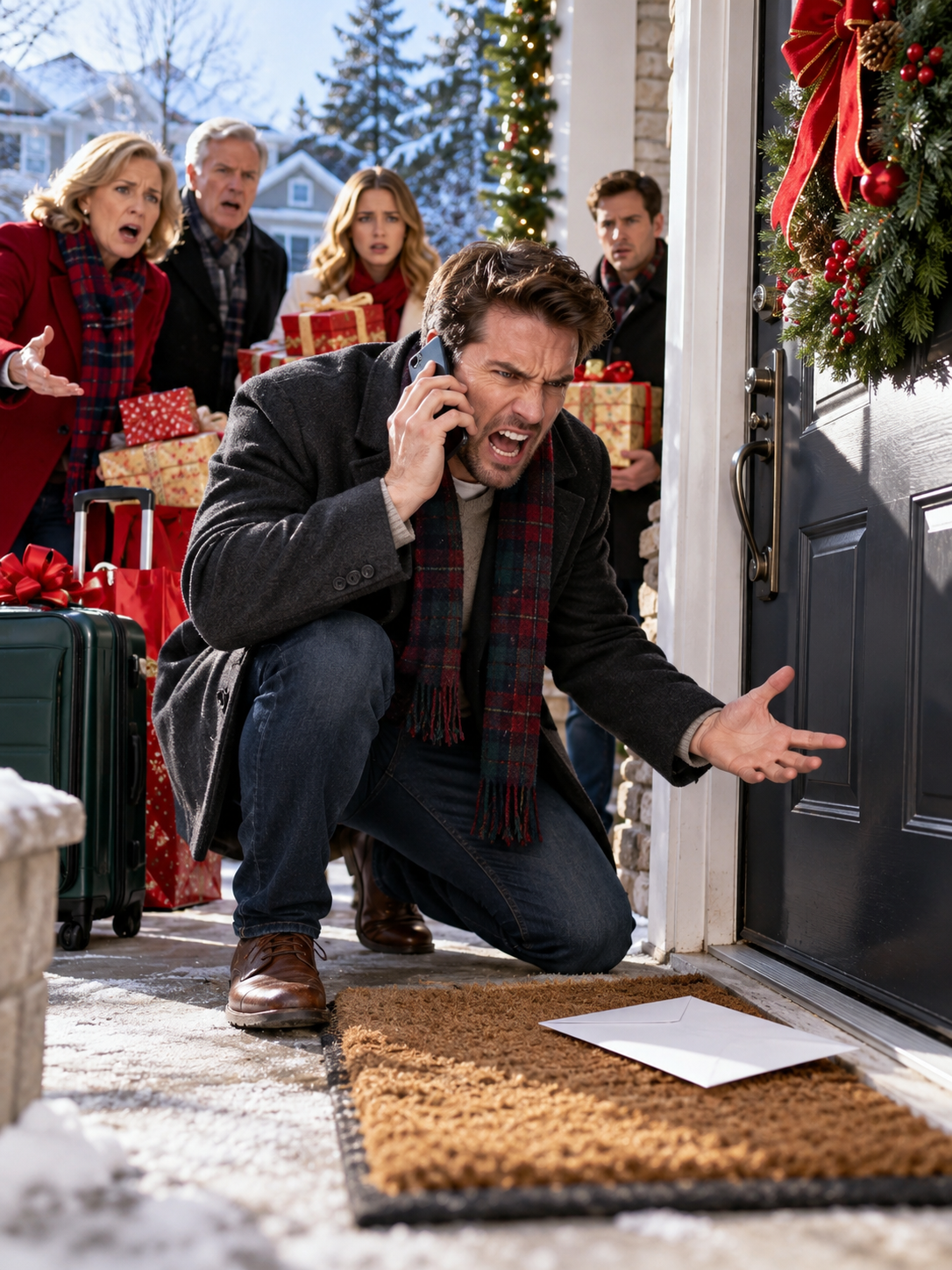
“Mom, open this door right now!” My son shouted into my voicemail on Christmas Eve, standing outside the house where I’d cooked his holiday dinners for thirty-eight years. Fourteen relatives were freezing on my driveway, and my phone had rung fourteen times. They expected a roasted turkey, expensive presents, and the mother who never said no. Instead, they found a dark porch, changed locks, and an envelope beside my wreath. But the letter wasn’t my only surprise. I’d discovered what they were planning to do with my house.
Part 1
The first warning came on December 3, when my son called to ask whether I could make two turkeys instead of one. Not whether I wanted to host Christmas, not whether I was feeling well, and certainly not whether I needed help. Just two turkeys, because his wife had invited additional relatives, and apparently my kitchen was now a commercial catering operation.
My name is Eleanor Mercer, and I was sixty-nine years old that December. I lived in a redbrick colonial house outside Richmond, Virginia, where my husband, Walter, and I had raised two children and celebrated thirty-eight Christmases together. Walter had been gone for six years, but his wooden ornaments still hung on our tree, and his chipped blue coffee mug still occupied the kitchen shelf.
I used to believe keeping our traditions alive was a way of keeping him close. Every December, I polished the silver, dragged the artificial tree downstairs, and prepared his mother’s stuffing recipe with sage and toasted pecans. But somewhere between Walter’s funeral and my sixty-ninth birthday, Christmas had stopped being a family celebration and become an unpaid job I was apparently forbidden to quit.
My son, Adam, was forty-three and managed a construction supply company. His wife, Simone, had an opinion about everything, especially things she wasn’t paying for. My daughter, Bridget, taught middle school and had perfected the exhausted sigh of a woman who believed her responsibilities were considerably more important than anyone else’s.
Last Christmas, I’d spent eleven hundred dollars on groceries, decorations, and additional gifts before anyone arrived. Bridget complained that the green beans were too salty, Simone photographed my dining room and suggested replacing the “dated” curtains, and Adam announced that everyone would be staying overnight without asking me. By December 26, there were wine stains on my tablecloth, greasy pans stacked beside the sink, and fourteen people who had apparently forgotten how dishwashers worked.
The worst moment came while I was carrying dirty plates into the kitchen. Simone was telling Adam that I was lucky they bothered coming, because otherwise I’d spend Christmas sitting alone with Walter’s photograph. Adam chuckled and said, “Mom needs us more than we need her, so she’ll complain and then do exactly what we want.”
I stood behind the swinging kitchen door with gravy dripping onto my slipper. They hadn’t noticed me, and I didn’t interrupt them. But that sentence lodged somewhere inside my chest, alongside all the other little humiliations I’d swallowed because I was afraid an empty house would feel worse.
So when Adam called about the two turkeys, I finally told him I wasn’t hosting Christmas. He laughed, asked what I meant, and then accused me of being dramatic when I repeated myself. “Mom, everybody’s already making plans,” he said, as though other people’s assumptions somehow created obligations for me.
Bridget called twenty minutes later and informed me that Christmas wasn’t about my feelings. I reminded her that I’d hosted every holiday since she was born, and she replied that changing traditions at my age seemed unreasonable. Before hanging up, she added something peculiar: “Besides, we need everybody together this year because there’s something important to discuss after dinner.”
I asked what she meant, but Bridget said Adam would explain when the time came. Two days later, Simone sent me photographs of expensive table settings, and Adam forwarded a grocery list containing enough food for a wedding reception. Beneath the list was an unfamiliar name, Gavin Hale, followed by the words, “Arriving at six with the paperwork.”
I stared at those words for a long time, wondering why someone I had never invited would be bringing paperwork to my Christmas dinner.
Part 2
At first, I assumed Gavin Hale was another one of Adam’s business associates. Adam had a habit of inviting people to my home and introducing them as though I should be grateful for the opportunity to feed strangers. Still, the word “paperwork” bothered me enough that I searched the name online and discovered that Gavin worked for a real estate agency in Henrico County.
I called Adam immediately and asked why a real estate agent would be attending Christmas dinner. He hesitated just long enough for me to hear the television playing behind him, then said Gavin was helping a friend find a house. “He’s practically family, Mom,” Adam insisted, before changing the subject to whether I’d bought the turkey.
That afternoon, I drove to see my oldest friend, Ruth Palmer, whose husband had died two years before Walter. Ruth lived in a small cottage with yellow curtains, mismatched furniture, and a kitchen that always smelled of freshly baked bread. When I told her about the realtor, she stopped spreading butter on her toast and asked a question that made my stomach tighten: “Eleanor, has anyone been talking about you moving?”
I admitted that Bridget had mentioned senior apartments several times, usually after complaining about the upkeep of my property. Adam had also suggested that the house was too large for one person, although I still managed the yard, bills, and repairs without asking either child for assistance. Ruth listened quietly, then asked whether they understood that the house belonged entirely to me.
Walter and I had paid off our mortgage twelve years before his death. I’d worked thirty-one years as an elementary school secretary, and Walter had spent forty years repairing heating systems throughout Richmond. We hadn’t become wealthy, but we’d built something secure, and I had no intention of surrendering it because my children found my independence inconvenient.
The next morning, I visited my attorney, Patricia Collins, and showed her the messages. Patricia confirmed that nobody could legally sell my property without my authorization, but she recommended reviewing my estate documents and changing my emergency contacts if I no longer trusted their judgment. I left with an appointment scheduled for January and a growing suspicion that Christmas dinner wasn’t the only thing my children expected me to provide.
Five days before Christmas, Adam called again, this time sounding unusually cheerful. He announced that everyone would arrive at six, that Gavin would join us for dessert, and that I should leave the driveway clear for three SUVs. I reminded him that I wasn’t hosting, and his cheerfulness vanished. “You can’t seriously expect us to explain this to fourteen people,” he snapped, before hanging up.
I decided I wouldn’t argue anymore. Ruth and I booked two rooms at a historic country inn near Charlottesville, made reservations for Christmas Eve dinner, and arranged to spend Christmas morning walking through the gardens if the weather allowed. I bought myself a beautiful navy wool coat, something I’d admired for months but kept putting back because I always seemed to be saving money for someone else’s presents.
On Christmas Eve morning, I woke without an alarm and made pancakes for one. After breakfast, I packed an overnight bag, placed the grandchildren’s wrapped gifts inside the unlocked garden shed, and divided Walter’s carved ornaments between two labeled boxes while keeping his favorite wooden cardinal. Then I wrote my children a letter, tucked it into a cream-colored envelope, and secured it beside the front-door wreath.
At four o’clock, I switched off the porch light, locked the newly changed front-door locks, and drove away. By six-thirty, Ruth and I were sitting beside a roaring fireplace, enjoying roasted chicken and warm apple cider while my phone vibrated across the table. Adam had called eleven times, Bridget had left four messages, and the family group chat was filling with outrage.
Then another message appeared, this one from Simone: “The realtor drove all this way for nothing. Eleanor, you have absolutely no idea what you’ve just ruined.”
I looked at those words and realized that whatever my family had planned for Christmas, they had never intended to ask my permission.
Part 3
I didn’t answer immediately. Ruth noticed my expression, reached across the table, and gently turned my phone facedown beside the breadbasket. The dining room smelled of pinewood smoke and cinnamon, and somewhere near the fireplace, an older couple was laughing over a shared dessert. For the first time in years, I wanted to stay exactly where I was instead of rushing to solve someone else’s emergency.
At seven o’clock, I checked my phone and found that Adam had called exactly fourteen times. His last voicemail was almost unrecognizable, his voice shaking between anger and disbelief. “Mom, the children are freezing, the house is locked, and Simone says you changed the locks. Why would you embarrass us like this?”
I sent one message to the group: “Please read the letter beside the door.” Then I turned off my notifications and ordered another cup of cider. I didn’t know precisely what happened next until I reviewed my doorbell camera recordings the following morning, but what I saw confirmed how little my family understood me.
Adam stood beneath the dark porch roof wearing the expensive leather jacket I’d bought him the previous Christmas. Bridget held her phone flashlight above his shoulder while Simone stood nearby, tapping her foot against the concrete steps. Behind them, my grandchildren huddled in their winter coats, and a silver-haired man carrying a navy folder waited beside an unfamiliar sedan.
Adam tore open the envelope and unfolded the letter with stiff fingers. I had written it slowly that morning, determined to say everything that mattered without providing another opening for argument. There were no insults, no threats, and no accusations I couldn’t defend.
“Dear Adam and Bridget,
“For thirty-eight years, this house has welcomed our family at Christmas. Your father and I worked hard to make those celebrations special because we loved you, and I was happy to continue the tradition after he died.
“But somewhere along the way, my home became a place where everyone expected service and nobody offered gratitude. I became the cook, cleaner, shopper, hostess, and person expected to pay for everyone’s comfort.
“I told you repeatedly that I would not host Christmas this year. You dismissed my decision because you assumed I would surrender rather than disappoint you.
“I will not.
“The grandchildren’s presents are safely stored in the unlocked garden shed, along with boxes containing your father’s wooden ornaments. You may collect them tonight.
“I am safe and enjoying Christmas with a friend. Please do not disturb the neighbors or invent an emergency because I refused to do what you wanted.
“And if anyone came tonight expecting to discuss selling my house, you may tell them this: my home is not available, and my future is not yours to arrange.
“Merry Christmas.
“Mom.”
On the recording, Bridget covered her mouth when Adam reached the final paragraph. Simone stepped forward, apparently demanding to see the paper, but Adam pulled it away from her. The silver-haired stranger began saying something I couldn’t hear, and Adam answered sharply enough that the man returned to his car.
My grandchildren were the only people I felt sorry for that evening. They hadn’t chosen to stand outside in the cold, and they weren’t responsible for their parents’ arrogance. Fortunately, their coats were warm, their cars were nearby, and the shed contained every gift I had promised them.
The next morning, I found one additional message waiting in my inbox. It came from Gavin Hale, the real estate agent, and contained a brief apology for arriving without speaking directly to me. His last sentence made my hands tremble: “I was led to believe you had agreed to review an offer for the property, and that your children were authorized to negotiate preliminary terms.”
Part 4
On December 27, I met Patricia Collins in her office above a small shopping center. I brought Gavin’s email, the family messages, and a copy of the holiday schedule Adam had sent me. Patricia read everything carefully, then asked whether I’d ever authorized my children to negotiate the sale of my house.
I told her I hadn’t, and she assured me that no sale could proceed without the necessary legal authorization. She suggested requesting copies of whatever documents Gavin had prepared and making my position clear in writing. Before I left, she also helped me begin updating the estate planning documents that still named Adam as my primary financial representative if I became incapacitated.
Gavin responded to Patricia’s inquiry that afternoon. According to his email, Adam had approached him about a possible private sale of my property to a buyer interested in older homes with large lots. Gavin believed I was considering moving into a smaller residence and that the Christmas gathering would provide a convenient opportunity to discuss the proposal with the entire family.
Attached was a preliminary property valuation and a handwritten page labeled “Proposed Family Arrangement.” The estimated sale price was substantial, but what caught my attention was a note about helping Adam and Bridget with their respective financial needs after my relocation. Apparently, my children had already found uses for money that did not belong to them.
I asked Adam to meet me at a coffee shop the next morning. He arrived fifteen minutes late, wearing the same jacket from Christmas Eve and carrying an untouched bakery bag that he pushed across the table as though a cinnamon roll might repair everything. “I thought we could have a reasonable conversation now that you’ve made your point,” he said.
I placed Gavin’s email between us and asked why he’d invited a realtor into my home without my permission. Adam’s expression shifted from irritation to embarrassment, and he started explaining that his family needed more space while Bridget was struggling with expenses. “Nobody was stealing anything,” he said, lowering his voice. “We were trying to figure out a solution that benefited everybody.”
“Everybody except me,” I replied, and Adam looked away. He admitted that he and Bridget had discussed selling my home for months, believing I would agree once they presented a carefully organized plan. They had intended to show me several smaller properties, explain how unnecessary my large house had become, and suggest that I help them financially with the remaining proceeds.
I asked why they’d chosen Christmas. Adam shifted in his chair and admitted that Simone thought I’d be more cooperative with the grandchildren present. The confession was so ugly in its simplicity that I needed several seconds before speaking. They’d intended to surround me with family, presents, and holiday expectations, then make refusing sound like an act of selfishness.
I told Adam that I had never agreed to fund his larger house, finance his sister’s problems, or surrender the home Walter and I had worked so hard to purchase. When he said he was only concerned about my future, I asked him to name the last time he’d visited without needing money, food, childcare, or a favor. He couldn’t remember, and the silence between us was answer enough.
Adam finally admitted that my Christmas letter had humiliated him in front of everyone, especially Gavin. I told him humiliation was what he’d felt when his scheme became visible, not what I’d done by closing my own front door. He sat staring into his coffee while I gathered my papers and prepared to leave.
Then he caught my sleeve and said, “There’s something else you should know before you talk to Bridget. She already put down a deposit on an apartment for you.”
Part 5
I didn’t speak to Bridget until New Year’s Eve. By then, Patricia had obtained confirmation that no sale agreement existed, and I had received a brochure for an apartment complex in Mechanicsville. Bridget had placed a refundable holding deposit on a first-floor unit, apparently assuming that once the family approved their plan, I would obediently begin packing my belongings.
She arrived at my house carrying a poinsettia and wearing the defensive expression she’d used since childhood whenever she knew she’d done something wrong. I let her inside because I wanted answers, not because the flowers earned her forgiveness. She placed the plant on my kitchen counter, glanced toward the Christmas tree, and immediately asked why I hadn’t taken down the decorations.
I told her I was enjoying them. Then I asked how she would feel if someone arranged to sell her home, chose where she should live, and decided what to do with the proceeds without consulting her. Bridget’s cheeks reddened, and she insisted they’d only been exploring possibilities. “We thought you’d appreciate not having to make all those difficult decisions yourself,” she said.
I reminded her that I had managed a household, raised two children, worked for three decades, and cared for Walter throughout his final illness. I handled my own finances, drove myself to appointments, and maintained a home that was in better condition than either of theirs. The idea that I suddenly required supervision because I was sixty-nine wasn’t kindness; it was an excuse.
Bridget began crying and said she’d never intended to hurt me. I believed she regretted being caught, and perhaps she even regretted some of what she’d done, but her tears didn’t undo the months of secret conversations. When she asked whether we could put everything behind us, I told her I wouldn’t pretend the betrayal hadn’t happened just to make her comfortable.
I didn’t cut my grandchildren out of my life. They continued receiving birthday cards, small gifts, and invitations to visit me with arrangements made in advance. I also explained to Adam and Bridget that I wouldn’t host family gatherings, provide financial assistance, or tolerate surprise visits until they demonstrated that they could respect the word “no.”
In January, Patricia finalized my revised estate documents. Ruth became my first choice for certain emergency decisions, with a professional fiduciary named as a backup, and I updated my will to reflect my own wishes rather than the expectations my children had developed. I didn’t tell Adam or Bridget what they might inherit, because my death was no longer going to be treated as their future financial plan.
Over the following months, Adam sent several apologies, and Bridget occasionally invited me to lunch. I accepted a few meetings when I felt comfortable, but our relationship was different, and I made no promises that it would return to what it had been. I could be civil, love my children in a quieter way, and still refuse to hand them the same power over my life.
That spring, I had the kitchen painted a soft shade of green and replaced the dining room curtains that Simone had criticized for years. Ruth helped me plant hydrangeas along the back fence, and we began hosting monthly potluck dinners with neighbors and friends. Everyone brought something, everyone helped clean, and nobody ever treated my hospitality as something owed to them.
By November, Adam had organized Christmas at his own house. He sent me a polite invitation, included the menu, and assured me I wouldn’t be asked to cook or contribute money. It was more consideration than he’d shown in years, and I appreciated the effort without mistaking it for a reason to forget what happened.
I declined because Ruth and I had already booked another Christmas at the country inn. This time, we invited two widowed friends, and I bought myself a deep red scarf to wear with my navy coat. Adam sounded disappointed when I told him, but he didn’t argue, and that small change meant more than any grand apology.
On Christmas Eve, I placed Walter’s carved cardinal at the center of my tree, made myself a cup of coffee in his old blue mug, and stood for a moment in the quiet living room. I missed him fiercely, as I always would, but the silence no longer frightened me. It belonged to a peaceful house where I could live exactly as I pleased.
Before leaving, I switched on the porch lights, checked the locks, and closed the front door behind me. There was no envelope on the wreath this year because I had nothing left to explain.
My family had once believed I would accept anything rather than spend Christmas without them. They were wrong about that, just as they were wrong about my house, my money, and the years I had left to live.
At sixty-nine, I had finally learned that being loved and being useful were not the same thing. I wasn’t going to spend another Christmas buying affection with roasted turkey, expensive presents, and aching feet.
And when I drove away that evening, I wasn’t escaping my family.
I was going somewhere I was actually wanted.
Legal Notice: This story is a work of fiction. Names, characters, businesses, events, and incidents are the product of the author’s imagination or are used fictitiously. Any resemblance to actual persons—living or dead—or to actual events is purely coincidental. Thank you! 💓

