
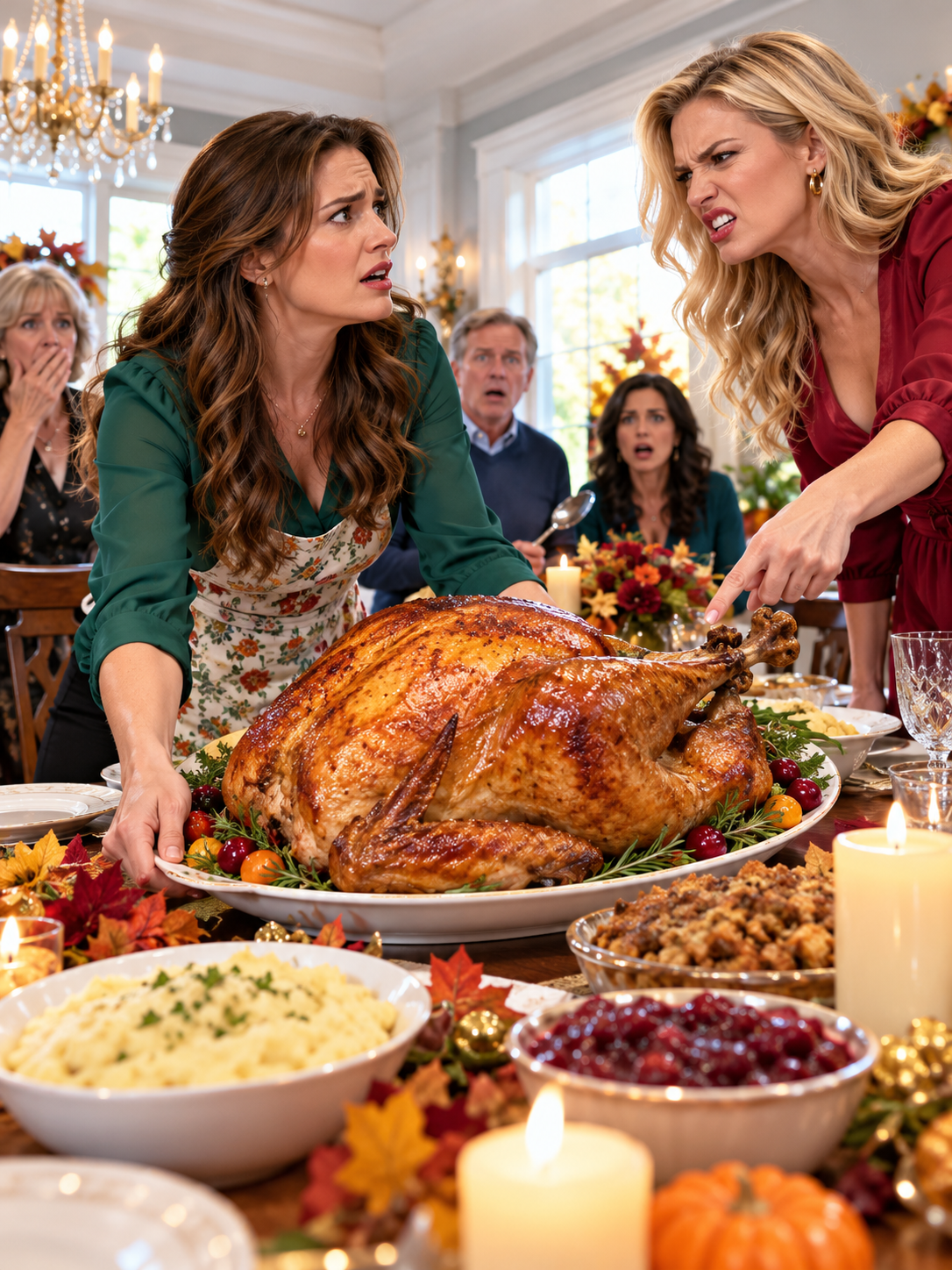
My Sister-in-Law Called My Thanksgiving Turkey Dry—So I Took It, and Her Perfect Holiday Fell Apart
“That turkey looks dry,” my sister-in-law announced before I had even taken off my coat. My mother-in-law looked at the twenty-two-pound bird I had spent five hours preparing and said, “I guess it’ll do.” After seven years of being their unpaid holiday cook and favorite target, I picked up the platter and walked out with my son. Three hours later, their frantic calls finally made sense. They hadn’t just been expecting me to feed the family. They had been selling something that wasn’t theirs.
Part 1
At 5:08 on Thanksgiving morning, my kitchen smelled like melted butter, orange peel, and the sage I’d rubbed beneath a turkey’s skin. My husband, Cole, had told me his mother’s oven was broken, and making the main course at our house seemed easier than another argument. I hadn’t understood yet that the broken oven was only the first thing I hadn’t been told.
By noon, the bird was golden, the pan juices were clear, and my shoulders ached from lifting it in and out of the oven. Cole carried Ben’s overnight bag to the car while I wrestled the covered platter into a cardboard box lined with towels. “Mom’s going to love it,” he said, without offering to take the heavy end.
His parents lived forty minutes away in a white colonial outside Madison, Wisconsin, where every holiday looked like a magazine spread. For seven years I had brought casseroles, pies, and birthday cakes, only to hear that my crust was tough or my seasoning was strange. Whenever I complained afterward, Cole said, “They’re particular people, Maren. Don’t turn it into a personal attack.”
I wanted this Thanksgiving to be different because Ben had started noticing things. At Easter, he’d asked why Grandma complimented Paige’s store-bought cookies but told me my homemade rolls were lopsided. That morning, I promised myself I would at least insist on a thank-you.
When we entered the house, Paige was standing by the dining-room archway with a glass of sparkling water. She looked at the turkey, wrinkled her nose, and said, “That looks awfully dry.” “It hasn’t been carved,” I replied. “You might want to taste it first.”
Paige smiled at someone behind me, as though I’d told a joke beneath her notice. On the sideboard sat a stack of cream-colored cards bearing the words Paige & Pine Events, a business she’d started after leaving her marketing job. Before I could ask, Darlene came in, inspected my work, and sighed, “Well, I suppose it’ll do.”
For a moment I heard only the dishwasher humming and Ben dragging his toy truck across the hardwood. I thought of the hours I’d lost, the shifts I’d traded at the rehabilitation clinic, and the way Cole was already opening wine for his father. “If it only has to do,” I said, “I’ll take it somewhere it’s wanted.” Darlene blinked as though the turkey had just spoken.
“Don’t be ridiculous,” she snapped. “People are coming at five.” Paige set down her glass hard enough to make the ice jump, and Cole finally turned around. “Maren, don’t start,” he warned, using the same voice he used when Ben spilled juice. I looked at him, waiting for one sentence in my defense, but he merely glanced toward the dining room.
I lifted the platter, carried it back through the doorway, and asked Ben to bring his jacket. He came without arguing, though he held my hand tightly on the porch steps as the November wind stung our faces. The front door clicked shut before I’d even started the engine.
My mother, Ruth, lived in a small duplex on the east side of town. She was expecting one neighbor for soup and toast, not a twenty-two-pound turkey and an upset daughter. When she opened the door, Ben announced, “Grandma, we’re having a different Thanksgiving,” and my mother laughed so suddenly I almost joined her. She helped me carry the platter inside without asking why I was there first.
We carved the bird on her little Formica counter, where the meat practically fell from the bone. Ruth tasted a slice, closed her eyes, and said, “Sweetheart, this is wonderful.” Then my phone began vibrating across the table, again and again, until an unfamiliar number appeared.
I answered expecting another lecture, but a woman introduced herself as Tessa Bell from an event-planning committee. “I’m sorry to bother you on Thanksgiving,” she said. “Paige told me you were handling the food, and now nobody can find the turkey.” I stared at the plate in front of me, unable to match her words to anything I’d agreed to do. Then she added, “We’ve already paid the deposit, so I need to know whether you’re still our chef.”
Part 2
I stepped onto my mother’s back porch, pulling my sweater tight against the cold. “I’m not a chef,” I told Tessa. “I work in occupational therapy, and I haven’t agreed to cater anything.” Her silence lasted long enough for a car to hiss past on the wet street.
Tessa explained that she coordinated the holiday dinner for a local engineering firm, a gathering of nearly eighty people scheduled for December. Paige had shown her photographs of my food, called me her culinary director, and promised a private tasting that night. Tessa was coming at five because her husband knew Cole. “I paid Paige twelve hundred dollars last week,” she said. “She assured me you’d be there to discuss the menu.”
My stomach dropped. I remembered Paige photographing my Christmas roast two years earlier, moving my handwritten recipe cards out of the frame before she took the picture. “You need to speak to Paige about the money,” I said. “I don’t work for her business, and I won’t be preparing that dinner.” Tessa apologized for the confusion, sounding more embarrassed than angry.
Inside, Ruth sent Ben to find a board game. “They’ve been taking your help for granted so long,” she said, “they forgot it was yours to give.” I wanted to believe this was merely Paige’s scheme, not something Cole had known about.
At eight, Cole arrived looking flushed and tired. He said his mother had cried, his father had driven out for pizza, and Paige had been humiliated in front of Tessa. “You made us all look dishonest,” he said, dropping onto Ruth’s couch. I stared at him. “I didn’t tell a client I was running a catering kitchen,” I answered. “Who did?”
I asked whether he knew she’d advertised me as the chef, and he looked toward the closed bedroom door instead of answering. “It was supposed to be one dinner,” he said. “Once you saw how much people liked your food, I thought you’d get excited.” The word thought landed harder than anything Darlene had said that afternoon.
“You thought I’d agree after you promised my time away?” I asked. Cole said I was making it sound worse than it was, that Paige needed help, and that we were family. He couldn’t explain why he hadn’t asked me or why I’d been told his mother’s oven was broken. When I mentioned the paid deposit, his eyes flicked toward his phone, and I knew there was more.
He reached across the couch, but I moved my hand away. “I’m staying here with Ben tonight,” I said. Cole looked genuinely shocked, as though carrying a turkey out of a house was one thing and refusing to come home afterward was another. I told him we were already discussing it and he still wasn’t answering the questions.
After he left, I opened Paige & Pine Events on my phone. The homepage displayed photographs of meals I’d cooked for years. Below the photographs was a sentence promising memorable meals by “our dedicated culinary director, Maren Lawson.” My name looked wrong in that elegant typeface, like something stolen and polished for display.
The site listed three December packages, including a corporate dinner and two private celebrations. I took screenshots while Ruth heated water for tea, then searched old family messages for the photographs Paige had requested. I’d emailed Paige my menu last year “for inspiration,” hoping we’d become friends. At the time, I hadn’t noticed Cole was included in the conversation.
Just before midnight, Tessa forwarded the proposal Paige had sent her. The PDF promised a tasting, a full menu, and “personally supervised preparation by Maren Lawson” in language I would never have used. Its last page carried two signatures under a statement of service responsibility. One belonged to Paige, and the other looked exactly like mine.
I enlarged the image until the letters blurred. The uneven loop on the L was a detail from my actual signature, but the date beside it was a Tuesday when I’d spent ten straight hours at the clinic. Someone hadn’t just volunteered me for a dinner; someone had signed my name to make the lie believable.
Part 3
I barely slept, and at six the next morning I spread the printed proposal across Ruth’s kitchen table. My signature was copied so neatly that I wondered how many other documents might carry it. I saved the emails, screenshots, and attachments in a separate folder and wrote down everything I remembered about the week Cole had first mentioned the turkey.
I called Paige before speaking to Cole again. She answered on the fourth ring with, “Are you satisfied now? Tessa canceled the tasting.” I asked where she’d gotten my signature, and her tone changed from sharp to syrupy. “Cole said you were fine with it,” she replied. “We were going to split the profits once the business grew.”
“I have never heard of a profit split,” I said. Paige gave an impatient laugh and told me to stop pretending I’d never wanted people to notice my cooking. When I told her to remove my name and photographs by the end of the day, she said, “Mom’s right. You always find a way to make things about yourself.”
At the bank, the next problem was waiting in plain sight. Our joint savings account, the one Cole and I called the roof fund, was short eighty-four hundred dollars. The memo read “P&P startup loan,” and my mouth went dry.
Cole met me that afternoon at our house, where the air still smelled faintly of sage. I had left Ben with Ruth, unwilling to make our son an audience to another adult argument. When I showed Cole the transfer, he sat at the kitchen island and stared at the screen. “Paige needed equipment and a commercial kitchen deposit,” he admitted. “I thought we’d have it back before you even noticed.”
“You took our emergency savings,” I said, “and told a customer I’d work for your sister.” He began with the same explanation he’d used for years: his mother meant well, Paige was under pressure, and none of it was supposed to upset me. I asked whether he’d allowed Paige to use my signature. His answer came so quietly I almost missed it: “I sent her a scan, but I thought it was just for her planning packet.”
Something in me went completely still. I had been expecting another excuse, perhaps even another lie, but he had handed a copy of my signature to someone who was taking deposits in my name. “You watched them insult the turkey,” I said, “and you knew it was meant to impress a paying client.” Cole looked miserable. “I thought if you stayed, we’d all get through the tasting, and I’d explain later.”
I’d built a home here with Cole, but I had also spent years doing the work of making his family comfortable while he called that peace. “You didn’t want me to be happy,” I said. “You wanted me to cooperate before I knew what I’d agreed to.” He reached for me again, and again I stepped back.
I told him to stay with his parents for the weekend, and for once he didn’t argue. After he left, I booked a consultation with a family-law attorney and contacted a local business attorney about the proposal. I wasn’t looking for a grand revenge plan or a way to ruin Paige’s life. I wanted my name removed, our finances accounted for, and Ben kept out of the fight.
By dinner, Paige’s website had vanished, but my phone had not stopped ringing. Darlene left a voice message demanding I “repair the embarrassment” before the corporate client started talking. I deleted nothing and played it once for Ruth, who listened with her jaw clenched. Then a second message arrived, quieter and meaner than the first.
“You have until Monday to make this right,” Darlene said. “Otherwise, Ben may need to hear why his mother ruined Christmas for everyone.” I stood beside the sink while warm water ran over my hands. They hadn’t frightened me into returning with the turkey, so now they were threatening to use my son.
Part 4
On Saturday morning I sat with Ben at Ruth’s kitchen table, helping him cut construction-paper stars for the window. He asked whether Dad was mad because we’d left Grandma’s house. I told him adults were having a disagreement, and he hadn’t caused it or done anything wrong. “Can I still see Dad?” he asked, keeping his scissors still. “Of course,” I said, and meant it.
After breakfast I called Cole and read Darlene’s message aloud. He was silent until I asked him whether he intended to let his mother discuss our argument with Ben. “No,” he said immediately. I explained that visits with his parents would have to wait until he could keep our son out of their complaints about me, and that Cole could arrange time with Ben directly. “That isn’t punishment,” I said. “It’s a boundary.”
The lawyers helped me put the next steps in writing. I notified Paige that I had not signed or approved her proposals, would not provide cooking services, and wanted every reference to my involvement removed. I sent Tessa a short factual statement, without screenshots of family arguments or any attempt to recruit her to my side.
By Monday, two more clients had contacted me after Paige canceled meetings without explanation. I sent them the same simple response and directed questions about refunds to the company that had accepted their money. Neither seemed angry at me; both seemed furious that Paige had advertised a cook who had never agreed to work for her.
That afternoon Darlene came to our house holding a tin of sugar cookies and a photograph of Ben from last Christmas. I didn’t invite her past the front door. “He deserves to know his grandparents love him,” she said, peering over my shoulder as though he might be hiding there. “He does,” I replied. “He also deserves not to be blamed for adults’ choices or used to blame his mother.”
Darlene’s eyes narrowed. She said that Paige might have to close her business and that Cole was sleeping badly, all because I couldn’t tolerate one joke about a turkey. “This isn’t about the turkey anymore,” I told her. “You can think my cooking is terrible. You cannot volunteer my labor, use my name on contracts, or threaten my child.” For the first time, she had no polite insult ready.
Then she tried a softer voice. “We all make mistakes, Maren. Families move on.” “You had seven years to treat me like family,” I said. “You chose to treat me like help.” I closed the door while she was still holding the cookie tin.
The following week, Cole gave me the full account statements and admitted he hadn’t checked whether Paige could repay the loan. Cole offered couples counseling and promised he’d never excuse his mother’s behavior again. I believed he regretted what had happened; I no longer believed regret was the same as trust.
At an appointment with my attorney, I reviewed what separation would mean for housing, expenses, and parenting arrangements. I would have to budget carefully, document payments, and make decisions that were tiring even when they were right. But the practical work felt cleaner than another seven years of excuses.
A few days before Christmas, Cole asked whether I’d consider one dinner with his family, just to show Ben everyone could get along. I was sitting on the floor wrapping a present when his message appeared. Before I answered, another message came from Paige: a photograph of our family table, captioned, “It doesn’t have to end this way.” I realized they still believed a holiday invitation could erase the choices they’d made when they thought I couldn’t say no.
I wrote back to Cole that I would cooperate on Ben’s holiday schedule, but I would not attend another family dinner or pretend we’d reconciled. Then I put down my phone and finished wrapping the gift. The next morning, an email arrived from the accountant handling Paige’s business: her company was winding down, and she wanted me to sign a statement calling the whole affair a misunderstanding. This time, a signature would cost me far more than a Thanksgiving meal.
Part 5
The statement said I had “informally approved” my participation, that Paige had acted in good faith, and that the dispute was a family matter rather than a business misrepresentation. I couldn’t sign any of those claims truthfully. My reply was short: I would confirm that I wasn’t seeking payment from Paige’s clients, but I would not certify consent I’d never given.
Paige left a furious voicemail accusing me of destroying her chance at independence. I kept the records and didn’t respond, except through the appropriate channels when a factual answer was needed. For the first time, silence didn’t feel like surrender; it felt like the right to stop participating in their version of events.
Christmas Eve, Ruth invited her neighbor Gloria and a widower from down the street to dinner. Ben helped shape biscuits into crooked stars, and our little kitchen windows fogged from the heat of the oven. We had roast chicken, mashed potatoes, and a pie I’d made without checking whether anyone preferred another kind.
Cole picked Ben up on Christmas morning for their agreed time together. He handed me a gift bag, still standing on the porch. Inside was a cookbook and a note saying he’d finally realized how much I gave his family. I closed the bag and told him that recognizing my work didn’t undo using my signature or hiding the money. He nodded, tears collecting at the corners of his eyes, and I let him leave without offering comfort.
During the winter, Cole began repaying the money he’d taken from our savings. He brought detailed records to mediation instead of vague promises, and we worked toward a parenting plan that put Ben’s routine ahead of our resentment. I grieved the man I thought I’d married, but didn’t want the marriage back.
In March I moved into a rented townhouse ten minutes from Ruth. It had a narrow backyard, mismatched kitchen cabinets, and enough room for Ben’s dinosaur collection to take over the living room. Nobody would mistake our new place for a holiday magazine spread, and I had never slept better.
Our divorce was finalized in late summer. Cole and I could exchange information about school pickups, dentist appointments, and snow days without reopening what had happened. He remained Ben’s father, and I wanted their relationship to be steady, but that didn’t require me to become his wife again. When he asked once more if we might start over, I said no without explaining it a second time.
As the next Thanksgiving approached, Ben asked whether we could cook another enormous turkey. “Just us?” I asked, opening the grocery store freezer while he studied the labels. He shook his head and named Ruth, Gloria, the widower, and his best friend from school. “And Dad can have his Thanksgiving at Grandma Darlene’s,” he added matter-of-factly.
I bought a smaller turkey and let Ben choose the cranberry sauce, even though he picked the jiggly canned kind I didn’t like. We spent Thanksgiving morning in socks on the kitchen floor, with music playing and flour drifting across the counter. Gloria brought green beans, Ruth made her sweet potatoes, and nobody had to earn a seat by arriving with something impressive. When the meat was ready, I carried it to the table and watched everyone make room.
Ruth raised her glass and thanked me for cooking. I smiled, but what stayed with me was Ben leaning against my shoulder, entirely at ease, while Gloria passed the rolls. A year earlier, I’d walked away shaking, certain I’d ruined a holiday and maybe my marriage. Now I understood that the marriage had been damaged long before I’d picked up the platter, and walking out had only made the damage impossible to ignore.
I didn’t need Darlene to apologize, Paige to admit what she’d done, or Cole to miss me for the ending to be good. My name belonged to me, my time belonged to me, and the people at my table knew the difference between a gift and an obligation. When Ben asked if he could have another slice, I cut him the biggest one. Nobody called the turkey dry.
Legal Notice: This story is a work of fiction. Names, characters, businesses, events, and incidents are the product of the author’s imagination or are used fictitiously. Any resemblance to actual persons—living or dead—or to actual events is purely coincidental. Thank you! 💓

