
My Sister Destroyed My $7,800 Wedding Dress—Then My Future Mother-in-Law Opened a Black Garment Bag
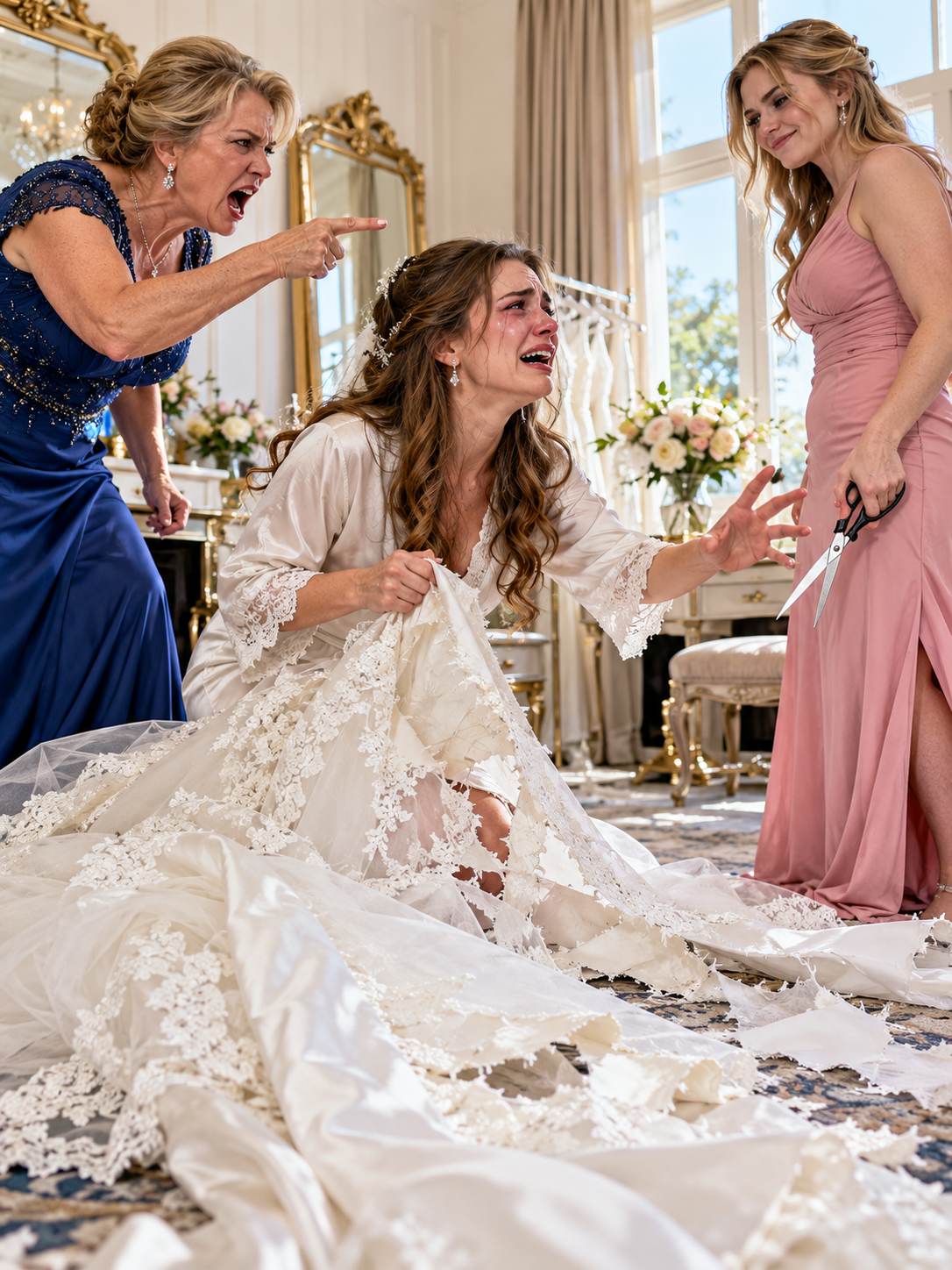
Three hours before my wedding, I found my older sister standing over my shredded $7,800 dress, still clutching the scissors. My mother didn’t comfort me; she screamed that I was bullying her precious daughter. Then my future mother-in-law walked in carrying a mysterious black garment bag, and my sister’s smile disappeared. I thought the bag held a replacement gown. I had no idea it would lead us to proof that my mother and sister had planned something far worse than ruining silk.
Part 1
A metallic click greeted me when I entered the bridal preparation room. My sister, Tessa, stood beside the dress rack at Willowbrook House, a wedding venue outside Richmond, holding a pair of silver tailoring scissors. At her feet lay ivory lace and pearls like spilled rice. I barely recognized the wedding dress I’d collected yesterday. The rack swayed slightly, shedding another pearl with each movement, and I could hear it bounce against the polished floor.
I’d spent eighteen months saving $7,800 for that gown, working extra shifts at my architectural firm. Its silk skirt moved like water; its pearls recalled my grandmother’s Sunday earrings. I had wanted to pay for it myself because my mother, Diane, always attached strings to gifts. Now the bodice hung in strips, the lace hacked apart.
“What did you do?” I asked, reaching for the torn fabric. Tessa studied the scissors as though surprised to be holding them. “I noticed a loose seam,” she said, and a small smile climbed across her face. “You should thank me for discovering how cheaply that dress was made.” Her voice carried the lazy certainty I remembered from every argument she had won by crying first.
I stared at the scissors, then at my sister’s spotless pale-blue bridesmaid dress, which I had bought for her. “You cut straight through the center of the bodice,” I said, struggling to keep my voice steady. “Nobody could mistake that for fixing a seam.” Tessa shrugged and nudged a pearl beneath the rack. “Maybe you’ll finally wear something appropriate for a woman your age.”
My mother appeared before I could answer, trailing gardenia perfume. “What on earth is this noise?” Diane demanded, scanning my wet face before sparing the ruined gown a glance. I told her what happened, and she stepped between us. “Stop bullying your poor sister! She’s been through enough, and you make everything about yourself.”
That line could have been lifted from any year of my childhood. When Tessa totaled my first car, I was told to apologize for lending it to her; when she quit college, I was warned not to celebrate my graduation too loudly. After Tessa’s engagement ended, Mom asked me to hide my ring whenever she visited. I’d complied twice, mistaking keeping the peace for being kind.
“She destroyed my wedding dress,” I said, louder now, but Diane pressed her lips together as if I were a difficult customer. “It’s fabric, Claire,” she replied. “Your sister’s feelings matter more, and you can wear something else.” Tessa leaned against the vanity, laughing softly. “Unless Owen sees what a disaster you’re being and realizes he’s making the same mistake my ex did.”
Owen Bellamy was downstairs checking the musicians’ setup, completely unaware that my wedding morning had turned into this. We’d met while volunteering to repair a neighborhood playground, and he’d proposed a year later with muddy sneakers and shaking hands. His quiet steadiness felt new after years of being told love meant swallowing insults. I pictured him waiting under the oaks, afraid Tessa might get her wish.
“Actually,” a calm voice said from the open doorway, “Claire won’t need to find something else.” Owen’s mother, Margaret, stood there in a navy suit, gripping a long black garment bag with both hands. A longtime bridal boutique director, she looked at me before examining the damage. Her lipstick was perfect, but a white thread clung to her sleeve, as though she had dressed in a hurry. “Sweetheart,” she said, setting the bag on an empty rack, “may I show you something?”
The zipper rasped downward, and Tessa stopped smiling. Inside hung an extraordinary gown of ivory silk and delicate French lace, its narrow waist and softly falling sleeves exactly the shape I’d described to Margaret months earlier. It had belonged to her late sister; a seamstress had altered it for me. Then, while Diane insisted there had been a misunderstanding, Margaret closed the bag halfway and said, “Before you put this on, Claire, you need to see why I brought it.”
Part 2
Margaret took a tablet from her handbag and placed it on the vanity, beside the scissors Tessa had finally abandoned. On its screen was a paused view of the small room where the venue stored valuable garments before ceremonies. A camera watched the racks and service entrance there; changing took place in a separate, private suite across the hall. The timestamp read 12:38 p.m., twenty-two minutes before I’d discovered the damage.
“You can’t film us without permission,” Diane snapped, although the printed notice about inventory security was visible beside the door. Margaret didn’t debate her; she touched the screen, and the footage began to move. Tessa entered alone with her purse, checked the hallway twice, and removed the scissors before she even approached my dress. I heard my mother draw in a little breath as the screen showed my sister cutting through the pearl-covered bodice again and again.
There was no loose seam, no accident, and no way to explain away the careful sequence of movements. On the video, Tessa stepped back, inspected the damage, and made another long cut, almost leisurely this time. My hand went numb where it rested against the vanity. “You knew what you were doing,” I told her, and she looked at our mother instead of answering me.
Diane recovered first, ordering Margaret to turn off the recording as though volume were the problem. “Tessa’s been emotional since her engagement fell apart, and you can’t understand what that does to a person.” Margaret stopped the recording, but she didn’t move the tablet. “I can understand pain,” she said. “I cannot understand using someone else’s happiness as a target, especially with a mother standing here to excuse it.”
The venue manager, a tall woman named Rochelle, knocked and entered carrying a clipboard. She explained that a copy of the recording had already been preserved and that staff would keep Tessa away from the preparations. “Claire, it’s your decision whether to make a police report,” she added, addressing me rather than my mother. “For now, we can remove anyone you don’t want here.” Hearing someone ask what I wanted made my throat ache more than the ruined dress had.
“Both of them need to leave,” Margaret said, then turned to me. “But it’s your wedding, and the choice belongs to you.” Diane laughed in disbelief and insisted, “I’m her mother. You don’t get to throw me out over a mistake.” For a moment I nearly apologized automatically, the way I always did when her voice hardened, but I looked at the severed pearls on the floor and managed to say, “I want them gone.”
Tessa’s face twisted. “You’re really choosing his family over us?” she demanded, her voice suddenly carrying the tears she’d never shed for my dress. “I just wanted you to stop showing off what I don’t have.” I expected Diane to object to that confession; instead she squeezed Tessa’s arm and whispered, “We’ll handle this outside.” The way she said we’ll left me with the uneasy feeling that they had something still to manage.
Rochelle asked two security staff members to escort them to the parking lot, and my mother gathered her purse as though she were leaving an unpleasant restaurant. At the door she looked back and said, “You will regret humiliating your family in front of strangers.” I wanted to remind her she hadn’t cared about humiliating me, but Margaret was already placing the replacement gown in my hands. Its silk was cool, solid, and almost impossibly beautiful.
When the door shut, Margaret finally explained why she’d brought a second dress. At my final fitting the previous Tuesday, she’d noticed Tessa photographing the shop’s delivery label while pretending to search for her phone. Margaret had asked the seamstress to ready her sister’s preserved gown, just in case, and had warned Rochelle to watch the garment storage area. “I hoped I was being foolish,” Margaret admitted. “But there’s something else Owen received earlier today, and I think you should hear it from him.”
Part 3
Owen arrived with his tie undone and his phone gripped so tightly that his knuckles looked pale. He didn’t ask whether I was overreacting or suggest that we postpone the ceremony to keep everyone comfortable. He put his arms around me carefully, avoiding the torn dress on the rack, and said, “I’m here, Claire. Nothing they do changes that.” The familiar smell of his cedar soap nearly undid me.
Then he showed me Diane’s message from 12:51 p.m.: “Claire’s having doubts. She’s too embarrassed to tell you herself. Please let her go quietly and don’t make a scene.” My mother had signed it with a heart emoji, the same little decoration she used when reminding me about family birthdays. Owen had responded, “I’ll hear it from Claire,” before forwarding a screenshot to the wedding coordinator.
“I never said any of that,” I whispered, although Owen’s face told me he already knew. He scrolled to an email the coordinator had received from the address Tessa and I had used for wedding planning. The subject was a request to stop the ceremony, with instructions to tell the guests that the bride had changed her mind. It had been sent twelve minutes before the first cut on the security footage.
I recognized the account immediately: a separate inbox created for vendor contracts, seating changes, and delivery confirmations. Months earlier, I’d given Tessa its password when she volunteered to organize the rehearsal dinner, a rare offer of help I’d foolishly celebrated. The password had remained the name of my grandmother’s old dachshund, followed by four numbers. Suddenly I remembered Tessa asking whether the venue refunded deposits if a wedding was canceled.
Rochelle brought in her laptop so we could check the account together and secure it. The sent folder contained the cancellation email, but also a draft addressed to Owen that had never gone out. It accused me of flirting with a coworker, using details of a harmless work dinner Tessa had questioned me about weeks before. I felt a different kind of anger rise: not the shock of seeing silk destroyed, but the cold realization that my sister had rehearsed several ways to make him doubt me.
“Change the password and sign out of every device,” Owen said, helping me through the security settings. While Rochelle confirmed that the venue had ignored the suspicious cancellation request, my phone began buzzing with calls from my aunt and cousins. One cousin, Melissa, had received a group message saying I’d suffered a breakdown and the ceremony might not happen. My mother was already writing a version of the afternoon in which she and Tessa were the injured parties.
I called Melissa instead of hiding. She listened as I explained the dress, the recording, and the forged cancellation, then asked one question: “Is Owen with you?” When I said yes, she answered, “Good. Then I’ll tell the family the truth when they arrive.” My mother had trained us all to maintain the appearance of a perfect family; Melissa’s willingness to break that rule gave me an unexpected burst of courage.
Margaret helped me step into the second gown in the adjoining dressing room, where sunlight lay in bright squares across the carpet. The sleeves brushed my wrists, and the waist fit so closely that I caught my breath. Inside the lining, stitched near the hem, were the initials of Margaret’s sister, who’d died before Owen was born. Margaret touched the embroidery and said softly, “She always said a dress should be worn by someone who feels free in it.”
As she fastened the last button, my phone lit up with a message from Tessa. “Mom said the email would get him to leave before he saw you,” it read. “I only cut the dress because it didn’t work. She promised you’d blame the venue.” Reading it again, my reflection blurring in the mirror, I realized my mother had helped design the entire afternoon rather than merely defend my sister afterward.
Part 4
I took a screenshot of Tessa’s message before she could delete it, then sent it to myself and Owen. For years I’d excused my mother’s favoritism as weakness, imagining that she loved us equally but didn’t know how to deal with Tessa’s temper. Now her plan had a timestamp, an intended outcome, and a backup measure sharp enough to ruin a gown. I felt strangely calm as I asked Rochelle to keep both women away from the ceremony and reception.
The decision did not make the afternoon magically easy. My makeup artist had to repair the streaks beneath my eyes, and the hairpins at my temple hurt because I’d been clenching my jaw. Outside, folding chairs scraped against the terrace stones as guests found their places, and a string quartet began warming up in scattered notes. I kept wondering whether my mother was sitting in her car, telling herself I’d come running out to apologize.
Melissa appeared at the door carrying a small blue box that smelled faintly of old cedar. Inside were my grandmother’s pearl earrings, which she’d given Melissa for safekeeping after the last time Tessa had borrowed jewelry without asking. “Grandma wanted these worn at your wedding,” my cousin said, fastening one earring for me. “She knew you wouldn’t ask Diane for them because Diane would make you pay for the privilege.” The gentle click of the clasp made me cry all over again.
I had nearly forgotten that my grandmother, Ruthie, was the person who taught me how to stand my ground. When I was thirteen, she’d watched my mother insist I hand over a birthday gift card to Tessa because my sister was having a bad week. Ruthie had replaced the card and told me, “Being generous doesn’t mean allowing people to take things from you.” I wished she were alive to see me finally understand the difference.
A few minutes before the processional, Rochelle received a call from the gatehouse. Diane was demanding entry, arguing that a bride couldn’t possibly get married without her own mother present. Security had told her the guest list had changed, but she insisted that the family would be scandalized if anyone noticed her absence. “Do you want me to take the call?” Rochelle asked, holding out the phone.
I could hear Diane’s voice through the speaker even before I answered. “Claire, sweetheart, stop this nonsense,” she said, switching to the soft tone that had once made me believe an apology was coming. “Your sister made a bad choice; we can discuss it after the ceremony, before people start talking about us.” I looked down at Margaret’s borrowed gown and replied, “They can talk about the truth. You’re not coming in.”
Diane’s softness vanished. “After everything I’ve done for you, you’re going to throw your mother away?” she demanded. “No,” I said, surprised by how steady my voice sounded. “I’m refusing to let you throw away one more important day of my life.” I ended the call without waiting for another accusation, and Rochelle quietly confirmed that the gatehouse would not let them through.
When the music changed, Owen stood beneath an oak, sunlight on his shoulders. The guests rose, and for one dizzy second I noticed every empty chair in the front row where my mother’s relatives had been assigned. Then I saw Melissa crying, Margaret beside Owen’s father, and my friends beaming. I walked forward without searching the crowd for my mother’s approval.
During our vows, Owen promised never to make me earn respect through silence. I promised to tell him the truth even when it was uncomfortable, and to build a home where love wasn’t confused with obedience. The applause afterward was warm and loud, punctuated by my nephew’s delighted shout from the second row. I thought the worst part of the day was over, until Rochelle approached us during the reception with an envelope my mother had left at the gate.
Part 5
The envelope contained no apology, only a typed invoice for the rehearsal dinner my mother had insisted on hosting. She listed flowers, catering, and place cards, writing at the bottom, “If you’re cutting us off, pay what you owe.” I recognized expenses I had already paid, including the flowers. Owen read the paper once and slid it back into the envelope without letting it interrupt our first dance.
“You don’t have to answer tonight,” he told me as the band started a slow song. I tucked the envelope into my bag and followed him onto the floor, feeling the unfamiliar weight of the borrowed gown sweep around my ankles. Margaret laughed when her husband missed a turn, and Melissa raised her glass. None of them asked me to be the bigger person by inviting my mother back.
On Monday, I filed a police report about the dress and the unauthorized messages, providing the security footage, screenshots, and purchase receipt. The officer explained what could be investigated and what would need to be addressed separately, without promising an outcome. I also called the boutique to ask whether any of the original beadwork could be salvaged. They offered to preserve a small section, and I requested just enough to make a keepsake for myself.
Three weeks later, Tessa hired a lawyer, and our attorneys began discussing repayment for the damaged gown. She eventually agreed to reimburse the full $7,800 under a written settlement, without my agreeing to keep her in my life. Diane sent emails accusing me of destroying the family over money, then changed tactics and claimed she’d only wanted to protect Tessa from another disappointment. She never acknowledged telling Owen to leave me.
I stopped responding after one final message explaining that neither of them could contact me through work, friends, or my husband’s family. I changed the wedding account passwords, removed their access to shared planning files, and blocked the numbers that kept appearing on my phone. It wasn’t the theatrical victory I’d imagined. Mostly, it felt quiet, like closing a window that had rattled in a storm for years.
Six months after the wedding, Owen and I invited Margaret and his father over for dinner in our small brick house. Rain tapped against the kitchen windows, the roast chicken was a little dry, and we spent half the evening arguing affectionately about whether a board game had too many rules. Margaret brought a photograph of her late sister wearing the same gown in a garden decades earlier. Seeing the dress on another happy woman reminded me that my wedding had become part of a story much larger than the people who’d tried to ruin it.
I told Margaret I wanted to have the gown cleaned and preserved for her family, but she shook her head. “It belongs to you now,” she said, pushing the photograph toward me. “Not because you married Owen, but because you chose to walk forward when someone tried to make you feel small.” We agreed to store it carefully and, someday, let another bride wear it if she wanted to.
A week later, a letter arrived from Diane, forwarded from my old apartment. She wrote that she missed me, that holidays felt empty, and that she hoped I’d understand how hard motherhood had been. There was not one sentence about the scissors, the cancellation email, or the lie she had sent Owen. I folded the letter, placed it with the other records, and went outside to help him plant tulips beside the front steps.
Some people might call that unforgiving, but I had spent twenty-nine years accepting apologies that never came and giving chances nobody earned. I didn’t hate my mother or my sister, and I didn’t need them punished forever to be happy. I simply no longer trusted them with the life I was building. Every spring, when those tulips open, I remember walking down the aisle in borrowed silk and realizing for the first time that I had nothing left to prove to them.
Legal Notice: This story is a work of fiction. Names, characters, businesses, events, and incidents are the product of the author’s imagination or are used fictitiously. Any resemblance to actual persons—living or dead—or to actual events is purely coincidental. Thank you! 💓

