My Parents Sold Our Robotics Company for $80 Billion and Exiled Me—But They Forgot I Owned the Patents
My father announced that our family’s robotics company had been sold for $80 billion, then smiled and told me every dollar would go to my older brother. “You’re no longer part of this family,” he said, ordering me to leave the boardroom. My mother laughed, and my brother leaned back like he’d already won. They expected me to cry, beg, and disappear. Instead, I opened my battered blue notebook and asked one question that made the buyer’s entire legal team stop moving.
Part 1
The first time my father called me replaceable, I was twenty-seven years old and standing beside a robot I’d spent eighteen months building in my rented garage. It was nearly midnight in Austin, and the workshop smelled of hot wiring, machine oil, and the burnt coffee I’d forgotten on my desk. The machine had just completed its first successful autonomous recovery test, adjusting its mechanical arm around an unexpected obstacle without stopping production. I remember laughing out loud because, for the first time, something I’d imagined on paper had become real.
My name is Natalie Whitmore, and eight years later, that invention would become the foundation of a robotics company valued at eighty billion dollars. Back then, my father, Richard Whitmore, operated a modest industrial equipment business with forty employees and more debt than he liked admitting. My mother, Diane, handled finances and public relations, while my older brother, Brandon, managed sales. I was the daughter who preferred circuit boards to cocktail parties, which my family considered an unfortunate personality defect.
When I showed Dad the prototype, he spent twenty minutes examining its movements before making his first offer. He wanted to incorporate the technology into his industrial equipment division, promising me laboratory space, engineers, and the opportunity to develop something extraordinary. I agreed because I believed we were building a family legacy together. What I didn’t tell him was that an intellectual property attorney had already helped me file the earliest patent applications under my own name.
That attorney, Margaret Sloan, had been recommended by a professor who knew how much personal money I’d invested in the project. She insisted that my original inventions remain legally separate from anything the family company might develop afterward. We created a licensing agreement allowing Whitmore Robotics to use the technology for specified commercial applications, while ownership remained with me through a small holding company. I signed the documents without imagining that protecting my work might someday mean protecting myself from my parents.
The arrangement worked beautifully at first, at least from the outside. Our machines reduced costly shutdowns in warehouses and manufacturing plants, and orders arrived faster than our production teams could fill them. Brandon became the company’s public face, charming investors with polished presentations and a smile that belonged on a billboard. Whenever reporters asked who had developed the underlying technology, he described it as “the result of our family’s collective vision.”
I still remember attending an industry conference where he accepted an innovation award for a control system I’d designed. I stood near the back of the ballroom wearing a navy dress I’d bought specifically for the occasion, waiting for him to acknowledge the engineering team. He thanked our parents, several investors, and even the catering staff before leaving the stage. When I mentioned the omission afterward, Mom squeezed my shoulder and said, “Honey, Brandon needs recognition more than you do.”
I accepted that explanation for years because arguing seemed harder than working. By thirty-two, I was overseeing hundreds of engineers, debugging systems during holiday dinners, and answering emergency calls from factories in three different time zones. Brandon attended investor retreats, bought expensive cars, and developed a reputation as a visionary executive. Dad regularly reminded me that technical talent was useless without leadership, while Mom insisted that my brother was carrying responsibilities I couldn’t understand.
The first warning came when our chief financial officer suddenly retired and Brandon began attending meetings previously reserved for senior engineering leadership. Soon, outside consultants appeared in the development center, requesting access to technical drawings and patent schedules they had no obvious reason to examine. My calendar invitations disappeared, and certain financial reports became inaccessible without executive authorization. When I asked Dad whether the company was being restructured, he told me to focus on my machines.
Two weeks later, I heard the number for the first time at Sunday dinner. Eighty billion dollars. Dad mentioned that a global technology consortium was considering an acquisition, while Brandon carefully avoided looking in my direction. Mom raised her glass and declared that our family was about to enter a new era, but nobody explained what my position would be after the sale.
The following morning, an electronic signature request arrived from the company’s legal department. Its subject line read “Routine Intellectual Property Transfer Authorization,” and Dad had attached a note telling me to sign before Friday. I opened the document expecting standard acquisition paperwork, but one paragraph required me to surrender ownership rights that had never belonged to Whitmore Robotics. At the bottom was a completed beneficiary schedule showing that my brother would receive the family’s controlling interest, while my name appeared nowhere.
I was still studying the document when Dad called. “Sign it, Natalie,” he said impatiently. “We’ve already decided how the money will be distributed, and you don’t need to complicate things.” I asked what would happen if I refused, and he laughed. “You’re an employee, sweetheart. Don’t confuse that with being an owner.”
After he hung up, I searched my old files and found an email from the acquisition team that had accidentally been copied to me. Attached was an internal presentation describing my patents as assets the company already owned outright. The final slide carried a sentence that made my blood run cold: “Natalie Whitmore’s departure will be completed before closing.”
Part 2
I spent the next two days trying to determine whether my family had misunderstood the licensing agreement or deliberately concealed it from the buyer. Every document I requested went through Brandon’s office, and every response arrived with another excuse about confidentiality. My engineering director, Melissa Torres, quietly warned me that unfamiliar consultants had been photographing equipment inside our restricted testing laboratory. When I asked who authorized them, she showed me a visitor log bearing Brandon’s signature.
I confronted my father that afternoon. He was standing beside his office window, overlooking the sprawling headquarters I’d helped design, when I asked why my departure had been included in the acquisition presentation. Without turning around, he said, “Because Brandon will be running the company, and there isn’t room for two people making decisions.” I reminded him that I’d developed the technology, but he dismissed that with a wave of his hand.
Then he offered me fifty thousand dollars. The envelope contained a severance agreement requiring my resignation, permanent confidentiality, and unrestricted transfer of every patent I personally owned. My father called it a generous opportunity to leave without embarrassing the family. When I asked why eighty billion dollars depended on a signature supposedly worth fifty thousand, his face turned red.
“You’re being greedy,” he snapped. “Your brother has sacrificed everything to make this company successful.” I looked at the framed photographs behind him, including one from our first product launch where I had been cropped almost entirely out of the picture. I placed the envelope back on his desk and told him I needed legal advice. He warned me that lawyers would only make things worse.
My boyfriend of four years, Andrew Collins, was the first person I called. He worked in corporate finance and had always encouraged me to be more assertive with my family. When I explained the documents, he listened carefully before suggesting that signing might preserve our relationship with my parents. His sudden willingness to sacrifice my life’s work unsettled me, although I wanted to believe he was simply worried.
Three evenings later, I stopped at a downtown restaurant to pick up dinner and saw Andrew sitting across from Brandon in a private booth. A leather presentation folder lay between them, and Brandon was showing him something on his phone. Andrew followed me outside when he noticed me, looking embarrassed rather than surprised. He admitted that Brandon had offered him a senior executive position after the acquisition, complete with a substantial signing bonus.
“You knew they were trying to erase me,” I said. Andrew rubbed his forehead and explained that he couldn’t ignore an opportunity that might change his career. He insisted that I would still have plenty of money and accused me of confusing professional negotiations with personal betrayal. I returned the apartment key he’d given me and walked away before he could ask me to understand his position.
That night, I called Margaret Sloan, the attorney who’d protected my original inventions. She had retired from regular practice but agreed to review everything with her former partner, Caroline Mercer, a specialist in corporate transactions. We spent three hours examining the patent records, licensing agreements, and acquisition documents. Caroline confirmed that Whitmore Robotics had commercial usage rights, not ownership, and that a change in corporate control triggered restrictions my family couldn’t simply ignore.
“The buyer has options,” Caroline explained, “but purchasing these shares doesn’t automatically transfer your intellectual property rights.” She recommended notifying the consortium, preserving evidence, and refusing to sign anything until the ownership disclosures were corrected. I asked whether the company could legally dismiss me while continuing to use the patents. She replied that my employment and intellectual property ownership were separate questions, governed by different agreements.
Meanwhile, Mom began calling relatives and board members with stories about my supposed emotional instability. Several executives who had previously praised my engineering judgment suddenly stopped speaking to me directly. Brandon told the technical staff I was struggling with the pressure of the acquisition and might be taking an extended leave. Melissa overheard him instructing an outside consultant to prepare for a future without me.
The final insult arrived at the company’s acquisition celebration, held at my parents’ estate overlooking Lake Travis. Brandon introduced himself as the sole architect of our success while Mom stood beside him beaming. When Melissa corrected an inaccurate technical claim, he humiliated her in front of several investors. I stepped forward to defend her, and Brandon deliberately tipped his red wine across my cream-colored jacket.
“Oops,” he said, smiling as the cold liquid soaked through my blouse. Dad stared into his drink, while Mom whispered, “Don’t ruin this evening for your brother.” I walked to the bathroom, cleaned my hands, and called Caroline. “Send the buyer everything tomorrow,” I said.
Before leaving the estate, I received a security notification from our patent management system. Someone had accessed confidential design files using my credentials while I was standing at the party. The access record showed a remote workstation registered to an outside engineering contractor, and the transfer involved the one technical system my family absolutely could not afford to lose.
Part 3
Caroline’s first instruction was to preserve the security alert without confronting anyone. Melissa helped our independent forensic consultant obtain properly authorized copies of the access logs, while I changed my personal credentials and requested an internal security review. The evidence showed that someone had downloaded sensitive development files through a contractor’s workstation. What frightened me most was that the access request had originated from Brandon’s executive office.
The contractor, Owen Fletcher, contacted Caroline after receiving notice that the download was being investigated. He claimed Brandon had hired him to evaluate whether our automation platform could function independently of certain patented components. Owen had initially believed this was ordinary acquisition preparation, but later instructions asked him to reproduce protected design features without documenting their origin. He stopped the work and retained counsel when he realized the ownership questions were unresolved.
I couldn’t understand why Brandon would risk damaging the company just to avoid my signature. Caroline explained that the buyer’s valuation depended heavily on exclusive access to our robotics platform, especially its adaptive control architecture. Without a reliable path to those rights, the proposed transaction might need substantial restructuring. My family had apparently convinced themselves they could replace the legal problem with a technical workaround.
The following Monday, Mom invited me to lunch at a quiet restaurant near the Capitol. She ordered my favorite salad before I arrived and spent twenty minutes reminiscing about childhood vacations, carefully avoiding the acquisition. Finally, she reached across the table and asked me to sign the transfer agreement for Dad’s sake. When I refused, her affectionate expression vanished.
“Your father built this company before you ever touched a computer,” she said. I reminded her that his original business had manufactured conventional warehouse equipment and that our robotics division existed because of technology I’d developed independently. She replied that children owed their parents gratitude, not legal arguments. I asked whether gratitude required surrendering something worth billions, and she pushed her plate away untouched.
That evening, I received a termination notice signed by Brandon. Effective immediately, I was relieved of my executive responsibilities and prohibited from entering company property without written authorization. My health insurance and accrued compensation would be handled according to my employment agreement, but the notice said nothing about my patents. I forwarded it to Caroline, who calmly reminded me that losing a job didn’t erase my ownership records.
Melissa called an hour later to tell me several engineers were considering resigning. They were furious that Brandon had blamed our development team for delays created by his unauthorized contractor. I asked them not to damage equipment, remove confidential company materials, or jeopardize their careers on my behalf. Instead, I encouraged everyone to document concerns through appropriate channels while I pursued the ownership dispute independently.
Caroline had already delivered formal notice to the acquisition consortium. Her letter included public patent records, the original licensing agreement, and confirmation that I had withheld consent to the proposed transfer. The consortium’s lead negotiator, Nathaniel Brooks, acknowledged receipt but declined to discuss the matter outside the closing process. His careful language suggested that someone had given him a very different understanding of what Whitmore Robotics actually owned.
Two days before closing, Dad called from his private office and gave me one last opportunity to cooperate. He offered to increase my severance to two hundred thousand dollars if I signed immediately and agreed never to challenge Brandon’s leadership. When I refused, he said I would be removed from the family trust and excluded from every future gathering. I told him he was free to make decisions about his own property, but not mine.
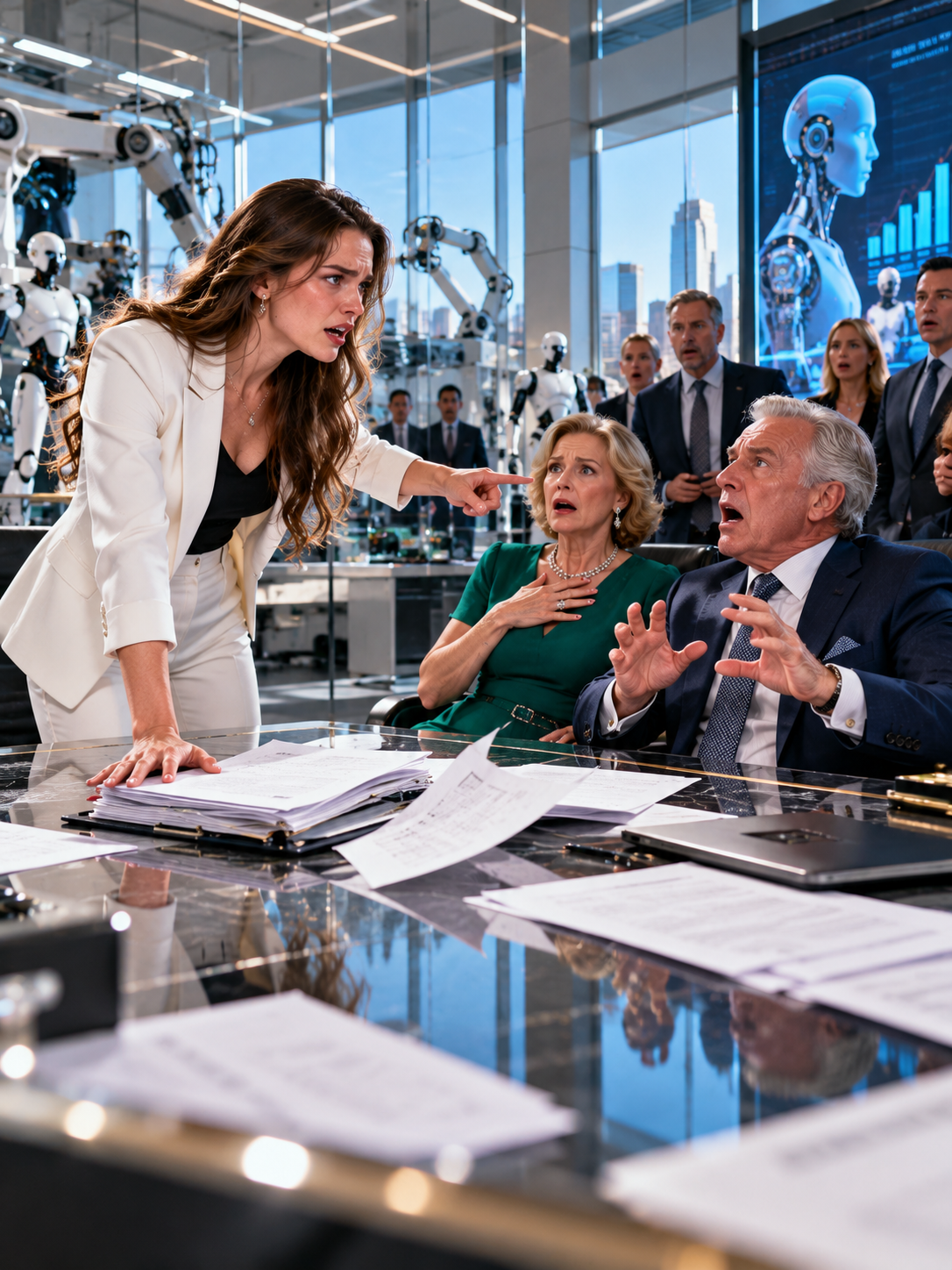
On Friday morning, I arrived at headquarters with Caroline carrying my original blue notebook and certified ownership records. Security tried to stop us at the entrance until the buyer’s legal team confirmed that I was an invited participant in the closing review. The boardroom smelled of fresh coffee and expensive leather, while a large display showed the consortium’s logo above the proposed transaction value. Brandon sat at the head of the table as though the money already belonged to him.
Dad stood before I reached my chair. “We’re transferring the entire eighty-billion-dollar deal to Brandon,” he announced, making no effort to hide his satisfaction. Mom smiled and added that I had been removed from the family trust, while Brandon told me my services were no longer required. Then Dad pointed toward the door and said, “You’re exiled from this family, Natalie. Leave.”
I opened my blue notebook and looked directly at Nathaniel Brooks. “Before I go,” I asked, “can someone explain how you’re buying my patents without my signature?” Nathaniel stopped writing, slowly closed the folder in front of him, and turned toward my father. “Mr. Whitmore,” he said, “there is something your family needs to understand about the eighty billion dollars.”
Part 4
Nathaniel Brooks stood slowly, adjusting his glasses before addressing my father. “The transaction has not closed, Mr. Whitmore, and no acquisition funds have been distributed,” he said. The room went quiet except for the low hum of the ventilation system. He explained that the consortium had identified material inconsistencies between Whitmore Robotics’ ownership disclosures and the public patent records.
Dad’s confidence disappeared almost instantly. He insisted that the patents belonged to the company because I’d developed commercially successful products while employed there. Caroline placed the original licensing agreement on the table, followed by documents establishing that my earliest inventions predated my employment. She explained that the company held valuable commercial licenses but had never purchased the underlying intellectual property.
Brandon jumped to his feet. “She built everything using our money,” he argued, slamming his palm against the table. I opened my blue notebook to the first prototype sketches, dated months before Dad had even seen the machine. Beside them were invoices for components purchased through my personal account. “You funded our expansion,” I told him. “You didn’t invent the technology.”
Nathaniel’s attorney examined the licensing agreement and turned to the section addressing changes in corporate control. Any permitted transfer required conditions that had not been satisfied, including my written consent. The buyer could acquire the company’s shares, but it couldn’t assume unrestricted ownership or use of my patents merely because my family promised those rights. Without them, its original valuation was impossible to support.
Mom tried to intervene, claiming she’d never understood the arrangement. Caroline produced the acknowledgment page bearing both my parents’ signatures, along with an email in which Mom had asked whether the patents could eventually be transferred without additional payment. Margaret Sloan had answered that they could not. Mom stared at the documents without speaking, while Dad demanded to know why those records had been preserved.
“Because they establish ownership,” I replied. Caroline then presented the severance offer requiring me to surrender the patents for fifty thousand dollars, followed by evidence concerning Brandon’s unauthorized development contractor. The buyer’s attorneys exchanged looks as they reviewed the access records and contractor correspondence. Nathaniel finally asked Brandon whether he’d commissioned work intended to bypass technology his company didn’t own.
Brandon’s face reddened. “I was protecting the acquisition,” he said, looking toward Dad for support. Nathaniel replied that creating additional intellectual property disputes was not protection. He asked whether the company had disclosed the contractor’s activities during due diligence, and nobody answered. I watched Dad slowly loosen his tie, his hands no longer steady.
The consortium requested a private recess. Twenty minutes later, Nathaniel returned and announced that the closing conditions remained unsatisfied, the parties had not resolved the ownership disclosures, and the consortium would not proceed with the transaction as structured. The proposed eighty-billion-dollar purchase was being terminated under the applicable contractual provisions. No one moved until Brandon whispered, “You can’t do this.”
Dad turned toward me with an expression I’d never seen before. “You destroyed eighty billion dollars because you couldn’t stand your brother succeeding,” he said. I told him I hadn’t taken his money, altered his systems, or prevented him from selling assets he actually owned. I’d simply refused to let him sell mine while pretending I didn’t exist.
Caroline gathered our documents, and I followed her toward the door. Behind us, investors were already calling their attorneys, while Brandon argued with the consortium’s representatives. I expected to feel victorious, but mostly I felt exhausted. Eight years of work had been reduced to an argument over whether I deserved to own what I’d created.
We were halfway to the elevator when Nathaniel’s senior attorney hurried after us carrying another folder. She said the buyer had received a supplemental patent assignment shortly before closing, supposedly resolving every ownership issue. Caroline opened it and immediately stopped walking. Across the final page was a scanned signature that looked exactly like mine, attached to a document I had never signed.
Part 5
Caroline examined the signature without touching the original document, then requested a digital copy with its complete transmission history. The supposed assignment was dated three weeks earlier, on a day I’d spent attending an engineering conference in Seattle. Its signature resembled one I’d used on an old employment form, including a distinctive crooked letter I’d stopped writing years ago. The document had been submitted through an account belonging to Brandon’s executive office.
An independent document examiner later identified signs that my signature image had been copied from an earlier record. The consortium suspended all further discussions while its lawyers investigated how the assignment had entered the transaction files. Caroline notified the appropriate authorities and pursued civil remedies concerning the attempted transfer. I didn’t need to manufacture revenge; the documents and electronic records spoke for themselves.
The fallout came slowly. Whitmore Robotics remained an operating company, but without the acquisition, investors demanded explanations and lenders reassessed their exposure. Dad resigned from executive leadership after the board commissioned an independent review, while Mom lost her role in corporate financial oversight. Brandon was removed from management, and his contractor arrangements became part of a broader legal investigation.
For weeks, my family called repeatedly. Dad left messages accusing me of ruining everything he’d built, while Mom alternated between demanding an apology and begging me to save Brandon’s future. I listened to none of them after the first few. Every financial or legal question went through Caroline, and every personal message remained unanswered.
Six months after the failed acquisition, Andrew contacted me. He asked to meet at a coffee shop near the university where we’d first met, claiming he’d spent months regretting his decision. When I arrived, he looked exhausted and admitted that Brandon’s promised executive position had disappeared with the deal. “I made a terrible mistake,” he said. “I thought we were all about to become rich.”
“You already knew what they were doing to me,” I replied. Andrew lowered his eyes and admitted that he’d chosen his career over our relationship. He asked whether we could start again now that the situation had changed. I finished my coffee, placed the cup on the table, and told him that losing the opportunity didn’t erase the choice he’d made.
By then, Melissa and I were developing an independent robotics company called Meridian Adaptive Systems. We negotiated the necessary intellectual property arrangements, carefully separating our new engineering work from any surviving commercial rights held by Whitmore Robotics. Our first office was a renovated industrial space with concrete floors, bright windows, and secondhand desks. I loved it more than the enormous headquarters I’d helped build for my father.
We established policies requiring engineers to receive documented recognition for their inventions and clear explanations of every ownership agreement. Nobody was expected to surrender personal work because an executive considered it convenient. At our first public demonstration, Melissa introduced me as the company’s founder and principal inventor. I nearly cried when the audience applauded, not because the crowd was large but because nobody had taken my name away.
Almost a year after the boardroom confrontation, Mom sent a letter saying Dad was experiencing serious health problems and asking whether I could help with medical expenses. I asked Caroline to verify the situation, then arranged limited direct payments for essential care. I didn’t send my parents unrestricted money, and I didn’t visit. Helping someone survive wasn’t the same as inviting them back into my life.
Mom responded with a message saying families were supposed to forgive each other. I deleted it without answering. For years, my parents had confused loyalty with obedience, and my brother had treated my work as something he could inherit without earning. Their apologies came only after their plans failed, and I no longer needed them to understand why I was leaving.
On the anniversary of the canceled acquisition, I stood in Meridian’s new laboratory watching our latest prototype complete its first autonomous recovery test. The machine adjusted around an unexpected obstacle, paused briefly, and continued working, just as my original invention had done eight years earlier. Melissa grinned from the control station, and our engineers erupted into applause. I opened my old blue notebook and added one final sentence beneath the earliest sketches: “This time, I built something nobody can take from me.”
My father had tried to exile me from an eighty-billion-dollar empire, but he’d misunderstood what made that empire valuable. It wasn’t his name, Brandon’s expensive suits, or the money investors had promised. It was the invention I’d created before any of them believed in me, and the courage I’d finally found to protect it. I closed the notebook, looked around at the people who respected my work, and realized I’d never needed my family’s permission to succeed.
Legal Notice: This story is a work of fiction. Names, characters, businesses, events, and incidents are the product of the author’s imagination or are used fictitiously. Any resemblance to actual persons—living or dead—or to actual events is purely coincidental. Thank you! 💓