
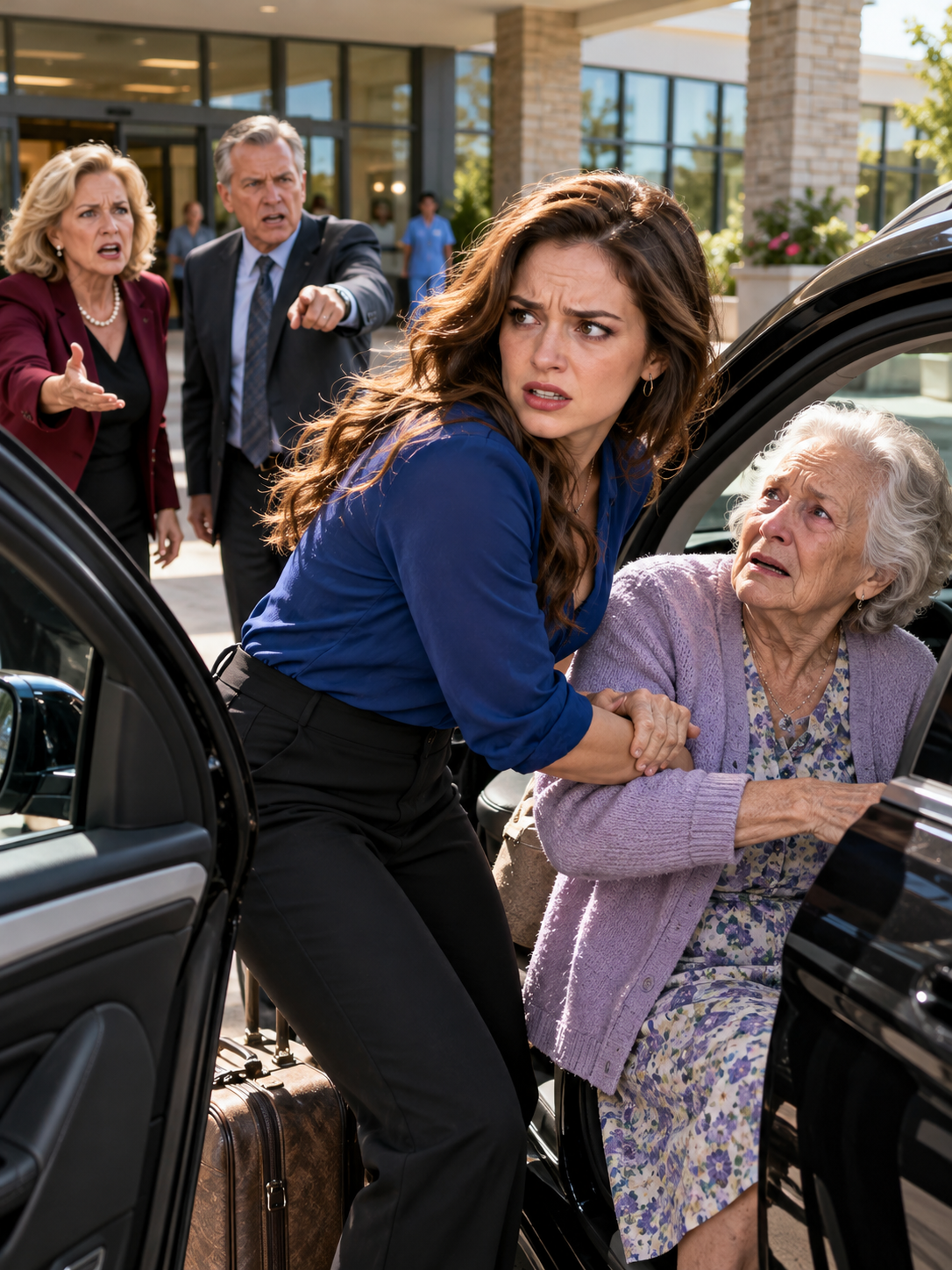
My Parents Abandoned Grandma at a Nursing Home, but When I Drove 190 Miles to Rescue Her, She Revealed the Secret They’d Hidden for 22 Years
My father told me he was taking Grandma to lunch. Three hours later, a nursing home called because my parents had abandoned her in the lobby with a suitcase and no explanation. I drove 190 miles to bring her home, expecting tears and confusion. Instead, she climbed into my truck and gave me an address I’d avoided for twenty-two years. By the following Monday, seventeen truck drivers would witness my father lose something he had spent decades pretending belonged to him.
Part 1
The call came at 3:17 on a Thursday afternoon while I was sitting in a grain terminal outside Wichita, waiting for a load of soybean meal to clear the scales. My truck’s air conditioner rattled, the cab smelled of diesel and stale coffee, and a clipboard covered in delivery tickets rested against my knee. The unfamiliar number showed a western Kansas area code. I almost ignored it, but something made me answer before the fourth ring.
“Is this Teresa Marlowe?” a woman asked, introducing herself as Allison Reed from Willow Creek Senior Living in Hays. “I’m calling about your grandmother, June Marlowe.” I sat straighter, expecting news of an accident or an illness. Instead, Allison explained that my parents had brought Grandma in for a prepaid respite stay that morning, signed some paperwork, and driven away. Grandma had been sitting in the lobby ever since, refusing to remove her coat.
“That can’t be right,” I told her. “Dad said he was taking her to lunch.” Allison hesitated before saying, “Your grandmother told us the same thing, but she seems completely aware of where she is.” I asked why they hadn’t called earlier. “She didn’t give us permission until a few minutes ago,” Allison replied. “She kept saying somebody would come back.”
I had driven commercial trucks for nineteen years, hauling grain through Kansas and Oklahoma, and I’d learned to stay calm when equipment broke or a delivery went wrong. But I barely remembered telling the dispatcher I had a family emergency. I left my loaded trailer with another driver and headed northwest in my pickup, watching flat farmland slide past the windshield. Somewhere outside Salina, I called my father’s number three times. He didn’t answer once.
I hadn’t lived in Ellis County since I was twenty-two, when Grandpa Raymond died and Dad announced the family farm was going to him and my younger brother, Eric. He’d delivered the news in the machine shed, one hand resting on my shoulder as if he were doing me a kindness. “Your grandmother has made her decisions, Tess,” he’d said. “There’s no future here for you.” I believed him because fathers weren’t supposed to invent stories about their own mothers.
That didn’t mean I’d abandoned Grandma. I visited her several times a year at the grocery-store coffee counter, mailed birthday cards, and called every February on Grandpa’s birthday. She always asked about my routes and whether I was eating properly, then told me about the weather and her stubborn tomato plants. What I never did was visit the farm. Twenty-two years of believing I wasn’t welcome had turned one ordinary gravel road into somewhere I couldn’t bring myself to go.
When I arrived at Willow Creek, Allison was waiting beside a reception desk decorated with artificial sunflowers. Grandma sat beneath a television playing a game show, dressed in her brown Sunday coat with a small suitcase standing beside her sensible black shoes. Her silver hair was pinned neatly, and she held her purse on her lap. When she saw me, she simply stood and said, “You came.”
“Of course I came,” I replied, reaching for her suitcase. Allison quietly showed me the paperwork, pointing out that Grandma had signed the admission form herself and listed my phone number as her emergency contact. Whoever had packed her suitcase had included two dresses and slippers but forgotten her reading glasses and other daily essentials. Grandma watched me inspect everything without offering an explanation.
Outside, I helped her into my pickup and asked whether she wanted to call Dad before we left. She clicked her seat belt into place, folded both hands over her purse, and shook her head. “Don’t call your father, sweetheart. I’ll tell you where to drive.” When I asked if she wanted to stop for dinner, she said she wasn’t hungry and gave me directions toward the old section road.
I recognized the turn before she finished speaking. My stomach tightened as we passed the weathered grain elevator and the little white church where Grandpa’s funeral had been held. “Grandma, that’s the road to the farm,” I said. She looked straight through the windshield and answered, “I know exactly where I’m going.” Then she told me to avoid the driveway to my parents’ house and use the northern entrance instead.
The farmhouse porch light was burning when we arrived, and a newspaper lay unopened beneath the door. Grandma climbed out without taking my offered hand and pointed toward the kitchen, where a yellow coffee tin sat beside the stove. I expected her to collapse into a chair, exhausted by the day, but she filled the kettle and measured coffee as though we’d merely returned from shopping. Then she turned to me and said, “Tomorrow morning, we’re seeing Warren Kepler, and I want you there when he opens his books.”
Warren was the man who’d harvested our family’s wheat for decades. I couldn’t imagine what his records had to do with Grandma being abandoned. But when I asked what we were looking for, she gave me an answer that made my chest go cold. “The truth about what your father has been doing with my land.”
Part 2
I slept badly that night on a narrow bed in Grandma’s guest room, listening to the farmhouse settle around me and the distant sound of trucks on the highway. At five the next morning, I found her at the kitchen table wearing a blue cardigan, her reading glasses balanced low on her nose. A stack of old envelopes lay beside her coffee cup. She slid one toward me and said, “Your father gives me one of these every July.”
Inside was a handwritten receipt for thirteen thousand four hundred forty dollars, the yearly payment for using 480 acres at twenty-eight dollars an acre. I looked through several more envelopes and noticed that the amount hadn’t changed in over two decades. “That’s all he pays you?” I asked. Grandma nodded and explained that Dad had offered the arrangement after Grandpa died. When I asked about a lease, she said they’d always settled matters with a handshake.
She led me to a rolltop desk in the living room, its wood darkened by years of furniture polish. Inside were tax receipts, insurance notices, harvest slips, and a faded photograph of Grandpa standing beside an old combine. I searched for a document transferring the farm to Dad or Eric, but couldn’t find one. “Where’s the deed?” I asked. Grandma looked at me strangely and answered, “In the bank box where it’s always been.”
I told her what Dad had said after Grandpa’s funeral, expecting her to remember some arrangement I’d misunderstood. Instead, her expression changed in a way I’d never seen before. “Your grandfather and I never gave that ground to your father,” she said quietly. “Ray helped farm it, but it came from my family, and I’ve owned it since 1978.” I sat down because my knees suddenly felt unreliable.
For twenty-two years, I’d believed Grandma had chosen my brother over me, leaving me with memories and nothing else. She admitted she’d known Dad wanted control of the land, but said she hadn’t realized he’d told me ownership had already been transferred. Before I could ask why she’d never corrected him, she closed the desk and reached for her coat. “First, you need to understand what the farm produces,” she said. “Then we can talk about why I stayed quiet.”
Warren Kepler lived twelve miles away in a white bungalow surrounded by rusting machinery and neatly stacked spare tires. He’d been cutting wheat for local farmers since before I was born, and he greeted Grandma by putting a fresh cup beneath his coffee machine. When I asked about last year’s harvest, he brought a leather notebook from the kitchen counter and began reading yields, dates, and acreage totals. The numbers were healthy enough to make Grandma’s yearly payment seem painfully small.
I knew that farming carried genuine expenses and bad years, so I wasn’t interested in pretending every bushel was profit. What bothered me was the complete absence of accounting between Dad and the woman who owned the land. Warren said he’d left harvest summaries in Grandma’s mailbox every year because Grandpa had asked him to. Grandma admitted she received them but had never understood how to compare the figures with what Dad paid.
“There’s something else,” Warren said, opening a drawer filled with yellow weight tickets. “Dale told me he’s changing how we’re delivering this year’s wheat.” He explained that Dad had already arranged some of the crop sales and expected to use the same cooperative account as always. I asked whose account he meant, assuming the answer was obvious. Warren pushed three tickets across the table and told me to look at the upper right corner.
Every ticket carried Grandma’s full name and the same membership number. As a truck driver, I had handled thousands of these slips, and I knew that the account identified where grain deliveries were credited. Warren explained that Dad had used Grandma’s long-established account for years because its membership and marketing arrangements were favorable. “I figured she knew exactly how everything worked,” he said, glancing uneasily at her.
Grandma remembered signing a form at the cooperative shortly after Grandpa died, allowing Dad to handle deliveries and payments while she dealt with the funeral and household bills. She couldn’t recall the wording or whether the authorization had ever been reviewed. I gathered the tickets and asked Warren for copies, because I was beginning to understand how much power an ordinary piece of paper could give someone. He agreed to help, then warned us that Dad had already committed much of the coming harvest at a price negotiated months earlier.
Before returning to the farm, we stopped at the county records office in Hays. A clerk named Diane confirmed that the property remained entirely in Grandma’s name, with no recorded transfer to Dad or Eric. She also found something in an old paper folder: an incomplete request from 2019 to redirect property correspondence to my father’s address, with Grandma’s signature line left blank. It had been submitted the same year Grandma stopped driving, and the clerk had refused to process it.
I carried that copy to my truck with my hands trembling. Dad had not only told me the land was gone; he’d tried to position himself between Grandma and the records proving otherwise. That evening, my brother Eric drove up to the farmhouse, and the first words out of his mouth were, “Dad already sold this year’s wheat forward, Tess. If you interfere now, you could bankrupt him.”
Part 3
Eric parked sideways across the driveway, blocking my pickup as though I might escape with the entire farm in the glove compartment. He was forty-one now, with two children and a face weathered by long harvest seasons. “I’ve worked that ground since I was sixteen,” he said, refusing to come inside. “You’ve been gone twenty-two years, and suddenly you show up acting like you own the place.”
“I came because our parents left Grandma in a nursing home,” I answered. Eric shifted his weight, then said she had been forgetting things and needed supervision. When I asked what exactly she’d forgotten, he mentioned confusing names during a phone call months earlier. I pointed toward the house, where Grandma was sorting her tax receipts by year without help. “Forgetting a name doesn’t mean someone loses the right to make decisions,” I told him.
Eric lowered his voice and explained that Dad had promised him the farm would eventually belong to his children. Worse, Dad had committed the coming wheat harvest under a forward-price contract tied to the cooperative account. If that arrangement changed before delivery, the financial consequences could be serious. “Dad borrowed against what he expected to make,” Eric said. “You can’t destroy all that just because Grandma’s upset.”
A vehicle horn sounded behind us. My mother’s SUV had been waiting near the road, and I realized she’d been watching our conversation through the windshield. She rolled down her window only far enough to speak. “Bring your grandmother back where she belongs, Teresa, before you ruin this family.” Then she drove away without once asking whether Grandma had eaten, slept, or wanted to return to Willow Creek.
I stood in the dusty driveway until Eric followed her. The hot wind carried the metallic rattling of an irrigation system from a neighboring field. What disturbed me wasn’t merely the money; it was how efficiently everyone had agreed to talk about Grandma as a problem rather than a person. They had discussed her future, her property, and her supposed confusion without allowing her a meaningful place in any conversation.
That evening, Grandma brought two mugs of tea onto the back steps. I told her about Eric’s warning and asked why she’d been taken to Willow Creek now, of all times. She admitted that three weeks earlier she’d requested a full accounting from Dad and told him she planned to transfer ownership of the land to me on July first. She wanted the arrangement prepared with proper legal advice, but Dad had dismissed the idea as unnecessary.
The dates finally made sense. The prepaid respite stay covered the very day Grandma intended to begin transferring the farm. I couldn’t prove my parents had deliberately scheduled it to interfere, but the timing made my skin crawl. “Why didn’t you tell me?” I asked. Grandma watched the darkening wheat fields before answering, “Because I wasn’t certain how you’d feel about accepting it.”
I told her that wasn’t the question I’d meant. For twenty-two years, I had believed she had rejected me, and she’d allowed that misunderstanding to live between us. Grandma clasped her hands together and admitted something she’d never told anyone. In the last week of Grandpa’s life, he’d asked her not to rush into giving the land away and said she should remember who continued visiting when there was nothing to gain.
“I wanted to see who loved me without asking for anything,” she said. I stared at the porch boards and thought about every birthday phone call, every meeting at the grocery-store counter, every time I’d stayed away because I believed Dad’s story. “You should’ve told me the truth anyway,” I answered. Grandma nodded, and for the first time that weekend, I saw tears gather in her eyes. “You’re right, Tess. I should have.”
We sat together until the porch light attracted moths. Eventually Grandma said, “I waited three hours at that place, hoping one of them would come back.” I reached for her hand, understanding that she’d been abandoned by people she’d spent her life protecting. I couldn’t undo those hours, but I could make certain her next decisions were genuinely hers.
On Sunday, we called an attorney recommended by the county clerk and arranged the earliest available consultation. I also contacted the cooperative to ask what an account holder could review or change in person. The manager confirmed that Grandma could examine her records and request changes to authorized access, though existing contracts required review. Grandma listened carefully, then polished her black church shoes and placed them beside the door.
“We’re going to the grain elevator Monday morning,” she announced. I warned her about the trucks, the heat, and the men who would recognize her son. She looked at me with a steadiness I hadn’t seen in years. “Good,” she said. “I want them to recognize me, too.”
Part 4
At six Monday morning, seventeen grain trucks were lined up outside the cooperative, their engines vibrating through the gravel beneath my boots. Wheat dust drifted through the pale sunlight, and the air smelled of diesel, hot metal, and freshly cut straw. I parked near the office, where Grandma sat beside me wearing her blue dress and polished black shoes. She studied the long line of trucks, then opened her purse and took out her identification.
Before stepping down, she touched my arm. “Let me do the talking first.” I nodded and walked beside her toward the scale-house window, where a clerk named Hank Porter was typing delivery numbers into an aging computer. Several drivers recognized me from the road, but their attention shifted when Grandma introduced herself. “June Marlowe,” she said. “I’d like to review my account and the people authorized to use it.”
Hank checked her identification and brought the cooperative manager over to help. On the screen were years of grain deliveries, marketing agreements, and settlement instructions linked to Grandma’s membership. Dad had been listed as an authorized representative since shortly after Grandpa died, with payments directed through his farm operation. The arrangement had continued without Grandma reviewing the details, and the manager confirmed there was a current contract requiring special attention.
Dad’s pickup arrived before the records review was finished. He crossed the gravel smiling, greeting drivers by name before reaching for Grandma’s elbow. “Mom, what are you doing out here? It’s going to get dangerously hot.” She moved her arm away and answered, “I’m checking my own account, Dale.” His expression changed as several nearby drivers stopped talking.
He turned toward me, anger tightening his mouth. “You put her up to this.” I started to answer, but Grandma raised one hand. “Teresa drove me because I asked her to,” she said. “The land is mine, and I want to know where the money goes.” Dad glanced at the office window, then lowered his voice. “We’ve managed this farm for decades. You can’t change everything overnight.”
Grandma agreed that he and Eric had worked hard, but reminded him that hard work didn’t turn rented property into inherited property. I laid out copies of the tax receipts and cooperative delivery tickets, explaining that Grandma had been paying the land taxes while receiving the same modest payment every year. Dad insisted the rent reflected family arrangements and his operating expenses. “Then let’s put the complete numbers on paper,” Grandma answered.
By then, several engines had gone quiet. Dad looked around at the drivers who’d known him for years, and I watched his confidence begin to falter. Hank’s manager explained that any changes to payment instructions would require checking the existing forward contract, but that Grandma could formally challenge the current authorization and request a full accounting. She asked him to begin that process immediately.
Dad stared at her. “You’re doing this to your own son?” Grandma held his gaze without raising her voice. “You took me somewhere I didn’t agree to stay, told my granddaughter the farm wasn’t mine to give, and expected me to remain quiet.” He opened his mouth, but she continued before he could interrupt. “I’m not giving you control anymore.”
The manager documented Grandma’s request, gave her copies of the account information, and flagged the disputed payment instructions for review. Nothing was magically settled at that window; the contract still had to be honored or resolved, and the harvest still belonged in the ordinary accounting process. But for the first time in twenty-two years, Dad could no longer quietly treat Grandma’s signature as a substitute for her consent.
As we walked back toward my pickup, Warren’s combine operator waved from a waiting truck, and Grandma returned the gesture. Dad stood near his vehicle, surrounded by drivers who suddenly had much less to say to him. Eric arrived just as we were leaving, looked toward the office, and asked his father what had happened. Dad answered, “Your grandmother decided she doesn’t trust us anymore.”
Grandma heard him through the open window. “Trust isn’t something you get to keep after you stop earning it,” she replied. I started the truck and watched her settle into the passenger seat, exhausted but satisfied. Then my phone rang with a message from the attorney’s office: someone had already called asking whether Grandma’s proposed property transfer could be stopped because she supposedly wasn’t capable of making decisions.
Part 5
I called the attorney immediately, pulling into a gas station where the smell of fresh coffee drifted through my open window. She explained that my father had raised concerns about Grandma’s decision-making, but a phone call alone couldn’t remove Grandma’s legal rights. Grandma requested a private meeting with the attorney, without me or any other family member present. “I want everything done properly,” she said. “Nobody is going to claim you talked me into something I didn’t want.”
The following morning, Grandma met with the attorney and answered questions about her finances, property, family, and intentions. The attorney also arranged an independent assessment to address the concerns Dad had raised. Grandma returned from those appointments tired and irritated, but with no indication that she lacked the ability to make her own decisions. When I asked whether she still wanted to transfer the farm, she said, “More than ever, but we’re doing it carefully.”
On Wednesday, July first, we returned to the attorney’s office in Hays to complete the documents. Grandma had received independent advice, and the transfer was prepared with protections for her continued use of the farmhouse and financial security. She signed the deed before a notary, then watched the attorney arrange for its recording. The little stamp sounded ordinary, almost disappointing after everything we’d survived.
In the parking lot, I sat behind the wheel without starting the engine. “I thought you didn’t want me,” I finally admitted. “Dad told me you’d chosen him and Eric, and I believed it for twenty-two years.” Grandma reached across the console and covered my hand with hers. “I loved you every time you called, sweetheart. I was wrong to let you believe otherwise.”
We still had work to do. With professional help, Grandma and I reviewed the harvest accounts, the existing contracts, and Dad’s years of informal arrangements. The cooperative required proper documentation before redirecting disputed proceeds, and the attorney helped negotiate an accounting and settlement without disrupting commitments already made to grain buyers. Dad didn’t lose everything, but he lost the unrestricted control he’d treated as his birthright.
News traveled through the county faster than any official notice. Dad stepped down from his position on a cooperative committee after the questions about Grandma’s account became public. Eric stopped calling me, although his oldest son quietly began visiting Grandma on Sunday afternoons to mow the yard and bring groceries. I never asked the boy to choose sides, and Grandma never used him to carry messages.
My mother called one evening while I was helping Grandma wash dishes. She didn’t apologize for abandoning her at Willow Creek or ask how she was recovering from the ordeal. Instead, she wanted to know whether I understood how difficult life had become for Dad. “He’s humiliated, Teresa,” she said. “People at church barely look at him.”
I dried my hands and answered, “You left an eighty-eight-year-old woman sitting in a nursing home because she wanted control of her own property. You’ve asked me about Dad six times, but you haven’t asked about Grandma once.” My mother went silent, then accused me of choosing money over family. “No,” I replied. “I’m choosing the family member you treated as disposable.” I ended the call and decided I wouldn’t answer another one.
By August, we had arranged for an independent farm operator to manage future seasons under a written lease, with Grandma involved in every decision. I returned to Wichita and resumed my regular hauling routes, though I now drove northwest whenever she needed me. The recorded deed arrived by mail, and Grandma placed a copy in her rolltop desk beside the last empty envelope Dad had delivered. Above her kitchen table, she hung a yellow grain ticket from that Monday morning.
Sometimes I still think about the three hours she spent in that nursing home, waiting for somebody to come back. My parents believed they could make her disappear quietly, the same way they’d spent twenty-two years making the truth about her farm disappear. They were wrong about her, and they’d been wrong about me.
Last Sunday, Grandma called while I was parked at a grain elevator outside Dodge City. She wanted to discuss next year’s crop rotation, then reminded me to eat a proper dinner. I smiled, resting my clipboard against the steering wheel as trucks rolled past. For nineteen years, I’d made my living checking that the right names appeared on the right papers. This time, the most important name wasn’t on my delivery sheet.
It was on a deed, exactly where my grandmother wanted it to be.
Legal Notice: This story is a work of fiction. Names, characters, businesses, events, and incidents are the product of the author’s imagination or are used fictitiously. Any resemblance to actual persons—living or dead—or to actual events is purely coincidental. Thank you! 💓


