
My Mother Uninvited Me From My Sister’s Wedding—Then I Recognized the Groom’s Stolen Watch
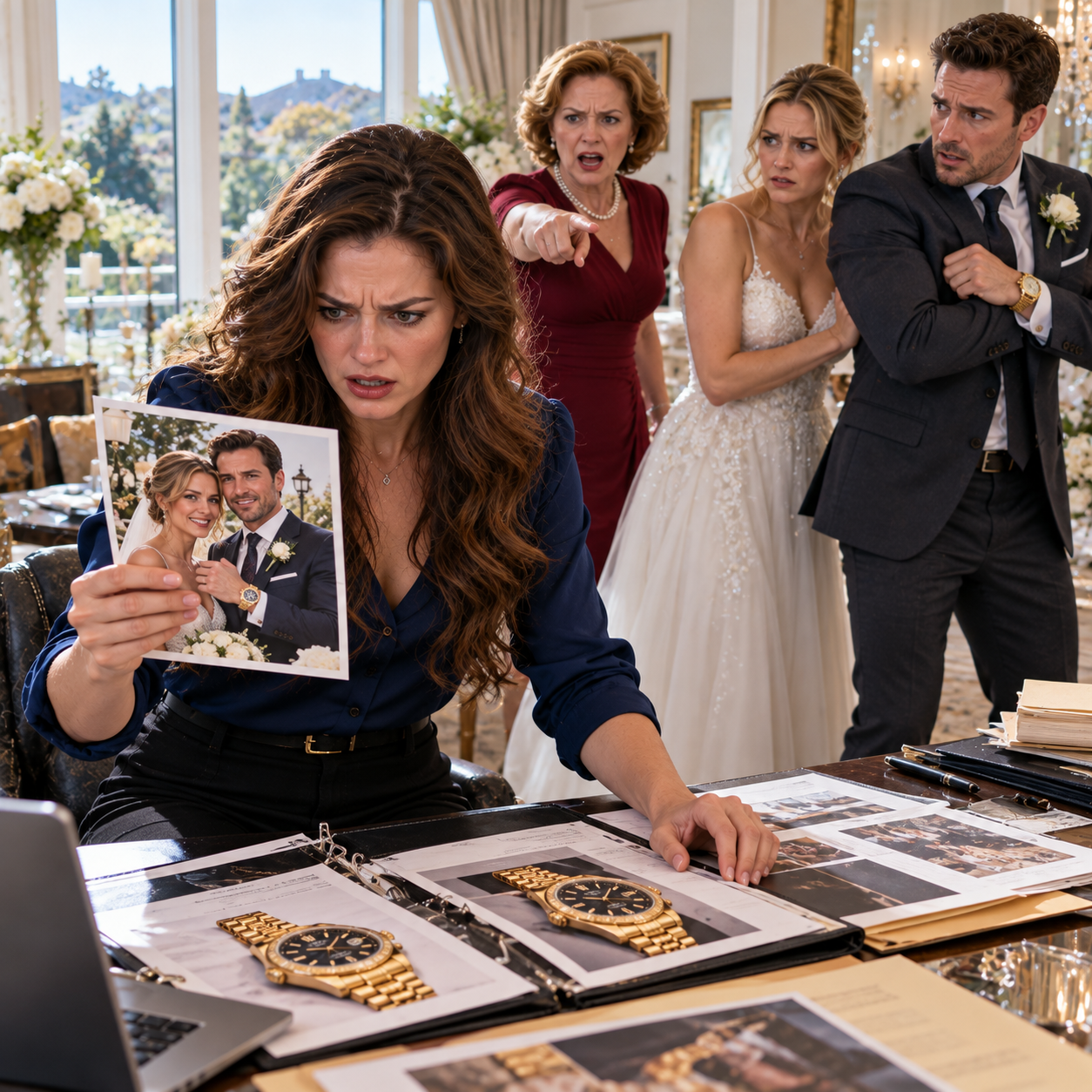
“You’re not welcome at your sister’s wedding,” my mother texted five days before the ceremony. “Don’t embarrass us in front of important people.” Minutes later, she sent a photograph of the smiling bride and her supposedly wealthy fiancé. I almost deleted it—until I noticed the scratched gold watch on his wrist. Two years earlier, a widow had cried across my desk while describing that exact watch. My mother thought she had erased me from the wedding. Instead, she had sent me the clue that could stop it.
Part 1
My mother didn’t call to uninvite me. She sent a text at 9:16 Monday morning, while I was standing in my Providence kitchen waiting for coffee to drip into a chipped blue mug. “Paige needs a peaceful wedding, Elise. You’re not invited. Bennett’s family is very traditional, and we won’t have your negativity making a scene.” Before I could respond, another message arrived with a professionally edited engagement photograph, as if showing me what I’d miss was part of the point.
My sister Paige was glowing in a satin dress, her head tilted toward her fiancé, Bennett Vale. He stood behind her with one hand resting on her shoulder and the other holding a champagne flute. On his wrist sat a vintage gold Hamilton watch, its face turned slightly toward the camera. I enlarged the picture until the pixels blurred, then found the thin scratch cutting across the numeral seven. That small mark felt more familiar than his face, and my first impulse was to close the picture before it could change anything.
For a moment, all I could hear was the refrigerator compressor clicking on. Two years earlier, a woman named Meredith Shaw had placed a photograph of a similar watch between us during a fraud interview. Her late husband, Thomas, had scratched it changing a tire, and she’d recognized the damage immediately after it disappeared from her dresser. The man who had taken it had also vanished with nearly everything she’d saved.
I’m thirty-four and work as a forensic accountant, which my mother describes as “looking at receipts all day.” The work isn’t glamorous; mostly I follow authorized financial records through ordinary-looking companies until an account stops making sense. Meredith had come to our firm’s bank-fraud referral unit after her second husband, a man calling himself Simon Reed, gained access to her savings and disappeared. Other people assumed she’d given him the money willingly and regretted it afterward.
I remembered her hands wrapped around a paper cup, the lid crushed beneath one thumb. “My daughter says I’ve misunderstood,” she’d whispered. “I just want someone to tell me where it went.” By the time we finished reviewing the statements, I could show her withdrawals routed through businesses that didn’t appear to sell anything. I couldn’t promise recovery, but I could tell her she wasn’t imagining the missing money.
The investigation grew. Two other women had described relationships with men using different names, each followed by emptied accounts and a sudden disappearance. Transfers touched several of the same intermediary companies, enough for me to prepare a referral to Special Agent Leo Castillo in Boston. We never found a current identity or location, and eventually the case stopped moving, although I kept a working copy of my authorized analysis securely filed.
My family knew none of this. My father died when I was twenty-five, and Mom responded by treating social status as a goal we had somehow inherited from him. When Paige sold her wellness company for $4.2 million, Mom began speaking of her success as our family’s entrance into a better class. Bennett, with his seaside connections and stories about generations of wealth, seemed to complete the picture.
Paige and I hadn’t always been strangers. I’d reviewed the contract before she sold her company, caught an expensive clause, and stayed awake with her until she felt ready to sign. But at a bridal lunch last month, Mom squeezed my wrist under the table and whispered, “Don’t correct anyone today.” Paige saw my expression, looked away, and later told me I always made people uncomfortable.
I pulled the old case notes onto my laptop without opening any restricted records. The watch wasn’t proof of who Bennett was, but it was too distinctive to ignore. I sent Agent Castillo the photograph with a short explanation, then called his office. When he answered, I said, “I think the man we lost is about to marry my sister.” His voice changed when I mentioned the scratched seven: “Send me the full image, Elise. And don’t confront him.”
Part 2
Castillo called back that night while I was washing my dinner plate. He had compared the new photograph with the limited images from the old investigation and agreed the resemblance was strong. “It’s a lead, not an identification we can take to court,” he cautioned. “We need independent verification, and I need you to stay clear of anything that isn’t yours to access.” I promised, although it meant sitting still while Paige’s wedding moved closer.
Tuesday morning, I drove to Meredith’s modest house outside Worcester. She answered wearing a gardening apron, with soil on her fingers and a dish towel hanging from one shoulder. For a second she looked worried that I’d come with bad news about her money. I told her I’d found someone who might be Simon Reed, and asked whether she was comfortable looking at a photograph.
We sat at her kitchen table beside a bowl of small red tomatoes. Meredith studied the groom’s face, then turned the phone to see his wrist more clearly. Her finger stopped over the watch. “Thomas wore that every day for twenty-nine years,” she said. “I know that mark. And that’s the man who told me I’d never have to be alone again.”
She brought out a box she’d kept in a hall closet. Inside were bank letters, the courthouse marriage certificate, a photograph taken at a summer barbecue, and a note Simon had left the morning he disappeared. I called Castillo from the porch and connected him with her permission; he arranged for an agent to collect copies and take a formal statement. Meredith surprised me by asking if she could attend the wedding, not to cause a scene, but because she wanted to be there when someone finally believed her.
Back in Providence, I reviewed only what my family had openly shared about Bennett. His claimed ancestral home appeared in lavish social photographs, but I couldn’t find a normal public history for the supposed family foundation he praised in interviews. That could have meant little; privacy isn’t a crime. The clue that bothered me was an old announcement describing Bennett as the heir to a charity his own biography never named.
Castillo’s team handled the official checks. Meanwhile, I tried Paige’s number twice, and she finally answered from a dress fitting. I heard rustling fabric and Mom asking who’d called. “Please postpone the wedding for two weeks,” I told my sister. “There is something serious about Bennett that I can’t responsibly explain over this phone. I’m asking you to trust me once.”
Mom took the phone before Paige replied. “We know exactly why you’re doing this,” she said, her voice bright enough for the bridal shop to hear. “You couldn’t bear your sister becoming a Vale, so now you have invented a scandal.” I reminded her I had helped negotiate Paige’s company sale, not tried to ruin it. She answered, “That’s ancient history. Stop inserting yourself into her happiness.”
“Paige,” I said, waiting until I heard my sister again. “I don’t need an invitation. I need you to protect yourself and postpone.” She was quiet long enough that I thought she might listen. Then she said, “You don’t get to decide whether I deserve a good marriage,” and ended the call.
That afternoon Castillo confirmed that the grand Vale estate was leased, not owned, and that the family history his agents could verify began only months before Bennett met Paige. It was suspicious, but it didn’t prove the older financial crimes or justify treating the groom as guilty in public. Castillo asked whether Paige had recently mentioned paperwork giving Bennett authority over her investments. I remembered a photograph Mom had posted of the couple signing something at a private bank, captioned “Planning their future.”
I sent him the publicly shared image, careful not to guess what it showed. He called again after dark. “Elise, the institution has flagged a disputed authorization tied to your sister’s brokerage account,” he said. “Our team is looking at it now.” I looked at the calendar on my wall, with Saturday circled in green. Someone might already be reaching for Paige’s money, before she’d even taken her vows.
Part 3
By Wednesday, I had barely slept and reheated the same soup twice. Castillo said his team had obtained the proper records and confirmed an attempted $350,000 borrowing arrangement against Paige’s brokerage holdings. The authorization carried her name, but the signature differed from authenticated samples, and the institution had suspended the request pending review. The money hadn’t been released, which was the first good news I’d heard all week.
“Can I tell her?” I asked. Castillo said Paige needed to hear about the disputed paperwork through proper channels, and agents were arranging a discreet interview. He warned that a criminal investigation and an allegation weren’t the same as a conviction. I wasn’t interested in winning an argument with my mother; I wanted my sister’s assets protected before she trusted a stranger with any more documents.
Thursday morning, Paige texted me, “Did you call someone about my accounts? Bennett says a bank officer is trying to embarrass him.” I wrote that I had reported concerns to the appropriate people and urged her to speak privately with her own adviser. I didn’t mention Meredith or the watch. Paige replied with a single sentence: “Mom says this is why you weren’t invited.”
I went to work instead of staring at my phone. The office smelled of toner and burnt coffee; I reviewed inventory reports while picturing Paige’s wedding dress hanging in Newport. At five, Castillo called with confirmation that Paige had spoken to investigators, although she had disputed the possibility that Bennett would forge her signature. “She’s been informed of the allegation,” he said. “What she believes is her decision.”
I drove that evening to see Meredith again. She had arranged the documents in a neat pile and laid Thomas’s old photograph on top. “I used to think that losing the savings was the worst part,” she said, pouring tea. “It was hearing people describe me as foolish after I finally asked for help.” I told her the man in my sister’s photograph had been counting on exactly that kind of shame, and Meredith nodded as though she’d been waiting to hear it said aloud.
She asked about my family. I told her Mom had always considered my work an embarrassing substitute for charm, and that Paige had begun repeating those judgments when her company became successful. Meredith looked at me for a long moment. “You’re trying to save your sister,” she said, “but nobody seems worried about what it’s costing you.” I carried that sentence home more carefully than the documents.
On Friday, news arrived that the authorities had established a stronger connection between Bennett’s present identity and the older fraud investigation. Castillo couldn’t share everything, but he confirmed that the disputed authorization and supporting records had provided grounds for an arrest warrant. His team planned to locate the groom before the ceremony, ideally away from the guests. “You don’t need to attend,” he told me. “In fact, I’d rather you didn’t.”
I said I wanted to be close enough for Paige to find me when the truth surfaced. He reminded me that I wasn’t part of his operation, and I agreed not to interfere or disclose anything confidential. Meredith had separately been invited by investigators to assist with identification and would wait wherever they directed her. There would be no dramatic confrontation staged for my benefit; the agents would handle the arrest.
At 10:48 Friday night, Paige called. Her voice was low, with the sound of music playing elsewhere in the house. “Bennett says we need to sign one more thing in the morning,” she whispered. “He says it’s for our new investment account, but I asked my adviser and she doesn’t recognize it.” I told her not to sign anything she didn’t understand and to contact the investigator who’d interviewed her.
“Did you really mean what you said about postponing?” Paige asked, and for the first time I heard the little girl who used to crawl into my bed during thunderstorms. Before I could answer, a man’s voice called her name in the background. The line went dead, and I realized that even with an arrest warrant, Saturday might arrive before anyone reached her.
Part 4
At nine Saturday morning, I parked across from the Newport wedding venue, a restored stone mansion overlooking the harbor. White flower arrangements framed the entrance, and a quartet was rehearsing inside. I had told Castillo I would remain outside unless Paige asked for me, but after twenty minutes my sister sent a message: “Please come. I can’t do this alone.” I walked through the doors in a plain navy dress, feeling every head in the foyer turn.
Mom reached me beside a table covered in gold-printed place cards. “I specifically told you not to come,” she hissed, then raised her voice so a nearby cousin would hear. “Somebody find the coordinator. My older daughter is trying to create another scene.” For a moment I was twelve again, standing in the hallway while she described my serious face as a family inconvenience. Then I remembered why I was there and asked, “Where is Paige?”
Bennett appeared from the reception room, immaculate in a gray suit with Thomas Shaw’s scratched watch glinting beneath his cuff. “Elise, what a surprise,” he said warmly, addressing the gathering crowd instead of me. “We know today may be difficult for her, but there’s no reason to let jealousy spoil it.” Several guests nodded, and Mom folded her arms with an expression that said she had finally found an ally who understood me. An uncle I had known since childhood looked down at his shoes, pretending not to hear, and I wondered how many years I had mistaken that silence for kindness.
“I’m here because Paige asked me to come,” I answered, holding up her message. Bennett’s smile narrowed, and he asked to see my phone; I lowered it. “You can speak to her if she wants you to,” he said, taking a step toward the staircase. But a venue coordinator came down first, followed by Paige, her veil still unpinned and her eyes red from crying.
“I didn’t sign the new authorization,” she told Bennett from the bottom step. “I asked the bank what it was.” His expression changed so quickly that even Mom stopped talking. He tried to laugh and said there had been a misunderstanding about the investment account. Paige looked at me, not him, and asked, “Is there another woman who says he married her?”
Before I could answer, two investigators entered with Agent Castillo and approached Bennett, identifying themselves and stating they had a warrant. Castillo asked the guests to give them space while another agent spoke privately with Paige. Bennett protested that a jealous relative had invented the allegations, but the agents were there because of records and testimony, not my opinion. The room went silent as they escorted him toward the entrance.
Meredith stood near the far doorway with an agent, wearing a dark green coat and holding her purse with both hands. Bennett recognized her, and his eyes flicked toward the side corridor before returning to Castillo. Meredith didn’t shout or move closer. “That’s him,” she said steadily when asked to confirm her identification, and I saw Paige glance from the older woman’s face to the scratched gold watch.
“He took that from her?” Paige whispered. I told her the watch had belonged to Meredith’s late husband and that the investigation involved other women as well. No one in the room laughed now. Mom opened her mouth to repeat the jealousy accusation, but Paige turned toward her and said, “Elise warned me. You told me to ignore her.”
After Bennett was taken away, the coordinator suggested moving everyone into the garden. An aunt tried collecting abandoned champagne glasses, then gave up; nobody knew whether to leave or wait, and the silence felt heavier than the music had. Paige sank onto a bench, her wedding dress pooling over the polished floor, and told me she’d called her bank at dawn. The disputed $350,000 borrowing request was only part of what they’d uncovered. “Mom gave him money, too,” she said, twisting her engagement ring, “and he told her it would buy us a house. Elise, she gave him Dad’s retirement savings.”
Part 5
The number was $96,000. Mom had wired it into what she believed was a private family investment, without consulting me or Paige, because Bennett promised her a share in a Newport property after the wedding. He hadn’t needed an elaborate pitch; he’d offered her the social position she’d spent years chasing. When she admitted the transfer, her first question wasn’t whether the money could be recovered, but whether the guests would hear about it. She called the payment “an investment,” although investigators were examining the receiving company, as if that word made an avoidable decision sound like bad luck.
I sat opposite her in a quiet hotel lounge after everyone else had gone home. There were wilted white flowers on a side table and the smell of cold coffee between us. “Did you know Paige was being asked to sign financial documents?” I asked. Mom looked down at her hands and admitted she’d urged Paige to trust Bennett when the bank began asking questions. “I thought he was protecting our future,” she said, as if that were an answer.
Paige canceled the ceremony and asked the venue to distribute a simple announcement that the wedding would not take place. I stayed to help her make the practical calls, but when she tried to embrace me that evening, I stepped back. She looked startled, and I explained that I loved her enough to warn her, but I wasn’t ready to pretend her silence and accusations hadn’t happened. Saving someone doesn’t erase the way they treated you while you were trying.
The weeks afterward were quieter. Investigators reviewed transactions and contacted other women who recognized the suspect under different names. Paige worked with her attorney to protect her accounts, while Meredith received updates through the proper channels. The Newport fortune had been rented rooms and carefully staged introductions.
Mom called, sometimes crying and sometimes accusing me of humiliating her. “If you hadn’t arrived, we could have settled this privately,” she said on one voicemail. I saved it and stopped answering; I would not replace the money she’d offered a stranger while treating me like an embarrassment. I checked her messages only when my attorney said one might concern the investigation. Ignoring the rest felt uncomfortable, then peaceful.
Months later, court filings identified Bennett as Owen Rusk and documented his aliases, and he eventually pleaded guilty to financial fraud offenses. Restitution remained uncertain for his victims. Meredith got Thomas’s watch back after the evidence process and called while holding it. “The scratch is still there,” she said. “I can finally put it where it belongs.”
She told me she planned to place it beside Thomas’s photograph, not locked away in a drawer. Listening to her, I remembered the day she had asked whether anyone would ever believe her. This time she didn’t need to ask.
After starting counseling, Paige wrote that she’d feared losing Bennett, upsetting Mom, and hearing me prove her wrong. She acknowledged how often I’d protected her financially while she answered with suspicion. I accepted the apology as sincere, but told her I needed distance, not another promise about the next holiday.
That summer, we met once by the Providence River. “I knew you were trying to help,” Paige admitted. “I wanted Mom to be proud of me more.” I wished her well, paid for my coffee, and went home without agreeing to rebuild our relationship.
Meredith and I stayed close. We visited her garden and volunteered at a financial-literacy workshop for people who felt ashamed of being deceived. Answering their questions gave my work a meaning Mom had never cared to understand.
In September, Mom mailed the wedding portrait with “I suppose you were right” written on the back. There was no apology. I filed it away and finished my pasta beside the kitchen window, no longer mistaking a quiet phone for rejection.
They had called me difficult, jealous, the woman who ruined a room by asking one question. The stolen watch had exposed what everyone refused to see. I no longer wanted a place at Mom’s table; I had my own, and I trusted myself to decide who deserved a seat.
Legal Notice: This story is a work of fiction. Names, characters, businesses, events, and incidents are the product of the author’s imagination or are used fictitiously. Any resemblance to actual persons—living or dead—or to actual events is purely coincidental. Thank you! 💓


