
My Mother Planned to Humiliate Me at Christmas for Missing My Stepfather’s Birthday. She Forgot She Was the One Who Told Me Not to Come.
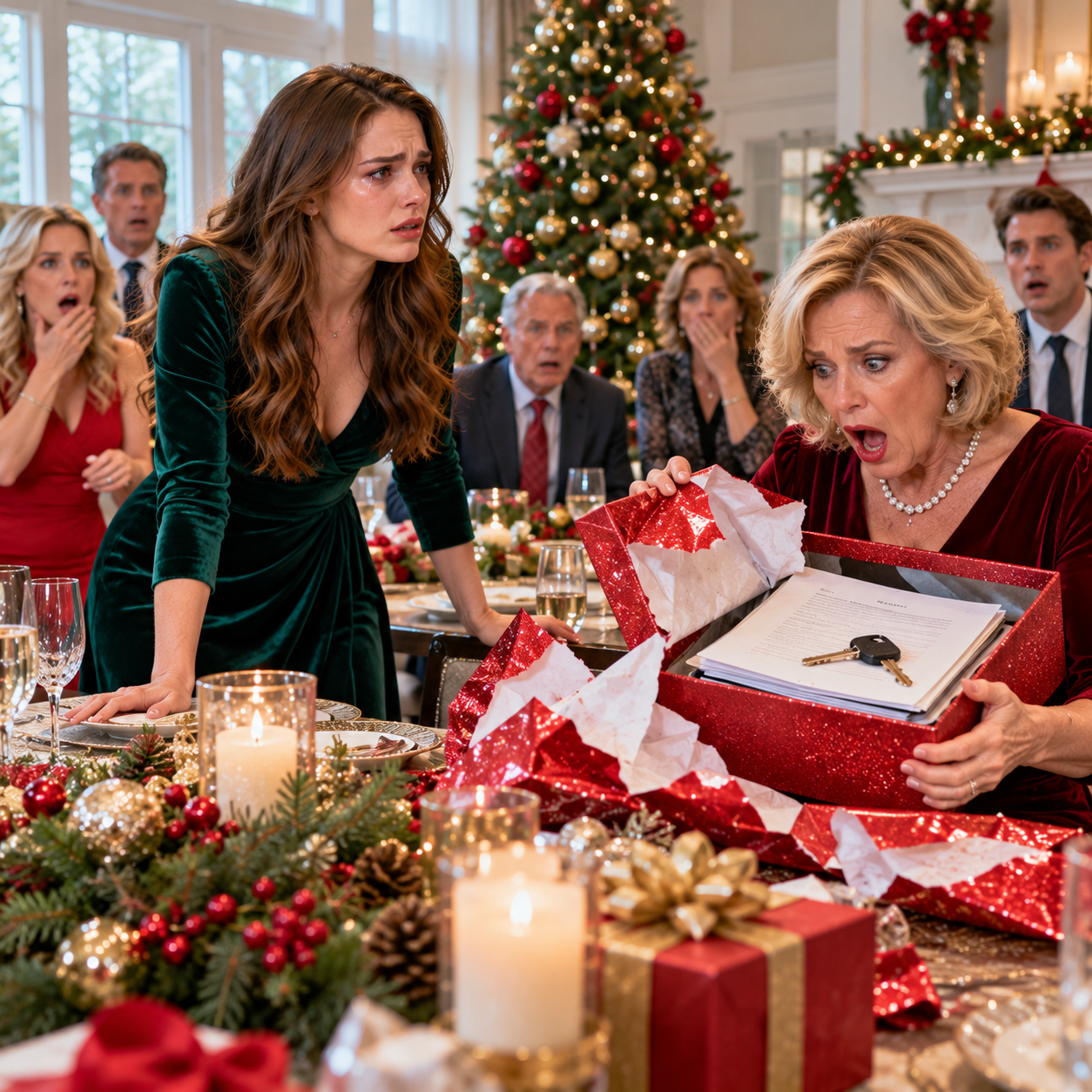
On Christmas morning, I overheard my mother telling my brother to give me an award for being “Most Likely to Forget Her Own Family.” She wanted everyone laughing while I explained why I’d skipped my stepfather’s seventieth birthday. What she didn’t know was that six months earlier, she’d ordered me to stay away from that celebration because my divorce embarrassed her. I still had every message. So I prepared twelve Christmas envelopes, returned to the party, and handed them out. By nine that night, Mom was screaming into my phone—but not for the reason I’d expected.
Part 1: The Christmas Award My Mother Prepared for Me
“Make sure everyone sees the picture of Thomas sitting alone before you give her the award.” I stopped outside my mother’s dining room, holding a tin of homemade sugar cookies while my younger brother laughed at something on his laptop. It was Christmas morning, and I’d arrived early because Mom had specifically asked me to help prepare dinner. Instead, I was listening to her organize my public humiliation.
My name is Rachel Donovan, and at forty-two, I had spent most of my adult life trying to make my mother happy without ever discovering what happiness actually looked like to her. I lived outside Cincinnati, Ohio, worked as a scheduling coordinator for a regional healthcare company, and had recently finalized a difficult divorce. My nineteen-year-old son, Caleb, was spending Christmas morning with his father before coming to my apartment the following day. I had hoped a quiet family holiday might make the past year feel a little less exhausting.
My mother, Elaine, was sixty-eight and considered family gatherings her greatest achievement. She loved coordinated decorations, perfectly arranged photographs, and posting pictures that made our relatives look like characters in a holiday advertisement. My younger brother, Derek, was thirty-eight and had always enjoyed making jokes at other people’s expense. Mom called him charming, especially when I was the punch line.
Then there was Thomas, my seventy-year-old stepfather, who had married Mom when I was nineteen. He wasn’t the man who raised me from birth, but he’d helped me through college, taught me to change a tire, and attended every important milestone in my adult life. When my marriage collapsed, Thomas was the only person in my family who asked whether I was eating properly. I loved him, which made what happened on his birthday especially painful.
Six months earlier, Mom had organized an elaborate dinner for Thomas’s seventieth birthday. I’d purchased him an engraved pocket watch, arranged to leave work early, and ordered a chocolate cake from his favorite bakery. Then, the evening before the celebration, Mom sent me a message. “Rachel, please don’t come tomorrow. Your divorce is still fresh, and I don’t want people asking uncomfortable questions during Thomas’s special night.”
I stared at the message before calling her. Mom answered with an irritated sigh and explained that my presence might remind everyone of the unpleasant circumstances surrounding my divorce. “This evening is supposed to be joyful,” she said. “You understand why I can’t have people whispering about your personal problems.”
I asked whether Thomas knew she wanted me absent. She assured me she’d explain that I had another commitment, then warned me not to make the situation difficult. I was hurt, but after months of legal paperwork and emotional exhaustion, I didn’t have the strength for another fight. I stayed home and cried while eating the cake I’d intended to bring.
The following morning, Thomas answered my birthday call with genuine disappointment. “We missed you last night, sweetheart,” he said, and I could hear it in his voice. I apologized without explaining what had happened because I thought telling him would create an argument between him and Mom. He thanked me for the pocket watch I’d mailed and said he wished we’d celebrated together.
For six months, Mom occasionally mentioned how hurt Thomas had been by my absence. Derek joked that I couldn’t be trusted to remember important family occasions, and several relatives began treating me as though I’d deliberately neglected my stepfather. I never corrected them because I believed silence would eventually make the situation disappear. Instead, Mom turned that silence into evidence against me.
Now I stood outside her dining room, listening as Derek tested a slideshow titled Family Loyalty Awards. He read the words “Most Likely to Forget Her Own Family,” then asked whether he should make me stand in front of everyone. Mom answered immediately. “Absolutely. Make her explain why Thomas’s seventieth birthday wasn’t important enough for her.”
Derek hesitated. “You think she’ll get upset?”
“Rachel gets upset whenever anyone points out her mistakes,” Mom replied. “Maybe she’ll finally learn to laugh at herself.”
I tightened my fingers around the cookie tin until its metal lid shifted. The woman who’d forbidden me from attending Thomas’s birthday was preparing to humiliate me for obeying her. Worse, she’d arranged for the person I loved most in that household to witness it.
I backed quietly into the kitchen, slipped through the rear entrance, and hurried to my car. My hands shook as I started the engine, but I didn’t drive away immediately. I sat watching the Christmas lights blink around Mom’s front windows, imagining everyone laughing while Thomas looked at me with disappointment.
Then I remembered something Mom apparently hadn’t considered. I still had every message she’d sent me in June, including the exact words ordering me to stay away.
And if she wanted the family to hear why I’d missed Thomas’s birthday, perhaps it was finally time they heard the truth.
Part 2: Twelve Envelopes Beneath the Christmas Tree
By eleven that morning, I was sitting at my kitchen table with my laptop open and six months of messages displayed on my phone. Outside, a thin layer of frost covered the driveway, and the refrigerator hummed beside me. I found Mom’s conversation almost immediately. Nothing had been deleted, including the sentence that had kept me away from Thomas’s birthday.
“Please don’t come tomorrow. Your divorce is still fresh, and I don’t want everyone asking questions about it.” Beneath that was my reply asking whether she was certain because I’d been looking forward to celebrating with him. Her final message said, “I’ll tell Thomas you have another commitment. Please don’t make this difficult.”
I read those words several times, remembering how ashamed I’d felt when Mom implied that my divorce made me unsuitable company. My marriage had ended after years of growing apart, and I’d worked hard to handle the separation without involving relatives in unnecessary arguments. Yet Mom had treated my changed marital status as a stain on her perfect family photographs. Now she wanted to punish me for the absence she’d demanded.
My first instinct was to telephone Thomas privately. I could explain everything, send him the messages, and avoid returning to Christmas dinner altogether. But then I remembered Derek’s slideshow and how Mom planned to make me defend myself in front of twelve adults. She’d already told everyone her preferred version of the story, and private explanations wouldn’t necessarily correct the damage she’d done publicly.
I opened a blank document and began writing. I explained that I had intended to attend Thomas’s birthday dinner, had purchased his present, and had been explicitly asked to stay home. I acknowledged something difficult, too: I’d allowed Thomas to believe I had another commitment rather than telling him his wife had excluded me. My silence had been a mistake, even if Mom had created the situation.
Then I printed the original messages without changing their wording or removing my own replies. I placed a short explanation and the message copies into twelve cream-colored Christmas cards, one for each adult attending dinner. Thomas’s envelope contained an additional handwritten note. “I wanted to be there, and I’m sorry I wasn’t brave enough to tell you why.”
For several minutes, I sat staring at his card. Thomas had always treated me like his daughter, even when Mom complained that I was overly sensitive. I remembered him driving through a snowstorm to help when my car wouldn’t start and bringing groceries after my divorce without asking questions. Of everyone involved, he was the person whose opinion mattered most.
At one o’clock, Caleb called to wish me Merry Christmas. He noticed something was wrong immediately and asked whether Grandma had upset me again. I told him I’d discovered she was planning another uncomfortable family joke, but I didn’t explain the details. He sighed and reminded me that I didn’t have to keep attending gatherings where people treated me poorly.
He was right, but I wanted Thomas to know I hadn’t abandoned him. I told Caleb I had something to settle and promised we’d spend the following day together. He wished me luck, then added, “Mom, don’t let Grandma convince you that telling the truth is disrespectful.” After we hung up, I placed the envelopes in a gift bag and drove back to my mother’s house.
By four, the living room was crowded with relatives, pine-scented candles, and the sound of holiday music. Mom greeted me warmly, apparently unaware I’d overheard her conversation that morning. Derek stood beside the television, arranging slides for his awards presentation. He grinned when he saw me and asked whether I was ready to receive some family recognition.
“Actually, I brought something for everyone first,” I replied. Mom smiled approvingly as I reached into the bag and distributed the envelopes. She told Aunt Patricia how thoughtful I was to prepare Christmas cards despite my difficult year. Nobody seemed to notice that my hands were trembling.
I saved Thomas’s envelope for last. He sat near the fireplace wearing the navy sweater I’d given him the previous Christmas, his pocket watch resting on a small table beside him. When I handed him the card, he smiled and asked whether I’d written another one of my sentimental messages. I nodded, unable to find my voice.
He opened it carefully and read the first page. Then he unfolded the printed messages, and his smile disappeared. His eyes moved slowly across the words before he looked up at me. “Rachel,” he asked quietly, “your mother told you not to come to my birthday?”
The room became so silent that I could hear the clock above the fireplace ticking. I nodded, feeling tears gather behind my eyes. Thomas looked down at the messages again, then toward my mother.
“Elaine,” he said, his voice unusually firm, “why did you tell me my daughter didn’t want to celebrate with me?”
Part 3: The Christmas Cards Nobody Expected
Mom’s face changed so quickly that I almost felt sorry for her. One moment, she’d been smiling beside the Christmas tree, pleased with the festive atmosphere she’d created. The next, Thomas was holding printed evidence that directly contradicted the story she’d told him for six months. She reached for the papers, but he moved them gently beyond her hand.
“Those are private messages,” she said sharply. I told her they were the messages she’d sent me the evening before Thomas’s birthday, and that I hadn’t altered a word. Aunt Patricia unfolded her card, studied the conversation, and looked toward Mom with obvious confusion. “Elaine, you told us Rachel couldn’t be bothered to attend.”
“I never said she didn’t care,” Mom protested. Derek interrupted from beside the television, holding his own envelope. “Wait, you actually told Rachel to stay home?” he asked. Mom insisted everyone was misunderstanding a complicated situation and that she’d only wanted to protect Thomas’s celebration from uncomfortable conversations about my divorce.
Thomas stared at her. “Protect me from what, Elaine? Rachel is my daughter, and her divorce doesn’t make her unwelcome at my birthday.” Mom began explaining that certain relatives had been asking questions about my marriage and she hadn’t wanted gossip distracting from the occasion. Her voice became increasingly defensive as she realized nobody was accepting the explanation.
I stepped forward and admitted that I should have told Thomas the truth immediately. He looked at me with an expression that hurt more than anger would have. “I thought you had something more important to do that night,” he said quietly. “I waited for you because I thought you might still arrive.”
My throat tightened as I remembered the birthday present I’d mailed rather than delivered. I explained that I’d believed remaining silent would prevent an argument between him and Mom. Thomas shook his head sadly and said he’d rather have known what happened than spend six months believing I’d chosen to stay away. I apologized again, knowing he deserved that much from me.
Then Derek asked why I’d chosen Christmas to reveal everything. I looked toward his open laptop and told the room what I’d overheard earlier that morning. I repeated the award title and explained that Mom had instructed him to make me publicly apologize for missing Thomas’s birthday. Derek’s expression collapsed as several relatives turned toward the television.
Mom immediately accused me of exaggerating a harmless holiday joke. “The awards are supposed to be funny, Rachel,” she insisted. “You always take things personally.” I asked whether Thomas would have found it funny to learn his daughter had been humiliated over an absence his wife had arranged.
Nobody answered. Aunt Patricia quietly folded her documents and said she couldn’t understand why Mom had allowed the misunderstanding to continue for half a year. Another relative suggested we should stop discussing the matter in front of the younger family members. I agreed, because I hadn’t returned to ruin Christmas for people who hadn’t been involved.
I explained that I wanted everyone to know the truth, not spend the evening arguing about it. Mom folded her arms and announced that I’d embarrassed her in her own home. I looked at Thomas, who was still holding my handwritten note. “I’m going home before dinner,” I said. “I don’t want this to become another fight.”
Thomas immediately stood. “Rachel, you don’t have to leave because of this.” I told him I needed time to calm down and that I’d call him the following morning. He reached for my hand, held it briefly, and said we’d talk properly when everything was quieter.
As I collected my coat, Mom followed me into the hallway. She whispered that distributing private messages to the entire family was cruel and unnecessary. I reminded her that she’d intended to embarrass me publicly with an award based on those same events. “You could have spoken to me privately,” she insisted.
“I tried that in June, Mom,” I answered. “You told me not to make things difficult.”
She stepped backward, looking offended rather than remorseful. I walked outside into the cold afternoon and drove home, feeling strangely exhausted. I’d finally corrected the story, but Thomas’s expression kept returning to me. He’d been genuinely hurt, and knowing the truth couldn’t restore the birthday we’d missed together.
At home, I reheated leftovers and sat beside my darkened Christmas tree. I knew Derek’s awards presentation was scheduled after dinner, and I wondered whether Mom would simply continue with the evening as though nothing had happened. At seven-thirty, my phone remained silent. By eight-thirty, I began hoping everyone had moved on.
Then, at exactly nine, Mom called. She was furious, demanding to know whether I understood what I’d caused after leaving. But when she finally told me what Thomas had done, I realized the Christmas cards had changed much more than the story about his birthday.
Part 4: What Thomas Did After I Went Home
“You humiliated me in my own house!” Mom shouted before I could finish saying hello. I moved my glass of water away from the edge of the kitchen table and asked what had happened after I left. She launched into an angry explanation about ruined Christmas traditions, uncomfortable relatives, and Thomas refusing to cooperate. Then she mentioned Derek’s slideshow, and I sat up straighter.
Apparently, Derek had connected his laptop to the television shortly after dinner. Several relatives were gathering their dessert plates when Thomas asked whether my award was still included. Derek hesitated before admitting that he hadn’t removed it. Thomas told him to close the presentation and leave it closed.
Mom tried explaining that the awards were a yearly tradition everyone enjoyed. Thomas stood beside the fireplace and said he wouldn’t participate in humiliating anyone, especially over something he now knew had been deliberately misrepresented. When Mom protested, he told the room that he considered me his daughter and had never wanted me excluded from his birthday. According to her angry account, nobody challenged him.
“The whole evening became awkward,” Mom complained. “Patricia kept asking questions, and Thomas barely spoke to me afterward.” I listened carefully, surprised by the relief spreading through my chest. Thomas hadn’t simply accepted the messages and returned to his dessert. He’d publicly defended me in the room where Mom intended to make me the joke.
Mom accused me of enjoying her embarrassment. I thought about the twelve envelopes, the hours I’d spent preparing them, and the fear I’d felt before handing Thomas his card. “So, did you enjoy my little Christmas present?” I asked quietly. She gasped, then demanded to know whether I considered hurting my own mother entertaining.
“No,” I replied. “But apparently hurting your daughter was supposed to be funny.” Mom repeated that she’d only been trying to protect Thomas from unnecessary gossip. I asked why she’d continued telling relatives I didn’t care about his birthday after the celebration was over. She couldn’t give me an answer that didn’t involve her own reputation.
Then she said something I’d never heard her admit before. “I thought you’d eventually apologize, and everyone could move on.” I realized she’d expected me to accept blame for the exclusion she created because I’d done exactly that in so many previous family disagreements. She’d mistaken my willingness to keep the peace for permission to rewrite what happened.
I told Mom I wouldn’t apologize for sharing accurate messages and that future communication would happen only when she was prepared to speak respectfully. She accused me of abandoning the family during Christmas, but I refused to continue arguing. After ending the call, I turned off the kitchen light and sat beside the tree until its colored bulbs began to blur through my tears. I hadn’t realized how desperately I’d wanted Thomas to choose my side.
The following morning, he called at ten. His voice sounded tired, but he greeted me warmly before asking whether we could discuss June. I expected him to talk about Mom’s behavior or explain what happened after I left. Instead, he asked why I hadn’t told him the truth on his birthday.
I admitted that I’d been frightened of creating another argument while my divorce was still being finalized. Mom had spent months criticizing my decisions, and I’d convinced myself Thomas would be happier if I simply accepted her instructions. He listened without interrupting, then asked a question that stayed with me long after our conversation ended. “Rachel, why did you think keeping me happy meant letting me believe you didn’t care about me?”
I couldn’t answer immediately. Thomas reminded me that he’d helped raise me through difficult years and had never required Mom’s permission to love me. He said he was disappointed I hadn’t trusted him enough to tell him the truth, but he understood why the conflict had frightened me. Then he asked whether I’d meet him for lunch later that week.
I agreed, feeling something in my chest finally loosen. Two days later, Derek sent an apology, admitting he hadn’t known Mom had instructed me to miss the birthday. I thanked him, then asked whether humiliating me would have been acceptable if I’d actually chosen not to attend. He took several hours to respond.
“I guess I never thought about it that way,” he wrote. He also admitted that Mom had repeatedly supplied material for his family awards, usually targeting relatives she was annoyed with. I read his message twice, remembering years of jokes I’d been expected to laugh off. Suddenly, Christmas didn’t feel like an isolated incident anymore.
It was simply the first time I’d refused to play the role Mom had assigned me.
Part 5: The Family I No Longer Needed Permission to Love
Thomas chose a small diner near the Ohio River for our lunch the following Friday. The place smelled of fresh coffee and grilled onions, and an elderly waitress greeted him by name before bringing two menus. He arrived carrying a narrow gift bag and wearing the same navy sweater he’d worn on Christmas. When I asked about the bag, he smiled and said we’d get to it after lunch.
For the first half-hour, we talked about ordinary things. He wanted to know how Caleb was doing at college, whether my new scheduling position was less stressful, and if I’d finally repaired the loose railing on my back porch. I realized how much I’d missed talking to someone who wasn’t waiting for an opportunity to criticize me. Thomas listened to my answers as though they genuinely mattered.
After we ordered dessert, he reached into the bag and removed the engraved pocket watch I’d given him for his seventieth birthday. He explained that he’d carried it every day since June, even though he’d believed I’d chosen not to attend his celebration. On the back, I’d had a short message engraved: “Thank you for always showing up.”
He placed the watch between us. “When I read that inscription, I should have known something was wrong with the story Elaine told me,” he said. I swallowed hard and admitted that I’d spent years allowing Mom to define my intentions for other people. Thomas shook his head and told me I never needed to prove my loyalty to him through obedience to anyone else.
Then he told me something unexpected. Mom had asked him to avoid discussing our Christmas argument because she believed the family would eventually forget about it. Thomas refused, explaining that he wasn’t willing to pretend nothing had happened while I continued carrying the blame. He’d also told Derek that future family gatherings wouldn’t include awards designed to embarrass relatives.
I asked whether he and Mom were going to be okay. Thomas looked toward the window, watching cars pass through the drizzle, and said their marriage involved decisions that belonged to them. He wasn’t asking me to repair it or choose between them. I appreciated his answer because my mother had always treated disagreements as invitations for everyone else to take responsibility for her feelings.
Before leaving, Thomas suggested we begin having lunch together twice a month. He wanted to remain part of Caleb’s life and hoped we could occasionally attend baseball games or spend an afternoon fishing. None of those plans involved Mom’s guest list, approval, or holiday schedule. I agreed immediately, feeling a happiness I hadn’t expected after such a difficult Christmas.
When I returned home, I found a message from Derek asking whether we could talk. He apologized again and admitted he’d begun questioning how often his jokes had made other family members uncomfortable. I told him I appreciated his willingness to reconsider, but I wasn’t ready to return to our old relationship. He accepted that answer without arguing.
Mom, meanwhile, remained silent for nearly three weeks. When she finally wrote, she said she’d been hurt by my decision to expose private conversations and needed time to process the incident. Her message contained no apology for excluding me from Thomas’s birthday or encouraging Derek to humiliate me. I decided not to respond.
For years, I’d treated Mom’s approval as the price of belonging to my own family. I attended dinners when she demanded it, apologized for disagreements I hadn’t caused, and accepted jokes that left me feeling small. After my divorce, I’d been so afraid of losing another important relationship that I’d surrendered my voice without realizing it. Christmas forced me to recognize that pattern.
In February, Caleb came home for a weekend visit, and Thomas joined us for dinner. We made homemade pizza, watched an old comedy, and spent nearly twenty minutes laughing because Thomas kept misunderstanding the rules of a card game. Nobody made jokes about anyone’s personal failures, and nobody left the evening feeling ashamed. It was the kind of ordinary family gathering I’d wanted for years.
Thomas later invited us to his seventy-first birthday lunch, which he planned himself. I arrived early carrying a chocolate cake, and Caleb helped him arrange chairs on the patio. Thomas hugged me before the other guests arrived and quietly thanked me for coming. I told him there was nowhere else I’d rather be.
Mom didn’t attend because she’d declined his invitation after learning I would be there. Thomas looked disappointed, but he didn’t ask me to apologize or convince her to change her mind. We celebrated anyway, and I finally gave him the birthday afternoon we’d both been denied the previous year. No one mentioned awards, loyalty tests, or family obligations.
Several months later, Mom sent a short message suggesting that we forget the entire Christmas incident and start fresh. I replied that moving forward required acknowledging what had happened, not pretending it was insignificant. She answered that I was holding onto unnecessary resentment. I didn’t respond again.
I wasn’t interested in spending the rest of my life convincing my mother to treat me with basic respect. Thomas and I continued meeting for lunch, Caleb remained close to both of us, and Derek occasionally reached out without expecting immediate forgiveness. My relationship with Mom stayed distant, and I discovered that distance could be peaceful rather than cruel.
That Christmas, I hosted a small dinner at my own apartment. Thomas arrived with homemade rolls, Caleb brought a ridiculous holiday sweater, and two close friends joined us for dessert. We exchanged thoughtful presents, told stories, and laughed until the candles burned low. Nobody handed out awards, and nobody needed permission to belong.
Later that evening, Thomas helped me clear the dishes. He placed his pocket watch on the counter while rolling up his sleeves, and I noticed the familiar inscription catching the kitchen light. I smiled, remembering how frightened I’d been to tell him the truth.
My family once prepared an award calling me “Most Likely to Forget Her Own Family.” What they never understood was that I’d spent years remembering everyone else’s needs while forgetting my right to be treated with kindness.
I hadn’t ruined Christmas by telling the truth. I’d finally stopped allowing my mother to decide what everyone else believed about me.
And the most meaningful gift I received that year wasn’t wrapped beneath a tree. It was discovering that I could have a loving relationship with my stepfather without asking my mother’s permission—and a peaceful life without waiting for her approval.
Legal Notice: This story is a work of fiction. Names, characters, businesses, events, and incidents are the product of the author’s imagination or are used fictitiously. Any resemblance to actual persons—living or dead—or to actual events is purely coincidental. Thank you! 💓


