
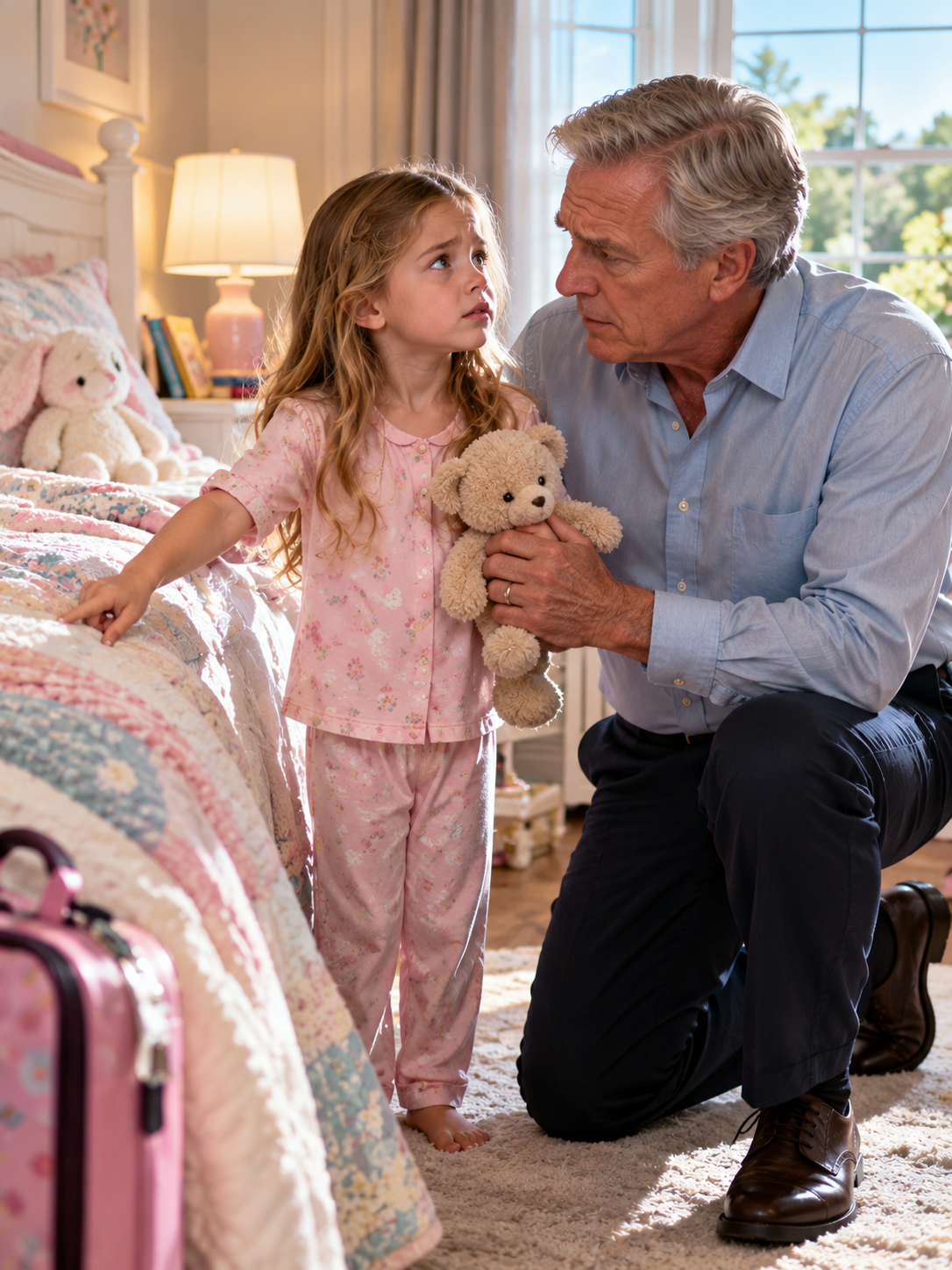
My Granddaughter Asked, “Grandpa, Am I Allowed to Sleep in the Bed?”—By Dawn, I Had Made Five Calls
My nine-year-old granddaughter came to stay for Thanksgiving and spent her first night asleep on my guest-room floor, wearing her winter coat. When I woke her, she whispered, “Grandpa, am I allowed to sleep in the bed?” Her stepmother called her parenting method “teaching gratitude,” and my son insisted everything was fine. Before sunrise, I made five phone calls. What I uncovered wasn’t just a cruel household rule. Someone was preparing to send my granddaughter away—and had already found a way to profit from it.
Part 1: The Bed She Was Afraid to Touch
Lake Superior wind shook my porch windows that Friday when my son arrived. Caleb parked crookedly beside my truck, unloaded a small duffel bag, and kissed his daughter on the head without taking off his gloves. “Nine days, Dad,” he said. “Vanessa and I need some time to reset things at home.” My granddaughter, Maisie, stood by the steps and waited until I invited her inside.
At seventy-one, after forty years maintaining freighter engines, I recognized her hesitation. She used to race straight to my workshop and demand to know which model ship we were building next. Now she was nine, with her late mother’s curly brown hair and a voice so careful it barely carried over the furnace. “May I put my bag here, Grandpa?” she asked, pointing at a perfectly ordinary hallway bench.
Caleb’s wife, Vanessa, stayed in the passenger seat scrolling on her phone. She ran a popular parenting account called Better Days at Home, full of spotless kitchens, color-coded calendars, and smiling children. I had admired her patience with a family still grieving Laura, Maisie’s mother. When Caleb drove away, Maisie watched the red taillights disappear into the snow and said, “I’ll be good here.”
At supper, she waited until I took my first bite before touching her grilled cheese. When a drop of tomato soup landed on the table, she went white and asked how many points she’d lost. I thought she meant a school game, so I said we didn’t keep score at dinner. Her shoulders tensed when I offered seconds.
I showed her the guest room after eight, with its blue quilt, flannel sheets, and a wooden sailboat on the dresser. She thanked me three times and asked whether the hallway light could remain on. I said the light could stay on. At ten-forty, I checked on her and found the bed untouched, its pillow smooth as a photograph.
Maisie lay curled beside the dresser, her cheek on the duffel bag and her coat zipped to her chin. She woke when I knelt, immediately sitting straight and apologizing. “Grandpa, am I allowed to sleep in the bed?” she whispered, glancing from the quilt to my face. I told her yes, of course, and waited while she searched for another answer in my expression.
At home, she explained, comfort was earned through a chart Vanessa called the Harmony Ladder. Chores earned points; crying or asking questions lost them. Below ten points, Maisie slept on a foam mat in the laundry alcove instead of her bedroom. “It helps me learn not to expect special treatment,” she recited, sounding nothing like a child describing her own thoughts.
I asked where her stuffed rabbit, Pebble, was; Laura had bought it for her before the last hospital stay. Maisie said it lived on a high shelf until she earned one hundred points. She had reached ninety-three before losing points for asking to call me. I got her into the guest bed, brought an extra pillow, and promised nobody would be counting anything here.
I recorded her words as carefully as engine temperatures. At 11:36, I called the county’s after-hours child protection line to report what she’d described and ask what to do next. Just after midnight, I reached an on-call pediatric service about an examination; at 1:10, I called family attorney Mara Ellison, who told me not to improvise a custody battle. At 4:45, I called Laura’s sister, Renee, coming off a hospital shift, and at 6:20 I asked my retired investigator friend Frank to preserve any public information about Vanessa’s business.
Only Renee cried on the phone. “Elliot,” she said, “Laura wrote Maisie a birthday letter for every year until eighteen, and I haven’t been allowed to see her since Easter.” Then she asked a question that made me stare at the stairs: “Did Maisie ever get the letter her mother left for her ninth birthday?”
Part 2: Eleven Calls I Never Answered
By seven-thirty Saturday morning, Maisie was sitting at my kitchen table with a bowl of oatmeal, waiting for permission to eat. I placed a spoon beside her and said, “You don’t have to ask about breakfast in this house.” She took two bites, then quietly requested permission to finish the bowl. I went to the sink so she wouldn’t see how upset I was.
The pediatric clinic arranged an appointment that morning, and I told the doctor exactly what Maisie had said without suggesting answers. She described recurring stomachaches, difficulty sleeping, and worries about doing things wrong. The doctor documented her condition and explained that the clinic would make its own protective-services report. I left with written follow-up instructions, grateful that someone else was taking the situation seriously.
Renee arrived after lunch with snow on her boots and a paper shopping bag filled with Laura’s favorite holiday cookies. Maisie crossed the room so quickly she nearly knocked over a chair, then stopped short and asked, “Can I hug you?” Renee opened her arms and held her without speaking. They hadn’t been together in seven months, even though Renee lived only a few hours away.
While Maisie worked on a cardboard lighthouse in my workshop, Renee showed me the messages she’d sent Caleb asking about visits. Most had gone unanswered; the few replies said Maisie needed “consistency” while adjusting to Vanessa’s system. Renee had also contacted Maisie’s school after hearing that she often seemed tired. A counselor promised to check on her, but Renee never learned whether anything changed.
Then Renee opened Vanessa’s public account. One photograph displayed a gray sleeping mat under a framed slogan about discipline; another showed the Harmony Ladder with colorful stars. Thousands of strangers praised the tidy space. In the comments, Vanessa had written that children sometimes needed to “experience the absence of comfort” before appreciating it, a phrase that sounded colder to me than it apparently did to her audience.
There was another post from that morning: two elaborate breakfasts overlooking a swimming pool in Arizona. Vanessa called it a couples’ renewal retreat, though Caleb had told me they were staying nearby to work through family issues. I had no objection to adults taking a break. I objected to my granddaughter believing she’d been sent away because she’d failed a test nobody her age should have to pass.
After supper, I asked Maisie whether she wanted to draw a picture for Renee or read together. She chose a book, nestled beside me, and stopped at a picture of a mother and daughter on a porch. “Mom wrote letters for my birthdays,” she said quietly. “Vanessa says I’m not ready for the newest one because I still get too emotional.” I told her those letters were hers and that the grown-ups would work out how to get them to her.
Later, as I tucked her in, she asked if I was angry she’d tried calling me from the old kitchen phone. I said I hadn’t known she called. “I left messages,” she answered, looking confused. “I thought you didn’t want to hear from me.” I remembered repeatedly ignoring calls labeled only Maple Grove, assuming they were robocalls.
Downstairs, I opened my voicemail and found eleven messages from the same number. In the first, Maisie wanted to tell me about a spelling test; in another, she said she missed Pebble. By October, her little voice had become hesitant, and every message ended with a request not to tell Vanessa. I listened without moving, ashamed of how easily I’d dismissed a number I didn’t recognize.
The last message had been left eight days earlier. “Grandpa, after Thanksgiving they’re taking me to a place in Wisconsin called Cedar Brook,” Maisie whispered. “Vanessa says a camera crew will be there when I arrive, and I’m supposed to cry because it helps other kids.” She paused before adding, “Please don’t let them take me. Daddy already signed the papers.”
Part 3: What the Camera Was Really For
I listened to that last voicemail three more times before I called Mara, my attorney, on Sunday morning. She instructed me to preserve the original recording, make secure copies, and avoid asking Maisie leading questions. “What she told you matters,” Mara said, “but so does what independent records can establish.” I wanted somebody to promise that Maisie would never leave my house, but Mara wouldn’t make a promise a judge hadn’t authorized.
Frank called later with printouts from public websites. Cedar Brook Family Renewal advertised residential behavior programs for children and teenagers, presenting itself as a solution for difficult home situations. Vanessa appeared in a promotional photograph under the title “Family Outreach Partner.” The website also announced an upcoming documentary-style series about a family’s journey from crisis to healing, though it did not name the child.
I stared at the smiling adults in the advertisement and thought of Maisie asleep on my rug. She wasn’t a troubled case study; she was a nine-year-old who liked blueberry pancakes and still drew smoke coming from the funnels of my model ships. Frank said he couldn’t establish the terms of Vanessa’s partnership from public material, and I appreciated that he didn’t pretend otherwise. The worst possibility wasn’t proof merely because I was frightened.
On Monday, Mara helped me file the appropriate request for temporary protection while the county reviewed the report. A caseworker named Ms. Ortega interviewed me and arranged to speak with Maisie privately in an age-appropriate setting. I stayed out of that conversation, resisting the urge to explain every silence and nervous glance. Maisie deserved to be heard in her own words, not mine.
Her school counselor, Mrs. Porter, called with a discovery of her own. Maisie had brought her ninth-birthday letter to school after retrieving it from a locked cabinet, afraid it would be confiscated again. Mrs. Porter had kept it secured at Maisie’s request and documented conversations about frequent exhaustion and anxiety. After checking the appropriate procedures, she arranged for the letter to reach Maisie through the caseworker.
Maisie asked me to sit nearby while she opened the envelope by the fireplace. Laura’s handwriting slanted across the front, unmistakably familiar even after three years. My granddaughter read silently for several minutes, then cried into the paper. “Mom says I can have a hard day and still be a good person,” she whispered, and leaned against my shoulder until she was ready to breathe normally.
That evening, I opened the drawer where I’d been stacking bank mail, searching for the folder containing Laura’s estate records. She had established an education trust for Maisie with Caleb handling routine administration and me listed as an additional trustee. Buried beneath an appliance warranty was a notice requesting acknowledgment of a proposed educational distribution. The amount was twelve thousand dollars, and the beneficiary was a company connected to Cedar Brook.
I hadn’t approved that payment. After verifying my identity with the trustee services office, I learned that money had already been disbursed and that the bank was reviewing an electronic authorization bearing my name. I told Mara immediately and forwarded the notice rather than trying to investigate the transaction myself. She asked the institution to preserve its records and examine whether the trust had been used properly.
On Thanksgiving morning, Maisie and Renee helped me make stuffing while wet snow gathered along the fence. We burned the first tray of rolls, laughed over the smoke alarm, and ate the second tray straight from the pan. For nearly an hour, Maisie forgot to watch my expression before smiling. It felt like being given back a small piece of Laura.
At four that afternoon, Frank arrived with a young woman named Hallie who’d recently worked as Vanessa’s video editor. Hallie clutched a flash drive and wouldn’t take off her coat until I offered tea. “I wrote the outline for Maisie’s arrival video,” she said, voice trembling. “And there’s something about the money that you need to see.”
Part 4: The Agreement My Son Signed
Hallie waited until Maisie was upstairs working on a puzzle with Renee before opening her laptop. The files showed a proposed video series about a supposedly defiant child undergoing a dramatic transformation. A production outline described Maisie’s arrival at Cedar Brook, including instructions to capture her tears before anyone offered reassurance. My stomach turned when I saw her first name beside a planned filming date.
The contract Hallie had retained from her work specified a referral payment to Vanessa’s media company if the enrollment went forward. It also included a separate promotional fee for the video series. I couldn’t determine every dollar from the pages in front of me, but the arrangement created an obvious financial incentive. Hallie said she’d quit after hearing Vanessa describe Maisie’s fear as “the hook that makes the audience care.”
“Why come here now?” I asked, more sharply than I intended. Hallie looked at her hands and admitted she’d convinced herself filming was simply part of the job. Then she’d seen the pickup schedule and remembered how Maisie asked permission even to drink water during a practice shoot. “I should have said something sooner,” she whispered. I told her to give the files to Mara and the investigators directly so their source and authenticity could be evaluated.
Friday morning, Mara updated the court about the proposed enrollment, the recordings, and the trust concerns. She told me that temporary restrictions had been granted pending an expedited hearing, and that Caleb would be formally notified. The county also continued its assessment and confirmed that Maisie should remain in my care until the next decision. I finally slept for more than three hours without waking to check the hallway.
Caleb called Saturday, furious that strangers had contacted him about his daughter. He said Vanessa was helping Maisie overcome behavior problems and accused Renee of stirring up old family grievances. When I asked whether he knew about the foam mat, he answered, “It was only for nights she wouldn’t settle down.” My heart sank because he hadn’t denied knowing about it.
I invited him to speak in person Sunday, with Mara present, and told him not to bring a camera. He arrived with Vanessa anyway, her phone mounted on a small handheld stabilizer. She smiled at my porch as if preparing a cheerful update for followers. Mara met them at the door and asked her to stop filming before entering; after a tight pause, Vanessa switched off the screen.
At the kitchen table, Caleb kept looking from Mara’s papers to the photograph of Laura above my stove. I asked him one question: “Where did Maisie sleep when she lost enough points?” He stared into his coffee and finally said, “Sometimes on the mat.” Vanessa interrupted with a polished explanation about accountability and emotional regulation, but even she couldn’t make the words sound gentle in my kitchen.
I played the final voicemail. Maisie’s small voice filled the room, describing the van, the cameras, and her fear that her father had approved sending her away. Caleb covered his face as the recording ended. Vanessa called it imaginative exaggeration, then insisted the program had been his decision as much as hers.
Mara placed the enrollment documents and the trust notice in front of Caleb. “Did you approve this arrangement and the proposed use of your daughter’s money?” she asked. He examined the papers for a long moment before nodding. “I signed because Vanessa said professional help would fix everything,” he admitted. “I saw how scared Maisie was, but I kept telling myself it would be worth it.”
Vanessa stood, snatched up her phone, and announced that everyone would regret interfering with her family. She walked out into the snow, leaving Caleb motionless at the table. My son began to cry, but I couldn’t reach out to comfort him. His tears were real; so was the fact that he’d signed anyway. On Monday, a judge would decide whether Maisie could stay with me, and for once Caleb would have no power to arrange the answer.
Part 5: A Bed Nobody Had to Earn
The expedited hearing took place the following week in a courthouse overlooking the harbor. Mara submitted the medical findings, the caseworker’s report, Maisie’s voicemail, and the documents concerning Cedar Brook. Caleb had his own attorney and did not oppose a temporary placement with me while the county continued investigating. The judge set conditions for contact and kept Vanessa from unsupervised involvement pending further review.
The order erased nothing. Maisie still startled when she knocked over a glass, apologized when she wanted seconds, and asked whether she had enough points to use the good towels. She sometimes looked relieved, sometimes afraid the rules might return. Recovery moved at the speed of a child learning kindness was real. We developed small routines: a bedtime story, a glass of water beside the bed, and a morning when she could choose whether she wanted pancakes or eggs.
Mara and an accountant reviewed the disputed payment. The records became part of a financial investigation. After several months, the twelve thousand dollars was restored to Maisie’s education funds through a negotiated resolution, and an independent professional was appointed to oversee future distributions. I would have traded it to erase her final voicemail.
Cedar Brook canceled Maisie’s enrollment before the planned pickup. Hallie’s documents were provided to the relevant oversight agencies, and Vanessa’s sponsorship arrangements began unraveling once partners learned what was being investigated. I gave no interviews. I also refused requests from distant relatives who suddenly wanted details they could pass around at dinner. Maisie had already spent enough of her life being treated as somebody else’s story.
Caleb moved into a small apartment near Duluth and attended the supervised visits allowed by the court. He began counseling and wrote that grief had made him trust Vanessa to raise his daughter. I read each letter, then put it away. Grief explained some of his choices, but it did not excuse leaving Maisie unprotected.
One Saturday, Caleb brought Pebble, the gray stuffed rabbit, to a scheduled visit. One ear drooped, its stitched eye loose. He knelt. “This is yours. Nobody should have made you earn it.” Maisie took the rabbit without answering and held it against her chest for the rest of the afternoon.
A few weeks later, Caleb asked me privately whether I would ever forgive him. I looked through the window at Maisie helping Renee hang paper snowflakes and remembered the child who had slept on the floor rather than risk breaking a rule. “I won’t pretend this was a misunderstanding,” I told him. “You have to become a father she can trust, whether I ever feel differently about you or not.”
He nodded and left without another request. I didn’t hate my son, but I wouldn’t rush to erase his responsibility because the sight of his remorse hurt me. Rebuilding belonged to Maisie and time. I could offer safety without offering him forgiveness. Sometimes those were two different responsibilities, and the harder one was remembering whose future we were supposed to protect.
By spring, Maisie had started a new school, made a friend who loved dinosaurs, and learned to bake cinnamon muffins with Renee. We watched the season’s first freighter enter the harbor. She asked whether I thought her mother could have heard that sound from heaven. I said I didn’t know, but Laura would have loved standing beside her to listen.
That night, I opened the guest-room door to check on her. Maisie lay diagonally across the bed, the blue quilt half on the floor and Pebble tucked under one arm. An open book lay beside her pillow. She hadn’t asked permission to climb in, and I stood there smiling at that small, enormous fact.
For forty years aboard ships, I’d learned to pay attention when a gauge moved a fraction beyond normal. I would always regret those unanswered messages. But I had listened when she finally asked her question, and the five calls I’d made before dawn had given the right people a chance to help her. I switched off the hallway light, left her door slightly open, and let her sleep in the bed that had always been hers.
Legal Notice: This story is a work of fiction. Names, characters, businesses, events, and incidents are the product of the author’s imagination or are used fictitiously. Any resemblance to actual persons—living or dead—or to actual events is purely coincidental. Thank you! 💓

