
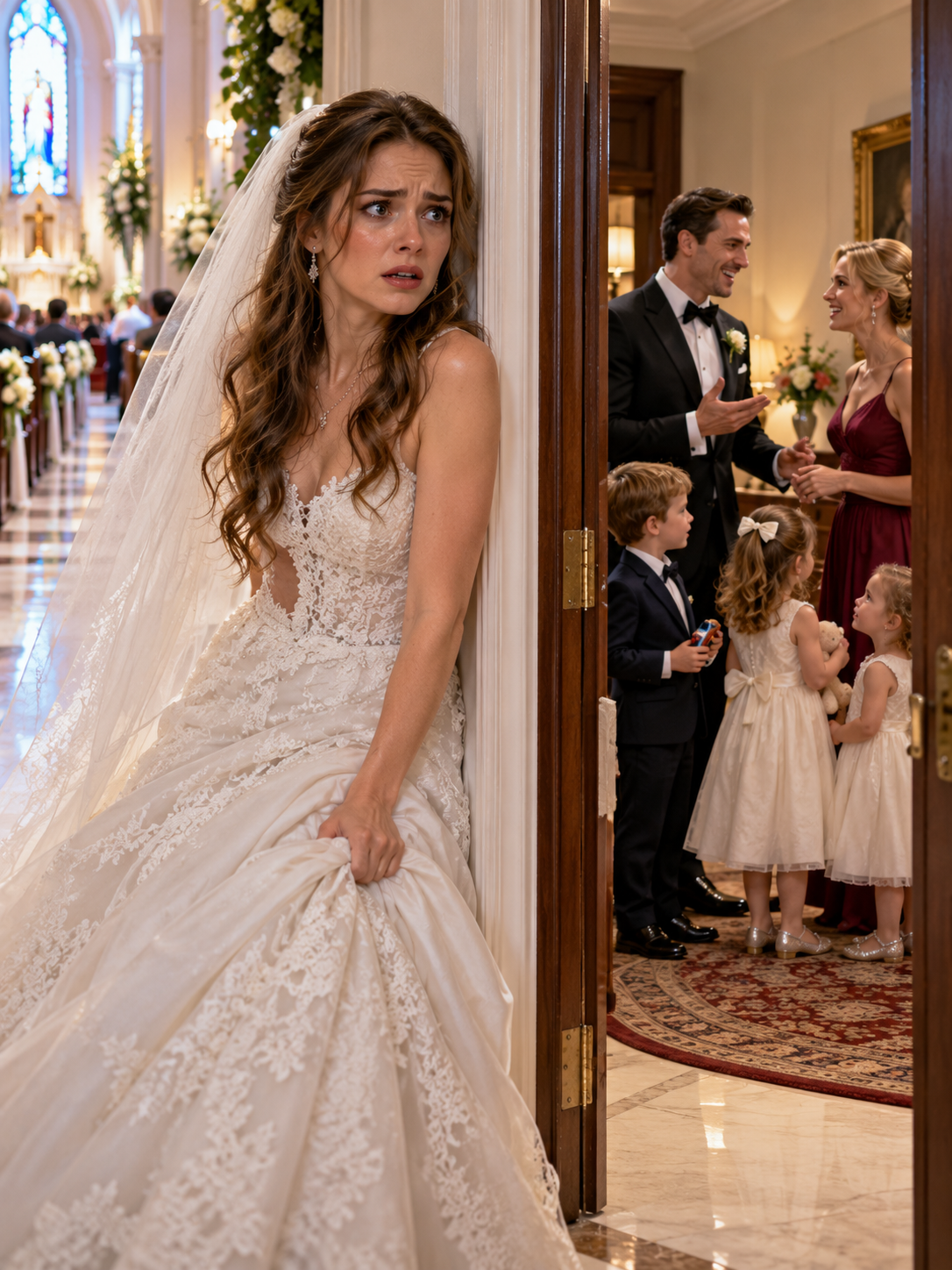
My Fiancé Promised His Sister I’d Quit My Job to Raise Her Three Kids—Ten Minutes Before Our Wedding, I Heard Everything
Ten minutes before my wedding, I heard my fiancé promise his sister free childcare for her three young children—five days a week, starting Monday. He’d decided I would quit the dental practice where I’d just earned a promotion, and he laughed that once we were married, I wouldn’t have a choice. Seventy guests were waiting in the church, and my mother was crying happy tears. I thought his betrayal ended with that conversation. Then I discovered what he’d already done in my name.
Part 1
The first thing I noticed was the smell of lilies. They filled the little church outside Columbus so completely that even the hallway smelled like a florist’s refrigerator. My wedding dress brushed the baseboards as I searched for my best friend, Tessa, who had disappeared to find a safety pin for a loose hook at my waist. In ten minutes I was supposed to marry Miles Keller, a man I’d loved for three years and trusted with every unguarded part of my life.
I’d made it as far as the fellowship-room door when I heard my name. “Don’t worry about daycare anymore,” Miles said. “Avery will take all three starting Monday.” I stopped with one hand against the wall, thinking I’d misunderstood. Then his sister Dana asked, “Every weekday? Even the baby?” and he answered, “Seven-thirty sharp, same as we planned.”
Dana’s children were five, three, and eighteen months old. I adored Brynn’s serious questions, Milo’s obsession with fire trucks, and little June’s habit of falling asleep against my shoulder. I’d watched them on occasional Saturdays, made them pancakes, and gone to their preschool programs. I had not offered to become their unpaid, full-time caregiver, and anyone who knew my schedule should have understood why.
I worked at a busy dental office in Dublin, Ohio, where seven years of early appointments and emergency cancellations had finally led somewhere. On Wednesday, Dr. Ward had offered me the office manager position, with a raise and responsibility for training the new front-desk team. Monday morning was my first planning meeting. I’d told Miles over takeout noodles, and he’d kissed my forehead and said, “That’s my girl.”
“What about the dental office?” Dana asked through the door. For one hopeful second, I thought she might rescue me from whatever absurdity this was. “She’s leaving,” Miles replied. “She’s talked about wanting more time at home.” He sounded casual, as though describing a grocery order. My hand tightened around a fistful of satin because I’d never said anything remotely like that.
I pictured our apartment calendar with Monday’s staff meeting circled in blue. Miles had seen it while reaching for the coffee filters that morning. We had agreed to wait a few years before having children of our own, partly because I wanted to establish myself at work first. He knew this, just as he knew I still had student loans and contributed nearly half our household expenses.
Dana lowered her voice. “I canceled their daycare two weeks ago. Friday was their last day, and the director said the openings are gone.” I heard a paper cup settle on the folding table. “If Avery changes her mind, I can’t just call them back.” Miles gave a short laugh. “Once we’re married, she won’t have much choice.”
The words traveled through the thin wooden door like a draft of cold air. I remembered how annoyed he’d looked last month when I’d worked late, and how he’d called Dana’s childcare bills “a ridiculous waste of money.” I’d taken those comments for ordinary complaints, not rehearsal for a plan. The piano in the sanctuary began the opening notes of our processional, stopped, and began again.
“Are you certain she agreed?” Dana asked, so quietly I had to lean closer. “You didn’t actually tell her you canceled everything, did you?” Miles sighed. “If I asked her beforehand, she’d invent ten reasons to say no. She’ll understand what’s expected once she’s my wife.” I stood there in a dress I’d saved eighteen months to buy, listening to my future being divided up without me.
I pushed open the door. Miles turned, and for one instant I saw panic on his face before he arranged it into the patient expression he used when he wanted me to doubt myself. Dana was holding a folder full of printed schedules, with three names written across the top. “Avery,” he said, looking down at my dress. “You’re not supposed to see me yet.”
Part 2
I glanced at the folder, then back at Miles. “Apparently there are a lot of things I’m not supposed to see.” Dana put the schedules against her chest and apologized for talking where I could hear, which told me more than any defense could have. Miles stepped between us, blocking my view of the hallway, and said, “We can discuss this after the ceremony.”
“The ceremony is exactly why we’re discussing it now,” I said. My voice sounded oddly steady, though the wire edge of my veil was scratching my neck. “Did you promise Dana I’d leave my job?” He folded his arms and said he’d been trying to help his sister through a difficult divorce. “And I appreciate her situation,” I answered. “That doesn’t explain why you’ve offered her my weekdays.”
He said he could afford our bills, that being an office manager was hardly the career of a lifetime, and that wives sometimes had to adjust their priorities. That last sentence finally burned through my shock. He wasn’t confused about what I’d agreed to; he believed marriage would make my agreement unnecessary. When I repeated his words back to him, he stared at the carpet rather than deny them.
Dana’s mouth trembled. “Miles told me you wanted to do this,” she said. “I even asked whether we should thank you before the wedding.” I looked at the typed schedules in her hands, where breakfast, naps, pickups, and meals had already been planned around my life. “You canceled their care without asking me once,” I said. “I love your children, but I’m not responsible for a promise I didn’t make.” She started crying, and Miles looked at me as if I had caused it.
He reached for my wrist when I took off my engagement ring. “Don’t make a permanent decision in a temporary emotional state,” he said. I set the ring on the table, beside a half-empty paper cup. “You made your decision two weeks ago, Miles. You’re only upset because I found out before you could make it legal.” He said I was humiliating him in front of seventy guests.
Outside, Tessa was hurrying toward me with a tiny silver safety pin. She took one look at my face, dropped her hand, and asked, “What happened?” “The wedding is off,” I said. “Please get my parents before somebody announces the bride is missing.” She turned and pushed through the sanctuary doors.
My father came out first, still wearing the navy tie I’d helped him choose. He listened without interrupting while I explained the childcare arrangement and Miles’s plan for my job. My mother reached for my hand and said, “Do you want to leave?” I nodded so hard the pins in my hair pulled. Dad went inside to ask the minister to tell our guests that the ceremony would not take place, and Mom walked me to the car.
My phone rang the entire drive to their house. Miles called, his mother Celia called, and even a cousin I’d met twice sent a message asking whether I understood what a spectacle I’d made. Tessa helped me remove my dress in my childhood bedroom, placing each hairpin in a little ceramic bowl. I expected to sob once the satin hit the floor, but what I felt first was relief so sharp it frightened me.
That evening I returned to the apartment with Tessa to collect my laptop and work clothes while Miles stayed with his parents. His truck wasn’t outside, but the kitchen light was still on, illuminating the seating chart we’d spent weeks perfecting. I opened our shared computer to check Monday’s office calendar. My email was already signed in, and the sent folder showed a message to Dr. Ward stamped 8:26 that morning.
The subject line read, “Formal Resignation—Avery Collins.” Its attachment was a letter ending my employment effective immediately, complete with a neat reproduction of my signature. At eight twenty-six, I’d been at the salon with my mother and Tessa. Miles hadn’t merely planned to pressure me into resigning after our vows. He’d tried to make sure I had no job to return to.
Part 3
I took photographs of the message, saved the attachment, and changed my email password before I touched anything else. Tessa stood beside me reading the letter, her fingers wrapped around a cold mug of coffee she’d found on the counter. It said I’d decided to devote myself to family responsibilities and would be unavailable for a transition period. Whoever wrote it had borrowed phrases from conversations I’d had with Miles about someday having children, then turned them into a decision I had never made.
I drafted a short correction to Dr. Ward, explaining that the resignation was unauthorized and that I intended to report for work on Monday. My thumb hovered over Send because I hated the idea of my private disaster arriving in my boss’s inbox over the weekend. Tessa said, “She’s about to put you in charge of the whole front office. She deserves the truth, and you deserve your job.” I sent it and shut the laptop.
Sunday brought the kind of messages people send when they want an apology without making one. Celia wrote that weddings were stressful and that a mature woman would recognize “a misunderstanding.” Dana texted that she’d spent the morning calling childcare centers and couldn’t find three openings together. Miles left a voice message saying, “Come home and we’ll sort out your work situation,” as if it were a pipe he’d accidentally broken.
I didn’t respond until he appeared outside my parents’ house that afternoon. Dad stayed inside, visible through the kitchen window, while I spoke to Miles on the porch. His dress shoes were scuffed, and he was holding the bouquet I’d left in the bridal room. He offered the flowers with a strained smile, and I asked him the only question that mattered: “Did you send that resignation from my account?”
He didn’t deny it. “I meant to tell you,” he said. “I thought once the wedding was over, you’d see how much easier life could be.” I asked why he’d copied my signature instead of asking me to sign. His eyes hardened. “Because every time I brought up Dana, you acted like your promotion was more important than family.” I realized he was talking about a conversation we’d never actually had, one in which my refusal had existed only in his imagination.
I told him I wouldn’t marry someone who made decisions by impersonating me. Miles insisted the letter was just an email and Dr. Ward could ignore it if she wanted. “It’s my livelihood,” I said. “You tried to take it because you assumed I’d be too embarrassed to stop you.” His expression changed, and he asked whether I’d really throw away three years over a job. I said I’d already lost three years to a man who didn’t understand what consent meant.
On Monday I walked into the dental office fifteen minutes early, wearing the navy blazer I’d set out before the wedding. The waiting room smelled of mint polish, printer toner, and fresh coffee. Dr. Ward invited me into her office, where a copy of my correction sat beside the supposed resignation. “We hadn’t processed it,” she said. “Frankly, the wording didn’t sound like you, and I was going to call you this morning.”
She told me the office manager offer still stood. When I asked whether she needed anything else, she said only that she’d document my correction and take reasonable steps to protect my work information. I left her office carrying a training binder, unexpectedly close to tears. For the first time since Saturday, I could imagine a future not organized around what Miles wanted.
At lunch, Dana called instead of texting. She admitted Miles had told her to bring the children to our apartment at seven-thirty on Monday whether I answered the phone or not. “He said you’d settle down once they were there,” she whispered. Then she said something that made me look toward the reception desk, where my keys lay beside my lunch: “He already gave me a copy of your apartment key last week.”
Part 4
I hadn’t realized I was gripping my phone until the plastic edge hurt my palm. Our apartment wasn’t large; the second bedroom held my desk, wedding gifts, and boxes of clinic training materials. Miles had told Dana she could let herself in with three children while I was preparing for the most important meeting of my career. When I asked why she hadn’t mentioned the key, she said she’d assumed he’d cleared it with me, although she’d now begun to understand how little he’d actually asked.
I told her firmly not to use it and made an appointment to speak with the property manager about our lease and access to the apartment. Dana promised to return the copy to Tessa. She also admitted she’d stopped paying for daycare partly because Miles said he could help her save for a move into a cheaper place. I could hear exhausted children arguing in the background, and it hurt to know their mother had trusted a solution built on my silence.
When Tessa collected the key, Dana included a folded note saying she was sorry. I read it twice without feeling any desire to call her. She hadn’t forged the resignation, but she’d accepted a full-time arrangement involving my home, labor, and career without ever asking me. Her desperation was real, and so was her part in the betrayal. I could feel sorry for her children without offering myself as the remedy.
My parents helped me inventory the apartment, and we arranged a time for me to retrieve my belongings without being alone with Miles. I took my desk, my mother’s old mixing bowls, the green armchair I’d paid for, and every framed photograph from my side of the family. Miles stood near the door saying we’d be laughing about this by next Thanksgiving. When I carried my wedding planner to the recycling bin, his smile finally disappeared.
The canceled wedding left bills neither of us could wish away. Some deposits were nonrefundable, and both our names were on the apartment lease, so I got copies of the contracts and arranged a consultation with an attorney before agreeing to any payments or changes. I had paid for most of the dress, and I sold it through a bridal consignment shop rather than storing it like a monument. None of those choices felt victorious, but each was a small piece of control returned.
Celia called my mother and accused us of turning a solvable family dispute into a scandal. My mother, who had spent Saturday evening washing mascara from my face with a damp cloth, told her, “My daughter did not cancel her wedding over babysitting. She canceled it because your son tried to make decisions in her name.” Celia replied that wives had always made sacrifices. Mom answered, “Sacrifice isn’t something another person can volunteer you for,” and ended the call.
A week later, Miles asked me to meet at a coffee shop near the clinic. I agreed because I wanted to settle the last few shared expenses in person, and I sat near the front window with my notes in a folder. He arrived carrying two drinks and spoke gently about counseling, compromise, and the house we’d once imagined buying. I told him I’d consider his repayment proposal, but that there was no wedding to reschedule.
He stared at my folder and finally asked, “If I’d just waited until after the vows, would you have stayed?” I looked at him, startled by the precision of the question. He rubbed his forehead and said, “That’s what I thought. You wouldn’t want everyone to know we’d failed after one day.” The steam rose between us from coffee I hadn’t touched. I’d spent weeks wondering whether he’d been reckless or simply selfish, and now he was calmly describing the embarrassment he’d planned to use against me.
I left my drink on the table and walked out. Behind me, his chair scraped across the floor, but he didn’t follow. On the sidewalk, I understood something that made my knees unsteady: Miles hadn’t misjudged my willingness to help. He had calculated how difficult it would be for me to refuse once I became his wife.
Part 5
By December, my boxes were stacked in a rented townhouse fifteen minutes from the dental office. The kitchen had a crooked drawer and a window overlooking a parking lot, but the lock belonged to a door nobody else could hand a key to without my permission. Every evening I came home, dropped my bag beside the stairs, and felt the peculiar relief of knowing exactly who would be there.
The separation of our finances took longer than moving. My attorney helped me sort out the remaining joint obligations, and I kept the correspondence about the unauthorized resignation rather than pretending it had never happened. Miles eventually repaid the part of the canceled wedding expenses he’d agreed to cover. We didn’t have a dramatic final argument; we had a spreadsheet, receipts, and a final email confirming that nothing remained to settle.
At work, learning the new scheduling software took three exhausting weeks. I made mistakes, corrected them, and stayed late twice to help train an employee who was frightened of the new system. Each night, I remembered Miles asking why a promotion mattered so much. The answer was in the tired satisfaction of doing something difficult and becoming better at it, not in anyone else’s approval.
Dana found temporary childcare through a combination of relatives and a licensed center with openings on different schedules. I learned that from Tessa, who still occasionally saw her at the grocery store. I was relieved the children were cared for, but I didn’t ask for details and didn’t offer help. Their circumstances had never made it acceptable to commandeer my time, and I no longer needed to explain that distinction to their mother.
In January, Celia mailed me a Christmas card with a handwritten message saying that forgiveness was the foundation of family. I placed it in the recycling bin after reading it once. I’d spent too much time worrying about whether the Kellers would think I was cold, selfish, or unforgiving. They were free to have their opinions, and I was free to stop arranging my life around them.
Miles tried one more time in February. He waited outside the clinic as I finished a late shift, standing beside his truck with a small bouquet of grocery-store roses. He said he’d started counseling and finally understood why I’d been angry, and I hoped that was true for the sake of the next person he might love. When he said, “I know how to be a better husband now,” I answered, “Then be a better man. I won’t be the person you practice on.”
He asked whether I could ever forgive him. I considered the question while traffic moved through the wet intersection behind him. “I don’t spend every day angry anymore,” I said. “That doesn’t mean I trust you, and it doesn’t mean you get another chance.” He set the flowers on the hood of his truck and let me walk to my car. I didn’t look back.
That spring Dr. Ward promoted me permanently after a successful office audit, and we celebrated with supermarket cupcakes in the break room. My mother came over that evening carrying a small potted fern for my kitchen window. She noticed a photograph on the refrigerator: me, Tessa, and two coworkers hiking on a bright Saturday morning. “You look happy,” she said, and I realized I was, without needing to defend it.
The following Monday, I arrived at work at seven forty-five, checked the day’s appointments, and unlocked my office. A new employee asked whether I’d always wanted to run a dental practice. I smiled and told her the truth: I’d wanted a chance to find out what I could do. Once, a man I loved had promised away my Monday mornings because he believed marriage would make my choices his. Now Monday morning belonged to me, and I had no intention of giving it back.
Legal Notice: This story is a work of fiction. Names, characters, businesses, events, and incidents are the product of the author’s imagination or are used fictitiously. Any resemblance to actual persons—living or dead—or to actual events is purely coincidental. Thank you! 💓

