
My Father-in-Law Put a Prenup on My Dinner Plate 14 Hours Before Our Wedding—So I Read Every Page to 60 Guests and Exposed His Biggest Secret
Fourteen hours before my wedding, my future father-in-law dropped an eleven-page prenuptial agreement onto my dinner plate and ordered me to sign it in front of sixty guests. My fiancé wouldn’t look me in the eye, and I immediately knew something was wrong. Instead of signing, I stood up and started reading aloud. On page three, I discovered a secret he’d hidden for years. But the real betrayal was buried farther back, where my future father-in-law had quietly arranged to take something I’d spent fourteen years earning.
Part 1
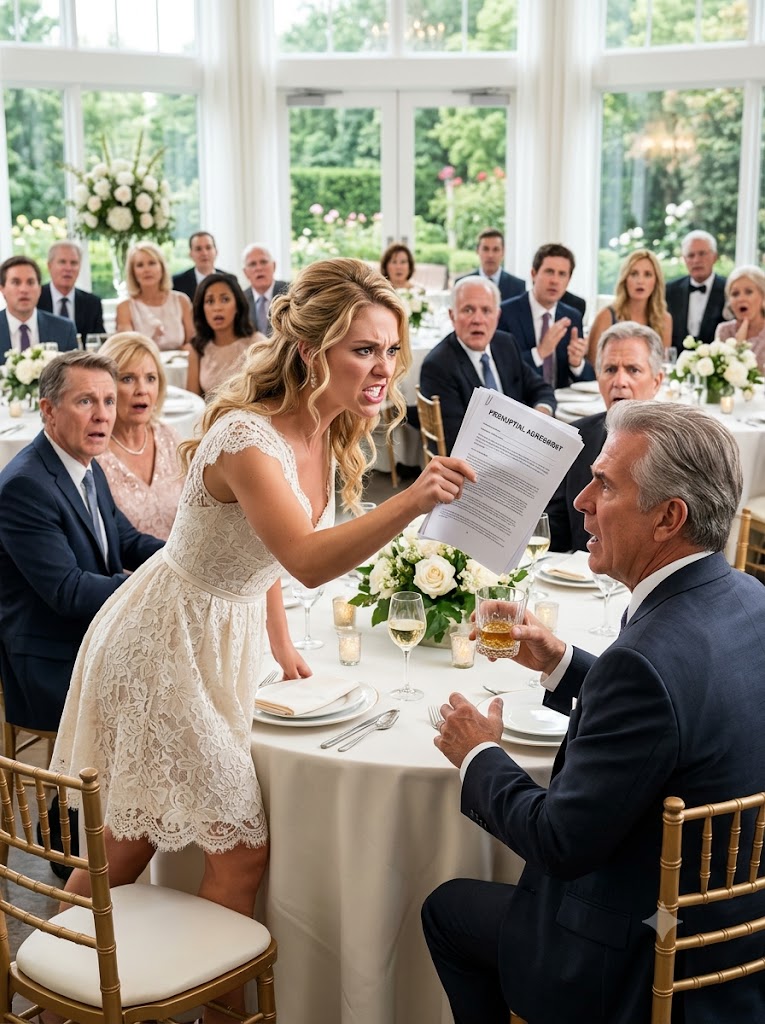
The green pen landed on my dinner plate at 8:07 on a Friday evening, right between my half-eaten walleye and a spoonful of wild rice. My future father-in-law, Douglas Voss, placed an eleven-page document beneath it, straightened his navy sport coat, and smiled at the sixty people attending our rehearsal dinner. “Sign it tonight, Avery, or there won’t be a wedding tomorrow,” he announced. “We protect what’s ours in this family.”
Fourteen hours later, I was supposed to walk down an aisle beside a Minnesota lake, wearing my late mother’s wedding veil and marrying the man I’d loved for three years. Instead, I sat frozen beneath the warm lights of Pinehaven Lodge, listening to the soft clink of silverware as every conversation stopped. My fiancé, Nolan, was beside me, staring at the food on his plate as though it contained the answer to an impossible question. His refusal to look at me told me something terrible before I even touched the document.
My name is Avery Hartwell, and I was thirty-six that September. I’m a certified public accountant in St. Cloud, Minnesota, where I work with small businesses, farms, contractors, and family-owned companies. My father, Martin, raised me after my mother died when I was twenty-two, and he taught me two things that have never failed me: keep copies of important paperwork, and never sign anything you haven’t read. Unfortunately, falling in love had made me forget how important his second lesson was.
I met Nolan Voss three years earlier when his family’s lumber company became a client of my accounting firm. Nolan managed one of their four lumberyards, and he was the kind of man who remembered employees’ birthdays and stopped to help strangers change flat tires. Once we started dating, I transferred the company account to another accountant to avoid a conflict of interest. Our relationship grew slowly, with Sunday breakfasts, fishing trips, and long conversations about the children we hoped to have someday.
His father, Douglas, was sixty-four and controlled everything connected to Voss Timber Supply. He sponsored youth baseball teams, donated building materials to churches, and gave generous holiday bonuses to employees. His favorite expression was printed above the coffee machine at headquarters: “We protect what’s ours.” I used to think it meant loyalty, but I’d eventually learn that Douglas had a very different definition.
The first warning came in May, when Nolan and I decided to buy a house before the wedding. We found a four-bedroom colonial on Cedar Ridge Drive in Sartell, with a fenced backyard and a sunny room I imagined turning into a nursery. The asking price was $389,000, and I contributed $60,000 from savings I’d accumulated over fourteen years. Douglas offered to have his longtime attorney handle the closing, saying it would make everything easier.
Two weeks before we signed, Douglas emailed me explaining that the financing would be simpler if the property went in Nolan’s name alone. He promised that his lawyer would add me to the deed immediately after our wedding. I hesitated because I understood what it meant to invest money in property without having legal ownership. But Nolan squeezed my hand and said, “It’s Dad, Avery. He wouldn’t do anything to hurt us.”
I kept Douglas’s email and wired the money to the title company. We moved in that June, painted the future nursery pale yellow, and bought curtains for the kitchen windows. I told myself the paperwork would be corrected in September. I wanted to trust the man I was marrying more than I wanted to worry.
There was another detail I hadn’t understood. Earlier that year, while reviewing our household budget together, I’d noticed a recurring $1,150 payment leaving Nolan’s checking account every month. The description was “Duluth Storage,” and he explained that he was paying to store his grandfather’s old fishing boat in a heated building. When I questioned the price, he laughed and told me it was a very large boat.
Once a month, Nolan drove to Duluth to check on it, always insisting that the trip was too boring for me to join him. One afternoon, I found a small green crayon beneath the passenger seat of his truck. He said a contractor’s child must have dropped it at the lumberyard. I believed him because I had never caught Nolan lying about anything important.
Two weeks before our wedding, Douglas invited me to lunch and casually mentioned a prenuptial agreement. I told him I had no objection to protecting family business assets, provided an independent attorney reviewed the document first. Douglas agreed, promising that Nolan would bring it home within a few days. But whenever I asked, Nolan insisted the lawyer hadn’t finished it, until finally he said his father had decided we didn’t need one.
Now that same document lay on my dinner plate, and Nolan’s silence made the entire conversation feel rehearsed. Douglas tapped the green pen with one finger, expecting me to sign while his relatives watched. Instead, I picked up the agreement, wiped a small streak of butter from the corner, and stood. “If you want me to sign this in front of everyone, Douglas, then everyone deserves to hear exactly what I’m signing.”
I began reading aloud, carefully and without raising my voice. The first pages contained familiar provisions about family businesses, inherited property, and retirement accounts, although one paragraph falsely suggested I’d already had an opportunity to obtain independent legal advice. Douglas leaned back in his chair, apparently satisfied that his little performance was working. Then I turned to page three, where a financial disclosure listed Nolan’s personal obligations, and my eyes caught a payment amount I recognized immediately.
It was $1,150 per month, but the words beside it had absolutely nothing to do with a fishing boat.
Part 2
“Child support,” I read aloud, my voice sounding strangely calm. “Monthly payment of one thousand one hundred fifty dollars, pursuant to a family court order in St. Louis County, Minnesota, for the benefit of Eli Voss, age six.” My eyes moved back to the beginning of the line because I thought I’d misunderstood it. Nolan, the man I was marrying tomorrow, apparently had a six-year-old son I’d never heard about.
The dining room went silent except for the low hum of the refrigeration unit behind the bar. I turned toward Nolan, waiting for him to laugh, explain a clerical mistake, or tell me there was another person with his name. Instead, he pressed his palms against his knees and whispered, “Avery, please.” That was when I knew the document was telling the truth.
Reverend June Palmer, who had conducted our premarital counseling, stood from her seat near the head table. “Nolan, is this your child?” she asked gently. He nodded without looking at her. “And did you know about him during our counseling sessions?” Another nod followed, and I heard my father’s fork settle against his plate.
We had spent four sessions discussing trust, honesty, parenthood, and the responsibilities of marriage. Reverend Palmer had specifically asked whether either of us had important obligations or relationships the other didn’t know about. Nolan had looked directly at me and said there was nothing. Now he admitted that his son lived in Duluth with his mother and that he’d been visiting him for years.
“Why didn’t you tell me?” I asked. His eyes filled as he finally turned toward me. “Dad said I should wait until after the wedding,” he answered. “He thought you’d leave if you found out before we were married.”
I looked at Douglas, who was standing beside his chair with his face growing red. “That document is private,” he snapped. “You had no right to announce the boy’s existence in front of everyone.” I glanced down at the agreement resting above my unfinished dinner. “You brought it to my table and ordered me to sign it publicly, Douglas.”
He pointed toward the papers. “Grant wasn’t supposed to include that information.” Then he stopped abruptly, realizing what he’d admitted. Grant Ellery, the family attorney, had apparently prepared complete financial disclosures while Douglas expected me to sign without reading them.
Nolan leaned toward his father. “You told me Grant had taken it out,” he said. Douglas waved him quiet, but Nolan continued. “Every time I tried to tell Avery, you said the timing wasn’t right.” I watched the man I loved surrender responsibility for three years of dishonesty to another man, and something inside me went cold.
Douglas changed his approach immediately. He came around the table, lowered his voice, and said we could resolve everything privately after the ceremony. “You’ll love the little boy once you meet him,” he promised. I picked up the green company pen and offered it back. “You keep telling everyone you protect what’s yours,” I said. “Well, so do I.”
I placed my engagement ring on page three, directly above the disclosure concerning Eli. Reverend Palmer quietly told me I had nothing to apologize for, and my father appeared beside my chair without being asked. My maid of honor, Brooke, retrieved my purse and sweater. Together, we walked through the lodge lobby, past the stone fireplace and framed fishing photographs, while the dining room erupted into whispered arguments behind us.
Outside, the September night smelled of damp pine needles and lake water. Dad took my arm beside his truck and said, “Your mother would have read every page, too.” That was when I finally cried, not because the wedding was canceled, but because I’d spent three years trusting someone who hadn’t trusted me with the truth.
Brooke took me to her apartment, where I sat awake long after midnight with a cup of chamomile tea. When she brought in my sweater from the car, three loose sheets slipped from its pocket onto the kitchen floor. They were the final schedules from Douglas’s agreement, separated from the staple during the confrontation.
I unfolded Schedule A and found an entry identifying the house on Cedar Ridge Drive as Nolan’s separate property, acquired before marriage and excluded from any future division. There was no acknowledgment of my $60,000 contribution, no reference to Douglas’s promise, and no provision requiring my name to be added to the deed. Had I signed that agreement, they would have had a signed document supporting their claim that the house belonged entirely to Nolan.
I opened my email and found Douglas’s original promise from May. Then I looked again at the property schedule, where my fourteen years of savings had been reduced to an invisible contribution. The secret child had destroyed my engagement, but the final three pages revealed something worse: someone had been preparing to keep my money even if the marriage failed.
Part 3
At ten the next morning, I was supposed to be walking toward Nolan beneath a wooden wedding arch decorated with white roses. Instead, I sat at Brooke’s kitchen table, printing Douglas’s emails and gathering every record connected to the house. My father called an attorney he’d trusted during the sale of his dairy farm. By noon, I had an appointment for Monday and a list of documents to bring.
There was one thing I refused to abandon: my mother’s veil. Brooke drove me back to Pinehaven Lodge, where employees were folding white chairs beside the lake and removing the decorations. The bridal suite smelled of hairspray and fresh flowers that nobody would use. When I opened the door, Elaine Voss, Nolan’s mother, was sitting on the bed holding the veil across her lap.
“I didn’t want them packing this into a box,” she said. Her silver hair was neatly pinned, but her eyes looked exhausted. She folded the delicate lace carefully and explained that she remembered my grandmother making it by hand. I accepted it, wondering why this woman who had barely spoken at dinner had been the only Voss to protect something that mattered to me.
Then Elaine told me about her own wedding forty-one years earlier. Douglas’s father had presented her with a prenuptial agreement during Christmas dinner, three weeks before the ceremony. She’d signed while everyone watched because she was twenty and terrified of embarrassing her future husband’s family. “It’s what they do,” she whispered. “They make refusing feel like the worst thing you could possibly do.”
Elaine admitted she’d overheard Douglas speaking with Grant two nights before our rehearsal dinner. Douglas had instructed him to include the Cedar Ridge property among Nolan’s separate assets, then laughed that I wouldn’t bother reading the schedules. “I should have warned you,” she said. “I was afraid of what would happen at home if I interfered.”
From her purse, she removed a copy of the closing statement she’d taken from Douglas’s filing cabinet. It showed my name, the title company’s information, and the exact $60,000 transfer toward a house titled solely to Nolan. Elaine handed it over without asking for secrecy. For the first time, I realized that she might finally be questioning the rules she’d spent decades obeying.
On Monday, my attorney, Sasha Bell, examined the records in her office above a downtown bakery. The smell of cardamom rolls drifted through the floorboards as she compared Douglas’s email with the closing statement and property schedule. She explained that recovering the money could require litigation, but the written promise and payment evidence gave us a substantial basis for demanding repayment. She sent a formal demand requesting the $60,000.
Douglas responded by spreading a story that I’d known about Nolan’s child for months and deliberately embarrassed his family to pressure them into giving me money. The rumor reached my father’s church and several clients at my accounting firm. Then Douglas contacted my managing partner, Arthur Bennett, threatening to move Voss Timber Supply’s business elsewhere unless the firm addressed my supposedly unprofessional behavior.
Arthur called me into his office, and I arrived expecting the worst. He asked whether I’d worked on the Voss accounts after beginning my relationship with Nolan, and I showed him the signed conflict-of-interest transfer. Then he asked whether I’d signed the prenuptial agreement without reviewing it. When I said no, he replied, “Then you did exactly what I’d expect a good accountant to do.”
I returned to my desk with trembling hands, grateful that someone still valued integrity over appearances. But the following afternoon, Sasha forwarded a letter from Grant Ellery rejecting our demand. His argument was simple: my $60,000 had been a voluntary gift to Nolan, who held legal title to the property. Without an enforceable agreement requiring repayment, he claimed, I had no right to recover it.
Douglas had evidently told his lawyer nothing about the promise he’d emailed me before closing. I called Sasha, and she suggested a meeting with everyone involved before filing a lawsuit. “Let him hear his own words read aloud,” she said. “Then we’ll see whether he’s still so confident.”
I thought of the green pen on my dinner plate, Nolan’s hidden son, and the house where I’d painted a nursery for a family that would never exist. Douglas believed he could control the story because he owned the biggest business in town. But the next time we sat across from each other, I wouldn’t be surrounded by wedding guests—and he wouldn’t be the only person with documents.
Part 4
On October twentieth, we met in Sasha’s conference room overlooking a narrow alley behind the bakery. Douglas arrived with Grant, carrying himself as though he’d already won, while Nolan entered separately and sat at the far end of the table. I hadn’t seen him since the rehearsal dinner, and he’d grown noticeably thinner. He gave me a small nod, but I couldn’t bring myself to smile.
Douglas refused the coffee Sasha offered. “Let’s finish this nonsense,” he said. “She gave Nolan money toward a house, and now she’s upset the wedding didn’t happen.” Sasha opened her folder without reacting. “Mr. Voss, before we discuss whether that payment was a gift, I’d like your attorney to read something.”
She slid Douglas’s May email across the table, with its original date, company address, and complete message preserved. Grant read it, then slowly read it again. The promise to put my name on the deed after the wedding was unmistakable, as was Douglas’s assurance that his lawyer would handle the paperwork for free. At the bottom were the words he’d repeated for years: “We protect what’s ours.”
“You never showed me this,” Grant said to Douglas. Douglas shifted in his chair. “It was just family correspondence.” Sasha pointed toward the closing statement. “It was a written promise made before my client transferred sixty thousand dollars, followed by an agreement attempting to exclude her from ownership.”
Grant turned toward Douglas. “You specifically told me the house was Nolan’s separate property and that Avery had agreed to that arrangement.” Douglas struck the table lightly with his palm. “I hired you to protect my son’s interests.” Grant replied evenly, “And I prepared the disclosures you requested, including his existing obligations.”
“That child never should have been listed,” Douglas snapped. Nolan looked up sharply. “His name is Eli, Dad, and he’s my son.” For several seconds, neither man spoke, and I watched Nolan straighten in his chair. “I’ll return Avery’s money,” he continued. “I’ll arrange financing against the house if necessary, but she’s getting every dollar back.”
Douglas threatened to remove him from the family business. Nolan’s expression didn’t change. “I’m thirty-eight years old,” he said. “You don’t get to make this decision for me.” Douglas left without shaking anyone’s hand, and the bakery bell downstairs rang when he pushed through the front door.
By the end of the meeting, our attorneys had prepared a written settlement requiring repayment of the full $60,000 by December first. Nolan signed, and I signed with my own pen. In the hallway afterward, he apologized for hiding his son and allowing his father to control decisions that should have been ours. I believed his remorse, but I told him the engagement was over permanently.
Two weeks later, an unexpected email arrived at my office. The sender introduced herself as Natalie Brooks, Eli’s mother, and explained that she’d heard about the canceled wedding. Her message ended with a sentence that made me read it twice: “I think Douglas lied to both of us about what you wanted, and I need you to know what happened.”
I drove to Duluth that Saturday, following the highway past bare birch trees and gray fields. Natalie met me in a café near the waterfront, wearing a green sweater and carrying a phone filled with pictures of her son. She showed me one photograph of Eli in a tiny gray suit with a bow tie. “He was supposed to be your ring bearer,” she explained.
In August, Douglas had called Natalie and told her I knew about Eli but refused to have him at the wedding. Natalie said she’d been devastated, especially because Eli had practiced carrying a ring pillow down their hallway for weeks. Douglas had also convinced her not to discuss the conversation with Nolan, claiming his son already knew everything. Meanwhile, he’d told Nolan that Natalie didn’t want Eli attending because the occasion might confuse him.
I sat staring at that little gray suit, realizing how carefully Douglas had separated three people who might otherwise have spoken honestly. With Natalie’s permission, I called Nolan and put him on speakerphone. She repeated the story while he listened without interrupting. Finally, Nolan asked, “Does Eli still have the suit?” Natalie whispered that he did, and Nolan answered, “Good. Tell him his dad wants to see him wearing it someday.”
After the call, I looked at Natalie across the table. We had both spent months believing the other woman had been cruel, when neither of us had even known the other existed in the situation. Douglas hadn’t simply hidden an inconvenient family secret. He had constructed an entire web of lies to keep everyone dependent on him—and now the people he’d manipulated were finally talking to each other.
Part 5
On December first, the $60,000 arrived in my bank account, exactly as Nolan had promised. I sat at my desk checking the transaction until I was certain it had cleared, then sent the confirmation to Sasha. Fourteen years of savings had nearly disappeared because I trusted a promise from the wrong person. Seeing the money returned felt less like winning and more like finally closing a door.
That same morning, Nolan resigned from Voss Timber Supply. Douglas initially laughed at the resignation, apparently convinced his son wouldn’t abandon a profitable position and a future inheritance. Then he threatened to remove Nolan from the family trust. When that failed, he offered him control of the entire company, but Nolan refused.
By March, Nolan had sold the house on Cedar Ridge Drive and moved to Duluth. He accepted a position managing a smaller building supply business and rented a modest home near Natalie and Eli. He began spending Wednesday evenings and alternating weekends with his son. Whatever I thought about his betrayal of me, I was glad Eli finally had a father who wasn’t hiding him.
Elaine called me once in April, and her voice sounded different. She’d begun visiting Eli twice a month despite Douglas’s objections. “I met my grandson last weekend,” she told me, crying softly. “He asked why he hadn’t seen me before.” I listened, then told her I hoped she would never let another person’s fear decide how much love that child received.
She apologized again for keeping silent before the wedding. I thanked her for protecting my mother’s veil and giving me the closing statement, but I didn’t pretend those actions erased everything. She understood, or at least she accepted my answer. We ended the conversation kindly, without promising a relationship neither of us knew how to build.
In late April, I bought a small two-bedroom house on the north side of St. Cloud. It had a maple tree in the front yard, white kitchen cabinets, and a narrow porch where I could sit with my coffee before work. It was nothing like the four-bedroom house I’d imagined sharing with Nolan. But every room was mine, and nobody had made promises about changing the paperwork later.
At closing, the title officer placed a thick stack of documents in front of me and pointed toward the signature tabs. “I’ll explain everything as we go,” she offered. I smiled and told her I’d like to read each page myself. She pushed the papers closer and said, “Take all the time you need.”
My father sat beside me wearing the same brown jacket he’d worn to my graduation. He didn’t interrupt once during the forty minutes I spent reviewing the documents. When I finally signed the deed, he brushed at his eyes and blamed the pollen outside. I laughed because my mother had always accused him of doing the same thing during sentimental movies.
That evening, Dad helped me carry the last box into the new kitchen. We ordered pizza, ate it from paper plates, and watched the sunset turn the walls a soft orange. My mother’s veil was wrapped safely inside a cedar chest in the bedroom. I realized I could remember the wedding I’d lost without wanting the life that would have followed it.
Nolan wrote to me occasionally, mostly with updates about Eli. He never demanded another chance, although once he admitted that he still loved me. I told him I hoped he’d become the father his son deserved, but I couldn’t return to someone who’d let me plan a marriage around a secret for three years. Regret could change his future, but it couldn’t repair my trust.
In July, he sent a photograph of Eli wearing a bright life jacket in an old green-and-white fishing boat. The boy was laughing while Nolan stood beside him, holding the railing. Beneath the photograph, Nolan wrote, “Grandpa’s boat. It was in Dad’s shed all along.” I smiled at the absurdity that the boat actually existed, even though the monthly payments had never been for its storage.
I didn’t reply, but I saved the picture because Eli had done nothing wrong. That summer, I spent weekends planting flowers, visiting my father, and learning to enjoy a life that didn’t require somebody else’s approval. Brooke came over often, and we sometimes laughed about how much trouble one green ballpoint pen had caused. Eventually, the rehearsal dinner became something I could talk about without feeling my stomach tighten.
Douglas never apologized to me. He continued telling people that I had embarrassed his family, even after Nolan left the company and Elaine began visiting her grandson without him. I stopped caring what people who believed his stories thought of me. The people whose opinions mattered had seen the documents, heard the truth, and watched what happened afterward.
Sometimes I still remember that Friday evening at Pinehaven Lodge: the smell of buttered fish, the sixty guests watching, and Douglas holding out a pen as though my future belonged to him. He expected me to choose between obedience and the wedding I’d dreamed about. Instead, I chose to read what he was so desperate for me to sign.
I lost a fiancé, a wedding, and the future I’d imagined, but I recovered my savings and kept my dignity. More importantly, I learned that love doesn’t become trustworthy simply because someone promises it will be better after the wedding. The last time someone placed legal papers in front of me with a pen, I read every word, signed my own name, and walked into a home that belonged to me.
Legal Notice: This story is a work of fiction. Names, characters, businesses, events, and incidents are the product of the author’s imagination or are used fictitiously. Any resemblance to actual persons—living or dead—or to actual events is purely coincidental. Thank you! 💓
WordsCharactersReading time


