
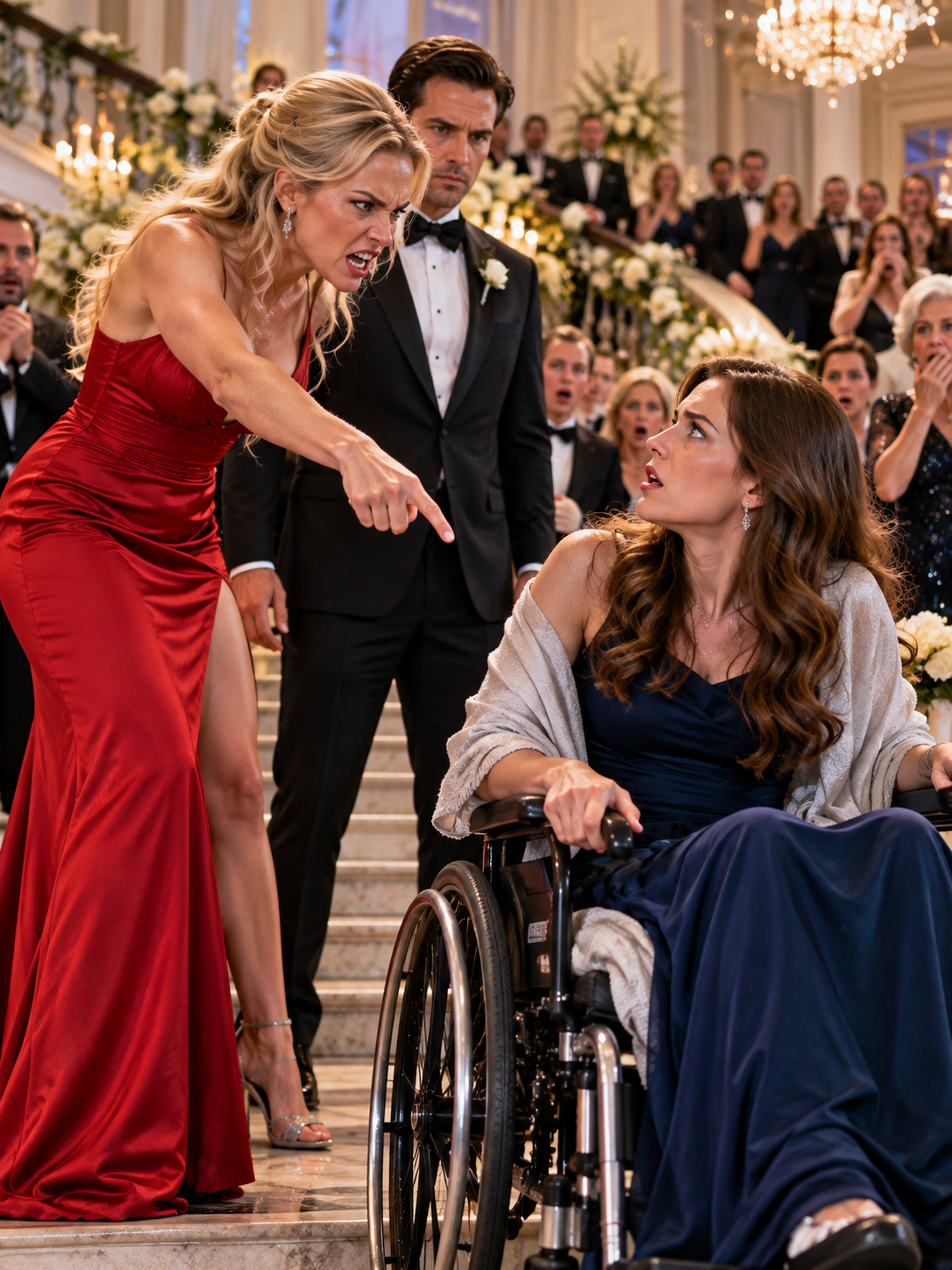
“Crawl Up the Stairs,” My Husband’s Mistress Sneered Before 200 Guests—Until I Stood Up and Exposed Their Darkest Secret
The night my husband planned to announce my retirement from the company I founded, his mistress ordered me to crawl up a marble staircase before two hundred guests. He didn’t defend me; he checked the photographers. Eleven months earlier, a crash had left me using a wheelchair, and everyone believed my recovery had stopped. They were wrong about my legs, but that wasn’t the biggest secret in the room. In my handbag was an envelope that could unravel our marriage, our business, and my accident.
Part 1
“Crawl up the stairs, Rowan,” Celeste Voss called, her silver heels planted halfway up the sweeping marble staircase. “If you want to join us, make an effort.” Behind her, a string quartet stumbled through its song, and several guests laughed before noticing my wheelchair. Two hundred people had gathered at a lakeside estate in Lake Geneva, Wisconsin, and apparently my humiliation was part of the entertainment.
My husband, Grant Mercer, stood beside Celeste in a charcoal suit I had bought him last Christmas. He glanced at her, then at me, and finally toward the photographers beside an arrangement of white roses. He was checking whether their cameras were pointed our way. I recognized that expression: Grant was calculating the cost of doing the decent thing.
“There’s an elevator,” I said, keeping my hands folded over my evening gown. Earlier, a server named Eli had offered to take me upstairs through the kitchen hallway, but the coordinator said Grant wanted me at the main entrance. Celeste leaned on the banister. “The service elevator is for staff. Surely you don’t expect us to rearrange everything for you.”
“Rowan, don’t make a scene,” Grant said, descending two steps. “Our investors are here.” I looked toward the screen above him, where gold letters read, A NEW ERA FOR ALDER & FINCH CREATIVE—GRANT MERCER, CHIEF EXECUTIVE OFFICER. Beneath them was a photograph of our original Chicago studio, cropped to exclude the corner where I’d painted our first logo.
I founded Alder & Finch eleven years earlier with a borrowed camera, three restaurant clients, and a warehouse that smelled of paint thinner. Grant joined six years later to manage accounts, and I had been proud of how easily clients trusted him. After my accident, I temporarily delegated daily operations while I recovered. I had never resigned, and I hadn’t authorized him to erase me.
“Is tonight my retirement party?” I asked. Grant’s jaw tightened, but Celeste answered. “Your husband has been carrying that company while you’ve been resting. He deserves a real partner beside him now.” A woman near the coatroom stopped stirring her drink, her spoon striking the glass with an embarrassing ping. “Do you mean a business partner,” I asked, “or someone who stays in his hotel suite?”
Celeste’s smile flickered, and Grant hurried down another step, spilling champagne over his fingers. “Not here,” he whispered. “You’ve been through a lot.” It was the same careful voice he’d used when telling my doctors I was too exhausted for visitors who happened to be my own employees. For months, he had been editing me out of rooms I once ran.
Eleven months earlier, a crash on a wet road outside Chicago had injured my spine. Grant promised at my hospital bedside that nothing between us would change, and I believed him even as meetings disappeared from my calendar. Then Celeste, our new strategy director, started wearing the perfume I found on his collar. By the time I knew about their affair, I was quietly investigating something worse.
My physical therapist and friend, Tessa, was waiting nearby with a car, and an attorney had helped me prepare the envelope in my bag. I could have left, but I wanted one answer: how far would Grant let Celeste go while everyone watched? “Tell her to stop,” I said. He rubbed his forehead. “We’ll discuss this privately after the presentation.”
Celeste laughed, a brittle sound across the foyer. “If Rowan doesn’t want the staff entrance, she can crawl. It’s not as if the stairs are coming down to her.” No one laughed this time, and Eli took a step toward my chair. I reached down and locked the right wheel, then the left, each click startlingly loud in the silence.
I gathered my skirt above my ankles, exposing the slim brace on my left leg, and pulled a collapsible cane from beside my seat. For four months, in a rehabilitation gym smelling of rubber mats, I’d practiced standing until my knees trembled. I placed my feet on the cold marble, pushed against the armrests, and almost fell before finding my balance. When I finally stood, Grant’s champagne glass slipped from his hand and shattered.
Part 2
For a moment I heard nothing but the ringing left by broken crystal. Standing did not mean my body had become what it was before the crash; my left ankle ached, and my balance depended on the cane. Eli slid a steadying hand beneath my elbow only when I nodded. Above us, Celeste gripped the banister as if the staircase itself had shifted.
“You can walk?” Grant asked. The surprise in his voice hurt more than the months of silence, because he sounded disappointed rather than relieved. “Sometimes,” I said. “For short distances, on good days. Recovery isn’t a performance you get to schedule.” I took one careful step, aware of every camera flash and the heavy pull of my dress around the brace.
Grant recovered first. He raised his palms toward the guests, smiling with the stiff cheer he used during difficult client meetings. “This is wonderful news. Rowan wanted to surprise everyone, apparently.” He reached for my arm, but I moved it away. “No, Grant. I wanted to tell you when I felt safe enough to tell you.”
That wiped the smile from his face. Eleven months earlier, he’d waited until I was sleeping to ask the hospital administrator about my power of attorney. Later, he told me I didn’t need the company’s financial reports because numbers were stressful. I’d mistaken that behavior for clumsy concern until my receptionist, Nora, began sending me screenshots of meetings held under my name without my knowledge.
Celeste descended a step. “You’re manipulating everyone,” she said, but her voice no longer carried its polished confidence. I looked at the silver evening bag hanging from her wrist. It was a gift Grant had charged to our joint account three days after telling me we needed to reduce my rehabilitation sessions. “The only surprise tonight,” I said, “is that you’re finally nervous.”
One of our board members, a retired publisher named Evelyn Price, came through the crowd. She had mentored me when my first major client threatened a lawsuit over a missed deadline, and I trusted her more than anyone at that party. “Rowan,” she said quietly, “tell me what you need.” I asked her to keep everyone in the room until the presentation could be corrected.
Grant shook his head. “Evelyn, this is a private family matter.” She glanced at the screen displaying his new title. “Then why did you invite our investors to witness it?” A low murmur traveled across the foyer, and for the first time Grant seemed to notice how many people had their phones out. He told the event coordinator to turn off the microphones, but she hesitated.
I reached into my bag and took out a sealed envelope, holding it against the cane’s handle. “When my car crashed, you told me the brakes failed because of a manufacturing defect,” I said. Grant’s gaze darted toward Celeste. “That’s what the preliminary report suggested,” he answered. “It was raining, Rowan. You lost control.”
“That’s what I thought, too.” The insurer had preserved my car while a civil claim remained open, and six weeks earlier an independent vehicle examiner inspected it with the insurer’s permission. His photographs showed fresh tool marks on a brake-line fitting, damage inconsistent with ordinary wear. The investigation wasn’t finished, but there was a reason the police had requested his findings and reopened questions about the crash.
Celeste let out a small, scornful breath. “So you’re accusing a car manufacturer now?” I turned to Grant instead. “You told me you hadn’t touched my car that week. Why does the service history show it was taken to a private garage the morning before the crash?” His lips parted, then pressed together. Behind him, Evelyn held out her hand for the envelope.
Grant didn’t let her take it. He stepped in front of the screen and nodded sharply toward the technician, who changed the slide to a document covered in electronic signatures. “Before this goes further,” he said, “everyone should understand that Rowan approved the leadership transition herself.” I recognized the document’s title, and a cold feeling went through me: it was a transfer of my voting rights that I had never seen.
Part 3
The word TRANSFER glowed across the screen, large enough for strangers to read. Grant watched me, waiting for panic. I remembered signing tax forms from a hospital bed with shaking hands and understood why he had volunteered to manage my passwords. He’d been collecting access while telling me he was protecting my energy.
“That document was signed electronically on February ninth,” Grant announced. “It authorizes me to vote Rowan’s shares during her recovery.” Evelyn examined the page. “You’ve used a proxy in board decisions without submitting it to the corporate secretary?” Grant called it an oversight, the sort of word that made deliberate choices sound like spilled coffee.
I asked the technician to open the verification record. He looked at Grant, then Evelyn, and clicked the link. The record showed a signature completed from a computer in our Chicago conference room, with a verification code routed to a phone number ending in 1842. It was Grant’s number; he’d told me my old phone was unreliable and switched our business accounts to his device.
“I was at therapy that afternoon,” I said. “But electronic signatures can be made remotely, which is why my attorney obtained the security logs.” Naomi Brooks had traced the document through company systems under my authority as majority owner. Grant’s assistant had created it following instructions from his private account. No message from me requested a proxy.
“Anyone can misunderstand an email,” Grant said, his collar suddenly looking too tight. “Besides, Rowan gave verbal permission.” Evelyn pointed to the original shareholder agreement I’d handed her. Our company required a witnessed, signed original for transferring founder voting rights, a safeguard I’d insisted upon years before. “Then this electronic proxy doesn’t satisfy the agreement,” she said.
“You can argue about intent later,” Evelyn told him, “but we can’t recognize this proxy tonight.” She asked the event coordinator to remove the retirement announcement from the program. Applause started in one corner before dying in discomfort. Grant looked at me as though I’d broken a promise, when all I’d done was refuse to disappear.
Celeste came down the remaining steps. “This is ridiculous. Grant kept the company alive, and the HarborBridge buyers know it.” I studied her face. HarborBridge was the investment group that had offered to buy control of Alder & Finch two weeks before my crash, an offer I’d refused because it meant closing our Chicago studio.
“How do you know what HarborBridge knows?” I asked. “Their offer was confidential.” Celeste opened her mouth, but Grant interrupted. “She’s strategy director. It’s her job.” I remembered what Nora had found in the expenses: monthly advisory fees to North Point Strategy, a company that produced no reports or work anyone could identify.
Naomi had spent three weeks tracing North Point through our audit and records obtained in a civil proceeding. Its public registration listed Celeste’s brother as manager, but Celeste herself could sign on its bank account. A payment of twenty-two thousand five hundred dollars had gone from that account to a garage employee shortly before my crash. Grant approved the expense as urgent consulting work.
Those records had cost me six nights of sleep. While Grant thought I was watching television, I sat at my kitchen table with ice against my aching back, comparing invoices to appointment logs. Each match felt less like victory than another door closing.
I didn’t announce those details immediately. An unexplained payment might be called a loan, and a strange appointment could be blamed on confusion. I wanted people to understand the connection without pretending an accusation was a conviction. The envelope contained one more item: a photograph that had reached Naomi that morning.
Evelyn looked at it first, then toward Celeste. A garage security camera had caught a woman in a pale trench coat opening the driver’s door of my car the night before the crash. Celeste took one look and stopped breathing for a beat. It was her coat, and her face was plainly visible.
Part 4
Celeste’s hand flew to the necklace at her throat. “I stopped at that garage to collect documents for the company,” she said. “There was nothing illegal about it.” Grant nodded too fast, grateful for a sentence he could repeat. Then he looked at the photograph again and asked why she had opened my car door if all she needed was paperwork.
That was the first time I saw them turn on each other. Celeste said she was checking whether the vehicle had been serviced, and Grant snapped that he had never approved a service appointment. He forgot he had just told me there was an ordinary explanation for the garage record. A reporter near the roses quietly wrote down both statements.
“I’m not asking this room to decide who committed a crime,” I said. My legs had begun to shake, and Eli brought my wheelchair without making a spectacle of it. I sat, relieved by the support, and placed the envelope in my lap. “I’m asking you not to let two people who lied about my authority sell a company they don’t own.”
Naomi Brooks appeared beside Evelyn, carrying a slim folder. She had been waiting in a downstairs sitting room at my request, ready to step in if Grant tried to present the forged proxy. She told the guests that the relevant records had already been preserved for investigators and that she would share only information we could substantiate. Celeste stared at her as though an attorney were more frightening than a staircase.
Naomi handed Evelyn a copy of North Point’s invoices. The entries said “strategic outreach,” yet the dates matched payments into an employee’s personal account at the garage. The employee had since given a statement to investigators and allowed his attorney to provide copies of messages from Celeste. He described being paid to interfere with my car before an early morning trip to the office.
“I have read those messages,” Naomi said, her voice low enough to demand attention. “One warns that Rowan could be hurt. The response is from a number registered to Ms. Voss and instructs the employee to complete the arrangement.” Celeste shook her head, but her denial was aimed at Grant rather than at us. “You said this was just to stop the vote,” she hissed.
Grant reached for her wrist. “Be quiet.” The gesture was small, but every phone in the room seemed to rise another inch. He released her when Evelyn said his name. Celeste stepped away, her silver heels making sharp little taps as she backed against the banister that had seemed like her throne an hour before.
I knew why the vote mattered. HarborBridge’s revised proposal offered Grant a generous executive payment and Celeste a lucrative position after the acquisition, while eliminating dozens of jobs in our Chicago studio. I’d rejected the earlier proposal because those designers and editors had built Alder & Finch with me. My crash had handed Grant the opening he needed to manufacture my consent.
“Was I supposed to miss a meeting,” I asked him, “or was I supposed to disappear for good?” Grant looked at the photograph on the screen, then at the black cane across my knees. “I never wanted you injured,” he said. It was the first admission that he knew the car had been interfered with, and it arrived wrapped in a defense of himself.
Evelyn addressed the investors. “There will be no announcement or sale tonight. The board will meet with independent counsel, and no disputed proxy will be counted.” Several guests walked toward the exits; others remained, silent and shaken. The quartet had stopped playing, leaving the hum of the ventilation system and the scrape of chairs strangely loud.
I thought I’d reached the worst of it. Then Naomi drew a separate court filing from her folder, its first page stamped with that morning’s date. Grant had petitioned to be appointed my guardian, claiming I could no longer manage my personal or financial decisions. While he was preparing to call me retired in public, he had been asking a judge to take away my right to speak for myself.
Part 5
I read the guardianship petition twice beneath the chandelier, my hands shaking harder than my legs had. It described me as confused and incapable of understanding contracts, using my need for assistance as evidence I couldn’t make decisions. Grant hadn’t merely planned to push me out of my company. He wanted legal permission to make my objections irrelevant.
“You filed this today?” I asked. He stared toward the lake through the tall windows. “I was trying to protect you,” he said, but even Celeste didn’t support him. Naomi reminded him that needing a wheelchair wasn’t evidence of incapacity and that we would challenge the petition with medical and financial records.
I wanted to walk out, but my ankle burned and fatigue made my balance unreliable. Tessa arrived from the neighboring hotel, took one look at my face, and rested her hand on my shoulder. “Chair or cane?” she asked, giving me the choice Grant never had. “Chair,” I said, and we headed toward the front doors.
Behind us, Grant called my name. I stopped and turned. For the first time all evening, he looked at me instead of the cameras. “Please don’t destroy everything we’ve built,” he said. An old instinct to comfort him rose and disappeared. “You didn’t build a life with me to give yourself permission to take it away,” I answered.
The next morning, I met Evelyn and our attorneys in a conference room above a Chicago bakery. The smell of cinnamon rolls drifted through the vents while we reviewed accounts, corrected shareholder records, and scheduled a board vote. Grant was removed from his executive role after an independent review, and the sale was suspended. HarborBridge withdrew once it became clear there was no valid authorization.
The guardianship petition was dismissed after the court considered evidence of meetings I had conducted throughout rehabilitation. Our divorce took longer because Grant argued over financial disclosures and property he had promised himself. I stopped answering his messages and let my attorney handle necessary exchanges. Marriage had taught me compromise; leaving taught me that not every dispute deserves another conversation.
The crash investigation continued for more than a year. The garage employee cooperated, and investigators assembled original messages, financial records, and technical findings rather than relying on the party confrontation. Eventually Grant and Celeste pleaded guilty to charges arising from the vehicle interference scheme and related fraud. Both received prison sentences, though no sentence could return the months I spent wondering whether I would ever feel safe again.
Before sentencing, Grant sent me a handwritten letter. It arrived without a return address, but I recognized his impatient slant. Through his lawyer, he said he regretted what happened and hoped we could someday talk about the good years. I gave the unopened letter to Naomi for the case file, because regret didn’t require me to offer him access to my life.
Alder & Finch survived, although we lost two clients and postponed an expansion. Nora moved into operations, and Evelyn helped me recruit people who could disagree with me without treating my recovery as a business obstacle. I returned gradually, sometimes using my cane and sometimes my wheelchair. Nobody interpreted either as a verdict on my intelligence.
At our next company celebration, we chose an accessible gallery overlooking the Chicago River. The entrance had broad automatic doors, and every guest arrived through them, whether they walked, rolled, or needed an arm to lean on. I stood briefly to thank our staff, then sat when I was tired and stayed for the evening. Nobody asked me to prove anything.
I sometimes think about that staircase in Lake Geneva, and how desperately Grant and Celeste wanted me to crawl. Standing had been unforgettable, but the real victory came afterward: quiet mornings when my decisions were my own, and the people who tried to steal them no longer had a place in my life. I didn’t need to forgive them to move forward. I only needed to keep choosing myself.
Legal Notice: This story is a work of fiction. Names, characters, businesses, events, and incidents are the product of the author’s imagination or are used fictitiously. Any resemblance to actual persons—living or dead—or to actual events is purely coincidental. Thank you! 💓


