
Before Everyone Leaves, I’d Like to Say a Few Words About Honesty—My Husband Went Pale While I Held Our Newborn Daughter
Six days before our anniversary dinner, my husband forgot to hang up the phone. I heard him laughing with another woman, mocking my exhaustion after childbirth, and planning a romantic weekend using our money. I recorded everything while our newborn daughter slept beside me. For six days, I pretended nothing had changed. Then, surrounded by our families and his business partners, I stood holding our baby and asked everyone to listen. My husband turned white before I even mentioned the affair. He knew his perfect marriage was about to collapse.
Part 1
The day my marriage ended, my husband didn’t confess, leave a note, or make some dramatic announcement about falling out of love. He simply forgot to disconnect a phone call, and I heard seven minutes of conversation that explained almost every lonely evening of the previous six months. I was standing in our kitchen outside Charlotte, North Carolina, with a burp cloth over my shoulder and a bottle warming in a mug of hot water. Our five-week-old daughter, Maisie, had finally fallen asleep.
My name is Audrey Garner, and until that Wednesday afternoon, I believed my husband, Graham, was working overtime to support our growing family. We’d been married almost two years, lived in a comfortable suburban house, and had recently become parents after months of planning. I was thirty-one, recovering from childbirth, and on maternity leave from my job designing book covers for a small publishing company. Most days, I barely recognized the exhausted woman looking back at me from the bathroom mirror.
Before Maisie arrived, I had deadlines, colleagues, lunch breaks, and enough energy to paint for pleasure after work. Now my days consisted of feeding her, folding tiny clothes, washing bottles, and wondering whether I could safely close my eyes for another twenty minutes. I loved my daughter more fiercely than I’d ever loved anyone, but motherhood was harder than the smiling photographs suggested. Graham seemed to think exhaustion was something only mothers experienced.
He worked for a regional commercial property firm, earning enough that we weren’t struggling financially, although he often complained about mounting expenses. During my pregnancy, he began accepting evening meetings, sudden client dinners, and weekend assignments that never appeared on his shared calendar. Whenever I asked when he’d be home, he sighed as though I were keeping him from something important. I told myself he was anxious about becoming a father.
That afternoon, I called because I wanted to know whether to cook dinner for two. Graham answered after the fourth ring, and I could hear traffic behind him. “Are you coming home tonight?” I asked. “I’ve got chicken thawing, and I don’t want to wait until nine again.” He replied, “Audrey, seriously, do you have to check on me every afternoon? I’m working.”
His irritation landed harder than it should have. “I’m not checking on you,” I said, looking at the untouched breakfast dishes. “I’m asking about dinner.” He muttered something about another meeting and told me not to expect him before ten. I answered, “Fine, Graham. I’ll see you whenever you get here.”
I pulled the phone from my ear, waiting for the call to end, but the timer kept running. There was a muffled thump, an engine starting, and the sharp squeak of a car door. I was about to disconnect when a woman’s voice said, “Well, that sounded romantic. Did your wife believe the meeting story again?” I recognized that bright, slightly nasal laugh before Graham answered.
“Audrey believes anything these days,” he said, sounding relaxed and cheerful in a way he hadn’t sounded at home for months. “She’s so buried in diapers and laundry that she barely remembers what day it is.” The woman laughed, and I pressed my free hand against the counter. Her name was Celia Marsh, a former colleague who had once brought homemade cookies to my baby shower.
“That’s awful,” Celia said, although she was laughing again. “You make her sound like some exhausted housekeeper.” Graham replied, “Honestly, that’s basically what my life has become. Everything revolves around the baby.” My stomach tightened as Maisie stirred in her bassinet, completely unaware that her father was discussing us like an inconvenience.
Celia asked whether he’d reserved their Asheville hotel. Graham said he’d booked a mountain-view suite from Friday through Sunday and told me he had a leadership retreat. She mentioned dinner reservations and the bracelet he’d promised her. Then she said, “Just make sure she doesn’t check the account like last time.” Graham laughed and answered, “Trust me, she won’t.”
I set the phone on speaker beside the little digital recorder I used for design interviews. My hands shook as I pressed record, but I kept both devices steady on the kitchen table. For several minutes, I listened to them discuss their weekend, complain about our marriage, and joke about how easily Graham could disappear from home. I recorded what I could before the call finally disconnected.
The worst moment wasn’t hearing about the hotel. It was Graham describing our daughter as another responsibility he needed to escape, while Celia asked whether he’d ever considered leaving. “Not right now,” he answered. “Audrey would make things complicated, and everyone thinks I’m such a good husband.” Celia replied, “Then let’s enjoy ourselves while she’s busy playing mommy.”
I stood in the kitchen until the bottle water went cold. Then Maisie woke, making the small, impatient sound she made when she was hungry, and instinct took over. I held her close, fed her, and watched her tiny fingers curl around my thumb. I wanted to cry, but something quieter and harder had settled inside me.
When Graham came home at ten fifteen, he kissed my forehead and said the meeting had been exhausting. I noticed a faint floral perfume on his jacket, unfamiliar and expensive. “You look tired, sweetheart,” he added, opening the refrigerator without asking how my day had gone. I smiled, took Maisie upstairs, and waited until he was asleep before checking our bank statements.
The first unfamiliar charge was for $1,460 at a luxury mountain resort in Asheville. The second was from a jewelry store, dated four days after Maisie’s birth. I stared at those transactions until the numbers blurred, then opened my calendar and circled the date of our upcoming anniversary dinner. Graham had invited both families and several business associates to celebrate our supposedly wonderful marriage, and suddenly I knew exactly why I needed to attend.
Part 2
The next morning, I called my friend Sofia, who had worked beside me at the publishing company for five years. I asked her to come over without explaining why. She arrived carrying coffee, blueberry muffins, and the expression she usually reserved for impossible deadlines. When I played the recording, she stopped halfway through her muffin and stared at me.
“Audrey, Celia stood beside you at your baby shower,” she whispered. I nodded, remembering how Celia had arranged the gifts and hugged me before leaving. She’d asked whether I was nervous about becoming a mother, then assured me Graham would be wonderful. Sofia reached across the table. “Tell me what you need, and I’ll help.”
I didn’t want revenge that would make caring for Maisie harder. I wanted financial information, somewhere safe to stand, and a way to stop Graham from rewriting what had happened. Sofia watched Maisie while I downloaded statements from accounts I was authorized to access. By lunchtime, I had a spreadsheet containing every unexplained charge from the previous eight months.
There were restaurant bills on nights Graham claimed he was traveling for work, hotel charges in cities he’d supposedly visited alone, and jewelry purchases I’d never received. A boutique receipt dated three weeks before Maisie’s birth showed two guests sharing a weekend package. Some expenses might have innocent explanations, but the Asheville reservation under Celia’s name did not. Its deposit had come directly from our joint account.
That afternoon, I met family-law attorney Leah Porter, bringing Maisie in her stroller and the documents in an envelope. Leah listened carefully, asked about our finances, and explained that separation required planning rather than a dramatic announcement. She warned me not to interfere with shared accounts or assume Graham would immediately lose access to our home. We discussed parenting arrangements, household expenses, preserving records, and the legal steps that could follow.
“You’re not required to make a final decision about every detail today,” Leah said, returning the envelope. “But you can decide what treatment you’re willing to accept.” I looked down at Maisie, asleep beneath her pale pink blanket. For the first time in two days, I felt like someone had handed me a door instead of another problem.
That evening, Graham mentioned his Asheville retreat while buttoning a blue shirt I’d ironed that morning. “It’s important for my career,” he said, studying himself in the mirror. I asked whether he’d booked everything through work, and he answered without hesitation. “Company handles it all.” He kissed Maisie’s forehead, then checked a message and smiled at his phone.
Friday morning, I watched him load his overnight bag into the car. He reminded me about Tuesday’s anniversary dinner and said his parents were excited to celebrate us. “Two years, Audrey,” he said, giving me a quick kiss. “Can you believe it?” I looked at the bag containing the clothes he’d packed for his weekend with Celia. “Hard to believe,” I answered.
While he was away, Sofia helped me organize my evidence. My work had taught me to make complicated information understandable without burying the important details. I prepared eight slim presentation folders containing a brief timeline, selected transaction records, and short excerpts from the conversation. I kept the full recording and supporting documents for my attorney rather than distributing private material indiscriminately.
On Sunday, Graham texted photographs of a conference breakfast and a mountain view. I recognized the resort’s distinctive terrace from its website, although his pictures carefully avoided its name. He wrote, “Wish you were here.” I typed three different replies before settling on, “Hope you get home safely.” The ordinary politeness of those words made me feel strangely distant from the woman I’d been six days earlier.
Monday night, Graham found me arranging the folders on my desk. I covered them with a magazine before he could read the pages. “Working already?” he asked, sounding annoyed. I told him I was organizing something for our anniversary and wanted it to be a surprise. He smiled, relieved, and said, “You’re always so thoughtful.”
After he went upstairs, a confirmation from the restaurant appeared on our shared calendar. Graham had added two more guests: his regional director and the colleague who supervised his largest client account. He intended to spend Tuesday evening receiving congratulations from everyone whose opinion mattered to him. I looked at the folders again and realized the audience for his performance had just grown.
Part 3
The private dining room overlooked downtown Charlotte, its tall windows reflecting the lights of passing cars. White roses stood between small candles, and the tables smelled faintly of rosemary and roasted vegetables. Graham had selected the restaurant himself, explaining that our second anniversary deserved something memorable. I arrived with Maisie in a cream-colored outfit, carrying the diaper bag in one hand and my presentation case in the other.
Graham greeted guests near the entrance, laughing with his regional director as though he’d never missed a night at home. His mother, Judith, took photographs while his father, Richard, complimented the arrangements. My parents hugged me, then asked whether I was sleeping enough. I almost laughed at the question. Graham had told everyone I was handling motherhood beautifully.
I positioned Maisie’s bassinet beside my chair and placed the white folders on a credenza near the dessert plates. Sofia, who had agreed to attend, gave me a small nod from across the room. Graham noticed the folders but assumed they contained anniversary photographs. “You’ve really gone all out,” he said, squeezing my shoulder. I looked up at him and answered, “I wanted everyone to remember tonight.”
Dinner lasted nearly two hours. Graham entertained his colleagues with stories about demanding clients and joked that fatherhood had turned him into a responsible man. Richard praised his dedication to work, while Judith said I was fortunate to have a husband willing to sacrifice so much for our family. I took small bites of dinner, listening to strangers congratulate him for the very absences that had concealed his affair.
When dessert arrived, Graham tapped his glass with a spoon. He thanked our guests for celebrating two wonderful years and spoke warmly about becoming a father. “Audrey has been incredible,” he announced, placing a hand over his heart. “I know my late nights haven’t been easy, but every sacrifice I make is for her and Maisie.”
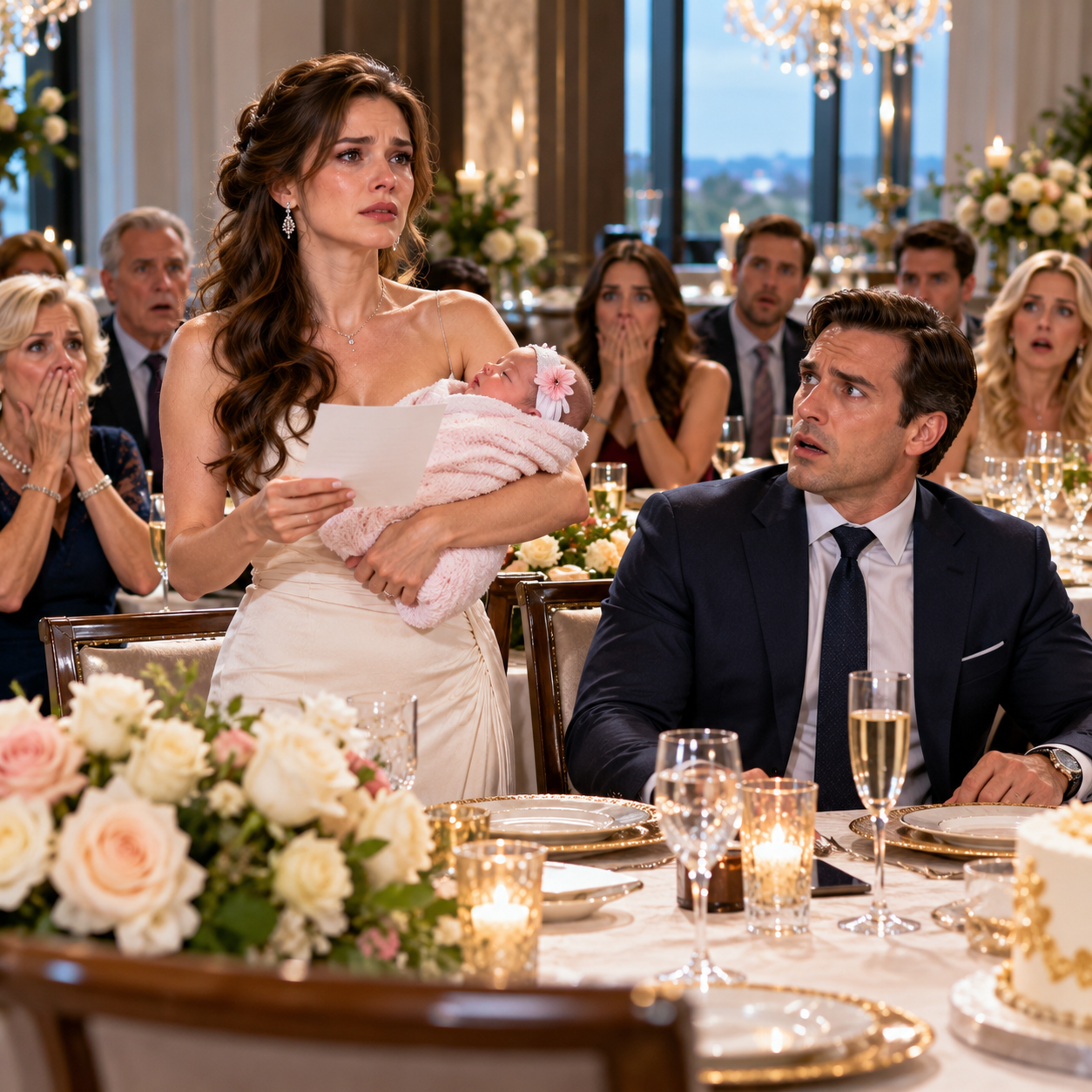
People applauded. Judith dabbed her eyes with a napkin, and my father raised his glass. I looked at Graham, remembering how he’d described me as someone too distracted by laundry to notice his dishonesty. Maisie stirred beside me, so I lifted her carefully into my arms. The warmth of her small body gave me the courage I’d been searching for all week.
“Before everyone leaves, I’d like to say a few words about honesty,” I said. Graham’s smile disappeared so abruptly that Richard turned toward him. I hadn’t mentioned Celia, the hotel, or the phone call, but Graham’s fingers tightened around his glass. “Audrey,” he interrupted, “maybe we should save your speech for another time.”
“No,” I answered. “I think tonight is exactly the right time.” I explained that marriage involved trust, especially when one partner was recovering from childbirth and caring for a newborn. Then I asked Graham’s brother, Nathan, to pass the folders around. Nathan hesitated, glanced at Graham’s expression, and began distributing them.
The sound of turning pages replaced the dinner conversation. Inside each folder were copies of selected receipts and a short transcript of Graham discussing Asheville with Celia. Richard read the first page twice. Judith whispered, “What is this?” Graham rose so quickly his chair scraped across the floor. “Audrey, this is completely inappropriate,” he said.
“What’s inappropriate,” I replied, “is using our household money for a romantic weekend while telling your wife you’re attending a company retreat.” Graham opened his mouth, but I continued. “I heard your conversation six days ago because you forgot to hang up your phone. I heard what you said about me, and I heard you discuss leaving our daughter at home while you enjoyed yourselves.”
Nathan looked at his brother with an expression I’d never seen before. My mother quietly asked whether I wanted her to take Maisie, but I shook my head. Graham insisted there had been a misunderstanding, until Richard placed the hotel receipt directly in front of him. “Then explain the reservation,” his father said.
Graham stared at the invoice without answering. I told everyone I had consulted an attorney and was arranging a separation, with our daughter’s needs protected through proper legal channels. I wasn’t asking the room to choose sides; I was refusing to let Graham’s carefully rehearsed story stand unchallenged. Judith began crying, but the sound no longer moved me.
I picked up my coat as Sofia collected the diaper bag. Graham followed us toward the door, his voice low and urgent. “Audrey, please, don’t do this in front of everyone. We can fix it.” I turned, holding Maisie against my shoulder, and answered, “You had six days to tell me the truth after that call, and you still chose to lie.”
He reached toward me, then stopped when Richard called his name. I walked out beneath the restaurant’s bright entrance lights, breathing the cool October air. My phone began vibrating before Sofia had even opened the car door. The first message was from Graham, but the second came from Celia, and its opening words made me stop: “You don’t know the whole story.”
Part 4
Celia’s message continued, “Graham told me he was going to end your marriage before the baby arrived. He kept saying he needed more time.” Another message followed, admitting their relationship had begun during my second trimester, not after Maisie was born. I stood beside Sofia’s car reading those words, remembering Celia smiling beside my ultrasound photograph at the baby shower. She had known exactly what she was doing.
I didn’t reply. Sofia drove me home while Maisie slept in her car seat, the streetlights sliding across her blanket. Graham called twelve times before we reached the driveway. My phone displayed messages promising explanations, accusing me of humiliating him, and begging me not to involve our families. Not one asked whether Maisie was all right.
My mother stayed that night, and I contacted Leah the next morning. We discussed how Graham and I could establish separate residences while maintaining a practical schedule for Maisie’s care. Leah advised me to keep communications focused on parenting and preserve the financial records. I followed her guidance, determined not to make decisions out of anger that might complicate our daughter’s life.
Graham arrived home shortly before noon. His eyes were tired, his suit wrinkled, and the confident smile he’d worn at dinner was gone. “My father won’t answer my calls,” he said, setting his keys on the counter. “Nathan says I embarrassed the family.” I looked at him over Maisie’s bottle and replied, “You did that yourself.”
He admitted the affair, then insisted it had meant nothing. According to Graham, he’d felt neglected during my pregnancy and convinced himself Celia understood him better. I asked whether he’d considered how lonely I’d been while preparing for childbirth. He lowered his eyes and said, “I didn’t think things would go this far.”
“How far did you think they would go?” I asked. “You booked hotels, bought gifts, and laughed about me caring for our daughter.” Graham admitted he’d kept promising Celia their relationship would eventually become official. The honesty I’d wanted for months had finally arrived, but hearing it now felt like receiving a birthday card after the party had ended.
His mother visited that afternoon, asking whether we could avoid separation for Maisie’s sake. Judith said marriages survived difficult periods, and she reminded me that Graham was a good provider. I asked whether providing financially excused using our money to deceive me. She hesitated, then answered, “No, but public embarrassment won’t make anything better.”
“Neither will asking me to pretend,” I said, opening the door for her. Judith looked toward the nursery and asked if she could still visit her granddaughter. I told her Maisie deserved loving grandparents, but that didn’t mean Judith could pressure me into staying married. She nodded, wiping her eyes, and left without another argument.
Two days later, Graham moved into a furnished apartment while we worked with our attorneys on temporary arrangements. We documented household expenses and developed a parenting schedule appropriate for Maisie’s age. I remained in our home during the initial transition, surrounded by baby clothes, half-finished nursery decorations, and the ordinary belongings of a marriage that had ended emotionally long before anyone packed a suitcase.
The hardest evenings came afterward. I’d reach for my phone to tell Graham something funny Maisie had done, then remember that our relationship was changing. I missed the husband I’d believed I had, not the man who had laughed about my exhaustion. Sometimes I cried while folding her clothes, but I never confused grief with a reason to return.
A week later, Graham sent an email asking for marriage counseling and another chance. He wrote that losing me had made him understand what mattered. I read it twice before answering through our agreed communication channel. “I’m willing to discuss respectful co-parenting,” I wrote, “but I’m not interested in rebuilding our marriage.”
That evening, I returned to my design desk for the first time since the phone call. My editor had emailed about a manuscript needing a new cover, a story about a woman starting over after losing everything she thought defined her. I opened a blank canvas and began sketching. For the first time in weeks, I looked toward the future without wondering whether Graham would approve.
Part 5
The months after our separation were not nearly as dramatic as the anniversary dinner. There were daycare applications, pediatric visits, grocery bills, and endless discussions about schedules. Maisie learned to roll over, sit independently, and clap when someone sang to her. Every milestone reminded me that life continued even when the future looked nothing like the one I’d planned.
I returned to work part-time when my maternity leave ended. My editor, Denise, welcomed me back without asking intrusive questions, and soon I was designing covers again. I worked from home three days a week and arranged childcare for meetings. Having work of my own helped me remember that I was more than someone’s wife or the woman whose marriage had collapsed.
Graham followed our parenting schedule, although he occasionally tried to turn exchanges into conversations about reconciliation. He brought Maisie home with detailed notes about her meals and naps, then lingered near the door. Once, he said, “I keep thinking about what we had.” I answered, “I’m glad you’re learning to be present for your daughter, but that doesn’t change what happened between us.”
Richard called several weeks after the dinner and asked whether he could visit Maisie. He apologized for praising Graham’s sacrifices without recognizing how much I had been carrying alone. I accepted his apology because it came without conditions, and we arranged regular visits. Judith also learned to respect the boundaries I’d established, even though I knew she still wished her son and I would reconcile.
Celia attempted to contact me twice. Her first message said she had never intended to destroy a family, and the second described how Graham had misled her about our marriage. I didn’t respond. Whatever Graham had told her, she had knowingly participated in deceiving me while pretending to be my friend, and I wanted nothing more to do with her.
By spring, I had started accepting independent design projects in addition to my regular work. Sofia helped me create a website, and we celebrated my first major client with takeout on the living-room floor. I named the business Clearline Studio because I wanted to create thoughtful work that made complicated stories understandable. The name also reminded me of the boundaries I’d finally learned to draw.
Maisie’s first birthday arrived with paper butterflies, strawberry cupcakes, and a small gathering in my mother’s backyard. Graham attended for an hour under an arrangement we’d discussed in advance. He brought a stuffed rabbit and helped Maisie open her presents, and I was genuinely glad she had a pleasant afternoon with both parents. When he suggested a photograph of the three of us, I agreed to one for her keepsakes, not for his social media.
Later, he sent me the picture with a message saying, “We still look like a family.” I stared at it for a moment before replying, “We are Maisie’s parents, and that matters. It doesn’t mean we’re getting back together.” He didn’t answer until the following morning, when he confirmed the time of his next visit.
A little over a year after Graham moved out, we completed our divorce under North Carolina’s separation requirements. The property and financial arrangements had taken months of careful negotiation, and our parenting agreement gave Maisie a predictable routine. Nothing about the process had been effortless, but it was finally settled. I signed the last documents at Leah’s office and walked outside feeling lighter than I had expected.
Graham asked to speak privately afterward. We stood near the parking lot beneath trees turning orange in the autumn sunlight. “I know I don’t deserve another chance,” he said, “but I really did love you.” I thought of the newborn I’d held while he joked with Celia, the evenings I’d spent alone, and the anniversary dinner when his first concern had been his reputation.
“Maybe you loved the life we looked like we had,” I told him. “But you didn’t take care of the people living inside it.” He lowered his head and said he would always regret what he’d done. I believed him, yet his regret no longer had the power to change my decisions.
That evening, Maisie fell asleep while I read her a picture book with a cover I’d designed. Rain whispered against the nursery window, and a small lamp cast gentle light across the rocking chair. Downstairs, my laptop held three new client contracts and a message from Denise congratulating me on a recent project. My future wasn’t perfect or guaranteed, but it belonged to me.
On our second anniversary, Graham had stood before everyone and described himself as a devoted husband who sacrificed everything for his family. One year later, there was no elaborate dinner, no speech, and nobody applauding me for surviving what happened. There was simply a peaceful home, work I loved, a daughter growing stronger every day, and the freedom to build a life without waiting for someone to choose me.
I looked down at Maisie sleeping in my arms and remembered the promise I’d made silently on the night of that forgotten phone call. I would never teach my daughter that love meant accepting disrespect, enduring dishonesty, or making herself smaller to keep someone else comfortable. Graham had lost his marriage because he mistook my trust for blindness, and I had gained something I hadn’t known I needed: the certainty that I could walk away and still build a beautiful future.
I didn’t forgive Graham, and I didn’t need to hate him. I simply stopped making room in my heart for a man who had already shown me what he was willing to do with it. My daughter would grow up knowing that her mother hadn’t lost everything when her marriage ended. She had finally chosen a life in which honesty, dignity, and love could exist together.
Legal Notice: This story is a work of fiction. Names, characters, businesses, events, and incidents are the product of the author’s imagination or are used fictitiously. Any resemblance to actual persons—living or dead—or to actual events is purely coincidental. Thank you! 💓


