
At My 36-Week Ultrasound, My Husband Knocked My Card Away—Then His Mother Walked In With an $8,000 Receipt
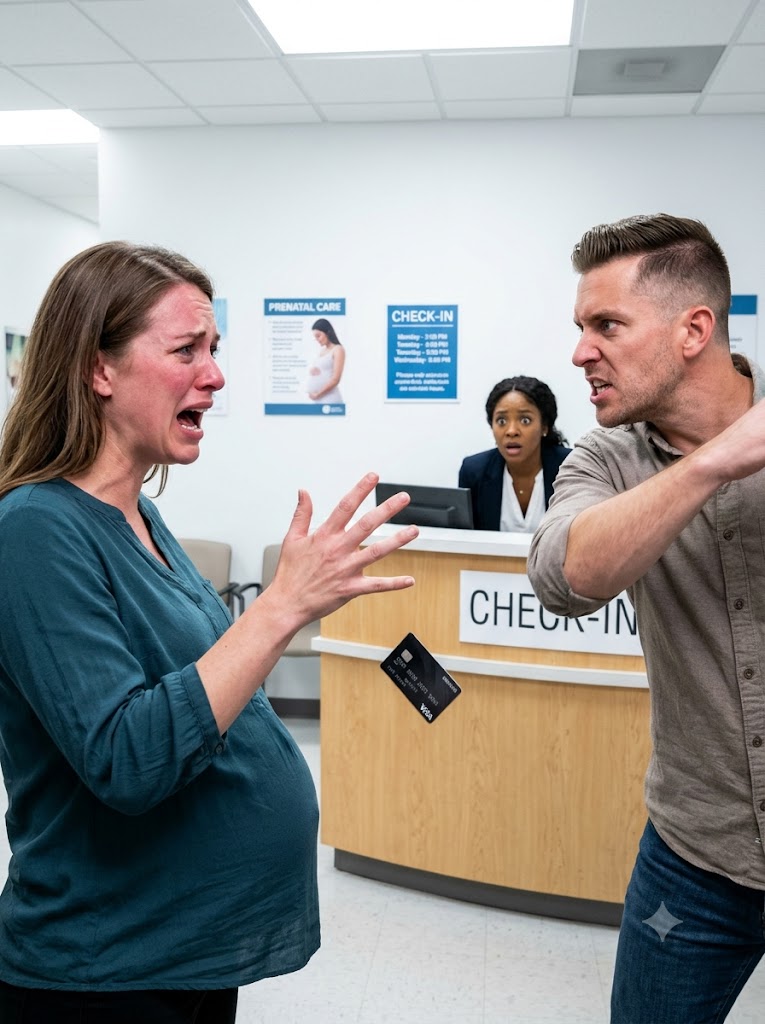
At thirty-six weeks pregnant, I watched my husband knock my debit card across a clinic floor and demand that the receptionist cancel our daughter’s ultrasound. He claimed we couldn’t afford the scan, although he was flying to Las Vegas that afternoon. Then his mother arrived with a receipt proving she’d already given him $8,000 for my medical bills. I thought that was the worst betrayal I would uncover. I hadn’t yet seen our baby’s savings account—or the document supposedly bearing my signature.
Part 1
My debit card skidded across the polished floor and stopped beneath a chair with a pink diaper bag hanging from its arm. Around me, the waiting room fell quiet except for a children’s cartoon playing on a wall-mounted television. My husband, Cole, leaned across the counter and said, “Cancel the scan. We’re not paying six hundred eighty dollars for another baby picture.”
“It isn’t another baby picture,” I said, bending awkwardly to retrieve my card. “Dr. Patel wants to check her growth.” At my appointment the previous week, my measurements had come up smaller than expected, and I’d spent seven nights waking to count kicks. Cole knew that, but he was looking at the receptionist as though she were the person holding up his afternoon.
“Your insurance was returned as inactive,” she explained carefully. “The billing coordinator can discuss payment options before you decide anything.” Cole picked up my purse from the counter, the strap scraping against his watch. “We’re leaving, Hannah,” he said, using the brisk voice he reserved for sales calls that weren’t going his way. “I have a plane to catch.”
His mother, Joanne Mercer, stepped inside holding a weathered brown leather tote. She’d never once come to an obstetric appointment, and Cole had told me she was refusing to help with baby expenses. Her gaze moved from my card under the chair to Cole gripping my purse. “Put that down,” she said, and something in her voice made him obey.
“Mom, this isn’t a good time,” Cole said as Joanne retrieved my card and placed it in my palm. She ignored him and asked, “Hannah, would you like to have your scan?” I nodded, speechless, while she handed her own card to the receptionist. “Please keep the appointment,” she said. “We’ll sort out the rest afterward.”
Cole reached for the tote, but Joanne moved it behind her, and his face changed. “What have you got in there?” he asked. “A receipt for the eight thousand dollars you said Hannah needed for this clinic,” she answered. I’d never heard of that money. Cole stared toward the exit instead of at either of us.
A nurse named Tessa appeared and asked whether I wanted Cole in the examination room; normally, he followed me without invitation and answered questions for me. I looked straight at him. “No, I’d like Joanne,” I said. His mouth tightened, but Tessa held the door until we were through.
The room smelled of disinfectant and warmed paper from the printer beside the ultrasound machine. I lay back, trying to keep my breathing steady while the technician moved the probe over my stomach. Then I heard that quick, familiar heartbeat, and my shoulders loosened for the first time all morning. The doctor confirmed that our daughter was growing and explained the follow-up plan.
In the billing office, Joanne unfolded a bank receipt showing a transfer into Cole’s personal account four months earlier. She’d written “Hannah’s medical bills and baby expenses” beside the confirmation number. The coordinator’s keyboard clicked as she checked our records and confirmed no such payment had arrived. A stack of unpaid statements sat between us like evidence at a trial. “He told me you refused to help,” I said, and Joanne closed her eyes.
“He told me you were too embarrassed to ask directly,” she replied. We found Cole waiting by the elevators, his phone already in his hand. “It’s in the baby savings account,” he said before we spoke. “I moved it there until the hospital sends the bill.” I asked him to open the account, but he said his flight boarded soon.
Instead, I called the bank and recovered access to the joint account he had quietly locked me out of. There should have been twenty thousand dollars there, including money from my extra shifts and our wedding gifts. When the balance appeared, I read it twice, convinced my eyes were playing tricks. Sixty-three dollars and eleven cents. I turned the screen toward Cole and asked, “Where is our daughter’s money?”
Part 2
Cole’s eyes moved from my phone to the elevator doors. “I shifted it into something better,” he said quietly as a family with a stroller passed. “It’ll all be back next week; it’s a short-term opportunity.” Joanne’s fingers tightened around her tote handles. “What kind of opportunity needs twenty thousand dollars and my eight thousand too?”
“I didn’t touch all of yours,” Cole answered, briefly forgetting to deny taking it. The floor seemed to tilt, and I leaned against the wall. “Show me where it went, right now,” I said. He held his phone against his chest and shook his head like I’d asked for company secrets.
“I have clients in Vegas,” he insisted. “If I miss this weekend, I lose the chance to fix everything.” Joanne pulled a folded notice from her tote and offered it to me. The envelope had come to our house, but I’d never seen it. Our family’s health insurance coverage had ended five months earlier after unpaid premiums, and the reinstatement window mentioned in the notice had already passed.
“You told me the website was glitching,” I said. I’d believed him when prenatal claims showed as pending, when the pharmacy quoted cash prices for a routine item, and when he insisted I stop asking billing questions. My hands shook so badly the paper rattled. “You knew I was going into the hospital soon, and you let me think we were covered?”
Joanne told me she’d stopped by our house that morning to deliver a stroller. Through the glass beside the front door she could see a pile of mail on the entry table, including the insurance envelope with the word FINAL printed across it. Cole had left a spare key with her years ago. She’d opened the door, found the notice among the mail, and phoned the insurer before coming to the clinic.
I remembered Cole’s late-night whispering on the patio, the green glow of sports scores on his phone, and how abruptly he’d closed his laptop whenever I entered the room. I’d mistaken his restlessness for anxiety about becoming a father. Now Joanne asked, “Is this why you keep asking me which games are on?” He didn’t answer, and the silence was its own confession.
“The trip is canceled,” I said, and Cole laughed. “You don’t get to cancel my work.” “Then go,” I replied, surprising myself, “but you won’t come to my next appointment or touch another dollar of mine.” His face reddened. “You’ll thank me when I win it back,” he said, and that one word, win, stripped the disguise off everything.
At a nearby bank branch, I opened an individual checking account and changed the direct deposit for my enrollment shifts. Joanne offered me two thousand dollars to cover immediate necessities, but I asked her to put it in writing as a gift so Cole couldn’t later claim it belonged to him. She nodded without taking offense, then asked the banker to mark the transfer clearly and print copies for us both. It felt strange to insist on receipts from someone offering kindness, but Joanne seemed to understand. “You should have asked for proof from all of us a long time ago,” she said.
My phone buzzed while we waited for the banker to print the paperwork. Cole had sent a screenshot showing a savings balance of $20,063.11. For one glorious second, I thought I’d misunderstood the whole thing. Then I noticed the date in the upper corner: it was from February, before the first missing withdrawal. When I pointed it out, he stopped replying.
We drove past our house without stopping because I couldn’t bear the thought of facing his luggage stacked beside our half-built crib. I asked Joanne if I could stay with her for the night. She agreed, then reached across the console and showed me a text from Cole, sent three months earlier. “Hannah signed off on the plan,” it said. Attached was a document bearing my name, my signature—and an account number I’d never seen.
Part 3
I enlarged the attachment until the letters broke into pixels. The signature looked enough like mine to fool someone who didn’t live with me, but the final stroke was wrong. More telling was the date: the form claimed I’d signed the approval at a local bank branch on a Wednesday when I was in Nashville helping my sister move. “I never signed that,” I told Joanne.
That evening I sat at her kitchen table, the air smelling of tomato soup and the lemon polish she used on the cabinets. I had a laptop, a folder of prenatal bills, and a daughter who kicked whenever I bent forward too long. My goal was simple: find out which accounts were exposed before Cole could reach them again. Joanne found an old printer and set it beside me without a word.
I recovered statements from the joint savings account after another identity check. The withdrawals had begun in small amounts, then turned into thousands transferred to Cole’s checking account, which I could not access. He’d labeled several transactions “insurance” or “hospital deposit.” In March, a transfer of $4,800 carried the note “nursery furniture,” although the crib and dresser in our house had been bought with my sister’s gift card.
My friend Elise, a paralegal who’d helped me file an insurance appeal years earlier, called when I sent a brief message asking for an attorney referral. She didn’t pretend she could solve the case herself. “Save the original records, not just screenshots,” she said. “And freeze your credit before you find another surprise.” We stayed on the phone while I secured my credit reports and changed passwords.
The following morning, Joanne received an email from Cole with the subject line “Please understand.” It wasn’t an apology. He’d sent her a spreadsheet claiming he’d lost money in a friend’s Nevada property deal and needed one more advance to recover it. Half the entries were highlighted green, but none included an address, contract, or investor name. He ended by asking her not to tell me.
I contacted a family-law attorney, Meredith Shaw, who explained that a marriage didn’t automatically make every transfer criminal and that a court would need full documentation to divide the debts. She asked whether I felt safe returning to the house and advised me not to change locks on property Cole could legally enter without getting specific guidance. For now, I could stay with Joanne and arrange a supported visit to collect my belongings.
Then the insurance situation became urgent again. A clinic social worker helped me review coverage options and the hospital’s financial assistance process, without promising that the old bills would disappear. I scheduled my next check and moved my enrollment work to shorter shifts. Having a plan didn’t erase my fear of an expensive delivery, especially when I looked at the crib catalog I’d marked before everything fell apart, but it stopped that fear from making decisions for me.
On Saturday, two cousins accompanied me home to collect my maternity clothes, medical documents, and the baby supplies I’d purchased. A navy suitcase stood open on the bed, and on the dresser lay a printed itinerary marked “Vegas—four nights.” The reservation was in Cole’s name, paid from an account I recognized. He had told me his employer had covered every cent.
Inside the suitcase was a crumpled receipt from a casino hotel and a small notebook marked with dates and team abbreviations. I photographed what I saw, leaving the originals in place as Meredith had advised. The notebook’s final page contained a column titled “Recovery,” followed by a number so large I thought it must be a joke. He wasn’t planning to replace twenty-eight thousand dollars. He believed he could win back more than sixty thousand.
As I stood in the nursery holding newborn pajamas, Cole called and demanded, “Why are your cousins at the house?” I glanced toward the small security camera we’d installed for package deliveries. Its status light blinked. He’d been watching us through the home app, and he knew exactly what we’d found.
Part 4
“We’re collecting my things,” I said, keeping my voice level while my cousin carried the diaper boxes to her car. “Please stop watching me through the camera.” Cole accused me of stealing from our own daughter, a sentence so upside down that I nearly laughed. Then he said, “If you take that notebook, you’ll regret it.” I hung up and wrote down his exact words.
Meredith helped me document the camera access and work through temporary arrangements without creating another confrontation. I left the shared furniture untouched, took my own records and clothing, and made a careful list of the baby items with receipts. That night, Joanne changed the password on her home Wi-Fi and double-checked the doors. She didn’t turn the situation into a performance; she simply made room for my bags.
Sunday afternoon came without the miracle payout, and Cole called six times before leaving a message I saved: “The game went the wrong way, but I can straighten it out if you stop interfering.” He sounded exhausted, almost childlike. I felt the urge to reassure him, but then our daughter rolled beneath my ribs. I remembered where reassurance had gotten us.
He arrived at Joanne’s house just before sunset, his suitcase dragging across the stone walkway. Through the window I watched him straighten his collar, trying to look like a man returning from a successful business trip. Joanne spoke to him through the closed front door. “You can communicate with Hannah through her attorney,” she said. “You cannot stay here.”
“You always liked her better,” he shouted. It startled me because nothing could have been further from the truth. Joanne had excused his missed birthdays, his borrowed money, his temper over small frustrations for years. She pressed her forehead against the door for a moment, then said, “I loved you enough to keep giving you chances. I should have loved you enough to tell you no.”
The next morning Meredith filed the appropriate separation and financial requests, seeking records and temporary orders rather than promising an instant courtroom victory. Cole responded with angry emails accusing me of turning his mother against him, then demanded repayment of Joanne’s gift, calling it “family money.” Meredith told me to preserve each message and let her handle the response, and I did, even when my fingers itched to explain myself. After one particularly ugly email, I set my phone facedown on the kitchen table and counted the soft taps of rain against Joanne’s window until the tightness in my chest eased.
Joanne met us in Meredith’s office with her transfer confirmation, Cole’s fabricated form, and his texts. She admitted she’d ignored warning signs because she couldn’t bear imagining her son lying to his pregnant wife. Meredith asked whether she’d provide a statement if needed. “Yes, even if he never speaks to me again,” Joanne said, swallowing hard.
Later, Cole messaged me: “I found a counselor and I’m going to quit betting, but you have to give me a reason to get better.” I read it beside a laundry basket filled with tiny socks. Once, it might have sounded romantic; now it sounded like another bill he expected me to pay. Through Meredith, I replied that my medical decisions and living arrangements would remain separate.
At thirty-eight weeks, the hospital confirmed my delivery plan and the support person I wanted present. I wrote Joanne’s name beside the question on the form, then hesitated. “You don’t have to do this because he’s your son,” I told her. She reached for the pen but waited until I handed it to her. “I’m doing it because you asked,” she said.
At 2:17 one morning near my due date, I woke with a cramp that didn’t fade when I moved; two more followed. I called the maternity unit, followed their guidance, and woke Joanne. She appeared wearing mismatched slippers, keys clenched in her hands. “Is it time?” she asked, and I nodded, frightened and unexpectedly ready.
Part 5
The hospital corridor smelled of coffee and fresh floor cleaner, and the fluorescent lights made everything look sharper than it felt. Joanne kept pace beside my wheelchair without trying to answer for me. When a nurse asked who should receive updates, I named Joanne and my sister, not Cole. For once, nobody questioned why a husband wasn’t on the list. The staff simply respected my decision.
Labor was long enough for the morning to become afternoon and then evening. I gripped the bedrail, listened to my nurse’s calm instructions, and focused on one contraction at a time. Joanne offered ice chips, adjusted the fan, and held my hand when I reached for hers. She never said I was strong when I didn’t feel strong. She just stayed.
Our daughter arrived healthy, warm, and furious at being brought into such a bright room. I named her Lucy, a name Cole and I had never agreed on because he’d insisted we wait until he could choose something “more impressive.” Her small fingers curled around mine, and all the noise in my head narrowed to her breathing. “Hello, Lucy,” I whispered. “You don’t owe anybody a performance.”
Joanne cried quietly when I handed her Lucy, rocking her with the same care she’d shown the ultrasound picture. “I’m sorry I didn’t see it sooner,” she said. I believed her without pretending the past was finished. “Be honest with me from now on,” I answered, “because that’s what Lucy needs from both of us.”
After we notified Cole through our attorney, the legal process moved much more slowly than his promises had. We exchanged financial disclosures, documented the money he’d transferred, and used temporary orders to settle immediate expenses and establish a parenting schedule once Lucy was old enough. The court considered evidence and both parents’ circumstances rather than treating my anger as a verdict. I wanted an arrangement that kept Lucy safe, not a performance of revenge.
Cole began counseling and a gambling recovery program, which I sincerely hoped he would continue. That hope didn’t make his debts mine to hide or his apologies mine to accept. Through counsel, we worked toward a plan with structured visits, support obligations, and a way to review arrangements if circumstances changed. I never told Lucy her father was a monster. I simply refused to pretend he had been trustworthy.
After a scheduled exchange, Cole asked to speak directly while Joanne waited nearby. “I was scared,” he said, rubbing his hands together; “I thought one win would fix each loss, and I thought you’d leave if you knew.” I could see the old familiar face beneath his exhaustion. “I did leave,” I replied, “not because you lost money, but because you kept choosing lies over our safety.”
“Can you ever forgive me?” he asked. Through the screen door I watched Lucy sleeping in her carrier, her yellow hat slipping over one eyebrow. “I hope you become a better father,” I said, “but I’m not coming back, and my forgiveness isn’t a prize you earn for finally doing what’s right.” He nodded and left without another argument.
By the time Lucy was six months old, I’d rented a small two-bedroom place near my job. The kitchen was narrow, the driveway needed repaving, and sunlight made bright rectangles across the secondhand dining table every morning. Joanne helped carry in boxes, but she knocked before entering and asked where I wanted things. That evening I sat on the living room rug while Lucy explored a cardboard box with both hands, squealing at the sound it made. Support without control was something I was still learning to recognize.
I still remember my debit card sliding beneath that waiting-room chair while Cole tried to make decisions about my body and our daughter. Joanne handed it back to me, and I finally took hold of my life. Now my front door opens with my own key, my bills are honest, and Lucy will grow up knowing that love should never require surrendering the truth.
Legal Notice: This story is a work of fiction. Names, characters, businesses, events, and incidents are the product of the author’s imagination or are used fictitiously. Any resemblance to actual persons—living or dead—or to actual events is purely coincidental. Thank you! 💓


